
August 14, 2026
Global energy markets face perpetual tension between geopolitical stability and supply chain vulnerability, with narrow maritime passages serving as critical bottlenecks that can instantly transform regional conflicts into worldwide economic disruptions. The intricate relationship between crude oil pricing mechanisms and international shipping routes demonstrates how quickly localised threats can cascade through interconnected global systems, creating volatility that extends far beyond immediate physical supply concerns. Recent tensions involving Brent oil prices and Iran Hormuz threat scenarios exemplify these complex market dynamics.
Understanding Critical Energy Transit Vulnerabilities
The world’s energy infrastructure depends heavily on geographic chokepoints where massive volumes of petroleum products traverse narrow waterways daily. These strategic passages represent fundamental structural weaknesses in global supply chains, where even temporary disruptions can trigger significant price movements across international commodity markets.
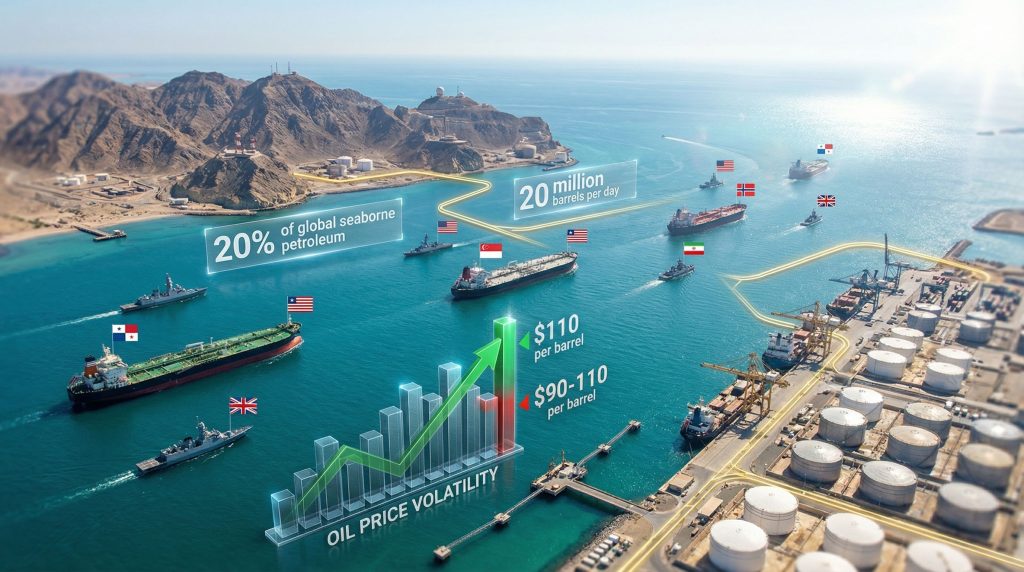
The Strait of Hormuz exemplifies this vulnerability, handling approximately 20 million barrels per day of crude oil and refined products, representing roughly 20% of global seaborne petroleum shipments. This massive throughput makes the narrow passage between Iran and Oman a critical component of Asian energy security, with countries like Japan importing 85% of their crude via this route, while South Korea depends on the strait for 70% of its petroleum supplies.
Recent market events demonstrate the immediate impact of geopolitical tensions on energy pricing. Furthermore, the current oil-price rally surged 6% within 24 hours following Iranian threats to target vessels transiting the strait, with crude briefly reaching US$85 per barrel before settling at US$82 following diplomatic interventions. This price movement occurred despite zero actual supply disruption, highlighting how threat perception alone drives significant market volatility.
Geographic Constraints and Alternative Infrastructure
The fundamental geographic reality creates structural dependencies that cannot be easily circumvented through alternative routing. While Saudi Arabia operates an East-West pipeline system capable of handling 7 million barrels per day to Red Sea terminals, this infrastructure serves only Saudi production and remains vulnerable to different attack vectors.
Pipeline alternatives face their own limitations compared to maritime transport. In addition to capacity constraints, even major pipeline systems handle fractions of total regional production, whilst speed limitations mean oil moves significantly slower through pipeline infrastructure than via tanker shipments.
Moreover, fixed pipeline routes present different but equally significant attack surfaces, and geographic specificity means pipeline systems serve individual producers rather than regional transit needs. The United Arab Emirates has developed some diversification through the Abu Dhabi Crude Oil Pipeline, providing 1.5 million barrels per day capacity to Fujairah terminals outside the Hormuz transit zone.
However, these alternatives combined represent less than half the total Gulf production capacity typically moving through the strait. Consequently, understanding oil market dynamics becomes crucial for evaluating long-term energy security strategies.
When big ASX news breaks, our subscribers know first
Market Psychology and Risk Premium Dynamics
Energy commodity pricing incorporates complex risk assessment mechanisms that extend beyond simple supply and demand fundamentals. Traders continuously evaluate geopolitical threat credibility based on historical precedent, demonstrated capability, and potential economic impact magnitude.
The recent Iran Hormuz threat episode illustrates sophisticated market psychology at work. Despite comprehensive U.S. government intervention promises including Development Finance Corporation political risk insurance and naval escort commitments, Brent oil prices immediately resumed upward movement during Asian trading sessions.
This pattern reveals critical market scepticism toward political assurances, with traders apparently discounting government capability to eliminate transit risks entirely. The price action suggests participants assess multiple contingency scenarios rather than accepting diplomatic solutions at face value.
Historical Pattern Recognition in Pricing Models
Market participants apply learned pattern recognition from previous regional conflicts when evaluating current threats. Iranian drone strikes on Saudi energy infrastructure and other Gulf state facilities hosting U.S. military bases established precedent for infrastructure targeting capability.
The escalation from infrastructure attacks to maritime vessel threats represents a logical extension of demonstrated Iranian operational capacity, lending credibility to current shipping disruption warnings. This historical context explains why markets react immediately to threat announcements rather than waiting for actual supply interruptions.
Key psychological drivers influencing energy pricing include:
- Previous attack success rates and target selection patterns
- Demonstrated technological capability for precision strikes
- Political willingness to escalate confrontation despite economic consequences
- Regional alliance structures affecting response probability
- Insurance market capacity to absorb potential claims
Volatility Amplification Through Financial Markets
Modern commodity markets feature sophisticated financial instruments that can amplify underlying supply concerns through speculative positioning and algorithmic trading systems. The 6% intraday movement in Brent crude demonstrates how quickly electronic trading can magnify geopolitical risk signals.
Options markets typically show elevated implied volatility during geopolitical tension periods, with energy sector derivatives pricing increased probability of extreme price movements. This creates feedback loops where financial market volatility reinforces underlying commodity price instability.
For instance, periods of oil-price stagnation can quickly transform into significant volatility when geopolitical tensions emerge unexpectedly.
Economic Transmission Mechanisms and Sectoral Impact
Energy price volatility transmits through economic systems via predictable but complex pathways, with different sectors experiencing varying degrees of impact based on their energy intensity and pricing flexibility.
Immediate transmission occurs through transportation costs, where commercial shipping, trucking, and aviation sectors face direct input cost increases. At current pricing levels around US$80 per barrel, Australian retail fuel prices climb above A$2 per litre, creating immediate consumer cost pressures.
Manufacturing sectors experience delayed but significant impact as energy-intensive processes incorporate higher input costs into production planning. Industries with limited pricing flexibility, such as utilities and heavy manufacturing, face margin compression during sustained energy price increases.
Inflationary Pressure Distribution
Central banks closely monitor energy price movements due to their broad inflationary impact across multiple economic sectors. Historical analysis suggests crude oil prices sustained above US$80 per barrel typically trigger measurable price level increases within developed economies.
The transmission timeline varies by sector:
| Economic Sector | Impact Magnitude | Response Timeline |
|---|---|---|
| Transportation | 15-25% cost increase | Immediate |
| Manufacturing | 5-10% input cost rise | 1-2 months |
| Consumer goods | 2-5% price adjustment | 2-3 months |
| Services sector | 1-3% indirect impact | 3-6 months |
Energy-importing nations face additional complexity through currency effects, as dollar-denominated oil pricing can create exchange rate pressures that amplify domestic price increases beyond direct commodity cost changes. Furthermore, tracking WTI and Brent trends provides crucial insights for understanding these transmission mechanisms.
Strategic Response Frameworks and Risk Mitigation
Governments and corporations employ various strategies to manage energy security risks and price volatility exposure. These approaches range from strategic reserve management to alternative supply development and financial hedging instruments.
Strategic Petroleum Reserve systems provide critical buffer capacity during short-term disruptions. International Energy Agency member countries maintain emergency stocks equivalent to 90+ days of import requirements, enabling coordinated releases that can offset 2-4 million barrels per day of lost supply temporarily.
The recent U.S. government intervention demonstrates policy tool evolution, with the Development Finance Corporation offering political risk insurance coverage for maritime energy trade. This approach attempts to address insurance market gaps that can amplify supply disruption effects beyond physical shortage concerns.
Corporate Risk Management Evolution
Energy-intensive industries have developed sophisticated hedging strategies that combine financial instruments with operational flexibility measures. These approaches include forward contract positioning for locking in energy costs during favourable pricing periods, alongside supply source diversification through developing relationships with multiple regional suppliers.
Additionally, operational flexibility maintains ability to adjust production schedules based on input cost changes, whilst strategic inventory management builds buffer stocks during market stability periods. Maritime shipping companies face particular complexity in managing Hormuz transit risks, with insurance costs potentially increasing 200-500% above baseline during acute tension periods.
Naval escort services can reduce these premiums by 30-50%, but require significant government resource allocation. However, many nations also face broader energy transition challenges that complicate long-term strategic planning.
Alternative Transit Routes and Economic Trade-offs
Physical geography limits alternative routing options for Gulf oil exports, with each substitute pathway involving significant economic penalties compared to direct Hormuz transit.
Cape of Good Hope routing represents the primary maritime alternative, but adds 2-3 weeks to delivery schedules and increases shipping costs by $2-4 per barrel. This extended transit time also reduces global tanker fleet availability, creating secondary supply chain pressures during disruption periods.
The additional voyage requirements during Hormuz closures would necessitate increased vessel chartering at premium rates during supply emergencies. Moreover, higher crew costs for extended voyage durations, elevated insurance premiums for alternative routing through potentially unstable regions, and storage facility pressure at destination ports unprepared for delivery schedule changes all contribute to increased costs.
Pipeline Development Economics
Long-term strategic planning increasingly focuses on pipeline infrastructure development to reduce maritime chokepoint dependency. However, these projects face substantial capital requirements and extended development timelines.
Regional pipeline capacity expansion faces several constraints, including geographic limitations through terrain and international border complexities, alongside capital intensity requiring multi-billion dollar investment requirements for major capacity additions.
Furthermore, regulatory complexity involves multiple jurisdiction coordination for international projects, whilst security vulnerability means fixed infrastructure presents alternative attack surfaces. The East-West Saudi pipeline system demonstrates both potential and limitations of pipeline alternatives, providing significant capacity for Saudi production while offering no solution for other Gulf producers’ export requirements.
Long-term Structural Implications and Investment Patterns
Persistent energy transit vulnerability drives structural changes in global energy investment patterns and strategic alliance formation. These long-term adjustments extend beyond immediate crisis response to fundamental system architecture modifications.
Renewable energy acceleration represents one significant response pathway, with energy-importing nations increasing investment in domestic renewable capacity to reduce hydrocarbon dependency. This transition faces technical challenges in industrial applications requiring high energy density, but proceeds rapidly in electricity generation and transportation sectors.
Infrastructure investment patterns show increased focus on supply chain resilience rather than pure cost optimisation. Storage facility expansion, alternative transportation route development, and redundant supply relationship cultivation receive elevated priority during geopolitical uncertainty periods.
Financial Market Adaptation Mechanisms
Capital markets have developed increasingly sophisticated instruments for managing energy price volatility and geopolitical risk exposure. These include commodity-linked securities providing inflation protection, energy sector ETFs enabling diversified exposure management, and currency hedging products addressing exchange rate effects of dollar-denominated energy pricing.
Political risk insurance evolution now covers supply chain disruption scenarios, whilst investment flows toward energy security infrastructure accelerate during crisis periods. Both public and private capital seek opportunities in strategic storage, alternative routing, and supply diversification projects.
The next major ASX story will hit our subscribers first
Regional Vulnerability Assessment and Economic Exposure
Different geographic regions exhibit varying degrees of vulnerability to Hormuz-related supply disruptions based on their import dependency patterns and alternative supply access.
Asia-Pacific economies face the highest direct exposure due to geographic proximity and limited alternative suppliers. China imports 40% of its petroleum via the Gulf, while India depends on the region for 60% of its crude requirements. This dependency creates amplified economic sensitivity to Middle Eastern geopolitical developments.
Japanese and South Korean economies show particular vulnerability due to their limited domestic energy resources and heavy manufacturing base. These countries maintain extensive strategic reserve systems and have developed comprehensive crisis response protocols including demand rationing frameworks.
European Market Indirect Effects
European markets experience lower direct supply exposure but face significant indirect effects through global price transmission and supply chain cost increases. Manufacturing competitiveness suffers when energy-intensive production faces sustained input cost disadvantages.
Currency effects represent an additional transmission mechanism, as euro-area economies face potential exchange rate pressures when global energy prices rise in dollar terms. This creates complex policy challenges for the European Central Bank in managing both inflation pressures and currency stability.
Crisis Management Protocols and International Cooperation
Effective response to energy transit crises requires coordinated international action combining diplomatic, military, and economic policy tools. Historical precedent demonstrates that successful crisis management typically involves multi-layered approaches rather than single-instrument solutions.
Naval security operations provide immediate market confidence benefits but require sustained resource commitment and careful escalation management. The announcement of U.S. Navy escort services immediately reduced Brent crude prices by $5 per barrel before markets resumed upward movement, indicating partial but incomplete trader confidence in military solutions.
International Energy Agency coordination mechanisms enable rapid strategic reserve releases and demand management measures during acute supply disruptions. However, these tools provide temporary relief rather than permanent solutions to structural chokepoint vulnerabilities.
Diplomatic Framework Evolution
Long-term energy security requires diplomatic frameworks that address root causes of regional instability rather than merely managing immediate crisis symptoms. This includes regional security arrangement development among Gulf producers and major importers.
Economic integration initiatives create shared interests in stability maintenance, whilst technology transfer programmes support diversified economic development in energy-producing regions. Multilateral insurance mechanisms provide coordinated risk management capacity, recognising that military solutions alone cannot eliminate supply chain vulnerabilities rooted in geographic and political realities.
How Do Iran’s Capabilities Affect Global Oil Markets?
Iran’s demonstrated military capabilities significantly influence global oil pricing through multiple channels beyond direct supply disruption threats. The nation’s precision strike capabilities, evidenced by attacks on Saudi infrastructure, create persistent risk premiums in energy markets.
“Iran’s asymmetric warfare capabilities pose a unique challenge to traditional naval protection strategies,” according to recent security analysis. The combination of drone technology, naval mining capabilities, and regional proxy networks creates multi-vector threat scenarios that are difficult to counter comprehensively.
Iranian threats carry credibility due to previous successful operations, including the 2019 attacks on Saudi Aramco facilities that temporarily reduced global oil production by 5%. This track record ensures markets respond immediately to escalatory rhetoric rather than dismissing threats as mere posturing.
Military Technology and Market Psychology
Advanced missile and drone technologies enable Iran to project power across the Gulf region with relatively modest resource investment. The development of precision-guided munitions capable of targeting specific infrastructure components creates concerns about surgical strikes on critical energy facilities.
Market participants recognise that even limited infrastructure damage can create disproportionate supply disruptions. A single successful attack on key pumping stations or loading terminals could affect millions of barrels of daily production capacity.
Furthermore, the Iranian Revolutionary Guard’s naval capabilities include fast attack craft, submarines, and naval mines that pose distinct challenges to commercial shipping. Insurance markets reflect these capabilities through elevated premiums for vessels transiting Gulf waters during tension periods.
What Are the Economic Implications of Strait Closure?
Complete Strait of Hormuz closure would trigger immediate and severe global economic disruption extending far beyond energy markets. Goldman Sachs analysis suggests oil prices could reach $150-200 per barrel within weeks of sustained closure, with cascading effects throughout the global economy.
The economic implications extend through multiple transmission channels. Transportation costs would increase dramatically, affecting global trade patterns and supply chain logistics. Manufacturing sectors dependent on petrochemical inputs would face severe disruption, particularly in plastics, fertilisers, and synthetic materials production.
“A complete Hormuz closure would represent the most significant energy supply shock since the 1970s oil crises,” notes comprehensive economic analysis. The combination of direct energy cost increases and secondary supply chain disruptions could reduce global GDP growth by 2-3 percentage points within the first year.
Financial Market Contagion Effects
Energy price shocks typically trigger broader financial market instability through multiple mechanisms. Currency markets would experience significant volatility as energy-importing nations face balance of payments pressures, whilst equity markets in energy-intensive sectors would face severe valuation pressure.
Central banks would confront difficult policy choices between combating inflation through interest rate increases and supporting economic growth during supply shock conditions. Historical precedent suggests that sustained energy price increases above $100 per barrel typically trigger recessionary conditions in developed economies.
Bond markets would likely experience flight-to-quality flows, with government securities in stable jurisdictions attracting capital despite energy-related inflation concerns. Corporate credit markets would face particular stress in energy-intensive industries and emerging market borrowers dependent on energy imports.
Energy security in an interconnected global economy demands comprehensive risk management approaches that combine strategic reserves, infrastructure diversification, financial hedging, and international cooperation. The recent Iran Hormuz threat and associated Brent oil prices and Iran Hormuz threat volatility demonstrate how quickly regional tensions can transform into worldwide economic challenges requiring sophisticated policy responses.
Understanding the transmission mechanisms between geopolitical risk and commodity pricing provides essential insights for investors, policymakers, and businesses operating in energy-dependent sectors. As global energy systems continue evolving toward greater diversification, lessons learned from Middle Eastern chokepoint vulnerabilities will inform future security architecture development and crisis management protocols.
Disclaimer: This analysis is for informational purposes only and should not be considered investment advice. Energy commodity markets involve significant risk, and past performance does not guarantee future results. Readers should conduct independent research and consult qualified financial advisors before making investment decisions.
Looking to Capitalise on Energy Market Volatility?
Discovery Alert’s proprietary Discovery IQ model delivers real-time alerts on significant ASX mineral discoveries, including energy and critical mineral sectors that often surge during geopolitical tensions. When global energy markets face disruption, alternative energy and resource companies frequently experience dramatic price movements, and Discovery Alert ensures subscribers identify these actionable opportunities ahead of the broader market. Begin your 14-day free trial today to position yourself strategically during periods of heightened market volatility.