June 20, 2026
The Hidden Architecture of Oil Price Risk: Why Geopolitical Premiums Collapse Faster Than They Build
There is an asymmetry at the heart of energy markets that most retail observers never fully appreciate. When conflict erupts near a critical supply corridor, fear spreads gradually, building layer by layer into crude benchmarks over days and weeks. When a diplomatic resolution arrives, however, that same premium can evaporate in hours. This asymmetry helps explain why the Brent weekly fall after the Israel-Hezbollah ceasefire was so sharp and so swift, catching some market participants off guard even though the diplomatic groundwork had been visible for some time.
Understanding this dynamic requires moving beyond the headlines and into the structural mechanics of how oil markets price uncertainty, absorb supply shocks, and recalibrate when geopolitical conditions shift. Furthermore, the interplay of oil trade and geopolitics adds additional layers of complexity that shape how benchmarks respond to diplomatic events.
When big ASX news breaks, our subscribers know first
What the Geopolitical Risk Premium Actually Measures
Oil markets do not simply price current supply and demand. They price expected supply and demand, weighted by probability distributions across dozens of possible futures. When a conflict erupts near the Strait of Hormuz, traders embed a risk premium that reflects the probability-weighted cost of potential disruption. This premium is not a fixed number; it expands and contracts dynamically as new information arrives.
The Strait of Hormuz is arguably the single most consequential maritime chokepoint in the global energy system. Roughly 20% of the world's combined oil and LNG supply transits this 33-kilometre-wide passage every day. There is no adequate alternative route for the volume of hydrocarbons that flow through it. The Persian Gulf producers most dependent on this corridor, including Iraq, Kuwait, the UAE, and Saudi Arabia, collectively account for a substantial share of global export capacity. Any credible threat to Hormuz transit, whether military or administrative, is immediately reflected in crude prices.
Historically, Brent crude tends to overshoot during escalation phases and then overcorrect during de-escalation. The overshoot occurs because traders price in worst-case disruption scenarios to protect against the tail risk of supply interruption. The overcorrection occurs because, once a diplomatic catalyst confirms the worst case has been avoided, the full accumulated premium is unwound rapidly, often before a single additional barrel has actually reached the market. This front-loaded repricing is a defining feature of commodity markets, and it is precisely what drove the pronounced Brent weekly fall after the Israel-Hezbollah ceasefire.
Breaking Down the ~8% Weekly Decline: Scale and Context
The numbers behind this week's move are striking in their magnitude.
| Metric | Value |
|---|---|
| Brent weekly price change | Approximately -8% |
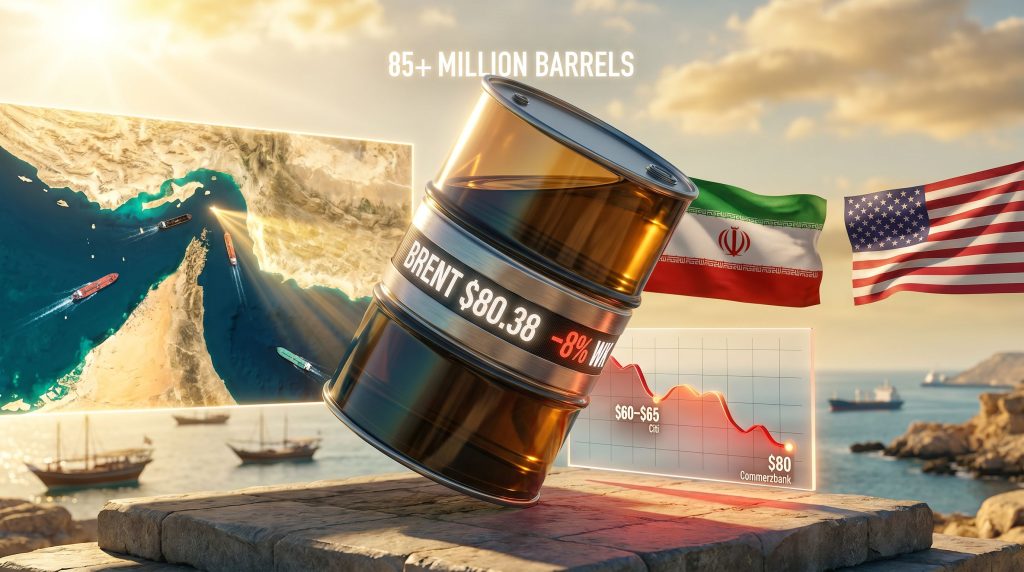
| Brent price at Friday midday (ET) | $80.38 per barrel (+0.53% on the day) |
| WTI price at Friday midday (ET) | $77.54 per barrel (+1.23% on the day) |
| Friday intraday gain (Brent) | +66 cents per barrel |
| Estimated stranded oil to be released | 85+ million barrels |
| Citi base-case Brent target (Q1 2027) | $60-$65 per barrel |
| Commerzbank revised year-end Brent forecast | $80 per barrel (down from $85) |
| OPEC global demand forecast (2030) | 113.3 million bpd |
| OPEC global demand (2025 baseline) | 105.1 million bpd |
Key Insight: Weekly declines of approximately 8% in Brent crude are historically rare. They typically occur only during acute demand destruction events, such as the COVID-19 lockdown period in early 2020, or during large-scale, sudden supply resolutions. The scale of this week's move places it in a relatively uncommon category of market events.
Why Friday's Partial Recovery Changed Nothing Structurally
Friday's modest intraday gains, with Brent up 66 cents and WTI advancing 94 cents, reflected residual uncertainty rather than a genuine reversal in market sentiment. Trading volumes were suppressed by a US federal holiday, which amplified the apparent magnitude of price moves without providing a reliable signal about underlying conviction.
The partial rebound was driven by a specific new variable: Iran's Persian Gulf Strait Authority circulated an advisory, seen by maritime industry participants, stating that no vessel is permitted to transit the Strait of Hormuz without a valid passage permit issued by the authority. State media also reported that vessels must coordinate directly with the Revolutionary Guards navy before transiting. This introduced an administrative and political friction layer that traders had not fully priced into the ceasefire scenario, temporarily arresting the broader weekly decline. For further context on how oil falls as supply moves through the strait, the evolving permit system adds a layer of discretionary complexity that markets are only beginning to absorb.
Rory Johnston, founder of the Commodity Context newsletter, noted that markets had been pricing in a deal with relatively smooth execution, and the emerging reality of Iran's new transit conditions was meaningfully different from that base case expectation. That gap between anticipated seamlessness and actual operational complexity provided the foundation for Friday's modest recovery within an otherwise deeply negative week.
The Strait of Hormuz: Strategic Geography as Permanent Price Risk
Why This Chokepoint Has No Substitute
The Strait of Hormuz occupies a position in global energy infrastructure that has no parallel. Unlike other maritime chokepoints where alternative routing is theoretically possible at additional cost and transit time, the Persian Gulf producers have extremely limited options for bypassing Hormuz entirely. Saudi Arabia's East-West pipeline and the UAE's Abu Dhabi Crude Oil Pipeline offer partial bypass capacity, but neither can handle volumes anywhere near the full throughput of Hormuz on a sustained basis.
This structural irreplaceability means that any Iranian policy affecting Hormuz transit, even a purely administrative one, carries market-moving weight disproportionate to its apparent bureaucratic scale. Iran's new permit requirement is not a military blockade, but it introduces a layer of discretionary control that gives Iranian authorities the ability to selectively delay or complicate transit for vessels they choose to scrutinise. Markets price this optionality immediately. The geopolitical and logistical factors surrounding this chokepoint continue to shape price behaviour well beyond the immediate ceasefire period.
Pre-Ceasefire vs. Post-Ceasefire Strait Risk: A Comparison
| Risk Factor | Pre-Ceasefire | Post-Ceasefire (Current) |
|---|---|---|
| Physical military threat | High | Low to Moderate |
| Iranian shipping controls | Absent | Active (permit required) |
| Tanker transit activity | Disrupted | Resuming (4+ vessels tracked Friday) |
| Market sentiment | Elevated fear premium | Cautious optimism |
| Price direction | Upward pressure | Downward trend with volatility |
At least four tankers carrying crude oil, petroleum products, and liquefied petroleum gas entered the strait on the day of the ceasefire announcement, heading toward Iraqi Gulf ports, according to MarineTraffic vessel tracking data. This resumption of physical transit is a constructive signal, but the pace of normalisation will be the critical variable for near-term price trajectory.
Supply Implications: Stranded Barrels, Sanctions Relief, and Iraq's Re-Entry
The 85-Million-Barrel Overhang
Analysts estimate that more than 85 million barrels of crude oil were effectively stranded in the Middle East Gulf during the active conflict period. These volumes accumulated because the combination of military risk, insurance restrictions, and transit uncertainty made moving them commercially unviable or logistically impossible. With the ceasefire in place, this inventory overhang represents a significant front-loaded supply event that will progressively re-enter global circulation.
The pace of release matters as much as the volume. Phil Flynn, Senior Analyst at Price Futures Group, observed that tanker backlogs can clear more rapidly than market consensus assumes when genuine cooperation exists between the relevant parties. With both Iranian and US authorities motivated to demonstrate that the diplomatic agreement is producing tangible results, the practical timeline for clearing this backlog may be compressed relative to historical precedents of post-conflict supply normalisation.
Sanctions Relief: The Structural Supply Addition
Beyond the immediate release of stranded barrels, the US-Iran agreement includes provisions for lifting American sanctions on Iranian crude exports. This is categorically different from a temporary supply release. Sanctions relief, if sustained, would restore Iran's ability to export at full capacity on an ongoing basis, adding a persistent structural increment to global supply that cannot be absorbed in weeks or months.
Iran's export capacity under sanctions had been substantially curtailed, with estimates suggesting the country was exporting significantly below its technical production ceiling. The return to unconstrained export capacity would, in combination with the stranded barrel release and Iraq's production normalisation, represent a meaningful shift in the global supply-demand balance. Consequently, OPEC's market influence will face a genuine test as Iranian volumes re-enter the system outside formal quota arrangements.
Iraq's Production Readiness
Iraq's Oil Minister confirmed that domestic oilfields are operationally prepared to resume full output, with production expected to return gradually to previous rates. Iraq's re-entry into full export mode adds another incremental layer of supply to an already well-supplied market. Unlike the stranded barrel release, which is a one-time event, Iraq's restored output represents recurring additional barrels entering the market month after month.
The Postponed Switzerland Talks: Signal or Noise?
A planned meeting between Iranian and US officials in Switzerland was deferred, with Iran's Foreign Ministry indicating the meeting had become less urgent following the digital signing of a memorandum of understanding between the two parties. Markets initially interpreted the postponement with mild concern, though analysts broadly view the MOU signing as reducing, rather than eliminating, near-term diplomatic risk. The timeline for full normalisation of the bilateral relationship remains genuinely uncertain.
Where Are Oil Prices Headed? Institutional Forecasts and Scenario Analysis
Institutional Price Targets: A Structured Comparison
| Institution | Forecast Horizon | Brent Price Target | Key Assumption |
|---|---|---|---|
| Citi (base case, 60% probability) | Q1 2027 | $60-$65 per barrel | Sustained Hormuz normalisation; market moves into surplus |
| Commerzbank | Year-end 2026 | $80 per barrel | Gradual supply recovery; prices remain above pre-war levels |
| Price Futures Group | Near-term | Directional decline toward pre-war levels | US-Iran cooperation accelerates tanker backlog clearance |
Three Credible Scenarios for Brent Over the Next 6-12 Months
Scenario 1: Full Normalisation (Bullish for Supply, Bearish for Price)
- Hormuz transit resumes without meaningful friction from Iran's new permit requirements.
- Sanctions relief is implemented on schedule, restoring Iranian export volumes.
- Stranded barrels are absorbed by the market within 60-90 days.
- Brent trends toward the $60-$65 range by early 2027, consistent with Citi's base case.
- OPEC+ faces intensifying pressure to defend price floors through accelerated production management decisions.
Scenario 2: Partial Recovery with Residual Friction (Base Case)
- Iran's permit requirements slow but do not halt transit normalisation.
- Supply returns gradually over 3-6 months, keeping prices in the $75-$85 range through mid-2026.
- Commerzbank's $80 year-end forecast aligns with this trajectory.
- Diplomatic talks resume, but sanctions relief is phased rather than immediate.
Scenario 3: Re-Escalation or Diplomatic Breakdown (Bearish for Supply, Bullish for Price)
- Iran tightens Hormuz controls beyond administrative requirements, signalling renewed geopolitical leverage.
- US-Iran talks collapse, reversing sanctions relief expectations.
- Brent rebounds sharply above $90 per barrel, potentially approaching conflict-period highs.
- This scenario carries low but non-trivial probability given the fragility of the current diplomatic framework.
In addition, broader oil market trade war risks could amplify any of these scenarios should trade tensions between major economies re-emerge alongside the diplomatic uncertainties already in play.
The next major ASX story will hit our subscribers first
Demand Fundamentals: Can Growth Absorb the Supply Surge?
OPEC's 2026 World Oil Outlook projects global demand rising from 105.1 million barrels per day in 2025 to 113.3 million bpd by 2030. This represents an addition of approximately 8.2 million bpd over five years, a pace that would ordinarily be sufficient to absorb meaningful volumes of new supply under stable conditions.
The critical distinction, however, is timing. The release of 85+ million stranded barrels is a front-loaded event concentrated within weeks to months, not distributed evenly across a five-year demand growth curve. Iranian production restoration and Iraqi output normalisation add persistent baseline supply that similarly arrives ahead of the demand growth trajectory needed to accommodate it comfortably.
This temporal mismatch between supply acceleration and demand growth is the core structural driver behind Citi's more bearish long-term forecast. Even with robust underlying demand fundamentals, the near-term supply-demand balance is likely to tilt into surplus as the market digests the combined effect of stranded barrel releases, sanctions relief, and restored production from key Gulf producers. Brent and WTI futures markets are already beginning to reflect this anticipated imbalance through a flatter forward curve structure.
Frequently Asked Questions
Why Did Brent Fall ~8% on a Ceasefire Rather Than a Full Peace Deal?
Oil markets are probability-weighted forward pricing mechanisms, not physical commodity ledgers. During the active conflict period, traders embedded a substantial risk premium reflecting the probability of sustained Hormuz disruption. When the ceasefire was confirmed, that probability collapsed rapidly, and with it, the premium. The 8% Brent weekly fall after the Israel-Hezbollah ceasefire reflects the accumulated magnitude of the embedded risk premium, not the completeness of the diplomatic resolution. Reports confirm that Brent crude slipped after the ceasefire while key structural risks remain very much in play.
How Quickly Can Stranded Oil Re-Enter Global Markets?
The pace depends on three interdependent variables:
- The operational speed at which Iran's new transit permit system is implemented and processed for waiting vessels.
- The degree of practical cooperation between Iranian maritime authorities and US counterparts in clearing the tanker backlog.
- The logistical and operational readiness of producers like Iraq to resume full export loading schedules.
Analysts suggest that with genuine bilateral cooperation, the clearing process could move faster than current market pricing implies, potentially within weeks rather than the months suggested by historical post-conflict normalisation timelines.
What Does Sanctions Relief Mean for OPEC+ Strategy?
Iranian barrels returning to global markets effectively increase OPEC+ collective output without requiring a formal quota adjustment. This places the cartel in a structurally uncomfortable position: either accept the additional volumes and watch prices drift lower, or attempt to offset them through compensating production cuts by other members. Neither option is without political and economic cost for the group's cohesion.
Key Takeaways for Energy Market Observers
- Geopolitical risk premiums unwind faster than physical supply recovers. The pronounced Brent weekly fall after the Israel-Hezbollah ceasefire illustrates how quickly decades of accumulated conflict pricing can dissolve in response to a single diplomatic catalyst.
- Iran's new Hormuz permit requirements introduce a previously absent administrative risk layer that markets did not fully price into initial ceasefire scenarios, providing the basis for Friday's partial recovery.
- 85+ million stranded barrels represent a concentrated, front-loaded supply event whose absorption timeline will be the primary price determinant over the next 60-90 days.
- Institutional forecasts diverge materially, from Commerzbank's relatively stable $80 year-end target to Citi's more structurally bearish $60-$65 by Q1 2027, reflecting genuine uncertainty about normalisation pace.
- Long-term demand growth provides a structural floor but cannot offset the near-term supply acceleration triggered by simultaneous resolution of stranded inventory, sanctions relief, and Iraqi production restoration.
This article contains forward-looking analysis, price forecasts, and scenario modelling drawn from institutional research. These projections involve significant uncertainty and should not be interpreted as investment advice. Oil market conditions can change rapidly in response to geopolitical developments, and readers should consult qualified financial professionals before making investment decisions.
Want to Position Yourself Ahead of the Next Major Commodity Discovery?
While geopolitical shifts reshape oil benchmarks overnight, Discovery Alert's proprietary Discovery IQ model delivers real-time alerts on significant ASX mineral discoveries — cutting through market complexity across 30+ commodities to surface actionable opportunities the moment they emerge. Explore how historic discoveries have generated substantial returns and begin your 14-day free trial today to gain a decisive market edge.