June 20, 2026
The Hidden Architecture of a Global Cooking Fuel Crisis
Energy crises rarely announce themselves with a single dramatic event. More often, they emerge from the accumulated fragility of systems that have quietly concentrated risk over decades, until one disruption cascades into consequences far larger than the geography of the original conflict. The LPG cooking fuel shortages unfolding across Asia and Africa in 2026 follow precisely this pattern, revealing how deeply interconnected global energy supply chains have become, and how catastrophically they can unravel when a single maritime passage is threatened.
Liquefied petroleum gas occupies a unique and underappreciated position in the global energy system. It is simultaneously an industrial feedstock, a transport fuel, and the primary cooking fuel for an estimated 2.5 billion people across the developing world. For low-income households in South Asia, Southeast Asia, and sub-Saharan Africa, the humble LPG cylinder is not a convenience — it is a lifeline. Understanding why that lifeline is now under severe strain requires examining the geography, the market mechanics, and the human consequences all at once.
When big ASX news breaks, our subscribers know first
The Strait of Hormuz: Why One Waterway Controls So Much
The Strait of Hormuz, at its narrowest point spanning roughly 33 kilometres, functions as the circulatory system of global LPG trade. Approximately one-third of all internationally traded LPG passes through this chokepoint annually, a volume that reflects decades of infrastructure investment concentrated on the Arabian Peninsula's coastline.
Saudi Arabia, Qatar, and the UAE collectively host the world's largest LPG export terminals. Qatar's Ras Laffan Industrial City alone processes enormous volumes of LPG derived from natural gas liquids, feeding tankers that supply markets from India to Japan to Europe. There is no viable alternative shipping route at equivalent scale. The nearest alternative, routing vessels around the southern tip of Africa via the Cape of Good Hope, adds 10 to 20 sailing days to transit times, substantially increasing freight costs and reducing effective supply velocity to importing nations.
This geographic concentration is not a new vulnerability. Energy security analysts have flagged Hormuz dependency for years. What changed in early 2026 was the transformation of this theoretical risk into an operational reality, amplifying broader energy market volatility that had already been building across global commodity markets.
From Military Escalation to Market Collapse: The Chain of Events
The conflict involving the United States, Israel, and Iran intensified sharply from late February 2026 onward. Missile exchanges and drone strikes targeting energy infrastructure in the Gulf region produced immediate and severe consequences for tanker operations. The decisive moment came when Saudi Aramco declared force majeure on March loadings from the Juaymah natural gas liquids facility, following drone debris strikes in the vicinity of the Ras Tanura complex.
Satellite vessel tracking data subsequently revealed a disturbing picture: LPG tankers accumulating near Ras Laffan, unable to safely transit the Strait, their cargoes stranded as insurance underwriters pulled coverage for vessels attempting passage. According to the BBC, the scale of disruption to regional energy flows was without modern precedent.
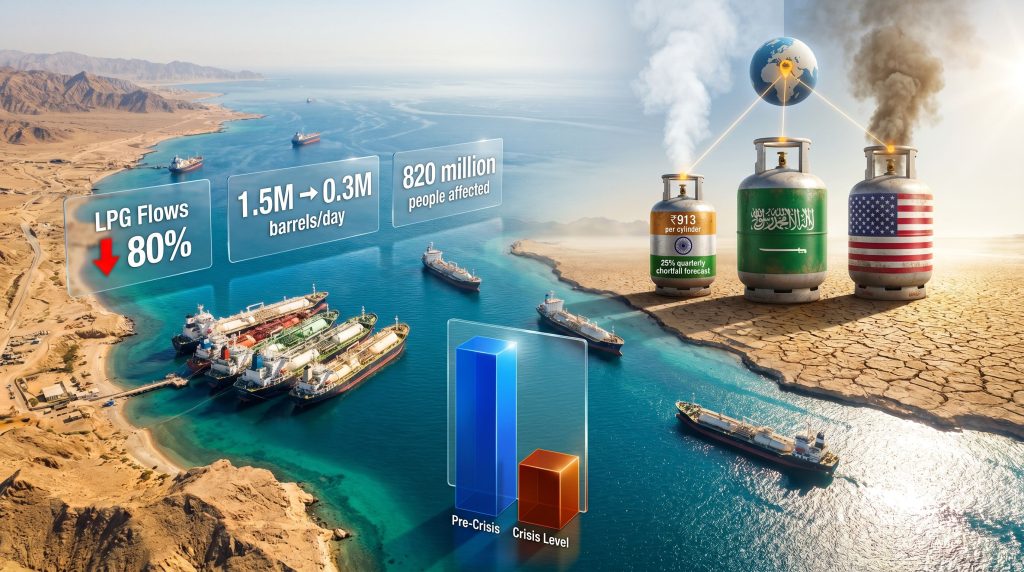
Key Market Impact: LPG flows through the Strait of Hormuz collapsed by approximately 80%, falling from roughly 1.5 million barrels per day to just 0.3 million barrels per day during March 2026. The International Energy Agency has documented this disruption as a supply emergency affecting an estimated 820 million people who depend on LPG as their primary cooking fuel.
The speed of this collapse is worth emphasising. LPG markets are not designed with the same emergency buffer infrastructure as crude oil markets. Furthermore, there is no LPG equivalent of the IEA's coordinated strategic petroleum reserve release mechanism — a gap that the crisis has exposed with uncomfortable clarity.
Quantifying the Supply Shock: Numbers Behind the Crisis
The scale of disruption across key metrics illustrates just how severe the LPG cooking fuel shortage has become:
| Metric | Pre-Crisis Level | Crisis Level | Change |
|---|---|---|---|
| LPG flows through Hormuz | ~1.5M barrels/day | ~0.3M barrels/day | Down ~80% |
| India LPG import volume | Baseline | Declined by over 50% (first two months) | Down >50% |
| India LPG price index | 2025 average | 90% above 2025 average | Up 90% |
| Delhi household cylinder price | ~₹853 | ~₹913 | Up ₹60 |
| India strategic LPG storage buffer | ~10 days | Insufficient for sustained disruption | Critical |
| India quarterly supply shortfall | Balanced | 25% shortfall forecast | Severe |
These figures represent not just market disruption but a genuine humanitarian challenge. India's strategic LPG reserve, covering approximately 10 days of national consumption, was architected as a short-term smoothing mechanism for minor supply interruptions. It was never designed to withstand a sustained closure of the world's most critical LPG shipping lane. Consequently, the India gas import structure has come under intense scrutiny as policymakers scramble to identify structural reforms that could reduce exposure in future crises.
Which Countries Face the Greatest Exposure?
The geographic distribution of vulnerability to LPG cooking fuel shortages in the Middle East conflict reflects the degree of Gulf supply dependency each nation has built over time.
- India stands as the most acutely affected nation globally. Approximately 90% of its LPG supply originates in the Middle East, with 80 to 85% of imports transiting the Strait of Hormuz. The combination of scale, dependency concentration, and thin strategic reserves makes India uniquely exposed.
- Southeast Asia, including Thailand, Sri Lanka, the Philippines, Indonesia, and Pakistan, all face elevated supply risk reflecting similar Gulf LPG sourcing patterns.
- Sub-Saharan Africa and West Africa experienced price surges of approximately 70% despite limited direct Gulf sourcing, a phenomenon explained by the global benchmark repricing mechanism discussed below.
- East Africa saw LPG prices rise in parallel with Asian markets, directly threatening the gains made by clean cooking access programmes that had spent years weaning households off biomass fuels.
The Saudi Aramco Contract Price: How Gulf Disruptions Go Global
One of the least understood dynamics of the LPG market is how a disruption in the Gulf can rapidly reprice LPG in countries that do not source their supply from the region at all.
Global LPG trade is priced against the Saudi Aramco Contract Price (CP), a monthly benchmark set by Saudi Aramco that serves as the reference point for LPG transactions worldwide. When Gulf production or export capacity contracts, the CP adjusts upward. This upward movement then flows through to all LPG importers globally, regardless of whether they source from the United States, Norway, Canada, or Russia. In addition, shifting natural gas price trends have compounded pressure on household energy budgets across import-dependent economies.
Why Does Middle East Disruption Affect Non-Gulf LPG Importers? Global LPG markets operate on a unified pricing benchmark: the Saudi Aramco Contract Price. When Gulf supply is disrupted, this benchmark rises, increasing costs for every LPG importer worldwide, including those sourcing entirely from non-Gulf suppliers. The repricing is near-instantaneous and universal.
This mechanism explains the seemingly paradoxical situation in West Africa, where nations with minimal Gulf LPG sourcing still experienced ~70% price increases. The global market reprices as a single unit whenever the dominant supply region is disrupted.
The next major ASX story will hit our subscribers first
The Human Cost: Households, Restaurants, and the Fuel Poor
The economic consequences of the LPG cooking fuel shortage are being absorbed most painfully at the household level. Approximately 45% of LPG-dependent households in significantly affected regions are now allocating at least an additional 1% of their income to cooking fuel costs — a meaningful burden for families already operating near subsistence consumption levels.
In India's urban restaurant sector, the practical consequences have been visible in changed menus. Operators have begun removing gas-intensive dishes to manage escalating fuel costs, reflecting a behavioural adaptation to a supply shock that shows no signs of rapid reversal.
Rural households face the sharpest exposure. Lower purchasing power combined with fewer alternative fuel access options means that when LPG becomes unaffordable, the fallback is not electric induction cooking — it is biomass, coal, or kerosene.
The Regression to Polluting Fuels: A Measurable Public Health Emergency
India's government has temporarily permitted commercial operators to substitute biomass and coal for LPG, a pragmatic policy response that nonetheless carries serious long-term health implications. The World Health Organization estimates that household air pollution from solid fuel combustion contributes to approximately 3.2 million premature deaths annually, with women and young children bearing a disproportionate share of the respiratory disease burden.
Warning: The shift back from LPG to biomass or kerosene is not a temporary inconvenience. It represents an acceleration of preventable mortality, with consequences that extend far beyond the duration of the current supply disruption. Respiratory disease patterns established during a crisis period can persist for years.
The gender dimension of this health burden deserves particular attention. Women and girls typically spend more time in cooking environments and carry a greater share of fuel collection responsibilities in biomass-dependent households. Energy regression therefore functions as a gender equity crisis as much as an energy access crisis.
India's Emergency Response: Five-Step Supply Diversification
India's response to the LPG shortage has been rapid and multi-layered. The government and national oil companies have implemented a coordinated emergency strategy:
- Identify alternative LPG exporters with available export surplus capacity, principally the United States, Norway, Canada, and Russia.
- Negotiate emergency spot contracts at prevailing market rates, accepting higher per-unit costs to secure guaranteed volume in a tight market.
- Redirect tanker routing through alternative shipping lanes, bypassing Hormuz entirely via the Cape of Good Hope or the Suez Canal, accepting the 10 to 20 additional sailing days this entails.
- Maximise domestic LPG production through refinery intensification, achieving a reported 28% increase in domestic LPG output from Indian refiners directed to prioritise LPG yield.
- Apply household-priority rationing to ensure residential consumers receive supply before commercial and industrial allocations are fulfilled.
These measures provide meaningful partial relief but cannot fully compensate for the scale of the Hormuz disruption. A 25% quarterly supply shortfall has been forecast even with emergency measures fully activated, illustrating the gap between what diversification can achieve and what the market actually requires. The global LNG supply outlook provides further context for understanding why alternative sourcing strategies face structural constraints in the near term.
Clean Cooking at Risk: Sub-Saharan Africa's Fragile Transition
Perhaps the most consequential long-term impact of the 2026 LPG cooking fuel shortages involves the potential reversal of clean cooking progress across sub-Saharan Africa. Millions of households across the region had been in the process of transitioning from biomass to LPG through subsidised cylinder programmes, representing years of development investment and public health improvement. As the IEA has documented, supply disruptions of this magnitude pose an existential threat to clean cooking access gains in the world's most vulnerable communities.
Price surges of 70 to 90% above baseline levels are pricing newly converted LPG users out of the market at precisely the moment when the transition gains were becoming durable. The critical risk is one of permanence: households that abandon LPG during a price shock frequently do not return when prices normalise, instead reverting to entrenched biomass habits.
| Consequence | Affected Population | Timeframe |
|---|---|---|
| Reversion to biomass and kerosene | Low-income urban and rural households | Immediate and ongoing |
| Elevated indoor air pollution mortality | Women and children with primary exposure | Short to medium term |
| Reversal of clean cooking programme gains | Sub-Saharan Africa, South Asia | Medium to long term |
| SDG 7 progress setback | Global developing economies | Long term, post-2030 targets |
Progress toward Sustainable Development Goal 7 — universal access to affordable and clean energy by 2030 — is now materially at risk. The IEA has been actively tracking these developments through its energy access and clean cooking research programmes, with analysts documenting the intersection between LPG market turbulence and development outcomes across vulnerable communities.
Structural Lessons and Policy Imperatives
The 2026 LPG crisis has exposed several structural vulnerabilities that will require sustained policy attention:
- Single-point dependency risk concentrated through Hormuz reflects decades of underinvestment in supply route diversification and has no short-term engineering solution.
- Thin strategic reserves across LPG-importing nations contrast sharply with the more developed strategic petroleum reserve infrastructure that exists for crude oil markets.
- Benchmark pricing fragility through the Saudi Aramco CP mechanism transmits Gulf supply shocks globally with minimal lag, creating simultaneous price pressure across all importing markets.
- Clean energy transition vulnerability is exposed when LPG's dual role as both a development tool and a poverty alleviation mechanism is disrupted, threatening the entire architecture of clean cooking programmes.
The policy recommendations emerging from this crisis point toward expanding strategic LPG storage to a minimum of 30 to 45 days of national consumption in high-dependency nations, accelerating import origin diversification, and developing emergency LPG allocation frameworks prioritising household and healthcare use. Furthermore, investing in alternative clean cooking technologies — including electric induction, biogas, and solar thermal — will be essential to reduce structural LPG dependency over the medium term. Broader progress on the clean energy transition will ultimately determine how quickly high-dependency nations can reduce their structural exposure to exactly these kinds of supply shocks.
The absence of an international LPG emergency coordination mechanism comparable to the IEA's oil stock release protocols represents a critical gap. Developing such a framework may be among the most consequential energy security policy tasks to emerge from the current crisis.
The LPG cooking fuel shortages generated by the Middle East conflict have moved a long-discussed theoretical vulnerability into lived experience for hundreds of millions of people. The structural lessons being written in real time across India, sub-Saharan Africa, and Southeast Asia will shape energy security policy, clean cooking investment strategies, and LPG market architecture for the decade ahead.
Want to Stay Ahead of the Commodity Disruptions Reshaping Global Markets?
Energy crises like the 2026 LPG shortage demonstrate how rapidly commodity supply chains can unravel — and how quickly informed investors need to act. Discovery Alert's proprietary Discovery IQ model delivers real-time ASX mineral discovery alerts, transforming complex commodity data into actionable investment insights, so subscribers are positioned ahead of the broader market — start your 14-day free trial today and explore historic discoveries that have generated exceptional returns.