
June 29, 2026
Why the Southeastern United States Deserves a Second Look for Copper-Gold Exploration
Investor capital has a long memory for success and a short memory for overlooked potential. For more than a century and a half, the southeastern United States has sat outside the boundaries of conventional porphyry copper district maps, dismissed as geologically unproductive for large-scale base metal systems. Yet the same region produced North America's first documented gold rush in the late 1700s, sustained commercial mining operations well into the nineteenth century, and continues to host geological signatures that few exploration programmes have tested at depth.
The question is not whether mineralisation exists in the southeastern US. The question is whether the right tools, models, and capital have ever been applied to find it. That question is now being tested in earnest at the Brewer copper gold porphyry system in South Carolina, a project that has recently produced what may be the most geologically significant drill results in the region's modern exploration history.
When big ASX news breaks, our subscribers know first
The Forgotten Metallogenic Province: Why the Southeast Was Left Behind
A Gold Rush That History Overlooked
The Carolina gold rush predates the California gold rush by approximately five decades. Small-scale and then commercial gold mining operations flourished across North and South Carolina during the late eighteenth and early nineteenth centuries, making the region one of the earliest documented gold-producing jurisdictions on the continent. That era ended abruptly after the Civil War, when westward expansion redirected virtually all exploration capital away from the Southeast.
What followed was not geological exhaustion but rather geological abandonment. The mineral endowment did not disappear — exploration simply stopped. For more than 150 years, the southeastern US remained dramatically underexplored relative to western North American porphyry districts such as the Arizona-New Mexico corridor, the British Columbia belt, and the prolific systems stretching through Chile and Peru.
Today, institutional interest in the Southeast is gradually increasing, driven by a combination of factors: the region's stable political and regulatory environment, its pro-mining policy culture, and growing recognition that large-scale copper systems may exist beneath well-documented near-surface gold mineralisation. Furthermore, understanding broader copper market trends reinforces why this region is attracting renewed attention. Early-stage explorers entering this space now occupy a structurally advantaged position, moving ahead of what could become a broader wave of regional exploration activity.
Brewer's Two Centuries of Recorded History
Located in Chesterfield County, South Carolina, the Brewer site carries more than 200 years of recorded mining history. The most recent period of commercial production occurred between the 1980s and 1995, when heap-leach operations extracted approximately 178,000 ounces of gold from near-surface mineralisation. As far back as 1893, the North Carolina Geological Survey made reference to Brewer exhibiting characteristics of a quartz porphyry target.
In 1977, the United States Geological Survey formally identified Brewer as a porphyry copper target in a regional assessment of the southeastern US. Despite that classification, no drill programme ever tested the system at depth. That gap in the exploration record persisted for nearly five decades.
"Confirming a mineralised porphyry copper-gold deposit at Brewer would not merely validate a single project. It would structurally reframe the entire southeastern US as a prospective porphyry copper province, potentially triggering a generation of new regional exploration across a jurisdiction that has been systematically ignored by the global mining industry."
Understanding Porphyry Copper-Gold Systems: A Technical Framework
The Architecture of a Porphyry System
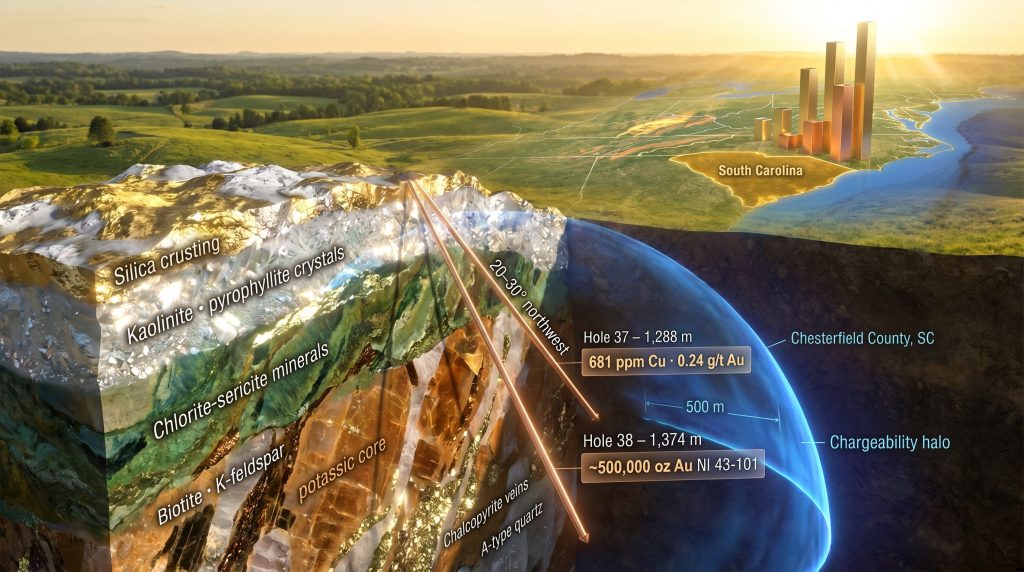
Porphyry copper-gold deposits are among the largest ore-forming systems on Earth. They are generated by magmatic-hydrothermal processes associated with intrusive igneous bodies, and they exhibit a predictable spatial zonation of alteration mineralogy moving from the surface downward toward the mineralised core. The canonical framework for interpreting these systems was formalised by Dr. Richard Sillitoe in a seminal 2010 paper published in Economic Geology, which remains the standard reference for porphyry exploration globally.
| Alteration Zone | System Position | Key Minerals | Exploration Significance |
|---|---|---|---|
| Vuggy Residual Silica / High-Sulfidation Epithermal | Uppermost (surface) | Enargite, covellite, chalcocite | Near-surface gold; historically mined |
| Advanced Argillic (Lithocap) | Upper-intermediate | Kaolinite, pyrophyllite, topaz (KPT) | Caps the porphyry system; key indicator |
| Chlorite-Sericite | Intermediate | Chlorite, sericite | Transitional zone; closer to economic core |
| Potassic Alteration | Deep core | Biotite, K-feldspar, A-type quartz veins | Primary host of copper-gold porphyry ore |
The critical mineral to understand is chalcopyrite. Unlike chalcocite, covellite, and enargite, which dominate near-surface epithermal environments, chalcopyrite is the diagnostic copper sulfide mineral of porphyry systems. Its presence in meaningful quantities signals proximity to a porphyry-style source. Similarly, B-type quartz veins carrying molybdenite are widely recognised as proximity vectors pointing toward a porphyry core.
Potassic alteration, characterised by biotite, K-feldspar, and early A-type quartz veins, is the alteration assemblage that directly hosts economic copper-gold mineralisation in porphyry deposits worldwide. This architecture is precisely what makes interpreting drill results so consequential at a project like Brewer.
What a Tilted Porphyry Geometry Means for Exploration
Most conceptual models of porphyry systems assume a broadly vertical orientation, with the potassic core sitting directly below the lithocap and epithermal surface expression. When a system has been rotated along a structural plane, however, the entire alteration column tilts, and the geometry of drilling required to intersect the economic core changes fundamentally.
At Brewer, the available evidence suggests the system is dipping and plunging to the northwest at an estimated angle of 20 to 30 degrees. This has two important implications:
- Standard vertical drill holes targeting a position directly below known surface mineralisation will systematically miss the potassic core
- The economic mineralisation, if confirmed, may occur at shallower true depths than a vertically oriented equivalent, which has meaningful implications for the economics of any future development scenario
This is the central conceptual breakthrough that has reshaped the Brewer exploration programme over the course of the current deep drilling campaign.
Deep Drilling at Brewer: What the First Results Reveal
The Significance of Going Deeper Than Anyone Has Before
Three deep drill holes, designated Holes 37, 38, and 39, have now been completed at Brewer, representing a combined total of approximately 3,500 metres of drilling. These are understood to be the deepest mineral exploration holes drilled in the southeastern United States, and possibly the deepest ever drilled in the region for any purpose. Hole 37 reached 1,288 metres and was collared approximately 250 metres northwest of the historic mine. Hole 38 reached 1,374 metres and was collared a further 750 metres to the northwest. Results for Hole 39 were pending at the time of publication.
Hole 37: Three Independent Lines of Evidence
Hole 37 produced three categories of geological observation that, taken individually, are each encouraging. Taken together, they constitute what exploration geologists describe as a convergence of vectors pointing toward a proximal porphyry source. The Brewer gold-copper project page provides additional background context for understanding the site's full exploration history.
- Elevated chalcopyrite: An interval exceeding 400 metres averaged approximately 183 parts per million copper. While not economic at this concentration, the copper occurs as chalcopyrite — the porphyry-diagnostic mineral. Prior drilling across more than 36 holes at Brewer had encountered virtually no chalcopyrite, with copper occurring instead as chalcocite, covellite, and enargite typical of the near-surface epithermal environment. Site background copper levels run at approximately 50 ppm, making the 183 ppm average over 400 metres a clearly anomalous result.
- B-type quartz veins with molybdenite: These vein types are a textbook proximity indicator in porphyry systems, signalling that the drill hole is approaching a mineralised source.
- Clear alteration zonation: Distinct zones of kaolinite-pyrophyllite-topaz (KPT), chlorite-sericite, and chlorite-epidote were all intersected within a single hole, demonstrating the structured alteration column expected from a coherent porphyry system.
"The simultaneous detection of chalcopyrite-dominant copper mineralisation, molybdenite-bearing B-type veins, and well-developed alteration zonation in Hole 37 represents the kind of multi-indicator signal that experienced porphyry geologists regard as strongly directional evidence for a nearby mineralised source."
Hole 38: The Critical Breakthrough Below the Lithocap
Hole 38 delivered the most significant result in the project's exploration history. For the first time at Brewer, drilling penetrated below the lithocap and encountered copper-gold mineralisation in progressively more proximal alteration environments, culminating in the first confirmed intersection of potassic alteration at the project.
| Interval | Alteration Zone | Width | Cu Grade | Au Grade |
|---|---|---|---|---|
| Interval 1 | Advanced Argillic (Lithocap) | 81 m | 167 ppm | 0.07 g/t |
| Interval 2 | Advanced Argillic (Lithocap) | 46 m | 386 to 66 ppm | 0.06 to 0.08 g/t |
| Interval 3 | Chlorite-Sericite (below lithocap) | 66 m | 470 ppm | 0.15 g/t |
| Interval 4 | Minor Potassic (chlorite-biotite + A veins) | 60 m | 681 ppm | 0.24 g/t |
The progression from Interval 1 through to Interval 4 is textbook. Both copper and gold grades increase systematically with depth as the alteration environment transitions from the lithocap through to the chlorite-sericite zone and into minor potassic alteration. The 60-metre interval at 681 ppm copper and 0.24 g/t gold, hosted within potassic alteration for the first time in Brewer's exploration history, is a direct data point confirming that the copper-gold porphyry system is real, not merely inferred.
An important nuance, however, is that what Hole 38 intersected is peripheral potassic alteration and peripheral copper-gold porphyry mineralisation. The economic core, where grade and volume are expected to be substantially higher, remains untested. Applying the tilted system model developed with reference to Sillitoe's framework, the porphyry core is interpreted to lie laterally to the west-northwest of Hole 38 rather than directly below it.
Geophysical surveys conducted prior to drilling support this interpretation. A persistent low-resistivity column has been identified, interpreted as the signature of an underlying intrusive body, and a high-chargeability halo approximately 500 metres in diameter extends to depths exceeding 1,500 metres, consistent with a substantial sulfide shell surrounding a porphyry system.
How Brewer Compares to Global Porphyry Copper Districts
The World Map of Porphyry Copper Systems
Copper-gold porphyry deposits are not distributed randomly across the globe. They cluster in well-defined metallogenic belts associated with ancient and modern subduction zones. In addition to the well-established districts, it is worth considering how emerging projects like Brewer compare to recognised copper-gold giants in other parts of the world.
| District | Geography | Notable Systems | Status |
|---|---|---|---|
| Southwest USA / Arizona | North America | Resolution, Bagdala | Established |
| British Columbia / Alaska | North America | Red Chris, Copper Mountain | Established |
| Chile / Peru | South America | Escondida, Antamina | Established |
| Ring of Fire (Philippines, Indonesia) | Southeast Asia | Tampakan, Grasberg | Established |
| Central Asia / Mongolia | Central Asia | Oyu Tolgoi | Established |
| Southeastern USA | North America | Brewer (emerging) | Unproven at district scale |
The southeastern United States does not appear on this map. It has never been classified as a porphyry copper province, and no mineralised porphyry copper-gold deposit has previously been confirmed in the region. The tectonic and structural arguments for porphyry potential in the Carolina Terrane have existed in the academic literature for decades, but they have never been tested by deep drilling until now.
The Sillitoe Validation: Why Independent Expert Opinion Matters
Dr. Richard Sillitoe, the geologist whose 2010 Economic Geology paper established the canonical porphyry model used by explorers worldwide, has visited the Brewer site on four occasions. After reviewing the most recent drill core from Hole 38, his independent assessment was that the system at Brewer is categorically a copper-gold porphyry, not a molybdenum-dominant system.
This distinction is material. Molybdenum porphyries carry very different economic profiles and market valuations than copper-gold systems. The specific confirmation that Brewer is a copper-gold porphyry, delivered by the world's foremost authority on such systems after direct examination of the core, carries substantial scientific weight. It is also worth noting that Dr. Sillitoe has conducted fieldwork in more than 100 countries across his career and has personally examined most known porphyry systems globally.
The Dual-Asset Investment Case at Brewer
Asset Layer One: The Near-Surface Epithermal Gold Resource
Before the current deep drilling programme began, Carolina Rush Corp. spent approximately five years defining the near-surface mineralisation at Brewer. With fewer than 35 drill holes, the company established an NI 43-101 compliant mineral resource estimate of approximately 192,000 ounces of gold in the Indicated category and approximately 210,000 ounces in the Inferred category, totalling approximately 500,000 ounces of gold.
This resource was developed from a high-sulfidation epithermal system, the same geological environment that hosted the historic commercial production of roughly 178,000 ounces between the 1980s and 1995. The relatively low drill hole count underpinning this resource implies meaningful expansion potential from infill and step-out drilling. Consequently, ongoing gold-copper exploration at comparable near-surface systems confirms how undervalued such assets can remain before deep testing begins.
However, the most strategically compelling aspect of the near-surface gold asset is its proximity to OceanaGold's Haile Gold Mine, located approximately 13 kilometres from Brewer. Haile is OceanaGold's single most important producing asset, expected to contribute up to 45% of the company's global gold production in the current year, with annual guidance in the range of 200,000 to 250,000 ounces.
OceanaGold recently announced a capital investment programme exceeding US$200 million to expand Haile's underground mining operations. As underground resources are developed and the open pit matures, Haile's processing mill will eventually face a point where feed supply becomes constrained. A 500,000-ounce NI 43-101 compliant gold resource located 13 kilometres from that mill, defined with fewer than 35 drill holes and carrying significant expansion upside, represents a logistically compelling mill feed option that operates entirely independently of any porphyry copper discovery outcome.
"At current gold prices, a half-million-ounce compliant gold resource adjacent to an operating gold mill in a stable, pro-mining jurisdiction carries standalone strategic value that should not be discounted simply because a potentially larger copper-gold discovery story is developing in parallel."
Asset Layer Two: The Deep Copper-Gold Porphyry Target
The porphyry target at Brewer is, by definition, a more speculative proposition than the defined near-surface gold resource. The potassic core remains undrilled. Its depth, geometry, grade profile, and economic viability are all unknowns at this stage. For context, reviewing US copper project insight from comparable North American programmes illustrates just how rare it is for a domestic copper-gold porphyry of this scale to emerge in an established jurisdiction.
What is known is that:
- Independent geophysical surveys have identified a high-chargeability sulfide halo approximately 500 metres in diameter extending beyond 1,500 metres depth
- A low-resistivity anomaly consistent with an underlying intrusive body has been identified at depth
- Hole 38 has confirmed potassic alteration with chalcopyrite-dominant copper-gold mineralisation that grades upward as the system deepens
- The tilted system geometry, if correct, suggests the economic core may lie at comparatively shallower depths than initially assumed
The exploration upside scenario, if a mineralised porphyry core is confirmed, involves potential expansion of the gold equivalent resource toward the range of one to two million ounces. Copper-gold porphyries also command premium market valuations relative to gold-only systems, partly because the copper revenue stream adds diversification and partly because the scale of ore systems capable of hosting economic copper porphyry mineralisation tends to be substantially larger than typical gold-only deposits.
The OceanaGold Earn-In Structure
| Parameter | Detail |
|---|---|
| Partner | OceanaGold Corporation |
| Phase 1 Commitment | US$8 million expenditure in 2026 to 2027 for 50% interest |
| Full Earn-In Potential | Up to 80% interest upon full funding commitment |
| Total Earn-In Value | US$20 million |
| Programme Operator | Carolina Rush Corp. (TSXV: RUSH) |
| Technical Governance | Four-person technical committee, two representatives per company |
OceanaGold's interest in Brewer is strategically logical on multiple levels. Their Haile Mine provides geographic proximity and mill infrastructure. Their Didipio Mine in the Philippines is an operating copper-gold porphyry, giving the company direct technical experience with the ore type that Brewer is targeting. Furthermore, the earn-in structure removes near-term financing risk from Carolina Rush's exploration programme while preserving operational control during the critical early drilling phase.
The next major ASX story will hit our subscribers first
Key Risks and What Reduces Them
Exploration-Stage Risk Factors
- Depth to the potassic core: The economic target remains undrilled. Current results confirm peripheral mineralisation and potassic alteration, but the core itself has not been intersected.
- Grade uncertainty: Peripheral copper-gold grades, while encouraging and directionally increasing, do not guarantee economic concentrations at the porphyry core.
- Structural model validation: The 20 to 30-degree tilt interpretation is a geological model built from two drill holes. Hole 39 results, and subsequent drilling, will either validate or require revision of this framework.
- Drilling cost: Deep holes exceeding 1,000 metres in the southeastern US represent significant per-metre expenditures. Programme efficiency and targeting precision are critical to maintaining value per drill dollar spent.
Factors That Reduce Exploration Risk
- Independent geophysical data from IP surveys provides a geochemically and geophysically constrained target zone for the next phase of drilling
- Multiple independent lines of evidence — spanning geochemistry, mineralogy, and alteration zonation — all point consistently toward a porphyry source to the west-northwest of Hole 38
- Expert independent validation from the world's foremost porphyry copper specialist adds scientific credibility to the exploration thesis
- OceanaGold's funded earn-in removes near-term capital raising pressure from the exploration programme
- The near-surface epithermal gold resource provides a standalone asset base that preserves project value regardless of porphyry drilling outcomes
Investors should note that all forward-looking statements regarding resource expansion potential, porphyry core grade, and system geometry are speculative in nature and subject to significant uncertainty. Mineral exploration involves inherent risks, and results from future drilling may differ materially from current geological interpretations.
Frequently Asked Questions: Brewer Copper Gold Porphyry System
What type of mineral system is the Brewer project in South Carolina?
Brewer hosts a structurally tilted copper-gold porphyry system overlain by a near-surface high-sulfidation epithermal gold deposit. Deep drilling has now confirmed porphyry-style alteration, including potassic alteration with chalcopyrite-dominant copper-gold mineralisation, below the lithocap. This is consistent with the architecture of a classic copper-gold porphyry system as described in peer-reviewed geological literature, including Sillitoe's 2010 Economic Geology paper.
How deep is the Brewer porphyry copper-gold target?
Hole 38, the deepest hole drilled at Brewer to date at 1,374 metres, intersected minor potassic alteration near the bottom of the hole. Geophysical surveys indicate the low-resistivity anomaly interpreted as the underlying intrusive body extends beyond 1,500 metres depth. Critically, the porphyry core is interpreted to lie laterally to the west-northwest rather than directly below current drill collars, meaning the economic target may be accessible at shallower true depths than vertical section analysis alone would suggest.
What is the current gold resource at Brewer?
The project hosts an NI 43-101 compliant mineral resource of approximately 192,000 ounces of gold in the Indicated category and 210,000 ounces in the Inferred category, totalling approximately 500,000 ounces of gold. This was defined with fewer than 35 drill holes and carries meaningful expansion potential from additional near-surface drilling.
Who is OceanaGold and why are they involved at Brewer?
OceanaGold is a mid-tier international gold producer operating four mines globally. Their Haile Gold Mine in South Carolina, located approximately 13 kilometres from Brewer, is their highest-producing asset, expected to contribute up to 45% of their global production in the current year. OceanaGold has entered a US$20 million earn-in agreement with Carolina Rush Corp., with the potential to acquire up to an 80% interest in Brewer. Their existing copper-gold porphyry operating experience at the Didipio Mine in the Philippines provides directly relevant technical capability for the Brewer programme.
What would confirming a copper-gold porphyry at Brewer mean for the southeastern US?
It would represent the first confirmed mineralised porphyry copper-gold deposit in the southeastern United States, a region not currently recognised as a porphyry copper province. A confirmed discovery would likely catalyse a broader wave of regional exploration, as it would demonstrate that the geological conditions necessary for large-scale copper-gold porphyry formation exist in the southeastern US, potentially beneath other near-surface gold systems that have been historically mined but never tested at depth.
What is the significance of potassic alteration in porphyry exploration?
Potassic alteration is the highest-temperature, deepest alteration zone in a porphyry system. It is characterised by biotite, K-feldspar, and early A-type quartz veins, and it is the primary host for economic copper-gold mineralisation in porphyry deposits worldwide. The first intersection of potassic alteration at Brewer in Hole 38, carrying 60 metres of 681 ppm copper and 0.24 g/t gold, is the most direct evidence yet produced that the Brewer copper gold porphyry system in South Carolina is a genuine copper-gold porphyry rather than a surface-only epithermal system.
Synthesising the Brewer Exploration Narrative
Two Value Drivers, One Geological System
What makes the Brewer copper gold porphyry system in South Carolina genuinely distinctive as an exploration opportunity is the structural independence of its two value drivers. The near-surface epithermal gold resource exists regardless of porphyry drilling outcomes, and the porphyry exploration programme is funded by a partner with direct financial and operational incentives to advance the project aggressively.
The geological data gathered from just two deep holes has transformed the project's understanding of the system's geometry, confirmed the presence of porphyry-diagnostic mineralogy and alteration, and provided a clear vector for the next phase of drilling. The progression from historical surface mining, to resource definition, to deep porphyry confirmation across roughly 200 years of geological activity at a single site represents a remarkable arc of scientific understanding.
The key unknowns that remain — principally the grade, geometry, and economic viability of the porphyry core — are the same unknowns that define every early-stage porphyry exploration programme globally. What distinguishes Brewer from most such programmes is the quality of the convergent evidence assembled so far, the calibre of the independent expert assessment underpinning the geological model, and the funded partnership structure that supports continued aggressive drilling.
Whether the southeastern United States ultimately emerges as a recognised porphyry copper province depends on what the next holes find. However, the scientific foundation for that possibility has now been established in a way it never was before.
Ready to Catch the Next Major Mineral Discovery Before the Market Does?
Discovery Alert's proprietary Discovery IQ model scans ASX announcements in real time, instantly identifying significant copper, gold, and base metal discoveries and turning complex geological data into actionable investment insights — just as compelling porphyry-style exploration stories like Brewer are beginning to reshape entire regional metallogenic maps. Explore historic discovery returns on Discovery Alert's dedicated discoveries page and begin your 14-day free trial to position yourself ahead of the market.