June 29, 2026
The Geology That Cannot Be Replicated: Why PGMs Define South Africa's Industrial Future
Few geological events in Earth's history have had as consequential an economic impact as the crystallisation of the Bushveld Igneous Complex roughly two billion years ago. Stretching across Limpopo, North West, and Mpumalanga provinces, this ancient magmatic intrusion created what remains the world's single most significant concentration of platinum group metals. No other known geological formation on Earth comes close to replicating its scale, its grade distribution, or its multi-element richness. Understanding this foundational reality is essential to grasping why Mintek and South Africa's PGM mining industry relationship carries such extraordinary long-term strategic weight.
When big ASX news breaks, our subscribers know first
South Africa's Structural Dominance in Global PGM Markets
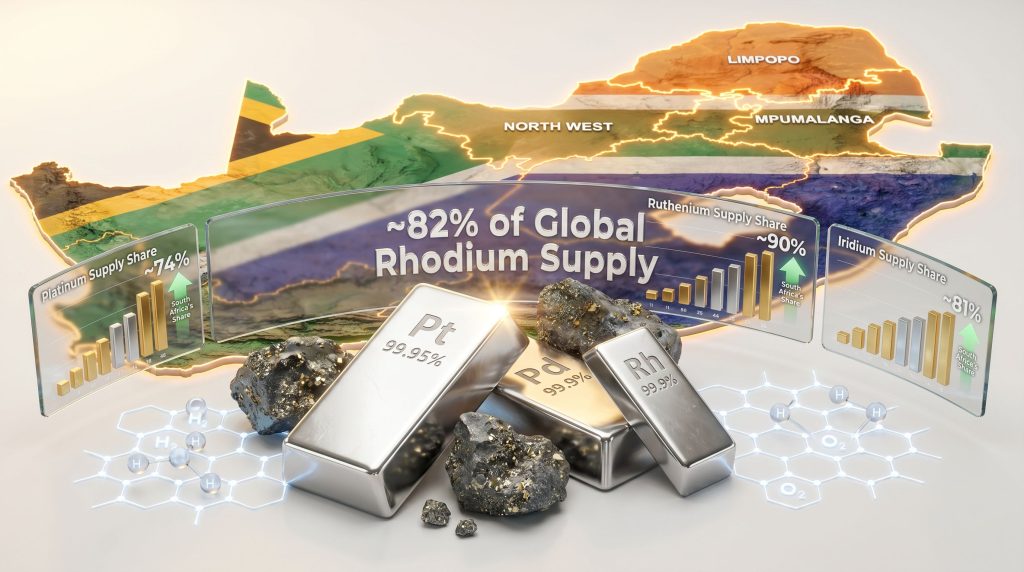
The numbers that define South Africa's position in global PGM supply are staggering in their concentration. The country accounts for approximately 74% of global platinum supply, 39% of palladium, 82% of rhodium, 81% of iridium, and roughly 90% of ruthenium, according to industry supply data. South Africa holds an estimated 80 to 90% of known global PGM reserves, a statistic that has remained broadly stable for decades despite intensive extraction.
Total refined PGM output from South Africa reached approximately 256.5 tonnes in 2024, representing a 1.4% year-on-year increase that signals operational resilience despite persistent cost pressures and declining average head grades across legacy operations.
| PGM Element | South Africa's Approximate Share of Global Supply |
|---|---|
| Platinum (Pt) | ~74% |
| Palladium (Pd) | ~39% |
| Rhodium (Rh) | ~82% |
| Iridium (Ir) | ~81% |
| Ruthenium (Ru) | ~90% |
This supply concentration creates a structural dynamic with no easy parallel in global commodity markets. Unlike most minerals where supply diversification is achievable through exploration in multiple jurisdictions, PGM supply cannot simply be replicated elsewhere on a meaningful commercial scale. The Bushveld Igneous Complex is not just the dominant source but, for practical purposes, the only source of scale that global industry can currently rely upon. Furthermore, the platinum and palladium markets continue to reflect this geological reality in their long-term price structures.
Why PGMs Matter Beyond Jewellery and Investment
A common misconception is that platinum group metals derive their value primarily from luxury applications. In reality, the industrial utility of these six elements, comprising platinum, palladium, rhodium, iridium, ruthenium, and osmium, spans some of the most critical technological systems in modern economies.
- Autocatalysis remains the largest single application, with platinum and palladium playing indispensable roles in reducing harmful vehicle emissions through catalytic converter systems.
- Hydrogen fuel cell technology relies on platinum as a catalyst within proton exchange membrane systems, making it central to zero-emission energy transition pathways.
- Industrial chemical catalysis uses platinum group catalysts in the production of nitric acid, silicones, and various petrochemical intermediates.
- Medical and biomedical applications include platinum-based chemotherapy agents used in oncology treatment, as well as cardiac pacemaker components and precision surgical instruments.
- Electronics depend on PGMs for hard disk drive coatings, sensors, and high-reliability electrical contacts.
The breadth of these applications means that PGM demand is, to a significant degree, structurally embedded across multiple industrial sectors rather than dependent on any single end market.
Mintek: Nine Decades of Mineral Science in Service of Industry
Established through an Act of Parliament in 1934, Mintek has operated as South Africa's national mineral research organisation for 92 years. Headquartered on a 34-hectare campus at 200 Malibongwe Drive in Randburg, the institution operates one of the most comprehensively equipped mineral science facilities on the African continent.
Mintek functions under the mandate of the Department of Science and Innovation (DSI) and has progressively evolved from a purely government-oriented research body into an active industrial collaborator, with its technologies and process methodologies deployed across more than 40 countries. This international footprint speaks to the transferability and commercial credibility of its intellectual property.
The organisation's scope spans mineral chemistry, extractive metallurgy, hydrometallurgy, and advanced process engineering, all of which are directly applicable across the full PGM value chain. Its hydrometallurgy division, led by executive manager Dr Elmar Muller, continues to advance leaching, solvent extraction, and refining processes tailored to the specific geochemistry of South African PGM ores.
The Hidden Value of Mineralogical Intelligence
One of the least publicly appreciated but operationally critical services Mintek provides is advanced mineral characterisation. Mintek principal scientist Dr Nthapo Sehlotho has outlined how this work directly translates raw geological complexity into actionable processing intelligence. The analytical workflow is systematic and multi-layered:
- Sample preparation covering drill cores, rock samples, and crushed materials using specialised equipment and microscopy arrays.
- Mineral identification determining whether PGMs are hosted as sulphides, alloys, or within more complex mineral associations.
- Liberation assessment quantifying how effectively PGM particles have been separated from surrounding host rock during comminution.
- Mineral association mapping characterising how PGMs co-exist with base metal sulphides, gangue minerals, and other phases.
- Particle size profiling measuring grain dimensions to optimise downstream concentration circuit design.
- Processing decision translation converting all characterisation data into specific plant-level operational guidance.
This sequence matters because liberation state is arguably the single most important variable in determining whether a PGM particle will be recovered or lost to tailings. A well-liberated PGM grain that is physically separated from its host mineral can be effectively concentrated. A grain that remains locked within a silicate or sulphide matrix may pass through a flotation circuit entirely unrecovered regardless of how well other process parameters are optimised.
Why Declining Head Grades Are Forcing Mineralogical Rigour
The PGM industry across the Bushveld Igneous Complex is confronting a structural challenge that cannot be resolved through capital alone: average ore grades are declining as the highest-grade, most accessible portions of reef horizons are progressively exhausted. This reality is driving a shift in how mineralogical analysis is valued within mine planning and metallurgical operations. In addition, PGM supply constraints are compounding pressure on producers to extract maximum value from every tonne processed.
Key operational pressures that make rigorous mineralogical analysis increasingly non-negotiable include:
- Declining head grades requiring more precise beneficiation strategies to maintain acceptable recovery economics.
- Increasing ore complexity as mining advances into reef zones with more variable mineralogy and finer PGM grain sizes.
- Tailings management obligations requiring discard assurance data to confirm that material classified as waste meets regulatory and commercial thresholds.
- Rapid troubleshooting requirements when plant recovery deviates unexpectedly from modelled performance.
- Variable plant performance linked to feed mineralogy changes that are invisible to conventional assay-only monitoring.
"Mineralogical analysis has shifted from a project evaluation tool to an ongoing operational requirement. As ore bodies become more complex and grades compress, understanding what is in the feed, and in what physical state, has become a prerequisite for competitive processing performance."
Mintek's Technical Legacy: Innovations That Reshaped PGM Processing
Mintek's contribution to PGM processing is not merely theoretical. Two landmark technical developments demonstrate the institution's capacity to deliver commercially transformative outcomes.
UG2 Reef Processing: Unlocking a Rhodium-Rich Resource
During the 1980s, Mintek developed a proprietary processing route that enabled the treatment of UG2 concentrates independently, without the need to blend with Merensky ore. This was a significant breakthrough because UG2 is disproportionately rich in rhodium, a metal now commanding extraordinary price premiums, but its fine PGM grain size and chromite-dominant mineralogy had previously made independent processing metallurgically problematic.
The Mintek-developed process achieved a PGM concentrate grade of approximately 430 grams per tonne with an 87% recovery rate, a combination of grade and recovery that validated UG2 as a standalone commercial resource. This single technical advance helped unlock an entirely new ore horizon across the Bushveld, significantly expanding the economic resource base available to producers.
DC Arc Smelting: A Technology That Became Industry Standard
Mintek pioneered direct current (DC) arc smelting technology, which was commercially deployed from 1988 onwards. This innovation replaced conventional alternating current furnace technology for PGM concentrate smelting, offering superior energy efficiency, greater metallurgical flexibility, and the ability to process higher-chromite-content feeds without furnace skull formation issues that had constrained earlier operations.
DC arc smelting technology remains the standard approach within South Africa's PGM smelting sector, used exclusively by the country's major integrated producers. The fact that an innovation developed in the 1980s by a government research institution continues to define industrial practice nearly four decades later is a testament to both its technical robustness and the depth of Mintek's original engineering contribution. Consequently, mining electrification trends are now extending Mintek's energy efficiency mandate into entirely new operational domains.
The SAPGMIR: Diversifying PGM Demand Beyond Hydrogen
One of the most significant strategic initiatives currently underway is the development of the South African Platinum Group Metals Industry Roadmap (SAPGMIR), commissioned by the Department of Science and Innovation and being developed by Mintek and South Africa's PGM mining industry. The roadmap is explicitly designed to reduce South Africa's dependence on any single end-market demand driver, including the widely discussed hydrogen economy, by building a diversified portfolio of high-value PGM applications.
| Priority Application Area | Key End Uses |
|---|---|
| Hydrogen Economy | Fuel cells, electrolysers, hydrogen infrastructure |
| Catalysts | Automotive converters, industrial chemical processes |
| Battery Technologies | Solar photovoltaics, lithium-sulphur, lithium-ion systems |
| Recycling | Hydrometallurgical and pyrometallurgical PGM recovery |
| Additive Manufacturing | Powder metallurgy, precision components, jewellery |
| Medical and Biomedical | Oncology pharmaceuticals, pacemakers, surgical instruments |
The deliberate inclusion of medical applications, additive manufacturing, and recycling alongside the more prominently discussed hydrogen and battery sectors reflects a sophisticated understanding of demand risk. Hydrogen economy timelines remain uncertain and capital-intensive, meaning a roadmap anchored solely on that transition would expose South Africa's beneficiation strategy to considerable execution risk.
The SAPGMIR is anticipated to be formally launched in the near term, with industry-wide consultation already underway across producer, research, and downstream manufacturing stakeholder groups. For instance, renewable energy in mining represents one of the cross-cutting themes being assessed within the roadmap's broader industrial framework.
The Investment Landscape: Opportunity in Suspension
The South African PGM sector is served by approximately 11 major producing companies, with market structure dominated by three integrated operators: Anglo American Platinum, the world's largest primary PGM producer; Impala Platinum (Implats); and Sibanye-Stillwater, a diversified precious metals group with substantial Bushveld exposure.
However, a less discussed but highly significant feature of the current investment landscape is the volume of stranded or suspended project capacity:
- 26 PGM mines are currently classified as on-hold across the Bushveld.
- 12 mine licences have been formally relinquished.
- This creates an estimated 38 discrete re-entry or greenfield investment opportunities for capital seeking PGM exposure.
This inventory of suspended assets reflects the combined impact of elevated cost structures, rand-denominated operating cost inflation, and the PGM price volatility experienced between 2021 and 2024. For contrarian investors with longer capital horizons, this pipeline represents an unusual concentration of potentially recoverable value in a single geological province. Moreover, platinum investment opportunities of this scale rarely present themselves simultaneously across so many discrete assets.
Next-Generation Projects Redefining Operational Models
Two development-stage projects are particularly relevant to understanding how the industry's cost structure may evolve:
The Waterberg Platinum Group Metals Project is designed as a shallow, mechanisable deposit that diverges fundamentally from the deep, labour-intensive, narrow-reef mining model that characterises most legacy Bushveld operations. Its geometry enables bulk mining methods that compress unit operating costs and reduce safety risk exposure significantly.
The Platreef Project targets a large, flat-lying, multi-metal deposit hosting platinum, palladium, gold, nickel, and copper within a single bulk-mineable ore body. Its polymetallic revenue streams provide natural commodity price diversification, while its amenability to modern bulk mining methods positions it at the lower end of the industry cost curve upon full production ramp-up.
Both projects signal a structural shift away from the operational model that built the South African PGM industry over the past century toward one better suited to the cost discipline demanded by contemporary global metal markets.
The next major ASX story will hit our subscribers first
Beneficiation: The Economic Multiplier South Africa Has Yet to Fully Capture
South Africa currently exports the majority of its PGMs in refined but functionally unprocessed form, capturing metal value but foregoing the substantial economic premium embedded in downstream fabricated products, chemicals, and engineered components. The contrast between a pure extraction model and a beneficiation-led model is stark across every economically relevant dimension:
| Dimension | Pure Extraction Model | Beneficiation-Led Model |
|---|---|---|
| Value Captured | Raw metal price only | Downstream application premium |
| Employment Impact | Mining and refining jobs | Manufacturing and technology jobs |
| Economic Multiplier | Low | High |
| IP Retention | Minimal | Significant |
| Mintek's Role | Peripheral | Central |
Mintek's strategic positioning within the SAPGMIR framework seeks to close this gap by building domestic technical capacity across high-value application areas, developing intellectual property in fuel cell components, advanced medical materials, and precision manufacturing. Furthermore, as Mining Weekly reports, the institution is providing producers with the mineralogical and metallurgical intelligence needed to optimise local processing at every stage of the value chain.
"The central challenge for South Africa's PGM industry is no longer the capacity to mine and refine at scale. It demonstrably possesses that capability. The open question is whether the country can construct the downstream industrial ecosystem required to capture the full economic value embedded in its unparalleled geological inheritance. Mintek's technical roadmap and nine decades of accumulated research capability represent a foundational pillar of that ambition."
Disclaimer: This article contains forward-looking statements, strategic projections, and market analysis that involve inherent uncertainty. Information regarding investment opportunities, project development timelines, and industry roadmap outcomes reflects available data and reasonable interpretation at the time of writing and should not be construed as financial or investment advice. Readers should conduct independent due diligence before making any investment decisions related to the sectors or companies discussed.
Want to Track the Next Major Mineral Discovery Before the Market Does?
Discovery Alert's proprietary Discovery IQ model delivers real-time alerts on significant ASX mineral discoveries, translating complex geological and commodities data into actionable investment insights — explore the historic returns major discoveries have generated and begin your 14-day free trial to position yourself ahead of the broader market.