August 24, 2026
When Sovereign Institutions Stop Trusting the System They Built
Reserve currency transitions do not announce themselves. They accumulate quietly across decades, visible only in the data that most market participants ignore: the gradual shift in what central banks choose to hold, where they choose to hold it, and why their preferences are changing. That process is underway right now, and BRICS buying gold and what it means for your portfolio is one of the most consequential questions in long-term investment strategy today.
Understanding why that matters to your portfolio requires stepping back from the headline debate entirely. The question is not whether a BRICS gold-backed currency will launch next year. The question is what it means when institutions collectively stewarding the reserves of economies representing more than 40% of global GDP at purchasing power parity make a coordinated, sustained, and accelerating shift away from dollar-denominated assets. That is the signal, and it carries structural implications for anyone holding savings denominated in dollars.
When big ASX news breaks, our subscribers know first
The Architecture of Dollar Supremacy: Built on a Fragile Loop
The post-Bretton Woods monetary order rests on a self-reinforcing mechanism that is elegant in its construction and vulnerable in its dependencies. Global trade is priced in US dollars. Foreign central banks hold US Treasury securities as their primary reserve assets. That demand for dollar-denominated debt allows the United States to borrow at lower interest rates than its fiscal fundamentals would otherwise support, enabling persistent deficit financing without the currency crises that afflict other heavy borrowers.
The loop sustains itself as long as demand for dollar assets remains structurally anchored. However, that anchoring is not permanent. It is a function of trust, alternatives, and incentive structures, all of which are now shifting simultaneously.
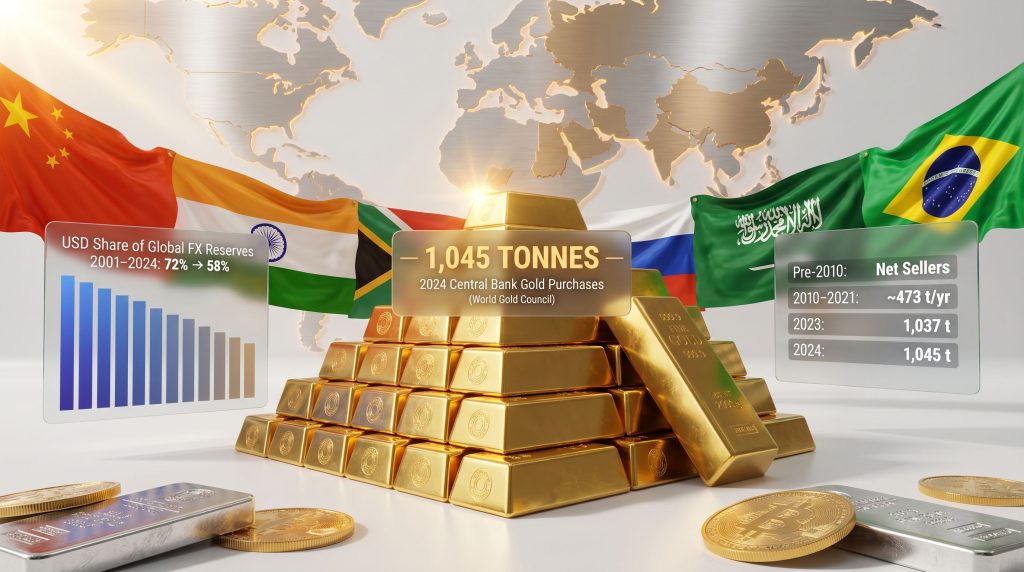
The measurable evidence of this shift is already recorded in IMF data. The US dollar's share of global foreign exchange reserves has contracted from approximately 72% in 2001 to around 58% as of 2024, according to the IMF Currency Composition of Official Foreign Exchange Reserves (COFER) database. That is a 14-percentage-point decline over two decades, achieved without a single rupture event.
| Year | USD Share of Global FX Reserves |
|---|---|
| 2001 | ~72% |
| 2010 | ~62% |
| 2016 | ~65% |
| 2020 | ~59% |
| 2024 | ~58% |
Source: IMF Currency Composition of Official Foreign Exchange Reserves (COFER)
The non-linearity in that table matters. The share actually recovered slightly around 2016 before resuming its descent. These are not clean trend lines; they are the uneven footprints of a system under long-cycle pressure. The direction, measured across the full period, is unambiguous.
Structural note: A 14-percentage-point contraction in dollar reserve share over two decades represents a fundamental rebalancing of global monetary architecture, not a temporary fluctuation. The dollar remains dominant, but the conditions supporting that dominance are becoming incrementally more costly to maintain.
The 2022 Inflection Point: When Reserve Doctrine Changed Permanently
Geopolitical events rarely rewrite institutional behaviour. The 2022 freezing of approximately $300 billion in Russian foreign exchange reserves by Western governments was an exception. It demonstrated to every sovereign reserve manager on the planet that assets held in foreign-issued instruments carry a dimension of risk that balance sheet analysis alone cannot capture: political seizure risk.
Domestically held physical gold carries none of that risk. It cannot be frozen, cannot be sanctioned, and belongs unconditionally to whoever holds it. That realisation, drawn independently by central banks across dozens of emerging-market economies, translated into an observable and dramatic shift in reserve acquisition behaviour. Furthermore, the role of central banks influencing gold prices has become increasingly significant in understanding this structural shift.
The World Gold Council's data tells the story in tonnes:
| Period | Average Annual Central Bank Gold Purchases |
|---|---|
| Pre-2010 | Net sellers |
| 2010–2021 | ~473 tonnes/year (net buyers) |
| 2022 | Over 1,000 tonnes |
| 2023 | 1,037 tonnes |
| 2024 | 1,045 tonnes |
Source: World Gold Council, Gold Demand Trends Full Year 2023 and 2024
The post-2022 annual pace is approximately double the prior decade's average. Central banks have been net gold buyers every year since 2010, but the scale shift after 2022 represents a categorical change in reserve doctrine, not merely an acceleration of an existing trend.
How BRICS Nations Are Building the Alternative Framework
Understanding BRICS gold buying requires understanding the full infrastructure being constructed around it. The original five-member bloc of Brazil, Russia, India, China, and South Africa expanded in 2024 and 2025 to admit six new full members: Egypt, Ethiopia, Iran, the UAE, Indonesia, and Saudi Arabia. The expanded group has developed:
- Payment and settlement systems that operate outside the SWIFT architecture
- Bilateral trade agreements denominated in local currencies rather than dollars
- Sovereign gold accumulation programmes at historically unprecedented scale
- Coordinated advocacy for reserve currency reform within multilateral institutions
None of these initiatives individually displaces the dollar. Collectively, however, they reduce the marginal necessity of holding dollar-denominated assets for an expanding portion of global trade. In addition, the broader global monetary shift driven by China's influence is reshaping how these frameworks interact with gold pricing globally.
China, India, and Russia: Three Distinct Accumulation Strategies
The three largest BRICS economies illustrate distinctly different approaches to gold reserve building, each with its own strategic logic.
China's People's Bank of China added gold holdings for 18 consecutive months through April 2024, then paused for six months as gold prices reached record levels, before resuming purchases in November 2024 and continuing since, according to Bloomberg reporting from December 2025. This pattern reveals disciplined, price-sensitive accumulation rather than reactive buying, suggesting a long-term rebalancing mandate rather than speculative positioning.
India's Reserve Bank executed a pair of notable repatriation decisions. Approximately 100 tonnes of gold were repatriated from the Bank of England in spring 2024, followed by a further 102 tonnes by year-end 2024, according to Business Standard. The significance here extends beyond the quantity. Repatriation, as distinct from purchase, signals a sovereign preference for physical custody over institutional trust in foreign depositories.
Russia has moved furthest along the de-dollarisation spectrum, having effectively substituted its dollar-denominated reserve holdings with gold over the preceding decade. Its reserve portfolio now represents the most complete example of full reserve substitution among major economies. Central bank gold reserves across these three nations alone illustrate how decisively sovereign institutions are repositioning away from dollar dependence.
BRICS Buying Gold: What It Means for Your Portfolio
Translating this macro framework into a practical portfolio response requires identifying the correct risk category. This is not primarily a crash hedge, though gold has historically performed well during financial crises. The risk being signalled by BRICS buying gold and what it means for your portfolio is slower and more structural: a sustained compression of dollar purchasing power over a 10 to 20-year horizon, driven by rising borrowing costs, incremental reserve share erosion, and an unconstrained US fiscal trajectory.
The dollar has lost purchasing power in every decade since 1971. The question is whether the rate of that erosion accelerates as the structural conditions supporting dollar dominance become incrementally less favourable.
| Risk Factor | Severity | Time Horizon |
|---|---|---|
| Dollar reserve share decline (72% to 58%) | Moderate, ongoing | 20+ years |
| Central bank gold buying doubling post-2022 | High signal value | 3-5 years |
| US fiscal trajectory (persistent deficit) | High | 10-20 years |
| BRICS+ settlement infrastructure development | Emerging | 5-15 years |
Physical Gold vs. Paper Gold: Why This Distinction Is Critical Under Stress
Gold exchange-traded funds and futures contracts track gold prices effectively under ordinary market conditions. They are financial claims on gold, not the metal itself. The operational difference between holding a gold ETF and holding physical gold is minimal when financial systems function normally.
It is precisely not normal conditions that the de-dollarisation thesis anticipates. Under monetary stress scenarios, paper gold instruments introduce a layer of dependencies that physical metal does not carry: the solvency of the fund, the reliability of the custodian, and the integrity of the settlement system. Understanding the differences between physical gold vs ETFs is therefore critical when constructing a portfolio designed to hedge genuine monetary system risk.
Risk framework: The conditions under which gold is most valuable as a portfolio hedge are the same conditions under which paper gold instruments face their greatest structural vulnerabilities. Hedging a monetary system risk with a monetary system instrument may undermine the hedge at the moment it is most needed.
Physical gold held in allocated vault storage or direct possession eliminates these dependencies entirely. The asset is not a claim. It is the thing itself.
Sizing the Position to the Thesis
Conventional financial planning guidance places precious metals at 5 to 10% of a diversified portfolio. Given the convergence of accelerating central bank accumulation, expanding BRICS+ coordination, a measurable 14-point decline in dollar reserve share, and an unconstrained US fiscal trajectory, a case exists for 10 to 15% in physical gold and silver combined. This is not a speculative allocation. It functions as structural insurance calibrated to a measurable, multi-decade risk.
The timing dimension also carries asymmetric logic. Sovereign institutions accumulating gold reserves are not waiting for a formal BRICS currency announcement before positioning. By the time a gold-backed settlement mechanism achieves front-page prominence, the structural repricing of gold will have largely occurred. The cost of early positioning is low. The cost of late positioning is the foregone hedge.
Silver's Role Within a De-Dollarisation Portfolio
Gold dominates the sovereign reserve conversation because central banks buy gold, not silver. The silver market is too small and too industrially oriented for sovereign accumulation at scale. That limitation, however, creates a structural opening for individual investors.
Silver carries the same core monetary properties as gold: scarcity, durability, and zero counterparty risk. Its per-ounce price is approximately 1/62nd that of gold at current market levels, placing the gold-silver ratio near its long-run historical average, according to GoldSilver research published in May 2026. This suggests silver is not historically overvalued relative to its monetary counterpart.
Unlike gold, silver also carries a structural industrial demand floor. Solar photovoltaic manufacturing, electric vehicle components, and AI data centre infrastructure all require silver as a functional input. This industrial layer does not substitute for the monetary thesis; it provides an additional demand dimension that gold does not possess.
Silver moves more dramatically than gold in both directions. For investors with conviction in the long-term de-dollarisation thesis and the capacity to hold through price volatility, that characteristic functions as leverage on the upside rather than unmanageable risk.
| Asset | Role | Allocation Logic |
|---|---|---|
| Physical gold | Core monetary hedge | Anchor position; sovereign-grade reserve asset |
| Physical silver | Higher-upside complement | Monetary and industrial demand; accessible entry price |
| Gold ETF or futures | Tactical price exposure only | Not recommended as primary hedge under monetary stress |
The next major ASX story will hit our subscribers first
Key Questions About BRICS Gold Buying and Portfolio Positioning
Does a BRICS gold-backed currency need to succeed for this to affect investors?
No. A formal BRICS reserve currency faces substantial structural obstacles, including eleven member nations with divergent economic interests and no shared monetary authority. However, the portfolio-relevant mechanism operates independently of whether a formal currency launches. What matters is whether bilateral settlement systems, local-currency trade agreements, and sovereign gold accumulation continue to reduce marginal demand for US Treasuries. That process is already measurable and ongoing regardless of any summit outcome. Analysts at GoldCore have outlined how the world is quietly preparing for precisely this scenario, reinforcing that the investment thesis does not depend on a headline announcement.
Why did central bank gold purchases roughly double after 2022?
The freezing of approximately $300 billion in Russian foreign exchange reserves in 2022 demonstrated that sovereign assets held in foreign-issued instruments carry political seizure risk. Physical gold held domestically is immune to that risk. The subsequent acceleration, from a prior annual average of roughly 473 tonnes to over 1,000 tonnes in each of 2022, 2023, and 2024 (World Gold Council), reflects a deliberate structural recalibration of reserve doctrine across multiple sovereign institutions.
Is the dollar's reserve share decline a sign of imminent collapse?
No. The decline from approximately 72% in 2001 to around 58% in 2024 unfolded over more than two decades without a crisis event. The dollar remains the world's dominant reserve currency by a wide margin. The investment-relevant risk is not collapse. It is a sustained, gradual erosion of the structural conditions that allow the United States to borrow cheaply and manage persistent fiscal imbalances without the currency consequences that would ordinarily follow. For further context, Nestmann's analysis of de-dollarisation and its implications for gold provides a useful independent perspective on this trajectory.
The Verdict Encoded in Sovereign Reserve Decisions
There is a category of market signal that does not appear in earnings releases, central bank meeting minutes, or geopolitical headlines. It appears in reserve allocation data: the quiet, multi-year decisions made by institutions with direct visibility into their own inflation dynamics, currency exposure, and the long-term costs of dollar dependence.
Those institutions are sending a consistent and accelerating signal. Central banks collectively managing reserves for economies representing more than 40% of global GDP have shifted their acquisition behaviour toward physical gold at a pace without modern precedent outside the Bretton Woods transition itself. They are not speculating. They are hedging against a risk they can observe from the inside.
| Macro Signal | Data Point | Portfolio Implication |
|---|---|---|
| Dollar reserve share erosion | 72% (2001) to 58% (2024) | Long-term USD purchasing power headwind |
| Central bank gold buying acceleration | 473 t/yr average to 1,045 t in 2024 | Structural demand floor for gold prices |
| BRICS+ membership expansion | 11 members, over 40% of global GDP (PPP) | Expanding alternative reserve framework |
| India sovereign repatriation | 202 tonnes from Bank of England in 2024 | Institutional validation of physical-over-paper thesis |
| Russia's full reserve substitution | Dollar reserves replaced with gold | Most complete de-dollarisation example to date |
The logic available to sovereign reserve managers is also available to individual investors. Assets held entirely outside the dollar-based financial system provide a form of protection that dollar-denominated instruments structurally cannot replicate. Physical gold and silver represent the individual investor's parallel to what central banks are building at the sovereign level: a reserve layer that exists independently of the monetary system it is designed to hedge against.
Consequently, BRICS buying gold and what it means for your portfolio is not a bet against any particular economy or currency. It is a recognition that monetary systems evolve, that transitions carry purchasing power risk, and that the current transition is already underway and measurable in the data that sovereign institutions publish about their own reserve decisions.
This article is for informational and educational purposes only and does not constitute financial or investment advice. Readers should consult a qualified financial professional before making any investment decisions. Past performance is not a guarantee of future results. All investments, including precious metals, involve risk and may result in partial or total loss.
Want To Know Which ASX Mineral Discoveries Could Benefit From Gold's Structural Tailwinds?
Discovery Alert's proprietary Discovery IQ model delivers real-time alerts on significant ASX mineral discoveries, instantly translating complex data across 30+ commodities into actionable insights — so subscribers can position ahead of the broader market. Explore historic discovery returns to understand the potential magnitude of major finds, and begin a 14-day free trial at Discovery Alert to secure a market-leading edge as gold's structural re-rating continues to unfold.