June 26, 2026
The Geometry of Global Energy Power Is Shifting Beneath Our Feet
For most of the twentieth century, BRICS energy security was a concept shaped almost exclusively by Western industrial nations and the multilateral institutions they built to protect their interests. The International Energy Agency emerged in the aftermath of the 1973 oil crisis as a direct response to supply disruption experienced by rich, oil-importing economies. For decades, its frameworks, its vocabulary, and its policy prescriptions shaped how the world understood energy vulnerability.
That architecture is no longer sufficient to describe the world as it actually exists. A new centre of gravity has formed, and it does not operate by the same logic.
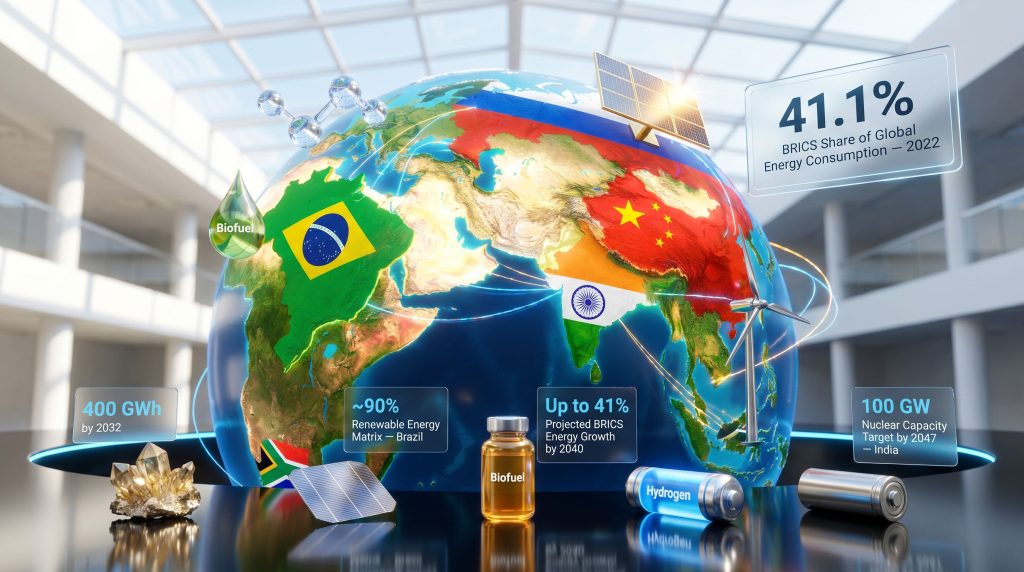
The five-nation BRICS bloc now accounts for 41.1% of global energy consumption, up from 34.7% in 2010, and projections suggest that collective BRICS demand and production could grow by as much as 41% by 2040. These are not marginal shifts. They represent a fundamental reorientation of where energy decisions get made, and who bears the consequences when those decisions fail.
Understanding BRICS energy security requires abandoning the assumption that all energy transitions follow a single path. The bloc's complexity is not a weakness to be managed; in many ways, it is its most strategically significant feature.
When big ASX news breaks, our subscribers know first
From Passive Consumers to Architects of Energy Frameworks
What distinguishes the current BRICS energy posture from anything that preceded it is the degree of institutional intentionality behind collective action. These nations are no longer simply large buyers in global commodity markets. They are actively constructing alternative governance frameworks, financing mechanisms, and technical cooperation networks that challenge the prevailing energy order.
The BRICS Energy Working Group serves as the institutional backbone of this effort. Its mandate spans an unusually broad spectrum of energy domains, covering new technologies in fossil fuels, renewable energy infrastructure, biofuels, green hydrogen, energy storage systems, critical minerals demand, carbon capture technologies, digitalisation, and energy efficiency. This breadth is deliberate. Rather than concentrating collective action in a single energy pathway, BRICS cooperation is designed to remain flexible across multiple technological trajectories simultaneously.
A recurring theme across ministerial communiqués is the emphasis on affordable financing as the enabling condition for all other cooperation goals. Without concessional capital flows that can match the development realities of bloc members, even the most technically sound cooperation frameworks remain aspirational rather than operational.
The resource curse paradox adds a counterintuitive dimension here. Nations that are richly endowed with energy resources frequently demonstrate greater energy security vulnerability than resource-poor nations, precisely because their economies become structurally dependent on commodity price cycles they cannot control. Governing resource endowments actively and intelligently is therefore as important as possessing them.
Critical Minerals: The Strategic Layer Beneath the Energy Transition
Perhaps no area illustrates BRICS energy security ambitions more clearly than the bloc's growing focus on critical minerals. Lithium, cobalt, manganese, graphite, and rare earth elements are the physical foundation of the clean energy economy. Battery storage, solar panel manufacturing, wind turbine components, and electric vehicle drivetrains all depend on reliable access to these materials.
BRICS nations collectively hold significant reserves across multiple critical mineral categories, positioning the bloc favourably relative to Western supply chains that are heavily dependent on imports from geopolitically complex sources. The strategic implication is significant: critical mineral governance within BRICS is simultaneously an energy security and critical minerals issue and a geopolitical leverage point.
Furthermore, several key mineral dependencies warrant attention:
- China dominates global processing of rare earth elements, controlling roughly 60% of global refining capacity for several categories
- South Africa holds the world's largest known platinum group metal reserves, materials essential to hydrogen fuel cell technology
- Brazil's lithium and niobium deposits represent strategically underutilised assets within the bloc's collective resource portfolio
- Russia controls significant nickel and palladium reserves, both of which are critical to battery chemistry and catalytic systems
China's rare earth export restrictions have further underscored how deeply intertwined resource governance and geopolitical strategy have become. The BRICS Energy Working Group's formal incorporation of critical minerals into its cooperation agenda signals an understanding that energy transition and supply chain sovereignty are inseparable objectives.
A Member-by-Member Strategic Profile
The internal diversity of BRICS is one of its most analytically important characteristics. Treating the bloc as a monolithic actor produces fundamental misreadings of its likely behaviour and trajectory.
| Member State | Carbon Neutrality Target | Renewable Share (Approx.) | Key Transition Asset | Primary Risk Factor |
|---|---|---|---|---|
| Brazil | 2050 | ~90% of energy matrix | Hydropower + biofuels | Deforestation pressure |
| Russia | 2060 | Low | Fossil fuel export revenues | Transition resistance |
| India | 2070 | Accelerating rapidly | Solar + nuclear pipeline | Financing gap |
| China | 2060 | Largest absolute RE capacity | Manufacturing dominance | Coal dependency |
| South Africa | 2050 | Emerging | Wind + solar potential | Grid infrastructure deficit |
Brazil presents what is arguably the most instructive case study in the entire bloc. With a national energy matrix drawing approximately 90% of its electricity from renewable sources, primarily hydropower and increasingly biofuels, Brazil has empirically demonstrated that energy security and an accelerated clean energy transition are not competing objectives. The Luz para Todos programme, which extended electricity access to millions of previously unconnected households, offers a replicable model for energy access expansion that BRICS knowledge-sharing mechanisms could transfer to other members facing similar challenges.
Russia occupies an analytically uncomfortable position within the bloc's energy cooperation agenda. Its deep structural dependence on fossil fuel export revenues creates incentive asymmetries that complicate consensus-building on transition timelines and any form of carbon pricing mechanism. This is not merely a diplomatic inconvenience; it represents a genuine fault line in collective action. If Russian hydrocarbon revenues decline sharply before alternative economic foundations are established, the pressure on BRICS energy cohesion could become acute.
India is perhaps the most consequential swing state in global energy governance over the next two decades. Its simultaneous commitments to development-stage energy access and accelerated clean energy deployment put it at the centre of every major tension within BRICS energy negotiations. The targets India has placed on the table are ambitious by any measure:
- 400 GWh of energy storage capacity by 2032, ranking among the most demanding storage mandates of any G20 economy
- 100 GW of nuclear power capacity by 2047, representing a long-horizon baseload strategy that complements intermittent renewable deployment
- 20% ethanol blending achieved ahead of schedule, demonstrating that India's execution capability matches its ambition when policy frameworks are aligned
India's co-leadership of the Global Biofuels Alliance and the International Solar Alliance further reinforces its role as a soft power architect within the clean energy transition, using multilateral platform-building as a tool of energy diplomacy.
China's position within the bloc is structurally dual-natured. Its dominance in solar panel manufacturing, lithium-ion battery production, and electrolyser fabrication gives it unrivalled leverage over the bloc's transition speed and cost trajectory. At the same time, China's domestic grid remains heavily coal-dependent, creating a tension between its global clean energy industrial leadership and its domestic decarbonisation timeline. How China resolves this tension will materially shape the bloc's collective emissions trajectory through 2040.
South Africa functions as a gateway for extending BRICS energy cooperation into the broader African continent, but faces structural constraints that limit its near-term transition capacity. Grid infrastructure deficits are the primary bottleneck to renewable energy deployment, and bridging that gap requires capital flows at a scale that South Africa cannot independently mobilise. This is precisely where intra-bloc financing mechanisms, if adequately funded, could have their most tangible impact. In addition, South Africa's critical minerals strategy for platinum group metals positions it as a uniquely valuable partner within the bloc's broader resource governance agenda.
The Four Core Tensions Threatening Bloc Cohesion
Development Rights vs. Transition Speed
The foundational tension within BRICS energy diplomacy concerns the right of developing nations to pursue industrialisation on their own terms and timelines. The principle that economic growth, employment creation, and improved living standards cannot be subordinated to transition timelines designed primarily by wealthier economies appears consistently in bloc communiqués. This is not a rhetorical position; it reflects genuine distributional concerns about who bears the costs of a global energy transformation.
Urbanisation as a Structural Vulnerability
Research evidence on the relationship between urbanisation and energy security produces a counterintuitive finding: urbanisation initially improves energy security by concentrating demand and enabling infrastructure investment, but ultimately increases consumption-driven risk as urban populations grow and per-capita energy use expands. BRICS nations are among the world's fastest-urbanising economies, which means this dynamic will intensify over the projection period. Urban energy planning must consequently be integrated into national energy security frameworks as a core priority, not treated as a downstream infrastructure matter.
A Two-Speed Transition Dynamic
Wealthier BRICS members face structurally lower energy security risk as they accelerate renewable deployment and diversify their energy mixes. Emerging members face precisely the opposite dynamic: transitional risk increases as fossil fuel infrastructure ages without adequate renewable replacement capacity, financing gaps widen, and energy poverty persists in rural and peri-urban areas. Unless intra-bloc concessional financing mechanisms are scaled significantly, this two-speed dynamic could fragment the collective action framework that gives BRICS its strategic coherence. Rare earth supply chains represent one specific area where this financing gap risks undermining transition progress for less advanced members.
Military Spending and Short-Term Security Stabilisation
A less commonly discussed dimension of energy security research concerns the measurable short-term positive effect of military expenditure on energy security risk management. Protecting energy infrastructure, supply routes, and extraction facilities through security force deployment reduces short-term vulnerability to disruption. However, the long-term sustainability of this approach is limited, and the opportunity cost relative to direct clean energy investment is substantial. This creates a genuine resource allocation dilemma for members navigating both geopolitical and transition pressures simultaneously.
BRICS vs. Western Energy Security Frameworks: A Structural Comparison
| Dimension | BRICS Approach | IEA/Western Approach |
|---|---|---|
| Energy Mix Philosophy | Diversified, no single pathway mandated | Accelerated fossil fuel phase-out |
| Transition Timeline | Member-differentiated (2050-2070) | Converging toward 2050 net-zero |
| Financing Model | Concessional + South-South cooperation | Private capital + carbon markets |
| Critical Minerals | Internal bloc resource governance | Supply chain diversification via allies |
| Fossil Fuel Role | Transitional bridge fuel accepted | Rapid phase-down prioritised |
The balanced energy mix doctrine that BRICS communiqués consistently articulate is strategically significant precisely because of what it deliberately avoids saying. By declining to adopt prescriptive fossil fuel phase-out language, the bloc preserves policy flexibility for members at fundamentally different development stages. This framing positions BRICS as an alternative governance voice in global energy diplomacy, one that speaks directly to the concerns of the Global South in ways that IEA frameworks have historically struggled to accommodate. Research published by energy transition scholars reinforces this point, noting that the bloc's heterogeneity demands governance models that existing Western institutions were not designed to provide.
The next major ASX story will hit our subscribers first
Innovation, Human Capital, and the Non-Technical Pillars of Energy Resilience
Long-term energy resilience cannot be built through hardware deployment alone. The BRICS energy cooperation agenda formally incorporates research collaboration and youth engagement as structural elements, reflecting an understanding that sustainable energy security depends on building domestic technical capacity rather than simply importing solutions developed elsewhere.
The complementary expertise distributed across bloc members creates genuine opportunities for human resource exchanges that could address skills shortages in solar engineering, grid management, hydrogen technology, and energy digitalisation. Brazil's biofuel engineering expertise, China's electrolyser manufacturing knowledge, and India's large-scale solar project management experience represent a portfolio of transferable capabilities that, if systematically shared, could accelerate transition readiness across less advanced members.
Cybersecurity has emerged as an increasingly prominent non-traditional security dimension within BRICS energy cooperation. As energy grids become more digitalised and interconnected, their vulnerability to state-sponsored and criminal cyber threats grows proportionally. BRICS working groups have formally acknowledged this risk, with joint cybersecurity frameworks for energy infrastructure representing a domain where pooled knowledge-sharing can deliver meaningful collective security benefits that individual members would struggle to achieve independently.
Three Scenarios for BRICS Energy Security by 2040
Scenario 1: Convergent Transition. All five members accelerate renewable deployment, critical mineral governance frameworks are established, and concessional financing bridges the development gap between wealthier and emerging members. China's manufacturing cost reductions make renewables economically dominant even in the absence of carbon pricing, pulling the entire bloc toward faster transition. BRICS collectively reduces fossil fuel dependence by 35-40% and emerges as the dominant force in global clean energy governance.
Scenario 2: Fragmented Divergence. Russia's fossil fuel dependency and India's financing constraints slow collective progress. China pursues bilateral rather than multilateral energy deals, optimising for national economic advantage rather than bloc cohesion. BRICS energy cooperation becomes increasingly rhetorical as geopolitical realignments post-2025 erode multilateral trust. Individual members pursue national strategies that occasionally align but lack the structural integration needed to constitute a coherent alternative governance framework.
Scenario 3: Resource Shock Acceleration. A major fossil fuel supply disruption, whether driven by conflict, sanctions, or climate-related infrastructure failure, forces emergency acceleration of renewable deployment across all members. Crisis-driven convergence produces faster-than-expected transition outcomes, but generates significant economic disruption for fossil-fuel-dependent members, particularly Russia. The bloc's long-term cohesion is ultimately strengthened by shared adversity, however the transitional costs are unevenly distributed.
Key Statistics at a Glance
| Metric | Value | Significance |
|---|---|---|
| BRICS share of global energy consumption (2022) | 41.1% | Up from 34.7% in 2010 |
| Projected BRICS energy growth by 2040 | Up to 41% | Largest single demand variable globally |
| India energy storage target | 400 GWh by 2032 | Among the most ambitious G20 mandates |
| India nuclear capacity target | 100 GW by 2047 | Long-horizon baseload security strategy |
| Brazil renewable energy matrix share | ~90% | Proof-of-concept for transition and security compatibility |
| Carbon neutrality targets across bloc | 2050-2070 | Reflects development-stage heterogeneity |
Frequently Asked Questions on BRICS Energy Security
What is BRICS energy security and why does it matter globally?
BRICS energy security refers to the collective strategies employed by Brazil, Russia, India, China, and South Africa to ensure reliable, affordable, and sustainable energy access for their combined populations. Representing over 41% of global energy consumption as of 2022 and growing, the bloc's energy decisions carry direct consequences for global commodity markets, climate outcomes, and the architecture of international governance. No credible global energy forecast can be constructed without accounting for BRICS trajectory.
What are the main areas of BRICS energy cooperation?
The BRICS Energy Working Group coordinates across a broad range of domains:
- Fossil fuel technology and new extraction methods
- Renewable energy infrastructure deployment
- Biofuel development and integration
- Green hydrogen research and commercialisation
- Energy storage systems and battery technology
- Critical minerals governance and supply chain development
- Carbon capture and storage technologies
- Energy system digitalisation and smart grid development
- Energy efficiency standards and implementation
- Cybersecurity frameworks for energy infrastructure
- Research collaboration and youth engagement programmes
Is BRICS energy cooperation a challenge to Western energy governance institutions?
The bloc's consistent use of the balanced energy mix doctrine, its member-differentiated transition timelines, and its emphasis on South-South concessional financing collectively position BRICS as an alternative governance voice rather than a direct institutional challenger. In multilateral climate negotiations, BRICS negotiating positions reflect the development priorities of the Global South in ways that the IEA framework, designed primarily for wealthy oil-importing economies, was never structured to accommodate. The two systems are not simply rivals; they represent genuinely different conceptions of what energy security means and who bears responsibility for achieving it.
Disclaimer: This article contains forward-looking projections and scenario analyses drawn from publicly available research and energy policy frameworks. These projections involve inherent uncertainty and should not be interpreted as investment advice or definitive forecasts of political or economic outcomes. Readers are encouraged to consult primary sources and independent analysis before drawing conclusions relevant to financial or policy decisions.
Want to Identify the Next Major Mineral Discovery Before the Market Does?
As BRICS energy dynamics reshape global demand for critical minerals, the investment opportunities emerging from this structural shift are significant — Discovery Alert's proprietary Discovery IQ model instantly translates complex ASX mineral discovery announcements across 30+ commodities into clear, actionable insights, giving subscribers a decisive edge. Explore historic discovery returns on Discovery Alert's discoveries page and begin your 14-day free trial today to position yourself ahead of the next major find.