June 26, 2026
When a Waterway Holds a Nation's Energy Hostage
Few vulnerabilities in modern energy systems are as stark as import concentration risk. When a single chokepoint controls the flow of a commodity that heats food for hundreds of millions of people, the consequences of disruption extend far beyond commodity markets. They reach household kitchens, factory floors, and the policy desks of government ministries simultaneously.
India's experience with the Strait of Hormuz disruption offers a real-time case study in what happens when a nation's energy import architecture is optimised for cost efficiency rather than resilience. The decision by India to raise LPG supplies to industries marks a significant turning point in the country's crisis response, signalling that supply conditions have improved sufficiently to partially restore commercial and industrial allocations that were suspended during the acute phase of the shortage.
Understanding the full significance of this restoration requires examining not just what happened, but why India was so exposed in the first place, and what structural changes are now underway.
When big ASX news breaks, our subscribers know first
The Architecture of Dependency: Why India Was So Vulnerable
India's LPG import profile before the conflict was heavily concentrated. Approximately 90% of total LPG imports were sourced from Middle Eastern producers, creating a supply chain with almost no structural redundancy. When the Strait of Hormuz was closed, this single-point-of-failure exposed itself almost immediately.
LPG in India occupies a unique dual role. It serves as the primary cooking fuel for hundreds of millions of households, many of whom depend on subsidised cylinders under the Pradhan Mantri Ujjwala Yojana scheme, which has connected over 100 million low-income households to clean cooking fuel since its launch. At the same time, LPG in the form of propane and butane serves as both an energy input and a chemical feedstock for a broad range of commercial and industrial users.
This dual-use structure created an immediate policy dilemma when supply contracted. India's daily baseline LPG consumption requirement stood at approximately 100,000 metric tons, and when Gulf supply routes were severed, meeting even household demand became operationally challenging. Furthermore, the broader context of global trade disruption risks made alternative procurement increasingly complex and competitive.
Emergency Governance: How India Deployed Regulatory Tools at Speed
Invoking the Essential Commodities Act
The Indian government's initial response centred on asserting direct control over LPG distribution through the Essential Commodities Act. This legislation, historically invoked during agricultural shortages and wartime supply disruptions, allowed authorities to regulate pricing, limit hoarding, and extend refill booking cycles as a demand-management tool. Complementary fiscal measures, including excise duty reductions on petrol and diesel, were deployed to reduce the broader cost-of-living pressure on consumers during the supply crunch.
Redirecting Petrochemical Feedstock
One of the more technically complex interventions involved a government directive requiring petrochemical manufacturers to divert their propane, butane, and related molecule streams toward LPG refiners rather than using them as petrochemical feedstock. This policy effectively converted existing industrial capacity into supplementary LPG production infrastructure.
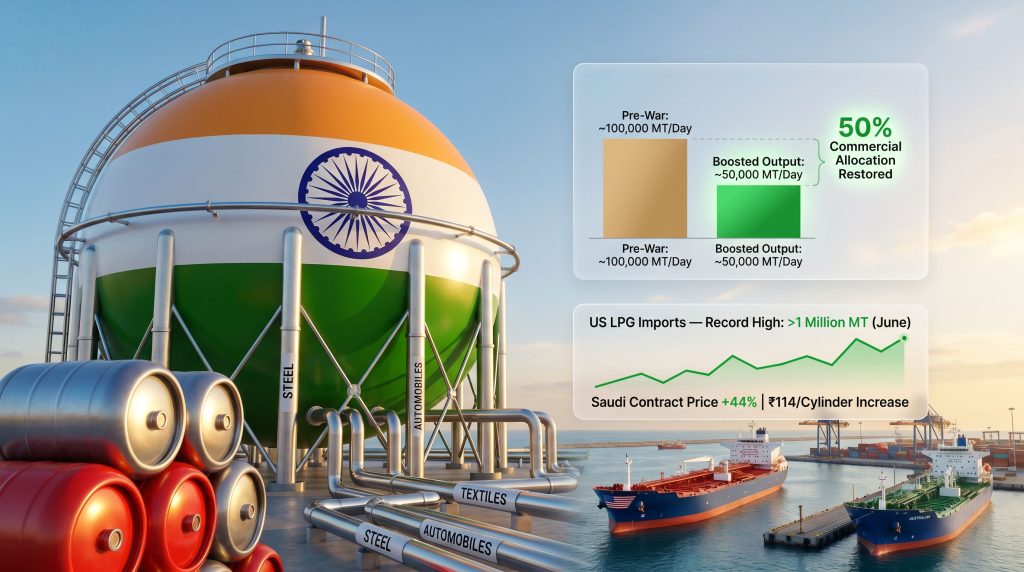
The outcome was significant: domestic daily LPG output climbed to approximately 50,000 metric tons per day, representing a roughly 40% uplift from baseline domestic production. This came at a direct cost to petrochemical output capacity, creating a production trade-off that placed the petrochemical sector in an unusual position, simultaneously acting as both a supply contributor and a competing industrial consumer of the same molecules. India's LNG tax structure further shaped the underlying economics of these emergency supply decisions.
Policy Insight: The feedstock redirection directive represents a precedent in Indian energy governance. It demonstrates that the government is willing to subordinate petrochemical manufacturing output to household energy security during crisis conditions, a calculus that industry participants should factor into their longer-term supply chain planning.
The Phased Commercial Suspension and Partial Restoration
Commercial and industrial LPG users were the first to face supply curtailment and, by design, among the last to receive restoration. India has now restored 50% of previously suspended commercial and industrial LPG allocations, a partial but meaningful step back toward normalcy.
Not all commercial users have been treated equally in the restoration framework. The government has established a priority hierarchy that reflects economic policy objectives as much as supply logistics. According to reporting on the commercial LPG increase, this phased approach was carefully calibrated to balance household needs with industrial demand.
Priority Sectors and the Industrial Allocation Hierarchy
Labour-Intensive Exports at the Front of the Queue
The government designated steel, automobile manufacturing, and textile sectors as priority recipients of restored commercial LPG supply. The economic rationale is straightforward: these are industries with high labour intensity, significant export revenue contribution, and substantial downstream employment multipliers. Disrupting their operations carries consequences that ripple through supply chains and regional employment markets.
Food Service and Hospitality: The Asymmetric Impact Problem
Hotels, restaurants, and other food service businesses present a different exposure profile. Unlike large industrial users who may have greater capacity to manage supply variability through inventory buffers or temporary process adjustments, small commercial establishments operating on LPG for cooking have limited operational flexibility. Industry bodies have flagged that sustained supply restrictions below operational thresholds could force business closures, particularly among smaller operators.
The allocation framework's current structure creates an asymmetric outcome: large industrial users benefit from priority designation and scale, while small commercial operators sit in a less clearly defined tier of the restoration hierarchy. In addition, India raises commercial LPG supply to 70% for key industries represents the next phase target under the government's forward restoration schedule.
Rebuilding the Import Base: India's Supply Chain Diversification
The most consequential structural change to emerge from this crisis is the rapid diversification of India's LPG import portfolio. The shift has been dramatic in both speed and scale.
| Import Source | Pre-Crisis Role | Post-Diversification Status |
|---|---|---|
| Middle East (Gulf producers) | ~90% of total imports | Significantly reduced; Strait of Hormuz constraints |
| United States | Marginal volumes | Record imports exceeding 1 million metric tons in June |
| Russia | Minimal presence | Part of alternative sourcing package |
| Australia | Minimal presence | Included in secured shipment portfolio |
Indian state energy firms secured approximately 800,000 metric tons of alternative shipments from the US, Russia, and Australia to compensate for the loss of Gulf supply. However, Australia's energy export capacity faces its own constraints, which have shaped the volume and reliability of Australian contributions to India's diversification strategy.
The US contribution has been particularly notable, with June imports projected to exceed 1 million metric tons, a record high for bilateral LPG trade between the two countries. This diversification pivot was not without cost. Saudi Contract Prices, the benchmark against which much of India's Gulf LPG was priced, rose approximately 44% during the disruption period. Emergency spot market procurement from alternative suppliers at premium prices has translated directly into higher costs for commercial users, with commercial LPG cylinder prices increasing by approximately ₹114 per cylinder.
The Numbers Behind the Supply Gap
Even with domestic production maximised and alternative imports flowing, India has not yet returned to pre-crisis supply levels. The data reveals a persistent gap that underscores why the commercial restoration is only partial.
| Supply Metric | Volume |
|---|---|
| Pre-war daily consumption requirement | ~100,000 metric tons/day |
| Government-mandated domestic production floor | 40,000 metric tons/day |
| Boosted domestic output (post-feedstock redirection) | ~50,000 metric tons/day |
| Alternative import shipments secured | ~800,000 metric tons (total) |
| US LPG imports in June (record high) | >1 million metric tons |
| Commercial allocation restoration level | 50% of suspended allocation |
| Commercial LPG cylinder price increase | ₹114 per cylinder |
| Saudi Contract Price increase | ~44% |
The gap between the government-mandated production floor of 40,000 metric tons per day and the pre-crisis daily requirement of 100,000 metric tons illustrates why import diversification is not merely a strategic preference but an operational necessity. Domestic production, even at maximum boosted capacity, can only satisfy roughly half of India's daily LPG demand.
The next major ASX story will hit our subscribers first
What India's Crisis Response Reveals About Future Energy Policy
The Case for Mandatory Diversification Thresholds
India's experience presents a compelling policy argument for establishing mandatory diversification thresholds in hydrocarbon import procurement. Just as India maintains strategic petroleum reserves as a buffer against oil supply disruptions, a parallel argument can be made for LPG import diversification requirements that prevent any single source or corridor from exceeding a defined share of total supply.
This is not a novel concept in energy policy. Japan and South Korea, both heavily import-dependent for hydrocarbons, have long operated under frameworks that incentivise source diversification and maintain bilateral supply agreements with geographically distributed producers. Consequently, the global gas supply outlook will increasingly shape how India and comparable import-dependent economies design their procurement architecture going forward.
Domestic Infrastructure Investment as a Strategic Imperative
The feedstock reallocation directive demonstrated that India can extract additional domestic LPG output from existing infrastructure under emergency conditions. However, the production uplift achieved, approximately 50,000 metric tons per day, still falls well short of the 100,000 metric ton daily demand baseline. Closing this gap through domestic means would require substantial investment in LPG separation, fractionation, and refinery upgrading capacity.
The medium-term investment case for expanding India's domestic LPG infrastructure is now considerably stronger than it was before the Strait of Hormuz disruption. The crisis has quantified the cost of under-investment in a way that policy discussions alone rarely achieve. Furthermore, the Saudi supply strategy will remain a key reference point as India recalibrates its long-term supplier relationships across multiple commodities.
Codifying the Triage Model into Formal Governance
India's crisis-era approach, prioritising household consumers over commercial and industrial users, was deployed reactively and operationalised through ad hoc regulatory instruments. The more durable lesson may be that this hierarchy should be codified into a formal LPG allocation governance framework before the next disruption, rather than assembled under pressure during one.
A tiered allocation system with pre-defined priority hierarchies, trigger thresholds, and restoration protocols would reduce response time, improve regulatory predictability for commercial users, and reduce the social and political friction that accompanies emergency allocation decisions.
Frequently Asked Questions: India Raises LPG Supplies to Industries
Why Did India Restrict LPG Supplies to Industries in the First Place?
The Strait of Hormuz closure severed approximately 90% of India's LPG import supply. To protect household cooking fuel access, the government suspended commercial and industrial allocations, directing available supply toward domestic consumers as the priority tier.
What Percentage of Commercial LPG Supply Has Been Restored?
India raises LPG supplies to industries at a restoration level of 50% of previously suspended commercial and industrial allocations, representing a meaningful but partial normalisation of supply for affected businesses.
Which Industries Have Been Given Priority in the LPG Restoration?
Labour-intensive, export-oriented sectors including steel, automobiles, and textiles have been designated as priority recipients of restored commercial LPG supply.
How Has India Replaced Lost Middle Eastern LPG Imports?
India diversified its import base to include the United States, Russia, and Australia. US LPG imports exceeded 1 million metric tons in June, a record bilateral volume reflecting the scale of the supply chain realignment.
What Is the Current Gap Between India's LPG Supply and Pre-Crisis Demand?
Domestic production has been boosted to approximately 50,000 metric tons per day, against a pre-crisis daily requirement of 100,000 metric tons, meaning the supply gap remains significant and import diversification remains essential.
How Have LPG Prices Changed for Commercial Users?
Commercial LPG cylinder prices increased by approximately ₹114 per cylinder, driven by a 44% rise in Saudi Contract Prices and the premium costs associated with emergency spot market procurement from alternative suppliers.
Disclaimer: This article draws on publicly reported data and policy analysis for informational purposes. Supply figures, price changes, and policy timelines reflect available reporting as of the publication date and may be subject to revision as conditions evolve. This content does not constitute financial or investment advice.
Want to Stay Ahead of the Next Major Resource Discovery?
India's LPG supply crisis illustrates how rapidly commodity markets can shift when geopolitical disruptions strike — and for investors, the ability to act on significant resource discoveries the moment they are announced can be the difference between a market-leading position and a missed opportunity. Discovery Alert's proprietary Discovery IQ model delivers real-time alerts on significant ASX mineral discoveries, instantly transforming complex resource data into actionable insights — begin your 14-day free trial today and explore how historic discoveries have generated substantial returns for those who moved first.