August 26, 2026
BRICS strategic minerals cooperation is really about bottlenecks, not rocks
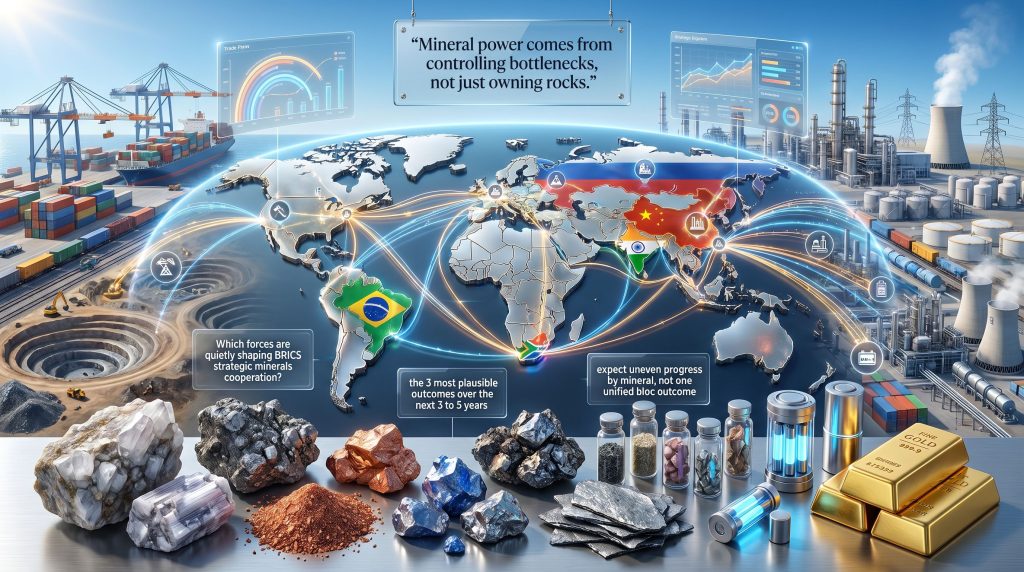
Mineral power rarely comes from simply owning deposits in the ground. In modern supply chains, influence is built at the choke points: chemical conversion, refining, separation, smelting, logistics, insurance, payments, and long-term offtake. That is the real lens for understanding BRICS strategic minerals cooperation.
As energy systems electrify, defence supply chains harden, and trade fragmentation deepens, critical minerals have shifted from a commodity issue into a matter of strategic statecraft. A country can hold large reserves and still remain vulnerable if it lacks sulfuric acid supply, high-temperature processing capacity, rail access, deepwater ports, solvent extraction expertise, or trusted payment rails.
That helps explain why BRICS discussions around strategic minerals matter even when specific agreements remain vague. The important question is not whether the grouping can issue joint statements. It is whether members can gradually coordinate the less visible parts of the value chain that determine who controls price discovery, delivery certainty, and industrial upgrading.
The core issue in mineral competition is usually control over processing bottlenecks rather than simple ownership of ore bodies.
What is BRICS strategic minerals cooperation?
BRICS strategic minerals cooperation refers to coordination among BRICS countries and associated partners around the extraction, processing, financing, trading, and stockpiling of minerals considered important for industry, energy, technology, and monetary resilience.
In practice, that can include:
- mine investment partnerships
- refining and smelting joint ventures
- long-term offtake contracts
- local-currency trade settlement arrangements
- shared logistics and industrial corridor planning
- strategic stockpile coordination
- standards, traceability, and certification systems
It does not automatically mean a unified bloc, a single minerals market, or seamless political alignment. BRICS remains a diverse grouping with different resource endowments, industrial ambitions, and diplomatic priorities.
Why critical minerals have become strategic
Critical minerals moved beyond normal trade policy for five main reasons:
- Processing concentration
- Sanctions and export controls
- Electrification demand growth
- Resource nationalism
- Industrial security
Many minerals are geographically widespread in ore form but highly concentrated in refined or chemical form. Consequently, countries that master midstream processing often secure the greatest leverage.
Restrictions on technology, payments, shipping, and intermediate materials can disable a supply chain even when mines are operating. In addition, the IEA has repeatedly highlighted rising material intensity in batteries, grids, wind, solar, and electric transport, reinforcing the wider critical minerals demand surge.
Governments also want more local value capture through export taxes, processing mandates, and local-content rules. As a result, minerals now sit at the intersection of energy security, defence manufacturing, and advanced technology policy.
A recent diplomatic push underscored this trend when China’s foreign minister called on BRICS countries to strengthen cooperation on strategic mineral resources while also linking security concerns to energy, food, cyber, and broader geopolitical risks, according to a June 2026 Reuters report.
Key terms readers should understand early
Strategic minerals
Minerals considered important to economic security, industrial competitiveness, defence capability, or energy transition systems.
Processing bottlenecks
Stages where capacity is scarce or highly concentrated, such as rare earth separation, precursor chemistry, sulfate conversion, or anode material processing.
Supply security
A buyer’s confidence that material will arrive in the required specification, volume, timeframe, and jurisdictional setting.
Resource nationalism
Policies designed to increase domestic control over mineral wealth, often through taxes, export restrictions, state participation, or downstream mandates.
Downstream integration
Moving from raw ore or concentrate into higher-value products such as refined metal, chemicals, cathodes, anodes, magnets, or semi-fabricated industrial inputs.
Why BRICS matters in global critical minerals supply chains
Geology alone does not decide strategic leverage. A country may rank highly in reserves yet remain dependent on foreign refiners, engineering contractors, reagents, or manufacturers. Conversely, a country with modest reserves can dominate value capture if it controls refining, component manufacturing, and end-market demand.
China is the clearest example. Its leverage in several strategic minerals is strongest not merely because of mining, but because of refining, chemicals, intermediate manufacturing, and integrated domestic demand. Furthermore, its role in rare earth supply chains illustrates how the hardest technical stages often create the deepest moat.
India matters more as a future demand centre and refining aspirant than as a dominant upstream holder. Brazil and South Africa offer strong upstream positions in selected commodities, while Russia’s role is shaped by sanctions pressure, Eurasian logistics, and energy-minerals linkages.
Commodity clusters where BRICS matters
The most important mineral clusters include:
- Battery metals: lithium, nickel, cobalt, graphite, manganese
- Electrification metals: copper and aluminium
- Magnet materials: rare earth elements
- Precious and monetary metals: gold
- Industrial and energy-adjacent inputs: uranium, chrome, platinum group metals, iron ore
As noted in an analysis of BRICS and critical minerals, the bloc’s influence depends less on headline reserves and more on how effectively it links mining, processing, and trade.
Which BRICS members hold the strongest leverage?
China
China’s strength comes from processing dominance, manufacturing depth, policy coordination capacity, and end-market scale. Even where mine supply is diversified globally, downstream dependence can remain concentrated.
Russia
Russia retains importance in nickel, palladium, uranium-related fuel-cycle capabilities, and some broader metals logistics across Eurasia. However, sanctions, shipping frictions, finance constraints, and technology access issues complicate execution.
Brazil
Brazil brings scale in iron ore, relevance in copper and nickel, and long-term upside in rare earths and lithium. It is also strategically valuable because it can supply both traditional bulk materials and future-facing minerals.
India
India’s main leverage may emerge from future demand growth, refining ambitions, and efforts to diversify supply. As a large manufacturing and infrastructure market, it can shape investment decisions even where current upstream control is limited.
South Africa
South Africa matters for platinum group metals, manganese, and chrome. However, electricity reliability, infrastructure performance, and logistics constraints remain central risks to any larger downstream vision.
What minerals are most likely to anchor cooperation first?
The earliest practical cooperation is most likely in minerals where one or more BRICS members already have meaningful scale and where bottlenecks are identifiable.
1. Battery metals
Lithium, nickel, graphite, manganese, and cobalt are natural candidates because they connect directly to battery material processing and EV supply chains. For instance, brine projects increasingly depend on direct lithium extraction or tightly managed evaporation chemistry.
A lesser-known technical point is that not all tonnage is equally useful. For investors, chemical form, impurity profile, and conversion route matter heavily.
2. Copper and aluminium
Grid buildout, motors, transformers, and industrial electrification keep copper central. Aluminium also matters due to transmission infrastructure, lightweighting, and its link to power availability.
3. Rare earths and magnet materials
Rare earth mining alone is not enough. The difficult steps are separation, metal-making, alloying, and magnet fabrication. According to a recent study on resource competition and strategic leverage, states that command these specialised stages can shape both technology access and industrial bargaining power.
4. Gold
Gold sits slightly outside the usual clean-energy narrative, yet it matters in reserve diversification, collateral use, and confidence in alternative settlement structures. A separate report cited by sector media noted BRICS+ nations hold more than 17% of global gold reserves.
5. Uranium and adjacent industrial inputs
Uranium can become more important where energy security, grid stability, and fuel-cycle issues converge. Its inclusion would depend heavily on geopolitics, safeguards, and financing conditions.
What problems is BRICS cooperation trying to solve?
Supply-chain fragility
Recent disruptions have shown that a mine alone does not guarantee material flow. Sanctions can interrupt feedstock. Export restrictions can choke intermediate products. Shipping insurance and payment rails can become as important as geology.
The pricing problem
Many producers remain dependent on external benchmarks, opaque contracts, or currency exposure. This creates incentives to explore:
- local-currency settlement
- bilateral clearing frameworks
- longer-term offtake structures
- new benchmark development for regional trade
The investment gap
Mines need roads, rail, power, water, tailings systems, and port access. Refineries need engineering talent, reagents, environmental controls, and reliable utilities. In Europe, the push for a critical raw materials facility shows how governments are trying to de-risk these weak points.
The technology gap
Solvent extraction, leach optimisation, impurity removal, precursor chemistry, cathode processing, rare earth separation, and recycling know-how remain unevenly distributed. In many cases, this is the real barrier to sovereignty in critical minerals.
How BRICS could move beyond raw-material exports
The biggest strategic shift would be moving from ore exports towards value-added industrial policy.
A practical corridor model
A hypothetical BRICS corridor could work like this:
- A mining jurisdiction supplies concentrate or mixed intermediate product.
- A second country hosts toll refining or chemical conversion.
- A development bank or sovereign fund helps de-risk capex.
- Offtake is locked in with downstream users.
- Trade settles partly in local currencies.
- Strategic stockpiles absorb temporary disruptions.
This kind of model is easier to imagine than to execute. The hard part is not diplomacy. It is aligning project economics, metallurgy, infrastructure, and trust.
Geopolitics, sanctions, and the hidden plumbing of mineral trade
Strategic minerals cooperation is inseparable from geopolitics. Unilateral restrictions can accelerate bloc-based planning because countries want redundancy in:
- payment systems
- shipping and insurance access
- digital and cyber resilience
Diplomatic language about multilateralism often masks industrial policy objectives. That does not make it insincere. Rather, it means resource cooperation is frequently framed in universal terms while pursuing very specific national capabilities.
For readers, a useful rule is this: watch customs changes, bankable project finance, refinery construction, and offtake contracts more closely than summit rhetoric. In that sense, the wider geopolitical mining landscape matters just as much as geology.
What it means for Western supply chains and ASX investors
For Western supply chains, stronger BRICS strategic minerals cooperation could mean:
- more competition for undeveloped deposits in Africa, Latin America, and Central Asia
- greater pressure to build refining capacity outside existing chokepoints
- tighter long-term offtake competition
- rising interest in strategic reserves and friendshoring responses
For investors, the most sensitive exposures are not always the obvious miners. Midstream processors, logistics owners, reagent suppliers, and companies with flexible marketing channels may gain strategic value if trade architecture becomes more regionalised.
This article is for informational purposes only and is not financial advice. Commodity markets are cyclical, politically sensitive, and highly volatile. Scenario analysis is not a forecast, and policy discussions do not guarantee commercial outcomes.
FAQ: BRICS strategic minerals cooperation
Which BRICS countries matter most in critical minerals?
China matters most in processing and manufacturing depth, while Brazil, Russia, South Africa, and India each matter in different combinations of reserves, production, logistics, and demand growth.
Could BRICS create alternative pricing or payment systems?
Possibly in limited corridors or bilateral trade first. It is easier to build local settlement mechanisms for selected flows than to replace global benchmarks wholesale.
Is this mainly about mining, refining, or geopolitics?
All three matter, but refining and intermediate processing are often the decisive leverage points.
Final takeaway
The most useful way to read BRICS strategic minerals cooperation is as a set of scenarios rather than a single prediction. The future balance of mineral power will not be decided by declarations alone. It will be determined by who can coordinate bottlenecks fastest across processing, finance, logistics, standards, and settlement.
If BRICS members can convert diplomatic alignment into durable industrial corridors, their influence over critical mineral flows could deepen materially. If they cannot, the concept may remain politically resonant but commercially patchy. Either way, the next decade is likely to reward countries and companies that understand a simple truth: in mineral markets, control over the difficult middle of the chain often matters more than headline ownership at the start of it.
Ready To Spot The Next Mineral Discovery?
Discovery Alert’s proprietary Discovery IQ model delivers real-time ASX discovery alerts that help investors track the companies most likely to benefit as strategic mineral bottlenecks reshape global markets, while the Discovery Alert discoveries page shows how major mineral discoveries have historically generated exceptional returns. Start a 14-day free trial through the Discovery Alert home page and gain a timely edge on actionable opportunities.