June 23, 2026
The World's Most Valuable Waterway Has a New Administrator
Every major disruption to global energy supply chains shares a common thread: the vulnerability of a single physical node through which disproportionate volumes of trade must pass. History is littered with examples of chokepoints that shaped geopolitical outcomes far beyond their geographic footprint. The Suez Canal closure of 1956, the mining of Nicaraguan harbours in the 1980s, and repeated Houthi interdictions in the Red Sea all demonstrated how maritime geography concentrates economic power into narrow corridors. None of these, however, compare in raw strategic weight to Iran control of the Strait of Hormuz, and none has produced a governance transformation as consequential as what is now unfolding in 2026.
When big ASX news breaks, our subscribers know first
What Makes the Strait of Hormuz the World's Most Critical Energy Corridor
The Physical Geography of Chokepoint Power
The Strait of Hormuz connects the Persian Gulf to the Gulf of Oman, forming the only maritime exit for crude oil, LNG, LPG, refined products, sulphur, and petrochemicals produced by the world's most hydrocarbon-dense region. At its narrowest navigable point, the strait measures approximately 33 kilometres across, with two dedicated shipping lanes each stretching just 3.2 kilometres in width.
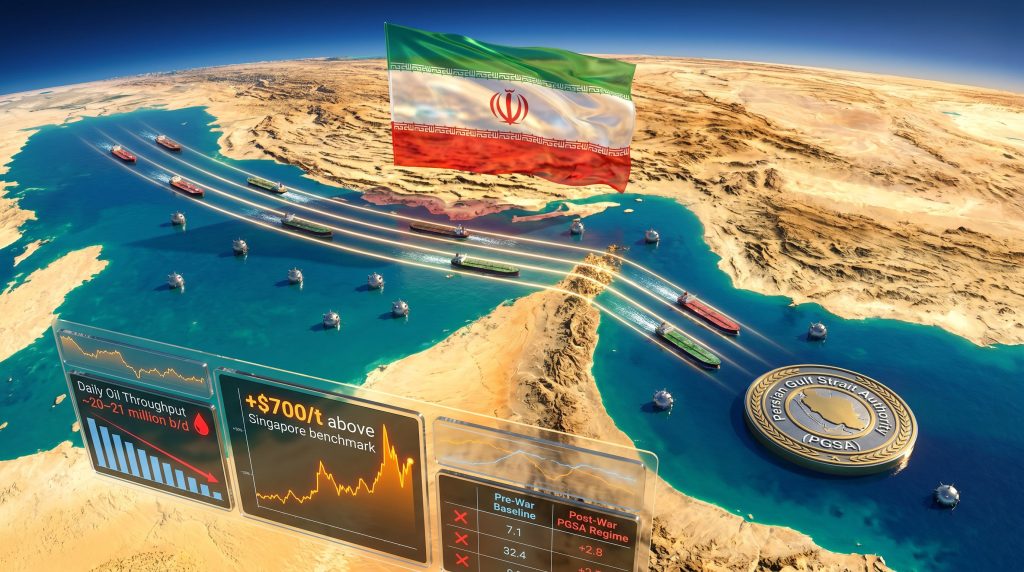
Before the 2026 conflict reshaped its operational character, roughly 20 to 21 million barrels of oil and petroleum liquids per day transited this corridor, representing approximately 20 to 21 percent of global petroleum consumption. Qatar, the world's largest LNG exporter, routes its entire seaborne LNG output through the strait. Furthermore, Kuwait, the UAE, Saudi Arabia, and Iraq depend on it for crude and refined product exports. There is no realistic substitute at scale. Saudi Arabia's East-West Pipeline and the UAE's Habshan-Fujairah overland pipeline provide partial redundancy, but combined they fall far short of replacing Hormuz-dependent volumes under any credible closure scenario.
Jurisdictional Architecture: Who Governs the Strait
The strait straddles the territorial waters of Iran to the north and Oman to the south. Under the United Nations Convention on the Law of the Sea (UNCLOS), the waterway qualifies as an international strait used for international navigation, a classification that triggers a specific and powerful legal framework. As Britannica outlines, no single nation owns the strait outright, which sits at the heart of the current governance dispute.
Legal Foundation: UNCLOS Articles 37 through 44 establish that all ships and aircraft enjoy the right of transit passage through internationally designated straits. This right cannot be suspended, restricted, or subjected to fees by any coastal state under any circumstances, regardless of geopolitical context.
This is a critical and frequently misunderstood distinction. Transit passage rights are fundamentally stronger than innocent passage rights, which apply to ordinary territorial seas and which coastal states can suspend under defined conditions. Iran's northern shore position gives it military proximity and enforcement capacity, but it does not confer legal ownership or administrative authority over the waterway.
How Iran Established De Facto Control of the Strait of Hormuz in 2026
Escalation Timeline: From Military Proximity to Institutional Governance
The US-Iran conflict, which commenced on 28 February 2026, immediately triggered Iranian operational responses targeting maritime traffic in the strait. Within weeks, commercial transits had fallen by approximately 95 percent below pre-war levels as Iran's Islamic Revolutionary Guard Corps Navy (IRGCN) leveraged its northern shore position to interdict vessel movement. Mine deployment and vessel inspections converted what had been a freely navigable international corridor into a permissioned chokepoint.
What distinguishes the 2026 episode from previous Iranian threats against Hormuz is the degree to which Tehran moved to institutionalise its control rather than simply exercise it as a wartime tactic. In May 2026, Iran formally established the Persian Gulf Strait Authority (PGSA), a maritime regulatory body designed to convert military leverage into permanent administrative architecture. The Venezuela oil policy shift earlier in 2025 had already demonstrated how quickly Washington's geopolitical posture could reshape global supply dynamics, and the Hormuz situation now represented an even more consequential test of that pattern.
The PGSA: Architecture of a Permissioned Corridor
The PGSA operates across a supervisory zone of roughly 22,000 square kilometres. Vessels seeking passage have been required to navigate a structured compliance framework:
- Submit advance permit applications to PGSA authorities
- Undergo security inspections prior to being granted transit clearance
- Coordinate passage timing with Iranian maritime officials
- In certain cases, remit fees via Iran's "Hormuz Safe" cryptocurrency platform
Iranian parliamentary speaker and top negotiator Mohammad Bagher Ghalibaf was unambiguous on the permanence of this arrangement, stating publicly that the administration of the strait would never return to its pre-war character and that Iran would manage it going forward. He also confirmed that coordination mechanisms, including a hotline and a joint contact centre, had been agreed with the United States to resolve transit disputes.
The PGSA has reportedly engaged with hundreds of vessels seeking passage permits since its establishment, suggesting the institution has moved beyond symbolic posturing toward operational functionality.
Pre-War vs. Post-PGSA Transit Conditions
| Metric | Pre-War Baseline | Post-PGSA Regime |
|---|---|---|
| Daily oil throughput | ~20-21 million b/d | Severely reduced; partial recovery post-deal |
| Permit requirement | None (free transit) | Mandatory PGSA permit application |
| Transit fees | None | Charged via Hormuz Safe crypto platform |
| Security inspection | None | Required prior to transit |
| Legal basis | UNCLOS transit passage | Iran claims domestic authority; internationally disputed |
| Full closure events | None in recent history | Multiple closures and reimpositions during 2026 |
Iran's Control of the Strait of Hormuz: The International Law Dimension
Where Iran's Framework Collides With UNCLOS
Iran's PGSA regime conflicts with established international maritime law at multiple pressure points. UNCLOS Articles 37 through 44 are unambiguous: the right of transit passage through internationally designated straits shall not be impeded, and measures adopted by bordering states must not have the practical effect of denying, hampering, or impairing that right. However, as explored in depth by international law scholars, whether Iran possesses any legitimate legal basis for its current PGSA regime remains a matter of acute debate.
| Aspect | UNCLOS Standard | Iran's PGSA Practice | Legal Compatibility |
|---|---|---|---|
| Passage rights | Non-suspendible transit passage | Permit-based permission system | Incompatible |
| Toll collection | Prohibited | Fees via crypto platform | Incompatible |
| Vessel inspection | Not a permitted transit condition | Mandatory | Incompatible |
| Traffic regulation | Permitted for safety purposes only | Deployed as control mechanism | Contested |
| Sovereignty claims | Shared coastal state jurisdiction | Iran asserts primary authority | Disputed |
The Innocent Passage Misapplication
A lesser-known but analytically important aspect of Iran's legal positioning involves its attempt to justify PGSA controls through the doctrine of innocent passage. This argument fails on a fundamental jurisdictional point: innocent passage applies to a state's territorial sea where vessels have no special protection against suspension. International straits, by contrast, are governed by the transit passage regime, a wholly separate and stronger legal framework that was specifically designed to prevent coastal states from exploiting geographic position to control commercially vital waterways.
International maritime law scholars broadly regard Tehran's invocation of innocent passage in this context as a deliberate misapplication of treaty law rather than a good-faith legal interpretation. The Strait of Hormuz has been internationally designated as a transit passage strait, and no unilateral recharacterisation changes that status.
Oman's Role and the Joint Working Group
The Southern Shore Factor
Oman controls the strait's southern shore and holds sovereign jurisdiction over the southern shipping lane. Unlike many regional states, Oman has historically maintained a carefully neutral diplomatic posture, sustaining functional relationships with Iran, the United States, and Gulf Cooperation Council members simultaneously.
In June 2026, Oman's Foreign Minister Badr Albusaidi publicly affirmed his country's commitment to international law and toll-free safe passage following bilateral discussions with Tehran. This statement matters beyond diplomatic protocol: Oman's cooperation is structurally necessary for any permanent governance framework because vessels must transit both the Iranian-controlled northern lane and the Omani-administered southern lane to complete passage.
The Iran-Oman Working Group: Opportunity or Cover?
Iran and Oman agreed in June 2026 to form a joint working group tasked with negotiating the future administration of strait navigation, the services to be provided to transiting vessels, and the costs associated with those services in accordance with international standards.
Policy Ambiguity Alert: The phrase "costs associated with services in accordance with international standards" represents one of the most consequential pieces of diplomatic language to emerge from the 2026 conflict. International law prohibits transit tolls, but it does not prohibit charges for genuine navigational services such as pilotage, vessel traffic management, or emergency assistance. How the working group defines the boundary between prohibited tolls and permissible service fees will determine whether Iran's PGSA is legitimised or dismantled.
This distinction is not merely academic. Several international precedents exist for legitimate service fee structures in congested waterways, including the Panama Canal's vessel measurement and booking system. Iran may consequently attempt to restructure PGSA fees as service charges under this framework, creating a commercially equivalent outcome to tolling while maintaining a veneer of UNCLOS compliance.
The US-Iran Interim Deal: Key Provisions Reshaping Hormuz Governance
The June 2026 Memorandum of Understanding
The US-Iran interim agreement, formalised on 18 June 2026, included specific commitments relating to Hormuz transit:
- Iran committed to ensuring the movement of vessels between the Persian Gulf and the Gulf of Oman
- Commercial traffic was to recover to pre-war levels within 30 days (targeting approximately 18 July 2026)
- Iran retained the right to clear mines and remove military obstacles, implicitly acknowledging its role in creating them
- Iran agreed not to charge transit tolls for at least the initial 60-day negotiation period
- A hotline and joint coordination centre between US and Iranian authorities was established to manage transit disputes
The broader trade war oil impacts already reshaping energy markets added another layer of complexity to these negotiations, as both Washington and Tehran weighed the economic costs of prolonged disruption against their respective negotiating positions.
The OFAC General License: What It Actually Permits
On 22 June 2026, the US Treasury's Office of Foreign Assets Control issued a general license authorising unlimited sales of Iranian crude, refined, and petrochemical products until 21 August 2026. The scope of the license is notably broad:
- Buyers may transact in US dollars
- All shipping-related services are covered, including vessel management, crewing, bunkering, piloting, registration, flagging, insurance, and salvage
- Iranian oil may be imported into the United States for subsequent trans-shipment
- The license waives sanctions on buyers but does not lift sanctions on Iranian sellers
The 60-day license window precisely aligns with the negotiation period established under the US-Iran memorandum of understanding, covering discussions on Iran's nuclear programme, Hormuz governance, and broader regional security arrangements. An extension is possible if negotiations progress; however, a breakdown could trigger early termination and sanctions snapback.
One underappreciated dimension of the OFAC license is the buyer-seller asymmetry it creates. By protecting buyers but not sellers, it incentivises Chinese state-controlled refiners and Indian buyers to explore Iranian purchases while preserving US leverage over Tehran. Prior to the conflict, Iranian crude flowed predominantly to Chinese independent refiners willing to operate under sanction risk. The license structure is designed to broaden that buyer base substantially, which would accelerate the market normalisation Iran needs to sustain its economic position.
The next major ASX story will hit our subscribers first
Commodity Market Impacts: The Cascading Effects of Hormuz Disruption
The Fujairah Bunker Market: An Extreme Case Study
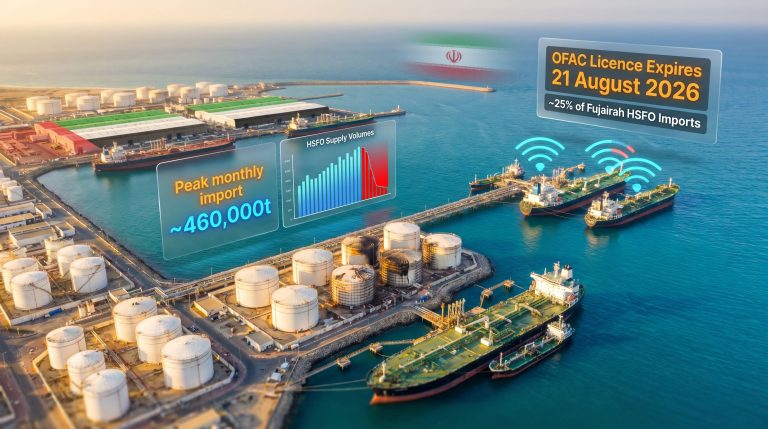
The Fujairah bunkering hub, which serves as the primary marine fuel supply centre for vessels transiting the strait, experienced supply dislocations of unprecedented severity during the 2026 conflict. Iranian HSFO had previously accounted for approximately 25 percent of all Fujairah imports, or around 70,000 barrels per day, based on data from oil analytics firm Vortexa. The complete cessation of these flows created an acute regional supply shortage.
Fujairah VLSFO bunker premiums against Singapore cargo benchmarks reached an extraordinary $700 per tonne in early June 2026, against a normal range of just $5 to $15 per tonne. Emergency cargo arrivals, including a 100,000-tonne low-sulphur fuel oil shipment from Nigeria's Dangote refinery on 20 June, provided partial relief, but premiums remained above $300 per tonne as of late June due to freight netback dynamics and continued security uncertainty.
A complicating factor for Fujairah's recovery is structural rather than simply logistical. When Iranian HSFO flows eventually resume in volume, the market will not simply revert to 2025 dynamics. Asian refiners with sophisticated secondary processing units are expected to compete aggressively for Iranian straight-run fuel oil as an economical cracking feedstock, potentially pricing regional bunker blenders out of the market. The post-sanctions Iranian HSFO will not trade at the steep discounts that previously made it attractive to Fujairah buyers; legitimate pricing under sanctions relief will compress that arbitrage significantly.
For the VLSFO sector specifically, Fujairah's supply recovery remains anchored to consistent output from Kuwait's 615,000 barrel per day Al-Zour refinery, the largest refinery in Kuwait's history. However, summer peak power demand in Kuwait is expected to constrain export volumes through at least the third quarter of 2026, as domestic utilities prioritise low-sulphur fuel oil for electricity generation and air conditioning over export commitments.
Sulphur and Fertilizer Markets: A Near-Total Supply Lockdown
The disruption to sulphur exports illustrates how broadly Hormuz closures cascade across non-energy commodity markets. Since hostilities began on 28 February 2026, only approximately 480,000 to 500,000 tonnes of sulphur exited the strait through mid-June 2026, representing roughly 10 percent of the normal regional export rate. The region is among the world's most significant sulphur-producing areas, with major output from UAE refining operations at Ruwais, Qatar's Ras Laffan complex, and Kuwait's Al-Zour facility.
Following the peace deal, a number of vessels confirmed transit:
- Espada (88,300 DWT): Ruwais to Jorf Lasfar, Morocco (ETA 18 July)
- MV Toro (55,000 DWT): Ruwais to Aqaba, Jordan (ETA 28 June)
- Yan Dang Shan (63,300 DWT): Ruwais to Indonesia
- Xin Qi Men (81,600 DWT): Ruwais to China
- Nejat (38,000 DWT): Ras Laffan, Qatar to Bahodopi, Indonesia
Despite these initial movements, confusion over PGSA permit requirements forced several vessels attempting transit on 17 and 18 June to turn back without completing passage, illustrating the operational friction that the new governance framework introduces even in a nominal post-conflict environment.
An estimated 500,000 tonnes of sulphur remained aboard vessels in or near the strait as of mid-June, much of it committed under prior contracts. The downstream implications for global fertilizer supply chains, which depend on sulphur as a feedstock for sulphuric acid and ultimately phosphate fertilizers, extend well beyond the immediate shipping disruption.
Broader Commodity Market Snapshot
| Market | Key Impact | Metric |
|---|---|---|
| Fujairah VLSFO bunkers | Acute supply shortage; record premiums | Peak $700/t above Singapore benchmark |
| Iranian HSFO (Fujairah) | Supply cut off; cautious recovery outlook | Was 25% of Fujairah imports (~70,000 b/d) |
| Sulphur exports (regional) | ~90% reduction in normal export volumes | ~480,000-500,000t exited since Feb 2026 |
| WTI crude futures | Sharp correction on easing tensions | Down 17% since 1 June 2026 |
| Nymex ULSD (diesel) | Declining from conflict-era highs | Down 14% since 1 June 2026 |
| Premium thermal coal | Demand surge from gas supply disruption | Rose from $117/t (Feb) to $142/t (early April 2026) |
In addition, the LNG supply outlook for the region has been materially affected, given that Qatar's entire seaborne LNG output remains contingent on safe and unimpeded transit. Furthermore, the US-China trade war impacts have compounded price volatility across energy markets, as Chinese demand assumptions shift in response to both tariff pressures and the uncertainty surrounding Hormuz access.
Three Scenarios for the Future of Hormuz Governance
Forward Pathways: How This Could Resolve
Scenario 1: Negotiated Normalisation (Base Case)
Iran and Oman formalise the joint working group into a standing maritime coordination authority. The PGSA is restructured to provide navigation services with fee structures argued as consistent with UNCLOS. Traffic recovers toward pre-war levels; commodity markets gradually restabilise. Iran retains administrative influence while nominally respecting international law.
Scenario 2: Sustained Iranian Administrative Control (Elevated Risk)
The PGSA remains fully operational beyond the 60-day interim period. Iran leverages the institutional framework to maintain de facto permit authority even without explicit toll collection, substituting service fees and scheduling authority as control mechanisms. Long-term uncertainty suppresses shipping insurance rates and discourages vessel operators not covered by the OFAC license framework.
Scenario 3: Breakdown and Reimposition (Tail Risk)
US-Iran negotiations collapse over nuclear programme disagreements or regional incidents. Sanctions snapback is triggered before the 21 August OFAC license expiry. Iran reimplements strait closures and potentially renewed mining operations. Global oil prices spike sharply, and any oil price rally of that magnitude would reverberate across already strained energy markets. Alternative routing via Saudi Arabia's East-West Pipeline and the UAE's Habshan-Fujairah pipeline cannot substitute Hormuz-dependent volumes at scale.
The Structural Constraints on Iranian Control
Iran's grip on the strait is operationally significant but structurally fragile. Three forces work against its long-term sustainability:
- Legal attrition: International pressure through UNCLOS dispute resolution mechanisms and diplomatic isolation among non-aligned shipping nations will accumulate over time
- Military capacity erosion: Iranian naval assets sustained losses during the 2026 conflict, reducing the IRGCN's ability to sustain enforcement operations across the entire supervisory zone
- Economic self-interest: Iran's own crude oil and petrochemical export revenues depend entirely on open Hormuz passage, creating a fundamental tension between geopolitical leverage and economic survival
Iran's Hormuz strategy is best understood not as a closure threat but as a leverage manufacturing mechanism: converting a waterway it cannot permanently close into a negotiating instrument it can repeatedly activate. The PGSA is the institutional infrastructure for that strategy.
Frequently Asked Questions: Iran and the Strait of Hormuz
Can Iran legally close the Strait of Hormuz?
Under UNCLOS, Iran has no legal authority to suspend or impede transit passage through the Strait of Hormuz. The waterway's classification as an international strait confers non-suspendible transit passage rights on all vessels under Articles 37 through 44. Iran's practical military capacity to enforce closures does not translate into legal entitlement to do so.
What is the Persian Gulf Strait Authority?
The PGSA is a maritime regulatory body established by Iran in May 2026 to formalise administrative control over Hormuz transit. It requires vessels to obtain permits, submit to inspections, and in certain cases pay fees. International maritime law experts broadly consider its toll and permit requirements to fall outside any valid legal basis under UNCLOS.
Does Oman support Iran's administrative control?
Oman controls the strait's southern shore and has publicly affirmed its commitment to international law and toll-free safe passage. While Oman agreed to participate in a joint working group with Iran, its stated position aligns with UNCLOS obligations rather than endorsing Tehran's unilateral authority claims.
What happens to global oil supply if the strait is closed?
A sustained closure would remove approximately 20 to 21 million barrels per day of oil and petroleum liquids from global supply chains. Alternative routing options cannot substitute this volume in any near-term scenario, making Hormuz effectively irreplaceable for Persian Gulf exporters. Consequently, Iran control of the Strait of Hormuz remains the single most consequential variable in global energy security assessments for 2026 and beyond.
How long does the current US sanctions waiver last?
The OFAC general license issued on 22 June 2026 permits unlimited Iranian oil sales until 21 August 2026, a 60-day window aligned with the US-Iran negotiation period. Extensions depend on negotiation progress; a breakdown in talks could trigger early termination and full sanctions reimposition.
Disclaimer: This article contains forward-looking analysis, scenario projections, and assessments of geopolitical risk. These represent analytical frameworks based on publicly available information as of the date of publication and should not be construed as investment advice. Commodity markets, geopolitical conditions, and legal frameworks referenced herein are subject to rapid change.
Want to Stay Ahead of the Next Major Commodity Market Shift?
Geopolitical disruptions like the Strait of Hormuz governance crisis can reshape commodity markets overnight — and Discovery Alert's proprietary Discovery IQ model delivers real-time ASX mineral discovery alerts, ensuring subscribers can identify actionable opportunities the moment they emerge. Explore how historic mineral discoveries have generated substantial returns and begin your 14-day free trial today to position yourself ahead of the next major market move.