June 24, 2026
The Geological Blind Spot That Has Defined American Industrial Vulnerability
For most of the past half century, the United States has accepted a structural paradox at the heart of its industrial economy: a nation capable of landing humans on the moon and building the world's most sophisticated military hardware has remained almost entirely dependent on tropical ore deposits it does not own, located in countries it does not control, processed in refineries it did not build. That paradox is alumina, and it sits at the centre of every aluminum product manufactured in America today.
The conventional aluminum production pathway begins with bauxite, a laterite ore formed through millions of years of intense tropical weathering. Bauxite is refined into alumina through the Bayer Process, a century-old chemical method that dissolves aluminum-bearing minerals in hot caustic soda to separate alumina from silica and iron impurities. Alumina is then smelted into primary aluminum metal via electrolytic reduction, the Hall-Heroult process, in enormously energy-intensive facilities. The first two stages of this chain have historically occurred almost entirely outside U.S. borders. The Brimstone Century Aluminum mine to metal aluminum supply chain partnership, formalised through a Memorandum of Understanding in June 2026, represents the most serious structural challenge to that dependency in over five decades.
When big ASX news breaks, our subscribers know first
Why Bauxite Has Always Been America's Achilles Heel
The Geology of the Problem
Bauxite forms in humid tropical and subtropical climates where intense chemical weathering over geological time strips away silica and other minerals, leaving behind aluminum hydroxide-rich residues. The continental United States simply does not possess this geological history at the surface in economically viable concentrations. The Southeast contains some bauxite-bearing formations, but grades and volumes fall far short of what industrial primary aluminum production requires.
This is not a policy failure or an investment shortfall. It is a geological reality. The implication is profound: any domestic U.S. alumina refining strategy must either import bauxite from overseas or find an entirely different feedstock. For more than 50 years, the industry chose the former. Brimstone is attempting the latter. Furthermore, global bauxite production remains heavily concentrated in a handful of tropical nations, reinforcing just how structurally exposed American industry has become.
What Makes Calcium-Bearing Silicate Rock Different
The feedstock Brimstone uses is not a rare or exotic material. Calcium-bearing silicate rocks, including minerals such as wollastonite, anorthosite, and related calcium-aluminum silicate formations, are distributed widely across the continental United States. They are not tropical weathering products. They are igneous and metamorphic rocks formed through entirely different geological processes, and they are abundant in states ranging from Nevada to Oklahoma to the broader Appalachian and Rocky Mountain belts.
The chemical challenge is extracting aluminum oxide from a silicate matrix, which is considerably more complex than extracting it from the hydroxide-rich matrix of bauxite. This is precisely why no commercial-scale silicate-to-alumina process existed before Brimstone's development work. The Bayer Process was optimised for bauxite over a century of industrial refinement. Brimstone's innovation is developing an entirely new chemical pathway suited to a fundamentally different feedstock geology.
Technical Note: Smelter-grade alumina must meet strict purity specifications, typically exceeding 99.35% Al₂O₃ content, with tightly controlled limits on sodium, silica, iron, and other trace elements. Achieving these specifications from a silicate feedstock rather than a bauxite input represents a non-trivial metallurgical and chemical engineering challenge. The Reno demonstration plant's primary purpose is validating that Brimstone's process consistently meets these industrial-grade purity thresholds at commercial throughput volumes.
The Co-Production Architecture: Economics Built Into the Chemistry
One of the least widely understood aspects of Brimstone's process is its co-production model. Unlike a conventional Bayer refinery, which produces alumina as its singular output alongside a problematic red mud waste stream, Brimstone's silicate-based chemistry generates three distinct industrial products from a single feedstock input.
| Output Product | Primary Market | Strategic Value |
|---|---|---|
| Smelter-Grade Alumina | Primary aluminum smelters (Century Aluminum) | Core supply chain objective |
| Portland Cement | Construction, infrastructure | Revenue diversification |
| Supplementary Cementitious Materials (SCMs) | Concrete production, lower-carbon construction | Growing premium market |
This co-production structure carries significant economic implications. Conventional alumina refineries bear their entire capital and operating cost burden against a single product stream. Brimstone's model, however, distributes those costs across three revenue streams simultaneously. In regions where Portland cement commands strong pricing and SCMs carry a green construction premium, the effective cost of alumina production may be meaningfully lower on a net basis than a single-output comparison would suggest.
The cement co-production angle also intersects with a growing construction materials market dynamic. Supplementary cementitious materials are increasingly valued in green building specifications and infrastructure procurement frameworks where embodied carbon is being scrutinised. This creates a potential demand tailwind for Brimstone's non-alumina output streams that did not exist a decade ago.
Mapping the Supply Chain: From Silicate Rock to Primary Metal
The Brimstone Century Aluminum mine to metal aluminum supply chain concept is best understood as a four-node industrial system, with each stage occurring within U.S. jurisdiction.
- Domestic feedstock extraction: Calcium-bearing silicate rock is quarried from U.S. geological deposits, eliminating international shipping of raw ore.
- Alumina refining at Brimstone's facility: The silicate feedstock is processed through Brimstone's proprietary chemical pathway to produce smelter-grade alumina alongside cement co-products.
- Electrolytic reduction at Century Aluminum smelters: Alumina is delivered to Century's U.S. facilities, where it undergoes Hall-Heroult electrolysis to produce primary aluminum metal.
- Downstream manufacturing supply: Primary aluminum metal enters U.S. manufacturing supply chains for defence, aerospace, automotive, packaging, and infrastructure applications.
Century Aluminum's Smelting Infrastructure
Century Aluminum operates as the largest primary aluminum producer in the United States. Its smelting network provides the downstream anchor for any domestic alumina supply initiative. In addition, major aluminium mining companies globally are watching this development closely as it signals a potential shift in how integrated supply chains are structured.
| Facility | Location | Approximate Capacity |
|---|---|---|
| Sebree Smelter | Kentucky | ~220,000 metric tonnes/year |
| Hawesville Smelter | Kentucky | Significant operating capacity |
| Mt. Holly Smelter | South Carolina | Recently expanded, adding ~10% to U.S. output |
Century currently sources a portion of its alumina requirements through its 55% joint venture stake in Jamalco, a Jamaican alumina refinery processing Caribbean bauxite. While this arrangement provides partial supply security relative to fully spot-market dependence, it still exposes Century to Caribbean weather disruptions, Jamaican regulatory shifts, international freight cost volatility, and currency risk. The Brimstone partnership consequently offers a pathway toward replacing that offshore exposure with a fully domestic, contract-backed supply relationship.
Development Milestones and What Investors Should Watch
The timeline for the Brimstone Century Aluminum mine to metal aluminum supply chain to reach industrial scale spans roughly eight years from the MOU signing, with two distinct validation phases.
Phase 1: Commercial Demonstration Plant, Reno, Nevada (Target: 2028)
The Reno facility is designed to prove the silicate-to-alumina chemistry at genuine commercial throughput, not just laboratory or pilot scale. This is the critical de-risking step for the entire programme. Investors and potential offtake partners will watch this facility closely for evidence that:
- Alumina purity specifications are consistently met across varied silicate feedstock batches
- Process energy intensity is competitive with conventional Bayer refining benchmarks
- Co-product quality meets market specifications for Portland cement and SCMs
- Capital and operating cost assumptions from feasibility modelling hold under real operating conditions
Phase 2: Industrial-Scale Plant, Oklahoma (Target: 2034)
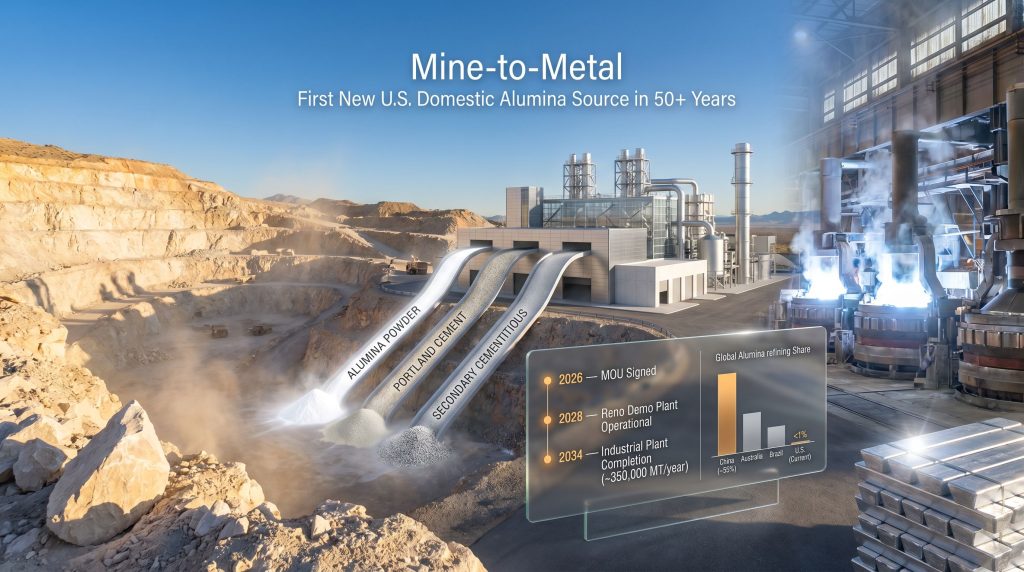
The full-scale facility, with Oklahoma identified as a leading site candidate, targets annual production of approximately 350,000 metric tonnes of smelter-grade alumina. To put this in context, global alumina refining capacity exceeds 140 million metric tonnes annually, with China alone accounting for roughly 55% of that total. Brimstone's initial industrial plant would represent a small but symbolically critical contribution to U.S. domestic capacity, establishing a replicable platform that could be scaled across additional sites if the economics prove out.
Timeline at a Glance:
- June 2026: MOU signed between Brimstone and Century Aluminum
- 2028: Reno commercial demonstration plant operational
- 2034: Oklahoma industrial-scale plant completion (target)
The Global Alumina Concentration Problem
The strategic rationale for domestic U.S. alumina production becomes clearest when viewed against the global refining landscape. For instance, the leading bauxite mines globally are overwhelmingly concentrated in regions far removed from American industrial centres, compounding logistical and geopolitical vulnerabilities.
| Country/Region | Estimated Share of Global Alumina Refining | Key Risk Factors for U.S. |
|---|---|---|
| China | ~55% | Export controls, trade policy escalation |
| Australia | ~15% | Shipping distance, energy cost exposure |
| Brazil | ~10% | Political risk, logistics complexity |
| Jamaica and Caribbean | ~3-4% | Weather disruption, political volatility |
| United States (current) | Less than 1% | Near-total import dependency |
This concentration means U.S. aluminum smelters are structurally exposed to supply disruptions originating in geopolitical environments ranging from Beijing trade policy decisions to South American political cycles to Atlantic hurricane seasons. Furthermore, US aluminium tariffs have already demonstrated how rapidly trade policy shifts can expose the fragility of import-dependent supply chains. The Brimstone model does not immediately close this gap, but it establishes the foundational domestic production infrastructure that has been entirely absent since the 1970s.
The next major ASX story will hit our subscribers first
Risks That Remain Real and Material
No serious analysis of this partnership should minimise the execution challenges that remain ahead. Indeed, the tariff impacts on bulk commodities have already illustrated how external shocks can rapidly destabilise even well-established industrial supply chains, underscoring why domestic solutions carry genuine strategic urgency.
- Technology validation: Brimstone's silicate-to-alumina process has not yet been operated at sustained commercial throughput. The 2028 Reno demonstration plant is explicitly designed to answer whether the chemistry scales as expected.
- Capital requirements: Industrial-scale alumina refineries are capital-intensive assets. Securing project financing at terms that preserve acceptable economics will require demonstrated performance from the Reno facility and a robust offtake framework.
- Energy cost sensitivity: Aluminum smelting ranks among the most electricity-intensive industrial processes in existence, consuming roughly 13–15 megawatt hours per metric tonne of primary metal. Century's smelting economics remain acutely sensitive to U.S. electricity price trajectories.
- Eight-year execution horizon: A 2034 industrial plant target represents a long development runway during which commodity prices, trade policy, competitive dynamics, and financing conditions can shift substantially.
Disclaimer: This article contains forward-looking information including project timelines, production targets, and market projections. These represent current expectations and are subject to material risks and uncertainties. Readers should not rely on forward-looking statements as indicators of future performance.
The Demand Tailwind That Makes the 2034 Target Relevant
Aluminum demand is broadly projected to grow through the 2030s, driven by three converging structural forces: electric vehicle adoption, which uses significantly more aluminum per vehicle than conventional internal combustion platforms; renewable energy infrastructure buildout, where aluminum features extensively in solar panel frames, wind turbine components, and transmission hardware; and grid modernisation investment, which relies on aluminum conductors as a cost-effective alternative to copper in many transmission applications.
If Brimstone's industrial plant reaches its 2034 production target, it would enter service at a point when U.S. aluminum demand growth may be at or near its steepest trajectory. Domestic sourcing preferences in defence and infrastructure procurement are also likely to be more entrenched than they are today. The timing, whilst ambitious, is consequently not commercially arbitrary.
Key Facts: Brimstone Century Aluminum Mine to Metal Supply Chain
| Dimension | Detail |
|---|---|
| Agreement Type | Memorandum of Understanding |
| Signed | June 2026 |
| Alumina Innovator | Brimstone |
| Smelting Partner | Century Aluminum (largest U.S. primary producer) |
| Feedstock | Calcium-bearing silicate rock (domestic U.S. geology) |
| Bayer Process Required | No |
| Co-Products | Portland cement, supplementary cementitious materials |
| Demonstration Plant | Reno, Nevada, target 2028 |
| Industrial Plant Target Capacity | ~350,000 metric tonnes/year alumina |
| Industrial Plant Target Date | 2034 |
| Industrial Plant Leading Location | Oklahoma |
| Strategic Significance | First new domestic U.S. alumina source in over 50 years |
The Brimstone Century Aluminum mine to metal aluminum supply chain initiative is not a marginal supply chain adjustment. It is an attempt to solve a geological and industrial problem that the United States has not seriously confronted in more than half a century, using a chemical process that did not commercially exist five years ago, with an offtake partner that represents the backbone of American primary aluminum production. Whether the demonstration plant validates the promise of the technology will be the most consequential test for domestic aluminum supply chain independence in a generation.
Want To Stay Ahead of the Next Major ASX Mineral Discovery?
Discovery Alert's proprietary Discovery IQ model delivers real-time alerts on significant ASX mineral discoveries, transforming complex geological and commodity data into actionable investment insights for both short-term traders and long-term investors. Explore how historic discoveries have generated substantial returns by visiting Discovery Alert's dedicated discoveries page, and begin your 14-day free trial today to position yourself ahead of the broader market.