
June 24, 2026
When Communities Win in Court, the Battle Is Often Just Beginning
Across Southeast Asia's resource-rich landscapes, a quiet but consequential shift is underway. Affected communities are no longer passive observers in the permitting processes that determine whether mines are built beside their homes, farms, and water sources. Armed with legal frameworks, international advocacy networks, and growing judicial precedent, local populations are mounting formal challenges that are reshaping how mining governance operates at the intersection of capital, sovereignty, and human rights.
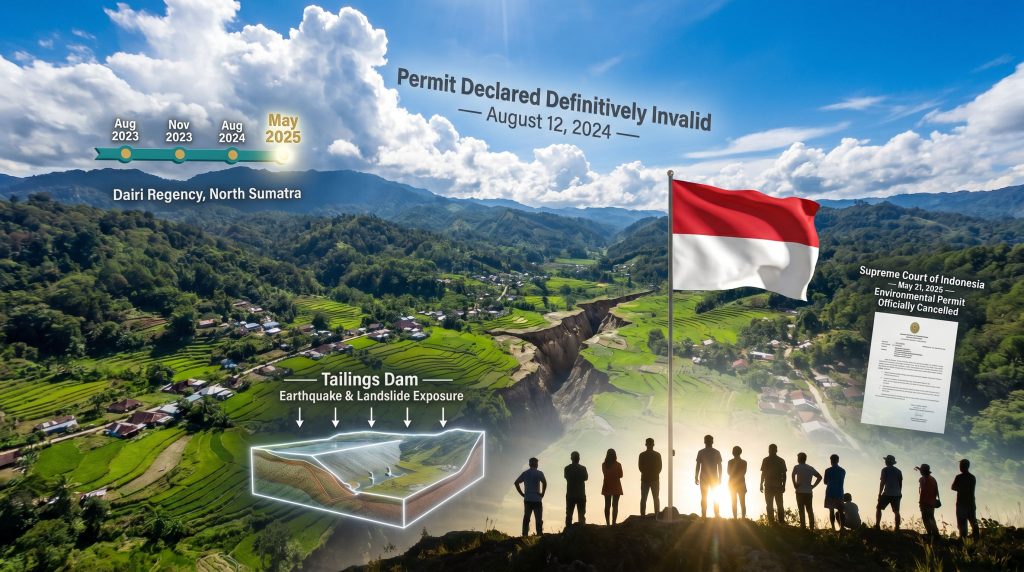
Nowhere is this shift more visible than in the PT Dairi Prima Mineral zinc mine permit dispute in North Sumatra, a legal battle that has wound through Indonesia's court system, reached the nation's Supreme Court, and is now entering a second contested chapter despite a definitive judicial ruling in favour of the affected communities.
When big ASX news breaks, our subscribers know first
Understanding the Dairi Zinc-Lead Project: Scale, Location, and Strategic Dimensions
The proposed mine sits within Silima Pungga-pungga district, Dairi Regency, North Sumatra, a predominantly rural area where agricultural livelihoods, dense village settlement patterns, and proximity to active tectonic structures define the physical and social landscape. The zinc and lead deposit targeted by PT Dairi Prima Mineral (PT DPM) represents one of the more substantial base metal development opportunities in Sumatra, which partly explains why the operator has pursued permitting through multiple pathways despite sustained opposition.
Zinc is an industrial workhorse. It underpins galvanisation processes that protect steel from corrosion, feeds into battery technology supply chains, and serves as a critical input across construction and manufacturing sectors. Lead, while facing long-term demand headwinds from the energy transition, retains significant industrial utility. Together, the Dairi deposit's strategic value was sufficient to attract China Nonferrous Metal Industry's Foreign Engineering and Construction Co. Ltd. (NFC), a Chinese state-linked enterprise with an extensive international footprint in mining and metals infrastructure.
That involvement immediately elevated the dispute beyond a routine domestic regulatory disagreement. When Chinese state-linked capital backs a project that faces community opposition in a country navigating its own democratic and environmental governance evolution, the dynamics extend into mining geopolitics that purely domestic disputes rarely reach.
The 2022 Permit and the Regulatory Architecture That Enabled It
To understand why the original environmental permit became so contested, it is necessary to understand the regulatory framework under which it was issued. Indonesia's Job Creation Law (Law No. 11 of 2020), commonly referred to as the Omnibus Law, substantially restructured the country's investment approval architecture. Designed to accelerate foreign and domestic investment by consolidating permits and reducing procedural friction, the law reformed the environmental impact assessment system in ways that critics argued weakened community participation rights and narrowed the scope of independent environmental scrutiny.
Under this framework, Indonesia's Ministry of Environment and Forestry issued a revised environmental permit to PT DPM in 2022, authorising mine development to proceed. Civil society organisations and affected communities responded almost immediately, arguing that the new permitting architecture had been used to bypass the consultation standards that existed under prior regulations.
The tension embedded in that argument is genuinely significant. Indonesia has constitutional environmental protection obligations that predate the Omnibus Law, and the question of whether a streamlined investment approval mechanism can override those obligations was precisely what the Dairi litigation would ultimately force the courts to answer. The mining claims framework in other jurisdictions demonstrates how similar tensions between investment efficiency and community rights can reshape entire regulatory systems.
The Community Legal Challenge: Procedural Grounds and Constitutional Principles
In February 2023, a coalition of 11 local villagers, the majority of them women farmers whose livelihoods and homes lay downstream of the proposed tailings storage facility, filed a formal administrative lawsuit against the Ministry of Environment and Forestry. The plaintiffs were represented through civil society support networks and argued their case on three interrelated grounds:
- The environmental impact assessment (AMDAL) process was procedurally deficient, failing to adequately model seismic and geological risks specific to the project site.
- The planned tailings storage facility was positioned within hundreds of metres of Sopokomil Village, on unstable volcanic soils with documented landslide susceptibility, representing an unacceptable structural risk to downstream populations.
- The consultation process violated the principle of Free, Prior, and Informed Consent (FPIC), a framework recognised under international indigenous and community rights conventions.
The participation of women farmers as lead plaintiffs in a formal administrative challenge against a nationally issued mining permit is not merely a procedural detail. It reflects the reality that in communities near proposed extractive projects, women who depend on land and water for subsistence agriculture often bear the most direct exposure to environmental risk, yet are typically the last to be meaningfully consulted.
FPIC as a legal concept deserves some unpacking for readers unfamiliar with its technical contours. The standard requires that affected communities receive genuinely complete and accessible information about a project's risks and impacts (informed), that consultation occurs before project decisions are made rather than after approvals are granted (prior), and that any agreement reached is entirely voluntary and free from coercion or manipulation (free). The Dairi plaintiffs argued that all three elements were absent, and the courts agreed.
The Legal Timeline: Court by Court, Ruling by Ruling
The judicial progression through Indonesia's administrative court system produced one of the most significant environmental permitting precedents in the country's recent legal history.
| Court Level | Date | Ruling | Outcome |
|---|---|---|---|
| Jakarta Administrative Court | August 2023 | Found for community plaintiffs | Permit declared invalid |
| High Administrative Court | November 2023 | Reversed lower court decision | Permit temporarily reinstated |
| Supreme Court of Indonesia | August 12, 2024 | Upheld original Administrative Court ruling | Permit definitively invalidated |
| Ministry of Environment and Forestry | May 21, 2025 | Formal regulatory action | Permit officially revoked |
The Supreme Court's August 2024 ruling was grounded in three core findings. First, the Ministry had failed to meet procedural standards for community participation before issuing the approval, meaning the permit was procedurally defective at the point of issuance. Second, the permitting process did not satisfy Indonesia's administrative law requirements for transparency and due process, constituting a violation of good governance principles. Third, the proposed tailings dam was assessed as posing an unacceptable structural threat given the site's documented exposure to earthquake and landslide hazards.
When the Ministry formally revoked the permit on May 21, 2025, it confirmed something with consequences far beyond this single project: environmental permits issued under the 2020 Omnibus Law framework are legally challengeable and reversible through judicial processes. That confirmation matters enormously for other communities across Indonesia watching similar disputes unfold at other project sites.
The Seismic and Geological Risk Profile: Why Location Is Everything in Tailings Management
The geological context of the Dairi project site is not incidental to the legal dispute. It is arguably the most technically decisive element in the entire case.
North Sumatra sits along the Sumatran Fault System, one of Southeast Asia's most seismically active tectonic structures. This right-lateral strike-slip fault runs approximately 1,900 kilometres along the spine of Sumatra and has generated numerous significant earthquakes throughout recorded history, including events exceeding magnitude 7.0. The Dairi Regency lies within the broader zone of seismic influence associated with this system.
Against that geological backdrop, the proposed tailings storage facility shared the following risk characteristics:
- Unstable volcanic soils with poor load-bearing capacity and drainage properties, inherited from the region's volcanic geology
- Positioning on slopes with documented susceptibility to mass movement events including landslides
- Downslope orientation relative to populated areas, meaning any structural failure would release tailings slurry directly toward residential communities
- Proximity within hundreds of metres to Sopokomil Village, eliminating meaningful buffer distance for emergency response
The global context for tailings dam risk is grim and instructive. The Brumadinho tailings dam failure in Brazil (January 2019) killed approximately 270 people when a dam storing iron ore processing waste collapsed suddenly, releasing a wave of toxic slurry across downstream communities. The Mount Polley failure in British Columbia, Canada (August 2014) released approximately 25 million cubic metres of tailings and mine water into a pristine wilderness watershed.
Both disasters occurred at sites where formal engineering assessments had been conducted and approvals granted, demonstrating that regulatory approval does not automatically translate to adequate risk management. Furthermore, the environmental concerns raised at comparable extractive projects globally underscore that communities facing proximity to tailings infrastructure have well-founded reasons to demand rigorous independent assessment.
Critics of the Dairi project argue that siting a tailings impoundment in a seismically active zone on unstable soils near populated areas represents a fundamental planning failure that engineering controls cannot fully mitigate. This position received implicit judicial validation in the Supreme Court's ruling.
Is the Backfill Method a Genuine Solution?
The next major ASX story will hit our subscribers first
2026 and the New Permit Application: A Technical Pivot Under Community Scrutiny
The period following the formal permit revocation should, in conventional narratives, represent the conclusion of the dispute. In practice, it represents the opening of a second chapter that may prove equally contentious.
Despite the Supreme Court ruling and the Ministry's formal revocation, PT Dairi Prima Mineral proposed a new environmental permit application in early 2026. The application incorporates a notable technical modification: a proposed shift from conventional tailings dam storage to a backfill method, in which processed mine waste is mixed into a paste or slurry and returned underground to fill the excavated voids created by mining operations.
The technical distinction between these two approaches is meaningful and worth examining carefully.
| Factor | Conventional Tailings Dam | Backfill Method |
|---|---|---|
| Waste storage location | Surface impoundment | Underground mine void |
| Structural failure risk | High in seismically active zones | Lower, but not eliminated |
| Land disturbance footprint | Significant surface area | Reduced surface impact |
| Community proximity risk | High where dams are near villages | Reduced but geology-dependent |
| Operational cost | Lower upfront capital | Higher due to paste preparation |
| Regulatory acceptance | Increasingly scrutinised globally | Gaining favour in high-risk zones |
| Seismic performance | Poor in active fault zones | Dependent on underground stability |
The backfill method does offer genuine risk reduction benefits compared to surface tailings impoundments, particularly in seismically active terrain. By removing the most catastrophically failure-prone element of the original design, PT DPM is making a technically defensible modification. However, community groups have identified several reasons why this technical pivot does not resolve the underlying dispute:
- Residents were reportedly not informed in advance of the new permit application and were denied access to supporting documentation, replicating the procedural failures that invalidated the original permit
- The seismic risk profile of the site itself has not changed, regardless of waste management methodology
- Underground workings in seismically active zones carry their own structural integrity risks that the backfill method does not eliminate
- The new application process is alleged by community organisations to be reproducing the consultation deficiencies that the Supreme Court ruled unacceptable
Whether a technical modification to waste management methodology can substitute for genuine procedural compliance in community consultation is precisely the question that will determine whether the new permit application survives legal scrutiny.
Consequently, the question of natural capital valuation becomes central: if the livelihoods, agricultural land, and water resources at risk are properly accounted for in project assessments, the calculus around acceptable risk thresholds shifts considerably.
International Pressure and the Role of Chinese State-Linked Capital
How Are Affected Communities Leveraging Global Networks?
The involvement of NFC in the Dairi project has given community advocates a lever that purely domestic disputes lack. Human rights organisations and local advocacy groups have escalated their campaign internationally, urging Beijing to direct NFC to withdraw financial support from the project given the ongoing community opposition and the judicial history of the original permit.
This mirrors patterns that have emerged at Chinese-backed resource projects in other jurisdictions, where affected communities have learned to leverage international media attention, diplomatic channels, and ESG-focused investor scrutiny to influence outcomes that domestic regulatory processes have not resolved to their satisfaction.
The effectiveness of such international pressure campaigns varies considerably by context, but the Dairi case's combination of a Supreme Court ruling, active community mobilisation, and prominent ESG concerns creates conditions where external attention may be more consequential than in typical disputes. In addition, civil society documentation of procedural failures — including the tailings dam risk assessment concerns raised through international human rights channels — has strengthened the credibility of community claims before both domestic courts and international audiences.
What the Dairi Case Means for Mining Operators, Investors, and Regulators
The implications of the PT Dairi Prima Mineral zinc mine permit dispute in North Sumatra extend well beyond the boundaries of Dairi Regency. For different stakeholders across the mining sector, the case delivers distinct and actionable signals:
For mining operators: Permits issued without rigorous FPIC compliance and independent, site-specific geophysical risk assessment are legally vulnerable in Indonesia, even under the post-2020 Omnibus Law framework. The Dairi case demonstrates that judicial review remains a viable mechanism for affected communities, and that procedural shortcuts at the permitting stage create downstream legal exposure that can invalidate years of project development investment.
For institutional investors: The case introduces a material risk framework that ESG-focused investors must incorporate into due diligence processes for Indonesian mining assets. Projects where community consultation has been compressed, documentation of FPIC compliance is weak, or geological risk assessments are site-inadequate carry elevated legal risk that can manifest in permit revocation years into the development cycle.
For regulators: The Supreme Court's ruling creates implicit pressure on the Ministry of Environment and Forestry to apply more rigorous procedural standards in high-risk geological zones. Approvals that survive a Dairi-style legal challenge will need demonstrably more thorough community consultation documentation and independent seismic risk assessment than the 2022 permit provided.
For affected communities: The case establishes a documented, replicable legal pathway for challenging mining permits through Indonesia's administrative court system when procedural standards have not been met. The three-court progression from the Jakarta Administrative Court through to the Supreme Court provides a template that other communities facing similar circumstances can now reference.
The Broader Question of Indonesia's Mining Governance Evolution
The Dairi dispute ultimately forces a question that Indonesia's political and regulatory establishment has not yet fully answered: can a streamlined investment approval architecture coexist with constitutionally grounded environmental protection obligations and internationally recognised community rights standards?
The 2020 Omnibus Law was designed to accelerate investment. However, the Supreme Court's Dairi ruling suggests that acceleration without procedural rigour produces permits that are legally fragile rather than commercially secure. For a country seeking to attract long-term capital into its substantial mineral resource base, that fragility is itself a risk factor for the broader investment climate.
Furthermore, the considerations around mine reclamation planning and post-operational accountability add another dimension to the governance challenge. Projects that cannot demonstrate credible rehabilitation commitments face compounding scrutiny from both regulators and community advocates.
The outcome of the new PT DPM permit application in 2026 will serve as a critical test of whether the Indonesian regulatory system has absorbed the lessons embedded in the Supreme Court's ruling, or whether the cycle of contested approvals and community litigation is set to repeat.
Disclaimer: This article is intended for informational purposes only and does not constitute legal, financial, or investment advice. References to ongoing legal proceedings and permit applications reflect information available at the time of writing and are subject to change. Readers are encouraged to consult primary legal and regulatory sources for current information on the PT Dairi Prima Mineral permitting status. Further coverage of the PT Dairi Prima Mineral zinc mine permit dispute in North Sumatra and related Indonesian mining governance developments is available through Mining Magazine at miningmagazine.com.
Want to Stay Ahead of Significant ASX Mineral Discoveries as Soon as They Hit the Market?
Discovery Alert's proprietary Discovery IQ model delivers real-time alerts on significant ASX mineral discoveries, instantly cutting through complex geological and commodity data to surface actionable opportunities — explore historic examples of major discovery returns to understand what early positioning can mean for a portfolio, and begin a 14-day free trial at Discovery Alert to gain a market-leading edge.