July 24, 2026
The Hardest Problem in Heavy Industry Decarbonisation
Across the global mining sector, one operational challenge has consistently resisted every clean energy solution thrown at it: the haul truck. These vehicles are not merely large pieces of machinery. They are the circulatory system of open-cut mining, running continuously across kilometre-long ramps, carrying payloads that would fill multiple Olympic swimming pools, operating through extreme heat, dust, and darkness without pause. For decades, the only viable power source for this workload has been diesel. Now, for the first time at industrial scale in Australia, that assumption is being directly tested.
The BHP Rio Tinto Caterpillar electric haul truck trials in the Pilbara represent one of the most significant technological experiments in Australian mining history, not because two trucks are being driven around a mine, but because the entire commercial logic of fleet electrification depends on what those trucks prove. This initiative sits at the heart of mining electrification and decarbonisation efforts reshaping the entire resources sector.
When big ASX news breaks, our subscribers know first
What Is Actually Being Tested at Jimblebar
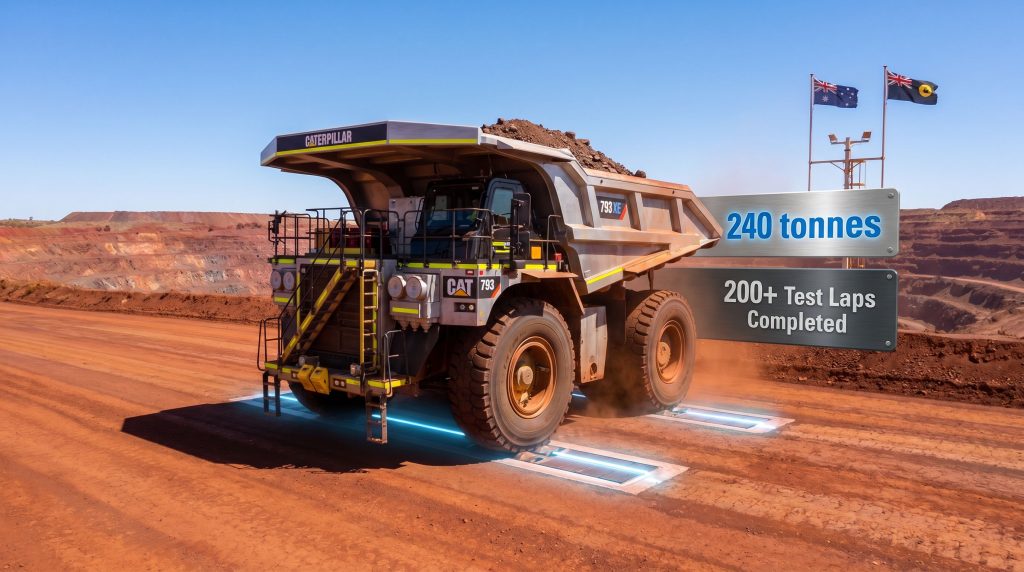
At the centre of this trial is the Cat 793 XE Early Learner, a fully battery-electric haul truck engineered to match the productivity profile of its diesel equivalent. The specifications are significant:
| Specification | Detail |
|---|---|
| Model | Cat 793 XE Early Learner |
| Payload Capacity | 240 tonnes |
| Exhaust Emissions | Zero |
| Performance Benchmark | Diesel-equivalent productivity |
| Global Units in Trial | 7 (Australia hosts the first two) |
| Trial Location | Jimblebar Iron Ore Mine, Pilbara, WA |
The term Early Learner carries specific technical meaning in this context. These are not pre-production concept vehicles, nor are they commercial-ready units being deployed at fleet scale. They occupy a deliberate middle ground, designed to gather real-world operational data that no controlled proving ground can replicate. The learnings from each unit directly inform Caterpillar's commercial development roadmap, meaning the Jimblebar data will shape how the next generation of battery-electric haul trucks is built.
It is also important to distinguish between zero exhaust emissions and zero lifecycle emissions. The Cat 793 XE produces no tailpipe emissions during operation, which directly addresses Scope 1 emissions, the category that currently dominates mining companies' decarbonisation obligations. However, the full carbon picture depends on the energy source powering the charging infrastructure. If that electricity comes from coal-fired or gas-fired grids, the upstream emissions burden shifts rather than disappears. This distinction matters for how investors and regulators should interpret electrification milestones.
Why the "Early Learner" Classification Matters for Commercial Timelines
Mining equipment procurement decisions operate on very different timescales to consumer technology. A haul truck fleet represents capital expenditure measured in hundreds of millions of dollars, with asset lifecycles typically spanning fifteen to twenty years. Procurement teams need performance certainty, not promising prototypes. The Early Learner designation signals that Caterpillar is still in the data-gathering phase, which means fleet-wide commercial deployment remains several years away, contingent on what the trial data reveals.
The Pilbara as a Global Proving Ground
The choice of Jimblebar is not coincidental. From a trial design perspective, the Pilbara offers conditions that are simultaneously the worst-case operational scenario and the most commercially valuable testing environment on earth.
Consider the operational stress profile:
- Ambient temperatures regularly exceeding 45°C, placing sustained thermal load on battery management systems
- Continuous 24/7 operations with no natural recovery periods for battery cooling
- Long haul cycles of multiple kilometres per loaded trip, demanding high energy throughput per cycle
- Heavy payload requirements with minimal tolerance for productivity loss relative to diesel benchmarks
- Remote location logistics that stress supply chain and maintenance protocols for specialist battery components
No controlled proving ground can reproduce the combination of sustained heat, continuous operation, and remote-location maintenance constraints that exist in the Pilbara. Data generated under these conditions carries a commercial premium that cannot be created in a laboratory setting.
This is precisely why the early results — more than 100 hours of operation and over 200 test laps completed within the first three months — are being watched closely not just by BHP and Rio Tinto, but by every major mining operation globally that faces similar haulage decarbonisation obligations. Furthermore, renewable energy in mining will ultimately determine whether these zero-exhaust-emission vehicles deliver genuine lifecycle carbon reductions.
Dynamic Charging: The Technology That Could Unlock Everything
The first phase of the trial validates fundamental performance assumptions. The second phase introduces the concept that could determine whether battery-electric haulage is commercially viable at scale: dynamic charging.
Unlike stationary charging systems, which require trucks to halt operations and connect to a charging point, dynamic charging infrastructure is embedded directly into haul road surfaces or adjacent infrastructure, enabling continuous energy transfer while the vehicle is in motion. The theoretical operational logic is compelling:
- A loaded truck travels down a ramp toward the processing facility, receiving charge through road-embedded infrastructure
- The empty truck returns uphill, partially regenerating energy through regenerative braking while continuing to receive supplementary charge
- Net energy consumption per cycle is reduced, potentially extending operational range and reducing peak battery demand
Key Concept: Dynamic charging in mining applications is fundamentally different from consumer EV wireless charging concepts. At the scale of a 240-tonne haul truck, the energy transfer requirements demand purpose-built infrastructure solutions, likely involving conductive rail or overhead catenary systems adapted for off-road mining environments rather than inductive wireless transfer.
The infrastructure buildout implications are significant. Dynamic charging systems require substantial civil and electrical engineering investment across haul road networks that may span dozens of kilometres across a single operation. For the Pilbara's dispersed, multi-pit mine designs, this creates a material capital question that the trial must help answer.
Why Competitors Are Working Together
One of the more strategically unusual aspects of the BHP Rio Tinto Caterpillar electric haul truck trials in the Pilbara is the collaborative structure itself. BHP and Rio Tinto are fierce competitors across iron ore, copper, and energy commodities. Yet here they are co-investing in technology trials at the same test site.
The logic is rooted in the economics of pre-competitive collaboration. Neither company can solve the haulage decarbonisation problem unilaterally. The infrastructure requirements, technology development costs, and supply chain depth required to electrify a full Pilbara haul fleet exceed what any single operator could justify on its own trial budget. By sharing data, infrastructure costs, and operational learnings, both companies accelerate their path to commercial deployment while Caterpillar gains the multi-operator data set it needs to refine its product.
This model has historical precedent. The Australian resources sector has previously coordinated on shared logistics infrastructure, safety standards, and environmental monitoring frameworks where the complexity and cost of individual solutions would be prohibitive. Haulage electrification represents a natural extension of that collaborative instinct, driven by the recognition that the Pilbara's decarbonisation challenge is an industry-wide problem, not a competitive advantage.
Emissions Targets and the Commercial Stakes
The urgency behind the BHP Rio Tinto Caterpillar electric haul truck trials in the Pilbara is inseparable from the specific emissions commitments these companies have made:
- BHP has publicly committed to reducing operational greenhouse gas emissions by at least 30% by 2030, a target that BHP President Australia Geraldine Slattery has linked directly to the progress being made through this trial collaboration
- Rio Tinto has articulated a net-zero emissions target for 2050, with interim milestones that require material action on Scope 1 emissions within this decade
- Both companies operate Pilbara haul fleets that collectively number in the hundreds of vehicles, each running on diesel around the clock
Haulage is estimated to account for a dominant share of Scope 1 emissions in large open-cut iron ore operations. Without a credible haulage solution, neither company can meet its published decarbonisation targets. This is not a peripheral ESG initiative. It sits at the structural centre of their emissions reduction roadmaps.
Rio Tinto Iron Ore CEO Matthew Holcz has described the scale of the challenge in terms that underscore why no single operator could address it independently, noting that decarbonising Pilbara haulage requires cross-industry collaboration to solve given its unique operational complexity. In addition, progress in green iron production will be closely linked to how quickly haulage electrification can be realised at scale.
The next major ASX story will hit our subscribers first
Technology Comparison: The Competitive Landscape for Electric Haulage
Battery-electric is not the only pathway being explored for heavy haulage decarbonisation. Understanding where the Cat 793 XE sits relative to competing technologies is essential context:
| Technology | Maturity Level | Key Advantage | Key Limitation |
|---|---|---|---|
| Battery-Electric (Cat 793 XE) | Early commercial trial | Zero exhaust emissions; EV supply chain depth | Charging infrastructure; battery thermal management |
| Hydrogen Fuel Cell | Pilot and concept stage | Long-range potential | Green hydrogen cost and availability |
| Trolley-Assist Hybrid | Commercially deployed at select sites | Proven at scale with existing diesel backup | Fixed overhead infrastructure; limited route flexibility |
| Diesel (incumbent) | Fully commercial | Globally proven and supported | Significant Scope 1 emissions; increasing carbon cost exposure |
The trolley-assist model deserves specific attention because it is already commercially deployed at several global mine sites. It uses overhead electrical wire infrastructure above fixed haul routes, allowing trucks to draw power during loaded uphill sections while retaining diesel for flexibility on other segments. Its limitation is architectural: Pilbara mine designs typically involve multi-pit, dispersed haul routes that resist the fixed-infrastructure logic of trolley systems.
This is part of why battery-electric, despite its current maturity limitations, is seen as more scalable for the Pilbara's specific operational geometry. Furthermore, hydrogen-powered mining trucks represent a parallel development pathway that may ultimately complement rather than compete with battery-electric solutions.
Five Barriers That Must Be Cleared Before Fleet Deployment
Industry analysts tracking the BHP Rio Tinto Caterpillar electric haul truck trials in the Pilbara have identified five critical barriers that the trial data must address before major procurement decisions can proceed:
- Battery thermal management under sustained high-ambient-temperature conditions without performance degradation or accelerated cell degradation
- Dynamic charging infrastructure design and buildout economics across dispersed, multi-kilometre haul road networks
- Grid and renewable energy capacity to power electrified fleets without substituting diesel emissions for coal or gas emissions upstream
- Total cost of ownership parity with diesel across the full asset lifecycle, accounting for battery replacement cycles, specialist maintenance, and infrastructure capital
- Remote supply chain depth for battery components, replacement modules, and specialist technical capability in one of Australia's most geographically isolated industrial regions
Each of these barriers is interconnected. Solving battery thermal management without solving renewable energy supply simply relocates the emissions problem. Achieving cost parity without solving supply chain depth creates procurement risk that fleet managers cannot accept. The trial must generate evidence across all five dimensions simultaneously.
What Industry and Policy Leaders Are Saying
Western Australian Premier Roger Cook has voiced strong support for the initiative, framing it within a broader economic ambition to position the state as a renewable energy leader while maintaining its status as Australia's most economically productive region. His presence at the Jimblebar site alongside mining executives signals the political significance attached to the trial's progress.
State Energy and Decarbonisation Minister Amber-Jade Sanderson has characterised battery-electric haul truck trials as a critical step toward net-zero heavy industry, urging the sector to treat emissions reduction as a structural industrial transformation rather than a regulatory compliance exercise.
It is important to note that these represent political statements of support and alignment with industry direction. They do not constitute confirmed government funding, accelerated permitting, project designation, or any form of official project-specific backing for the trial.
If the Trial Succeeds: What Changes for Global Mining
The downstream implications of a successful Pilbara trial extend well beyond BHP and Rio Tinto's balance sheets. Consider the signal it sends:
- Caterpillar would have real-world validation data from the world's most demanding haul environment, unlocking its ability to move the remaining five global Early Learner units toward commercial-ready specifications
- Other major iron ore, copper, and coal operations globally would face accelerated pressure to present credible electrification roadmaps, given that the Pilbara's extreme conditions would no longer serve as an operational excuse
- Capital markets would begin pricing emissions transition risk differently for miners who have credible haulage electrification timelines versus those who do not
- Battery and charging technology supply chains would receive the investment signal needed to scale manufacturing capacity for ultra-heavy-duty mining applications
The Pilbara has long set global benchmarks for large-scale iron ore production efficiency. If BHP and Rio Tinto can demonstrate that battery-electric haulage is viable under these conditions, the region has the potential to set an equally significant benchmark for how the world's largest open-cut mines decarbonise. Consequently, the iron ore market outlook will increasingly reflect how successfully operators embed electrification into their long-term production strategies.
Frequently Asked Questions
What is the Cat 793 XE Early Learner truck?
The Cat 793 XE Early Learner is Caterpillar's fully battery-electric haul truck, engineered to carry a 240-tonne payload with zero exhaust emissions. The Early Learner classification indicates it is a data-gathering platform designed to validate performance, safety, and infrastructure assumptions before commercial fleet deployment.
Where is the BHP, Rio Tinto, and Caterpillar electric truck trial taking place?
The trial is currently underway at BHP's Jimblebar iron ore mine in Western Australia's Pilbara region.
How many electric haul trucks are being tested in the Pilbara?
Two Cat 793 XE Early Learner units are currently on site at Jimblebar. Caterpillar has a total of seven Early Learner units in global circulation, with Australia hosting the first two deployed.
What is dynamic charging and how will it work on mining haul roads?
Dynamic charging refers to energy transfer systems that allow haul trucks to receive charge while in motion, eliminating the need for stationary charging stops. The next phase of the trial will test this capability, which could involve conductive or infrastructure-embedded systems along haul roads.
What emissions targets are driving BHP and Rio Tinto's investment in electric haulage?
BHP has committed to a minimum 30% reduction in operational greenhouse gas emissions by 2030. Rio Tinto has a net-zero target for 2050. Both targets require material progress on Scope 1 emissions from haulage, which represents a dominant share of operational carbon output.
When could battery-electric haul trucks be commercially deployed across Pilbara iron ore mines?
No confirmed commercial deployment timeline has been announced. The current trial is in an early data-gathering phase, with the dynamic charging evaluation still ahead. Fleet-scale deployment is likely at least several years away, subject to trial outcomes across all five critical barrier areas.
Are there other electric haul truck programmes operating globally?
Yes. Several mining equipment manufacturers and operators are running parallel development programmes globally. The Caterpillar and Komatsu programmes both represent advanced real-world trials in large-scale iron ore environments, with competing battery-electric ultra-class truck initiatives at various stages of development.
This article contains forward-looking statements and references to trial timelines, emissions targets, and technology development pathways. These are subject to change based on trial outcomes, technology development progress, regulatory frameworks, and commercial decisions by the parties involved. Nothing in this article constitutes financial or investment advice.
Want to Track the Mining Companies Leading the Decarbonisation Revolution?
Discovery Alert's proprietary Discovery IQ model delivers real-time alerts on significant ASX mineral discoveries, instantly identifying the exploration and mining companies positioned at the forefront of sector-transforming technologies — explore Discovery Alert's discoveries page to understand how major mineral breakthroughs have historically generated exceptional returns, and begin a 14-day free trial to stay ahead of the market.