July 24, 2026
The Infrastructure Gap No One Talks About: Why Federal R&D Is Now Targeting America's Hydrocarbon Delivery System
The United States produces more oil and natural gas than any other nation on earth, yet a significant portion of that wealth evaporates before it ever reaches a customer. Gas gets flared at the wellhead. Aging compressors leak product. Pipelines corrode. Digital tools that could optimise field performance by orders of magnitude sit unadopted in PowerPoint presentations. The productive capacity of American basins consistently outpaces the infrastructure designed to monetise it, and that gap has become a focal point for federal research investment.
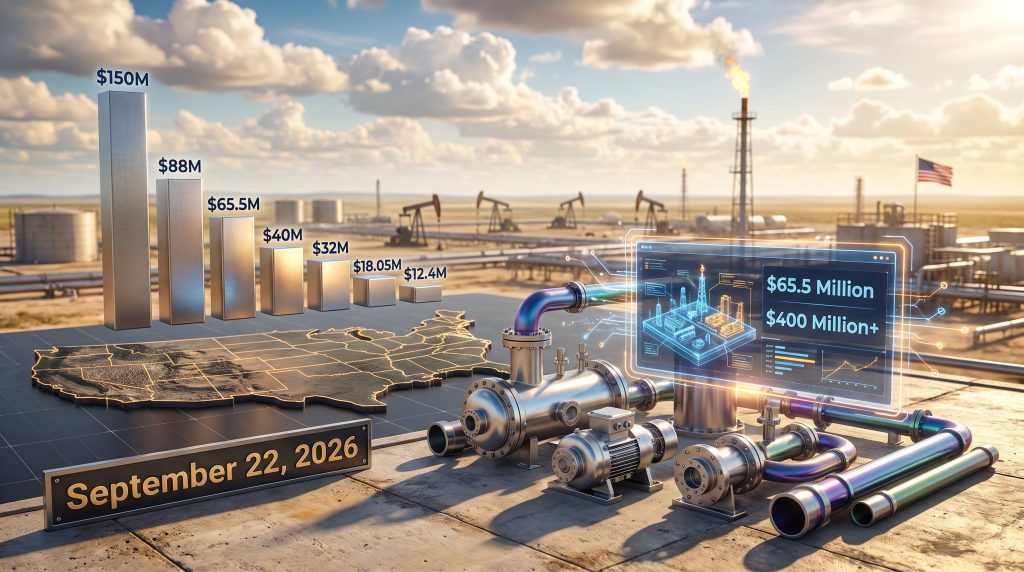
This is the context in which the U.S. Department of Energy's announcement of up to $65.5 million in cost-shared DOE funding for domestic oil and natural gas production and delivery should be understood. Released on July 23, 2026, the Notice of Funding Opportunity targets three operational failure points that collectively cost producers, consumers, and the broader economy billions of dollars annually. The deadline for applications is September 22, 2026, at 5:00 p.m. Eastern Time.
When big ASX news breaks, our subscribers know first
What the $65.5 Million NOFO Actually Targets
A Notice of Funding Opportunity, commonly referred to as a NOFO, is the federal government's mechanism for soliciting competitive research, development, and deployment proposals from industry, universities, national laboratories, and consortia. Unlike grants awarded to pre-selected recipients, NOFOs require applicants to demonstrate technical merit, commercial relevance, and alignment with defined programme priorities. Cost-sharing requirements mean that federal dollars are matched by non-federal contributions, which creates a built-in filter for proposals with genuine commercial viability rather than purely academic interest.
The current $65.5 million NOFO is structured around three distinct priority areas, each targeting a different layer of the production and delivery value chain:
- Stranded and underutilised resource valorisation focuses on converting gas streams that would otherwise be flared, vented, or left in the ground into transportable, high-value products through novel catalysts, modular reactor systems, and advanced separation technologies.
- Supply chain durability and infrastructure reliability targets the physical hardware layer, covering advanced materials for compressors, valves, piping, coatings, storage tanks, and alloys, with the goal of reducing product loss and preventing costly equipment failures.
- Digitalisation and smart field operations targets the adoption gap between available AI and sensor technologies and their actual deployment in upstream and midstream environments, including AI-supported digital twins and continuous monitoring platforms.
Each priority area spans a development arc from laboratory-scale validation through to full-scale, field-based deployment in active production basins, which gives the programme a clear commercialisation pathway rather than leaving technologies stranded at the research stage.
The Stranded Gas Problem: Larger Than Most Investors Realise
Flaring and stranded gas represent one of the most persistent inefficiencies in domestic energy production. When gas cannot be economically transported or processed, it is either burned at the wellhead or, in some cases, vented directly into the atmosphere. According to data from the U.S. Energy Information Administration, the United States flared approximately 470 billion cubic feet of natural gas between 2012 and 2022, with peak flaring concentrated in constrained basins like the Permian and Bakken where midstream infrastructure has historically lagged behind drilling activity.
The economic and environmental case for solving this problem is compelling. Stranded gas that cannot reach market represents lost revenue for producers and royalty holders, including federal and state governments. Furthermore, when it is flared rather than vented, it at least converts methane to carbon dioxide, but neither outcome reflects an optimal use of a finite resource.
The DOE's $150M push for enhanced recovery complements this approach, and the funding strategy here is technically ambitious. Rather than simply subsidising new pipelines, the programme targets modular, decentralised gas conversion, which means developing systems small enough to operate economically at individual well pads or small gathering points. Technologies in this space include small-scale gas-to-liquids reactors, methanol synthesis units, and portable LNG liquefaction systems.
These are not science fiction; several are operating at pilot scale globally. The challenge is reducing capital cost and improving reliability to the point where they pencil out in real basin economics, which is precisely what field-scale validation funding is designed to address.
Infrastructure Reliability: The Unglamorous Problem With Trillion-Dollar Consequences
Compressors, valves, and pipeline coatings rarely attract headlines, but infrastructure degradation is one of the most costly and underappreciated challenges in American energy delivery. The Pipeline and Hazardous Materials Safety Administration reported that between 2010 and 2022, pipeline incidents in the United States resulted in more than $10 billion in property damage and the loss of significant hydrocarbon volumes. The majority of significant incidents are attributable to material failure, corrosion, and equipment malfunction rather than external events.
Aging infrastructure does not just create safety risk. It systematically erodes the productive output of a basin even when wells themselves are performing well. A compressor station operating at reduced efficiency can throttle throughput across an entire gathering system.
The DOE's priority area targeting supply chain durability reflects a sophisticated understanding of this problem. Advanced alloy development, next-generation coatings that resist hydrogen sulphide corrosion in sour gas environments, and novel valve materials that maintain integrity under high-pressure cycling are not glamorous research topics. However, they represent some of the highest return-on-investment opportunities in the entire oil and gas technology landscape. A compressor that lasts three times longer than its predecessor and leaks a fraction of the product generates enormous value over the life of a field.
Digital Twins and AI: The Productivity Frontier in Upstream Operations
The concept of a digital twin involves creating a continuously updated computational replica of a physical asset, whether that is a single compressor, a well pad, or an entire gathering network. By feeding real-time sensor data into this model, operators can predict failures before they occur, optimise throughput without physical intervention, and test operational changes in simulation before implementing them in the field.
Despite widespread enthusiasm for digital twins in industrial manufacturing and aerospace, adoption within upstream oil and gas has been slower than the technology's maturity would suggest. Data-driven mining operations face similar structural barriers, and several of these same factors explain the lag in oil and gas:
- Data fragmentation across legacy SCADA systems, manually entered well logs, and disconnected sensor networks makes building unified data pipelines technically difficult.
- Workforce capability gaps mean that many field operators lack the data science skills needed to interpret model outputs without significant training investment.
- Return-on-investment uncertainty in a commodity business with volatile price cycles makes capital allocation for technology platforms harder to justify against drilling inventory.
- Vendor fragmentation has produced a landscape of incompatible software platforms with limited interoperability, increasing integration costs.
Federal funding for full-scale, field-based validation sites directly addresses the fourth barrier by creating shared testing environments where digital technologies can be assessed under real operating conditions. AI-powered mining efficiency solutions demonstrate a similar principle — their performance documented and results made available to a broader industry audience. This model has precedent in the DOE's earlier work on unconventional recovery technology, where funded pilot programmes at the basin level significantly accelerated commercial adoption timelines.
The Broader DOE Funding Portfolio: A Cumulative Picture
The $65.5 million NOFO does not exist in isolation. It builds on a sequence of recent DOE investments that together form a coherent capability-building strategy across the domestic hydrocarbon sector.
| Funding Programme | Amount | Core Focus Area |
|---|---|---|
| Current NOFO (July 2026) | Up to $65.5 million | Infrastructure reliability, digitalisation, resource valorisation |
| Unconventional Recovery NOFO (2026) | Up to $150 million | Enhanced recovery, fracture characterisation, produced water |
| Flaring Reduction Initiative | ~$32 million | Stranded gas conversion technologies |
| Produced Water R&D Programme | $18.05 million | Water treatment and management systems |
| FY2026 Advanced Production Technologies | $40 million | Exploration, offshore safety, water management |
| Enhanced Oil Recovery Programme (2019) | Up to $88 million | EOR and unconventional resource development |
| Unconventional Extraction Projects | $12.4 million | Shale gas and mature oil field improvements |
When these programmes are viewed collectively, active and recent DOE fossil energy R&D commitments exceed $400 million. This is not a policy gesture; it is a sustained capital allocation strategy designed to maintain and extend U.S. hydrocarbon production capacity at a time when geopolitical energy competition is intensifying. In addition, the critical minerals demand surge occurring in parallel further underscores how vital reliable domestic energy infrastructure has become.
The next major ASX story will hit our subscribers first
The Policy Architecture: Executive Mandate and Institutional Delivery
The funding strategy is explicitly tied to the Trump Administration's executive directive on unleashing American energy, which establishes domestic hydrocarbon production as a national economic and security priority. The US mineral production order similarly reflects this broader mandate, and the DOE's Hydrocarbons and Geothermal Energy Office serves as the institutional delivery mechanism, coordinating between federal research infrastructure, national laboratories, and private sector applicants.
The national security dimension of this investment is worth examining carefully. The United States' ability to influence global energy markets through export capacity depends directly on the efficiency and reliability of its domestic production and delivery infrastructure. LNG export terminals are only as valuable as the upstream and midstream systems feeding them. When infrastructure underperforms, export commitments become harder to fulfil, and the geopolitical leverage that flows from energy export capacity erodes accordingly.
Comparing Upstream and Midstream Technology Targets
| Operational Segment | Technologies Being Funded | Strategic Objective |
|---|---|---|
| Upstream Production | Digital twins, AI analytics, fracture characterisation | Maximise hydrocarbon recovery per well |
| Midstream Transport and Processing | Advanced alloys, coatings, compressors, modular gas systems | Reduce product loss, improve delivery reliability |
| Stranded Resource Conversion | Novel catalysts, reactor systems, sour gas processing | Unlock value from otherwise wasted resources |
| Produced Water Management | Treatment technologies, reuse and disposal systems | Reduce environmental risk, lower lifting costs |
Who Should Be Applying and How to Approach It
The NOFO is structured to attract a diverse applicant pool. Eligible entities include private companies across the energy technology spectrum, universities with relevant engineering and materials science programmes, national laboratories with prior DOE engagement, and collaborative consortia that combine industrial partners with research institutions. In practice, proposals that combine the technical depth of a national laboratory partnership with the commercial validation pathway of an industry co-applicant tend to score well in competitive federal reviews.
Strong proposals will need to demonstrate:
- Clear alignment with at least one of the three defined priority areas
- A credible technology readiness level assessment showing where the proposed work fits on the laboratory-to-field continuum
- Quantifiable performance targets expressed in terms of increased saleable hydrocarbon volumes, reduced operating costs, or measurable infrastructure reliability improvements
- A realistic cost-sharing structure that reflects genuine non-federal investment rather than in-kind contributions that inflate apparent match ratios
Given that the application deadline falls on September 22, 2026, organisations that have not already begun proposal development are operating with limited runway. DOE competitive selections in programmes of this scale typically require six to twelve months between application close and award announcement, with field deployment phases beginning one to two years after award.
Frequently Asked Questions: DOE Funding for Domestic Oil and Natural Gas Production
What is the total DOE funding available for oil and gas projects in 2026?
The current NOFO offers up to $65.5 million. Combined with the separate $150 million unconventional recovery NOFO announced earlier in 2026, total DOE funding for domestic oil and natural gas production announced this year alone approaches $215 million before accounting for other programme lines.
Is cost-sharing mandatory?
Yes. DOE cost-shared programmes require applicants to contribute non-federal funding, with the specific ratio depending on the technology readiness level and project type. Early-stage research projects typically carry lower match requirements than late-stage deployment work.
Can universities apply alongside private companies?
Yes. Collaborative proposals involving academic institutions, national laboratories, and private sector partners are explicitly encouraged and frequently competitive in federal energy R&D solicitations.
What is the relationship between this NOFO and the $150 million unconventional recovery programme?
The two programmes are complementary but distinct. The $150 million programme targets enhanced recovery from unconventional reservoirs, hydraulic fracture characterisation, and produced water management. The $65.5 million programme targets infrastructure reliability, stranded resource valorisation, and operational digitalisation. Applicants can pursue both but must submit separate proposals addressing each programme's specific requirements.
When does the application window close?
Applications must be submitted by September 22, 2026, at 5:00 p.m. Eastern Time. Late submissions are not accepted under standard DOE NOFO terms.
What This Investment Signals About the Long-Term Direction of U.S. Energy Policy
Federal R&D investment in hydrocarbon infrastructure serves a function that goes beyond immediate production gains. It establishes a technological capability base that the private sector can then scale commercially, creating a multiplier effect where every dollar of public funding catalyses several dollars of private capital deployment. This model has worked in previous energy technology cycles, from horizontal drilling and hydraulic fracturing to the unconventional gas research programmes that underpinned the shale revolution.
The current investment cycle is targeting a different set of constraints, namely the efficiency, reliability, and digital sophistication of existing infrastructure. Consequently, this reflects a mature recognition that the United States does not have a resource scarcity problem — it has a capture and delivery efficiency problem. The mining industry innovation trends shaping adjacent sectors reinforce this point, as federally catalysed R&D with commercial deployment risk ultimately carried by the private sector proves a cost-effective approach to maintaining production growth without proportional increases in capital expenditure.
For industry participants navigating the Australian oil and gas regulatory landscape, this U.S. funding model offers instructive parallels in how government-backed R&D programmes can accelerate commercial technology adoption across the broader energy sector.
Disclaimer: This article is intended for informational purposes only and does not constitute financial or investment advice. Figures related to DOE funding programmes are sourced from official DOE announcements and publicly available government data. Forward-looking references to programme timelines, technology adoption rates, and economic outcomes involve inherent uncertainty. Readers should conduct independent research before making investment or business decisions based on federal funding programme information.
For full programme details, eligibility requirements, and application submission instructions, the official NOFO documentation is published at energy.gov.
Want To Spot the Next Major ASX Mineral Discovery Before the Market Does?
Discovery Alert's proprietary Discovery IQ model delivers real-time alerts the moment significant mineral discoveries are announced on the ASX, transforming complex geological data into clear, actionable investment insights across more than 30 commodities — start your 14-day free trial today and see why historic discoveries, showcased on Discovery Alert's dedicated discoveries page, have the potential to generate extraordinary returns.