July 24, 2026
The Hidden Performance Crisis Inside Mineral Processing Circuits
Across the global mining industry, the conversation around productivity and recovery rates almost always gravitates toward the obvious culprits: ore grade variability, reagent costs, energy consumption, and capital equipment failures. What rarely makes it into boardroom discussions is the quiet, compounding performance drain that originates inside the cyclone circuit. For a unit operation that appears mechanically straightforward, Multotec glass cyclone mineral processing technology is helping to expose just how wide the gap between perceived and actual classification efficiency truly is.
Understanding why this gap exists, and how modern transparent cyclone technology is helping close it, requires stepping back from the operational surface and examining the physics, metallurgy, and economics of centrifugal separation in detail.
When big ASX news breaks, our subscribers know first
Why Cyclone Classification Is More Financially Consequential Than It Appears
The operating principle of a hydrocyclone is elegant in its simplicity. Slurry is fed tangentially into a conical vessel, generating a centrifugal vortex that forces denser, coarser particles outward toward the cyclone wall and downward through the underflow discharge, while finer particles and water are carried upward through the vortex finder and exit via the overflow. No moving parts, no complex control systems, no high-voltage electrical demands. This mechanical minimalism is precisely what makes cyclones easy to underestimate.
The deceptive simplicity of cyclone design masks an operational complexity that has real financial consequences. Classification accuracy, defined as how precisely the cyclone achieves its target cut point between coarse and fine fractions, directly governs how well every downstream unit operation performs. Flotation cells, leach circuits, and gravity concentrators all depend on receiving feed material within a defined particle size range. When the cyclone delivers outside those parameters, every subsequent process step compensates inefficiently. Furthermore, understanding mineral processing basics helps contextualise why classification failures cascade so widely across the plant.
The critical issue, identified by process engineers working closely with cyclone performance, is that misclassification rarely announces itself. As Ernst Bekker, a process specialist at Multotec, has noted, many plant operators conclude that a cyclone is functioning correctly simply because material is discharging from both the overflow and underflow outlets. This assumption is flawed and potentially costly. A cyclone can simultaneously maintain visible discharge at both points while delivering severely degraded classification sharpness, silently misrouting valuable mineral particles and inflating the circulating load within the grinding circuit.
Critical Insight: A cyclone discharging material from both outlets is not evidence of correct function. It is only evidence that the cyclone is passing slurry. Classification efficiency and discharge activity are entirely different metrics, and conflating them is one of the most common and expensive diagnostic errors in mineral processing plants.
The financial propagation of poor cyclone performance is non-linear. Misclassified coarse particles entering the overflow report to downstream flotation or leaching circuits where they are too large for adequate liberation. Simultaneously, fines returning through the underflow into the grinding circuit increase the circulating load, forcing the mill to process material it has already reduced. This dual mechanism means that a single underperforming cyclone cluster can degrade plant-wide economics across multiple processing stages simultaneously, and directly influences mining company performance at the operational level.
What the Multotec Glass Cyclone Actually Demonstrates
Multotec, a Johannesburg-based mineral processing and metallurgy company with decades of cyclone engineering experience, has developed a transparent glass cyclone unit specifically to make the invisible visible. The technology is not a commercial product in the conventional sense; it is a diagnostic and educational tool designed to transform how operators, engineers, and plant managers conceptualise what is happening inside a working cyclone.
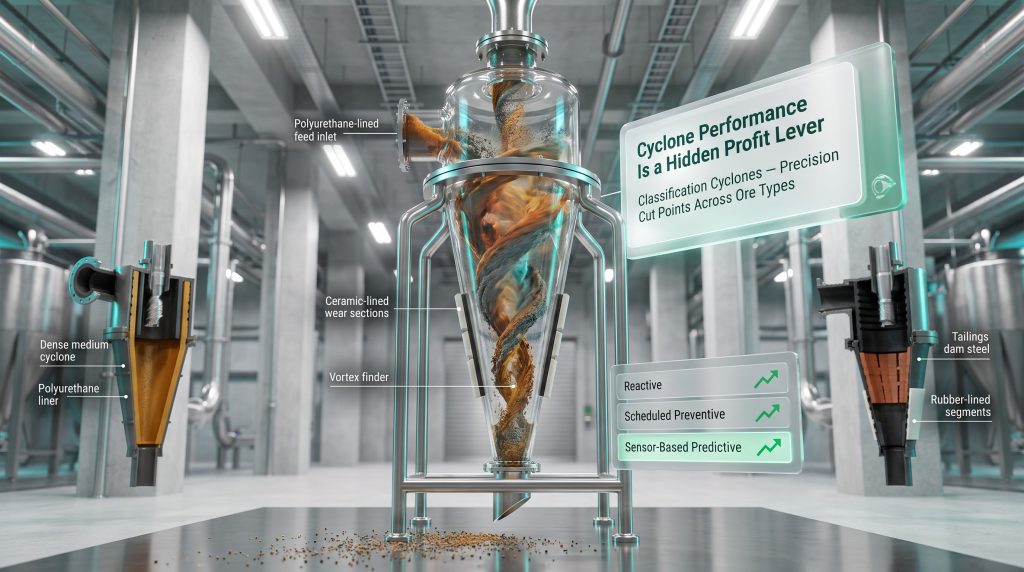
The Multotec glass cyclone mineral processing demonstration unit allows observers to watch the internal classification process in real time. The rotating vortex structure, the particle stratification along the cyclone wall, the behaviour of the inner air core, and the discharge dynamics at both the spigot and the vortex finder all become directly observable rather than inferred from indirect instrumentation readings. This shifts the operator's understanding from theoretical to empirical, a transition that experienced process engineers identify as genuinely transformative for plant personnel.
The three-way relationship that the glass cyclone makes legible is as follows:
- Cyclone geometry and design parameters govern the theoretical cut point and separation sharpness under ideal conditions
- Wear progression across internal components progressively distorts actual performance away from design specifications
- Overall plant throughput and recovery reflects the cumulative outcome of the above two factors operating simultaneously across every cyclone in the circuit
By compressing all three dimensions into a single observable unit, the glass cyclone creates a learning environment that conventional training materials, no matter how detailed, cannot replicate.
The Cyclone Design Variables That Determine Separation Outcomes
Hydrocyclone performance is governed by a set of interdependent operating variables, each of which interacts with the others in ways that make simple cause-and-effect reasoning insufficient for accurate diagnosis.
| Operating Variable | Functional Role | Impact on Separation Efficiency |
|---|---|---|
| Feed pressure | Controls slurry velocity and centrifugal force generation | Directly determines cut point; under-pressure causes coarse overflow |
| Cone angle and vortex finder geometry | Establishes particle trajectory paths inside the vessel | Governs coarse/fine split precision and misplacement fractions |
| Internal component wear condition | Alters flow dynamics and introduces turbulence | Progressively degrades classification sharpness without visible warning |
| Feed density and particle size distribution | Input variable determining appropriate cyclone specification | Influences both cut point accuracy and spigot discharge behaviour |
| Spigot (apex) diameter | Controls underflow discharge density and volume | Roping discharge indicates oversized spigot wear or feed density excess |
A lesser-known dynamic worth understanding is the relationship between the air core that forms along the cyclone's central axis and classification performance. Under optimal operating conditions, a stable, well-defined air core occupies the centre of the vortex, reinforcing the upward flow of fine particles toward the overflow. When feed conditions or wear states destabilise this air core, separation efficiency degrades rapidly and in ways that external instrumentation rarely captures with precision. Observing this phenomenon directly through a glass cyclone unit provides insights that pressure and flow data simply cannot offer.
Cyclone Types and Their Applications Across Mineral Processing
Not all cyclones serve the same function, and matching cyclone type to application duty is a foundational element of circuit design. Multotec's cyclone portfolio encompasses three primary categories, each engineered for a distinct operational environment.
Classification Cyclones
Classification cyclones are the workhorses of grinding circuit closure. Their purpose is to achieve a precise particle size cut point, returning oversized particles to the mill while passing correctly sized material to downstream recovery circuits. They find application across gold, copper, iron ore, platinum, and base metal processing operations, and are available in both standardised configurations and application-specific engineered designs for more complex mineralogical environments.
Dense Medium Cyclones
Dense medium cyclones operate on a fundamentally different separation principle. Rather than using size as the primary sorting criterion, they exploit density differential through a heavy medium slurry, typically ferrosilicon for diamond and iron ore applications, or magnetite for coal washing circuits. Valuable high-density minerals sink through the medium while lower-density gangue floats, achieving product grades that size-only classification cannot approach.
Tailings Dam Cyclones
Tailings dam cyclones are engineered for a completely different operational context. Deployed in high-volume, remote, and often challenging site conditions, these units prioritise reduced mass, ease of field maintenance, and corrosion resistance over classification precision. Their role in the responsible management of tailings storage facilities is growing in strategic importance as water scarcity pressures and regulatory scrutiny around tailings dam safety intensify across global mining jurisdictions.
Material Selection by Application
| Cyclone Category | Primary Liner Material | Typical Application Context |
|---|---|---|
| Small-diameter classification units | Polyurethane | Fine particle classification, moderate abrasion duty |
| Medium and large classification units | Polyurethane or rubber-lined steel | General mineral processing circuits |
| Dense medium and high-throughput units | Ceramic-lined steel | Maximum wear resistance, high-abrasion, high-volume duties |
How Internal Wear Silently Destroys Classification Performance
Wear management inside hydrocyclones represents one of the most underappreciated disciplines in mineral processing plant engineering. The abrasive nature of mineral slurries means that cyclone internals, particularly the vortex finder, spigot, and cone liner, experience continuous material loss during operation. This is not a maintenance concern in isolation; it is a metallurgical and financial performance issue with compounding consequences.
As internal components wear, cyclone geometry deviates from its design specification. Cut points shift, often becoming coarser than intended, which means fine valuable minerals that should exit via the overflow begin reporting to the underflow and returning to the grinding mill. The grinding circuit then processes already-liberated material unnecessarily, consuming energy without generating additional recovery value. In addition, cut-off grade economics are directly affected when classification failures allow marginal material to contaminate the processing stream.
Multotec process specialists recommend formal cyclone inspections on a quarterly to bi-annual cycle, with inspection frequency calibrated to ore abrasivity, feed density, and operational throughput rates. High-abrasion applications, such as those processing hard rock gold ores or abrasive iron formations, warrant intervals at the shorter end of this range.
Key Components to Assess During Formal Cyclone Inspections:
- Vortex finder condition, dimensional accuracy, and wear pattern symmetry
- Spigot diameter measurement and discharge pattern observation for roping indicators
- Cone liner thickness across high-wear zones using ultrasonic measurement where appropriate
- Feed inlet geometry and erosion pattern assessment
- Cyclone body external condition and potential for short-circuit flow through cracks or seals
Beyond scheduled physical inspections, sensor-based monitoring systems represent the next evolution in cyclone circuit management. Instruments measuring feed pressure, flow rate, discharge density, vibration, and acoustic signatures can collectively build a real-time performance picture that alerts operators when parameters deviate from the cyclone's optimal operating envelope. Bekker has indicated that these systems are capable of detecting performance degradation before it becomes visible through conventional observation methods.
The distinction between monitoring approaches matters operationally:
| Management Approach | Inspection Trigger | Cost Profile | Recovery Impact |
|---|---|---|---|
| Reactive (run-to-failure) | Visible discharge failure or blockage | High unplanned replacement costs and downtime losses | Significant recovery losses accumulate before detection |
| Scheduled preventive | Fixed quarterly or bi-annual cycle | Predictable, moderate maintenance expenditure | Limits the degradation window to known intervals |
| Sensor-based predictive | Real-time parameter deviation alert | Higher instrumentation capital, lower long-term total cost | Minimises performance loss duration to hours rather than weeks |
The next major ASX story will hit our subscribers first
Cyclone Circuit Optimisation and Its Downstream Multiplier Effect
Hydrocyclone classification sits at a particularly leveraged position in the mineral processing flowsheet. It is the boundary between size reduction and value recovery, meaning that every improvement in classification precision generates amplified benefits across every downstream unit operation simultaneously.
When flotation circuits receive correctly classified feed, froth stability improves, reagent consumption per tonne of concentrate decreases, and concentrate grades increase without additional reagent spend. When leach circuits receive properly sized feed, lixiviant contact efficiency improves and extraction kinetics accelerate. These are not marginal effects; in high-throughput operations processing millions of tonnes per year, even fractional improvements in classification sharpness translate to meaningful increments in annual recovered metal value.
Computational fluid dynamics modelling has become an increasingly important tool in optimising cyclone designs before physical manufacture. By simulating slurry flow behaviour, particle trajectories, and wear patterns inside virtual cyclone geometries, engineers can evaluate multiple design iterations rapidly. This capability has compressed the development cycle for application-specific cyclone designs considerably over the past decade.
Energy efficiency is also emerging as a significant design criterion. Optimised cyclone selection, matched precisely to feed characteristics and classification targets, reduces the pumping energy intensity of the classification circuit. Furthermore, more accurate classification reduces the recirculating load returning to the grinding mill, which in turn lowers mill motor energy draw per tonne of correctly classified product.
Diagnostic Indicators of Cyclone Circuit Deterioration
Plant metallurgists and process engineers working in mineral processing operations often describe cyclone performance degradation as a slow-moving and easily rationalised problem. Recovery shortfalls get attributed to ore variability. Increased circulating loads get blamed on mill liner wear. The actual root cause, a cyclone circuit operating outside its design parameters, frequently escapes identification until degradation is severe.
Five operational warning signs that cyclone classification efficiency has deteriorated:
- Coarse particles reporting to the overflow stream, detectable through sieve analysis of overflow samples, indicating vortex finder wear or incorrect operating pressure
- Roping discharge from the underflow spigot, characterised by a high-density, rope-like stream rather than the correct umbrella-shaped spray discharge pattern
- Sustained increase in grinding circuit circulating load without corresponding changes in mill feed rate or ore hardness
- Progressive unexplained decline in downstream flotation or leach recovery that does not respond to conventional reagent or operating adjustments
- Feed or cyclone operating pressure consistently outside the design range, suggesting internal geometry has changed through wear or partial blockage
Africa's Position as a Critical Arena for Cyclone Technology Advancement
The African mining sector presents a uniquely demanding environment for cyclone technology. The continent hosts processing operations spanning platinum group metals, chrome, gold, diamonds, iron ore, manganese, and base metals, each presenting distinct mineralogical challenges, ore hardness profiles, and particle size requirements. This diversity, concentrated within a geographically accessible market, makes Africa both a proving ground and a primary commercial opportunity for advanced mineral processing equipment.
Electra Mining Africa, scheduled for September 7 to 11, 2026, at the Johannesburg Expo Centre, represents the continent's largest industrial and electrical trade exhibition. Multotec has confirmed it will use the event to showcase the Multotec glass cyclone mineral processing demonstration unit, creating a direct knowledge-transfer opportunity between equipment engineers and processing plant operators from across the African mining sector. Events of this nature serve a function that published technical literature cannot: they allow hands-on observation of process dynamics that operators can immediately contextualise against their own plant experience.
The broader trajectory of cyclone technology is moving toward full integration with digital plant management frameworks. Real-time cyclone performance data feeding into plant-wide digital twin models, combined with machine learning algorithms, points toward a future where autonomous cyclone circuit management is operationally feasible. For a technology that has remained largely unchanged in its mechanical fundamentals for decades, the next ten years of digitalisation represent a more significant evolution than the previous fifty years of incremental design refinement. Consequently, separation efficiency advances being demonstrated by leading equipment manufacturers are setting new benchmarks for what plant operators can realistically expect from their classification circuits.
Frequently Asked Questions: Multotec Glass Cyclone and Mineral Processing
What is a glass cyclone used for in mineral processing?
A transparent glass cyclone functions primarily as an educational and diagnostic demonstration tool. It allows plant operators, engineers, and technical visitors to observe the internal particle classification dynamics of a working hydrocyclone in real time, making visible the interactions between cyclone geometry, wear condition, and operating parameters that normally remain entirely hidden from view.
How often should hydrocyclones be inspected in a mineral processing plant?
Process specialists recommend formal cyclone inspections on a quarterly to twice-yearly basis, with the specific interval determined by ore abrasivity, slurry density, and throughput volumes. Operations processing highly abrasive ores or operating at elevated throughput rates should favour the shorter inspection interval to prevent undetected wear from reaching the threshold where it materially degrades classification performance.
What materials are used in Multotec cyclone construction?
Material selection is governed by application duty and cyclone size. Smaller-diameter units used for fine classification at moderate abrasion levels are predominantly manufactured from polyurethane. Medium and large units may use polyurethane, rubber-lined steel, or ceramic-lined steel, with ceramic liners reserved for the highest-abrasion, high-throughput environments where extended wear life is the primary design requirement.
Can sensors replace physical cyclone inspections?
Sensor-based monitoring systems measuring flow rate, pressure, vibration, and discharge characteristics provide continuous real-time performance data and can alert operators to parameter deviations before they reach critical levels. However, physical inspections remain essential for assessing internal liner wear depths, vortex finder dimensional integrity, and conditions that instrumentation cannot fully characterise without direct measurement.
What is the difference between a classification cyclone and a dense medium cyclone?
Classification cyclones separate particles based primarily on size, using centrifugal force to achieve a defined cut point between coarse and fine fractions. Dense medium cyclones, however, separate particles based on density differential, deploying a heavy medium suspension such as ferrosilicon or magnetite to float lower-density gangue material while sinking higher-density valuable minerals. Dense medium separation achieves product grades that size-only classification cannot match and is widely applied in coal washing, diamond recovery, and iron ore beneficiation circuits.
How do drill results inform cyclone circuit planning?
Early-stage interpreting drill results provides mineralogical and ore hardness data that directly informs cyclone selection, circuit configuration, and throughput modelling during feasibility planning. Similarly, a well-structured definitive feasibility study will include detailed cyclone circuit design based on testwork data to validate classification performance assumptions before capital commitment.
This article contains forward-looking statements and operational observations based on publicly available technical information and industry commentary. Readers should conduct independent verification before making operational or investment decisions based on the content presented here. Further coverage of mineral processing equipment innovation and industry developments is available at canadianminingjournal.com.
Want to Identify the Next Major Mineral Discovery Before the Broader Market Does?
Discovery Alert's proprietary Discovery IQ model delivers real-time alerts on significant ASX mineral discoveries, transforming complex geological data into actionable investment insights for both short-term traders and long-term investors — explore the historic returns major discoveries have generated and begin your 14-day free trial to secure a genuine market-leading edge.