July 10, 2026
The Supply Chain Math That Doesn't Add Up
The global economy is being rebuilt around technologies that require minerals the mining industry cannot yet deliver fast enough. Electric vehicles, grid-scale battery storage, permanent magnet motors, and AI data centre infrastructure all share a common dependency: a reliable, high-volume supply of critical minerals that the current production pipeline is structurally ill-equipped to provide at the pace required. The growing critical minerals demand is, furthermore, outpacing the industry's ability to respond through conventional greenfield development alone.
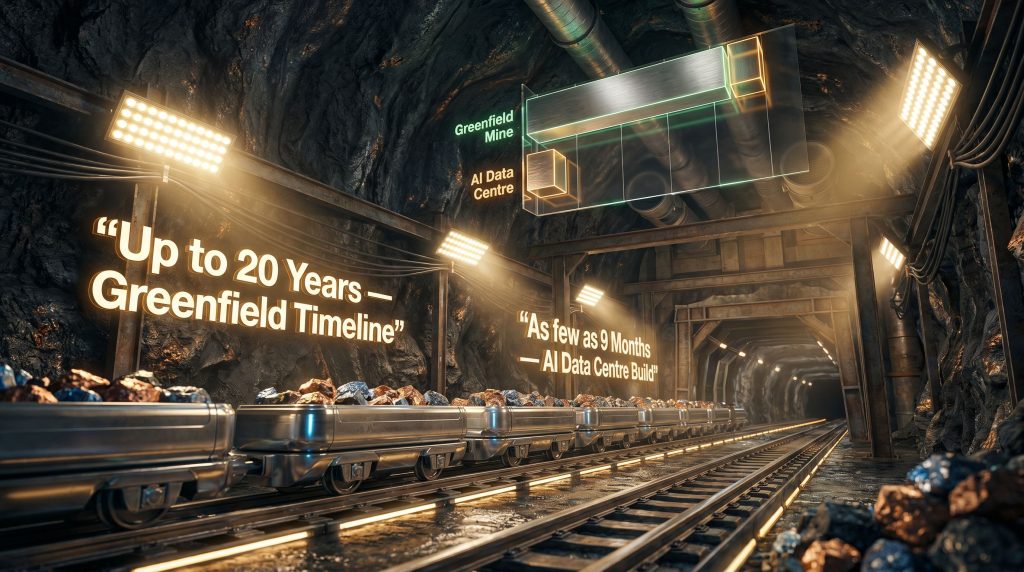
The arithmetic of the problem is stark. As Teck Resources President and CEO Jonathan Price has publicly observed, a state-of-the-art AI data centre can be constructed in as few as nine months, while a new mine can take as long as 20 years to progress from discovery to first production. Demand cycles are measured in years; supply cycles are measured in decades. That structural mismatch is not a temporary inconvenience — it is a fundamental constraint on the pace of the energy transition itself.
The minerals at the centre of this challenge — copper, nickel, cobalt, lithium, and rare earth elements — are not interchangeable. Each plays a distinct electrochemical or magnetic role in the technologies that underpin decarbonisation. For each, the greenfield development pipeline is insufficient to close the projected supply gap within the timeframes that downstream industries require.
When big ASX news breaks, our subscribers know first
Why Brownfield Operations Represent the Fastest Production Lever
The case for redirecting strategic attention toward brownfield critical minerals mining haulage systems and existing mine infrastructure is not simply about speed, though speed matters enormously. It is about compounding advantages that greenfield development fundamentally cannot replicate. Indeed, mining electrification trends are accelerating this shift toward brownfield solutions.
Brownfield operations already possess the foundational assets that define a mining project's commercial viability:
- Permitted land boundaries, reducing the scope and duration of environmental impact assessments
- Established surface infrastructure including access roads, processing facilities, and site services
- Power supply corridors already designed to support industrial-scale operations
- Existing shaft and decline access to subsurface ore zones
- Relationships with regulatory agencies, local communities, and workforce suppliers
Each of these elements represents years of development effort and hundreds of millions of dollars in capital that a greenfield project must build from scratch. For a brownfield operator, however, they are already in place — waiting to be leveraged.
What has historically prevented many brownfield operations from realising their full resource potential is not geology. It is economics. Specifically, the cost structures associated with conventional haulage and ventilation systems have repeatedly rendered deeper ore extensions and lower-grade zones commercially marginal under the mining methods available at the time those decisions were made.
The conditions that produced those decisions have changed materially. Critical minerals now carry a strategic premium that did not exist when many of these resources were first assessed. Revisiting the economics of previously shelved assets through the lens of modern haulage technology is not simply an engineering exercise — it is a supply chain security imperative.
The Hidden Cost Engine: How Conventional Haulage Constrains Brownfield Viability
The Linear Scaling Problem in Diesel Truck Fleets
Conventional truck-based haulage has served the mining industry reliably for decades. Its limitations, however, become most acute precisely where brownfield operations need it most: in maturing, deepening mines where ore grades are declining and haul distances are growing.
The core problem is linearity. In a truck-based system, production growth demands proportional fleet expansion. More tonnes extracted requires more vehicles, more operators, more maintenance personnel, more fuel, and more road infrastructure. Each increment of production growth carries a corresponding increment of cost.
As mines deepen, this scaling problem intensifies. Haul cycle times lengthen. Fuel consumption per tonne increases. The physical geometry of underground roads constrains traffic density. Furthermore, because declining ore grades mean that larger volumes of total material must be moved to extract equivalent mineral content, the haulage burden compounds even as the revenue yield per tonne contracts.
The result is a cost trajectory that bends upward precisely when project economics are most sensitive to cost control. Consequently, understanding what haulage involves in mining is essential before evaluating which system best suits a maturing brownfield operation.
Ventilation as a Cost Multiplier
One of the least publicly discussed cost centres in deep underground mining is ventilation. Diesel-powered equipment deployed underground generates both heat and exhaust gases that require active management through ventilation infrastructure. In many deep underground operations, ventilation systems represent one of the single largest categories of ongoing energy expenditure.
As mines extend to greater depths, the ventilation burden escalates. Longer air pathways, higher ambient rock temperatures, and greater diesel equipment density all drive ventilation energy consumption upward. This creates a compounding dynamic where the very expansion of productive capacity that generates revenue simultaneously inflates one of the operation's largest fixed costs.
Oil price volatility compounds this challenge. Diesel-dependent operations carry commodity price exposure across both their haulage fleet and their ventilation energy systems, creating a dual vulnerability to fuel market movements that can materially shift operating cost profiles without operational changes of any kind.
How Advanced Brownfield Critical Minerals Mining Haulage Systems Break the Cost Curve
From Fleet Logic to Infrastructure Logic
The most consequential shift occurring in brownfield mining economics is a structural one: the transition from fleet-based to infrastructure-based material movement. This is not simply a technology upgrade — it is a different conceptual model for how mines scale.
In fleet-based systems, capacity scales with fleet size. In infrastructure-based systems — particularly rail-based and conveyor-based configurations — capacity can frequently be increased through operational optimisation rather than proportional capital addition. This distinction breaks the linear cost-scaling relationship that makes conventional truck haulage so economically constraining in mature operations. The adoption of renewable mining solutions is, furthermore, enabling these infrastructure-based transitions at a growing number of brownfield sites worldwide.
Autonomous Electric Rail: The Compounding Advantage Stack
Fully electric, autonomous rail-based haulage systems represent the most advanced expression of infrastructure-based material movement available to brownfield operators today. Their advantages compound across multiple dimensions simultaneously:
Ventilation dividend: Eliminating diesel combustion underground directly reduces the volume and velocity of air movement required to maintain safe working conditions. For deep underground operations, this can translate to measurable reductions in one of the largest ongoing energy cost centres in the operation.
Economies of scale without fleet expansion: Once rail infrastructure is established, throughput capacity can often be increased through system-level optimisation rather than vehicle additions. The per-tonne cost of haulage therefore improves as production volumes grow, inverting the cost trajectory typical of truck fleets.
Steep gradient capability: Narrow-gauge light rail systems engineered for underground environments can navigate the confined geometry and gradient profiles of existing mine workings without requiring major new development. This is critical for brownfield integration, where capital efficiency depends on leveraging existing shafts and declines.
Multi-circuit discharge capability: Large-scale operations can deploy multiple rail circuits simultaneously, maintaining continuous material flow across several active production zones at once. This capability is difficult and expensive to replicate with equivalent efficiency using truck-based systems.
Autonomous operation: Remote operational oversight reduces the requirement for personnel in hazardous underground environments, lowers labour cost exposure, and enables predictive maintenance algorithms that reduce unplanned downtime and extend equipment service life.
Haulage Technology Comparison for Brownfield Critical Mineral Operations
| Haulage Technology | Energy Source | Cost Scaling Model | Ventilation Impact | Brownfield Integration | Long-Term Unit Economics |
|---|---|---|---|---|---|
| Conventional Diesel Truck Fleet | Diesel | Linear with fleet size | High ongoing demand | Moderate | Deteriorates with depth |
| Autonomous Diesel Truck Fleet | Diesel | Linear with fleet size | High ongoing demand | Moderate | Reduced labour, same fuel exposure |
| Fully Electric Truck Fleet | Electric | Linear with fleet size | Low demand | Moderate | Lower fuel cost, higher initial capex |
| In-Pit Crushing and Conveying (IPCC) | Electric | System optimisation | Minimal | High in open pit | Strong at scale |
| Autonomous Electric Rail System | Electric | System optimisation | Minimal | High in underground | Strongest over life of mine |
The Tailings Opportunity: Unlocking Critical Minerals from Historical Waste
One of the least appreciated dimensions of brownfield critical mineral recovery is the potential embedded in legacy tailings storage facilities. Decades of mining activity have accumulated vast volumes of processed waste material that, under the economic and technological conditions prevailing at the time of processing, were not worth recovering further.
That calculus is changing rapidly. Modern physical beneficiation techniques — including gravity separation, magnetic separation, and dense media separation — can be applied at or near tailings storage facilities to concentrate critical minerals before haulage. This pre-concentration step reduces the total volume of material requiring transport to a central processing facility, improving the economics of recovery. Moreover, as researchers have documented, the hidden costs and opportunities of brownfield tailings recovery are increasingly shaping strategic decisions at major operations worldwide.
For tailings streams containing rare earth elements, cobalt, or lithium — minerals that were frequently not targeted by the original processing circuit — this approach can generate meaningful production volumes from assets that carry no additional exploration cost. In many jurisdictions, such projects also attract regulatory support as remediation-linked mineral recovery, further improving project economics and approval timelines.
The combination of physical beneficiation pre-concentration with efficient brownfield haulage infrastructure creates a recovery model that is particularly well-suited to the geological reality of many legacy operations: large volumes of material at relatively low grades, where the economics of recovery are acutely sensitive to per-tonne transport costs.
The next major ASX story will hit our subscribers first
A Step-by-Step Framework for Unlocking Brownfield Haulage Economics
For mine operators and project developers evaluating brownfield haulage transitions, a structured analytical approach reduces the risk of suboptimal technology selection and ensures that life-of-mine value is captured rather than short-term capital cost minimised.
-
Identify stranded and marginal ore zones by reviewing geological models for deeper extensions, lower-grade domains, and previously shelved sections of the deposit that were assessed under historical cost assumptions.
-
Model full haulage cost scenarios across conventional truck fleet, electric truck, and rail-based alternatives over a complete mine life horizon — not just the initial capital payback period.
-
Quantify the ventilation cost differential by calculating the energy and infrastructure savings achievable from reducing or eliminating diesel equipment underground across the projected mine life.
-
Map existing brownfield infrastructure assets to identify which shafts, declines, power supply systems, and processing facilities can be retained, repurposed, or integrated without major additional capital expenditure.
-
Apply life-of-mine economics to assess project viability over a 10 to 20-plus year horizon, ensuring that the compounding advantages of infrastructure-based haulage are fully captured in the financial model.
-
Incorporate ESG and permitting advantages by factoring in the faster approval pathways available to brownfield expansions and the ESG credential improvements associated with low-emission haulage adoption.
-
Model economies of scale to assess how fixed-infrastructure haulage systems deliver improving unit economics as throughput increases, and identify the production volume thresholds at which rail-based systems generate the most compelling returns relative to fleet alternatives.
The transition from short-term capital cost thinking to life-of-mine economic modelling is consistently the single most important analytical reframe for unlocking the viability of brownfield critical mineral projects.
ESG Performance as a Structural Competitive Advantage
Beyond project economics, the ESG implications of brownfield haulage technology selection are increasingly material to project viability in a commercial sense. Institutional capital allocators and downstream technology manufacturers — including electric vehicle producers and battery cell manufacturers — are applying growing scrutiny to the environmental and social performance credentials of their mineral supply chains.
The mining decarbonisation benefits of electric haulage adoption are, consequently, becoming central to both financing decisions and supplier qualification processes. Brownfield operations that can demonstrate measurable scope 1 and scope 2 emissions reductions through electric haulage are better positioned to qualify for preferred supplier status and access sustainability-linked financing structures.
Retaining and upgrading integrated ESG monitoring platforms during brownfield expansions also protects operational narratives across multiple stakeholder audiences simultaneously — a consideration that has moved from peripheral to central in the strategic planning of major mining operators. In addition, the critical minerals security dimension of brownfield investment is increasingly shaping government policy frameworks, creating further incentives for operators who can demonstrate both production and sustainability credentials.
Key Data Points at a Glance
| Metric | Data Point |
|---|---|
| Greenfield mine development timeline | Up to 20 years from discovery to production |
| AI data centre construction timeline | As few as 9 months |
| Primary energy consumer in many deep underground mines | Ventilation systems |
| Key driver of escalating brownfield haulage costs | Increasing mine depth combined with declining ore grades |
| Core brownfield advantage over greenfield | Existing permits, infrastructure, power corridors, and processing capacity |
| Haulage systems enabling non-linear cost scaling | Rail-based and conveyor-based fixed infrastructure configurations |
| Critical minerals most targeted in brownfield expansions | Copper, nickel, cobalt, lithium, rare earth elements |
Frequently Asked Questions: Brownfield Critical Minerals Mining Haulage Systems
What defines a brownfield mining haulage system?
A brownfield mining haulage system refers to the material transport infrastructure deployed within an existing or previously operated mine site. Rather than constructing haulage systems from the ground up, brownfield solutions are engineered to integrate with legacy assets — existing shafts, declines, road networks, and power supply infrastructure — reducing incremental capital requirements and accelerating deployment timelines.
Why are infrastructure-based haulage systems preferred over truck fleets for brownfield critical mineral operations?
Infrastructure-based systems, particularly autonomous electric rail, break the linear cost-scaling relationship inherent in truck fleets. As production volumes grow, per-tonne haulage costs improve rather than holding flat, creating compounding economic advantages that become most powerful over extended mine lives in deep, mature operations.
How does electric haulage reduce costs in underground brownfield mines?
By eliminating diesel combustion underground, electric haulage directly reduces the ventilation infrastructure and ongoing energy consumption required to manage exhaust gases and heat. Ventilation is one of the largest energy cost centres in deep underground mining, so reducing ventilation demand through electrification delivers cost savings that compound across the full operating life of the mine.
Can legacy mine tailings be economically processed using modern haulage approaches?
Physical beneficiation techniques applied at or near tailings storage facilities can concentrate critical minerals before haulage, reducing the volume of material requiring transport. This approach improves the economics of tailings reprocessing while leveraging existing brownfield infrastructure and, in many jurisdictions, accessing regulatory frameworks designed to support remediation-linked mineral recovery.
What permitting advantages do brownfield critical mineral projects typically hold over greenfield developments?
Brownfield projects generally operate within already-permitted land boundaries, reducing the scope and duration of new environmental impact assessments. In the United States, frameworks including FAST-41 prioritisation pathways and categorical exclusions applicable to remediation-linked critical mineral recovery can further accelerate approval timelines for qualifying brownfield projects, though the availability of these pathways depends on project-specific circumstances.
Disclaimer: This article contains forward-looking statements and projections relating to critical mineral demand, mining technology adoption, and project economics. These represent analytical perspectives based on available information and should not be construed as financial or investment advice. Readers should conduct their own due diligence before making investment decisions related to any of the sectors or technologies discussed.
Want to Invest in the Critical Minerals Driving the Energy Transition?
Discovery Alert's proprietary Discovery IQ model delivers real-time alerts on significant ASX mineral discoveries — instantly translating complex mineral data into actionable investment insights for both short-term traders and long-term investors. Explore historic examples of major mineral discoveries and their returns, then begin your 14-day free trial at Discovery Alert to position yourself ahead of the market.