July 10, 2026
When a Single Smelter Fire Exposes a Global Supply Chain Fault Line
Global commodity markets are rarely kind to complacency. For decades, industrial planners and metals traders have treated zinc as a reliable, low-drama base metal with predictable supply dynamics. Yet the events that unfolded at a major South Korean smelting facility have delivered a sharp reminder of how precarious that assumption has become. The fire at Young Poong Seokpo zinc smelter, which ignited inside a sulphuric acid plant at one of the world's largest zinc processing operations, sent ripple effects far beyond the factory gate.
The fire at Young Poong Seokpo zinc smelter is not simply an industrial incident. It is a diagnostic event that illuminates the structural fragility sitting beneath global zinc and sulphuric acid markets, both of which had already been operating under meaningful supply-side stress before the flames were even extinguished. Furthermore, understanding zinc production trends helps contextualise just how exposed these markets already were.
When big ASX news breaks, our subscribers know first
Young Poong's Place in the Global Zinc Hierarchy
To understand why this event commands attention well beyond South Korea's industrial sector, it helps to understand who Young Poong actually is within the global zinc supply architecture. The company ranks among the world's six largest zinc producers, and its Seokpo facility in North Gyeongsang province sits at the heart of that output.
According to Young Poong's own published data, the Seokpo smelter carries an annual production capacity of approximately 400,000 metric tons of zinc ingots, positioning it as one of Asia's most consequential non-ferrous metal processing sites. Some broader estimates of the facility's total throughput, when accounting for associated operations and intermediate products, have been cited at higher figures in industry coverage, though the company's stated ingot capacity is the confirmed benchmark.
Zinc's primary industrial function is the galvanisation of steel, a process that protects structural metal from corrosion across construction, automotive manufacturing, and large-scale infrastructure projects. This means Seokpo's output feeds directly into the supply chains that underpin physical economic activity across multiple continents.
Anatomy of the Fire: What Burned and Why It Matters
The blaze ignited within the facility's sulphuric acid production unit at approximately 12:36 local time, according to reporting by the Maeil Business newspaper. Emergency response teams extinguished the fire within roughly one hour, and no casualties or toxic gas releases were confirmed at the time of initial reporting.
On the surface, a contained, one-hour fire with no human casualties might seem like a manageable event. However, the specific location of the fire is what elevates its significance considerably.
Sulphuric acid production units at zinc smelters are not peripheral infrastructure. They sit at the operational core of the smelting process, and their disruption creates compounding economic consequences that extend well beyond zinc output alone.
In zinc pyrometallurgical processing, sulphur dioxide is generated as a natural byproduct when zinc concentrates are roasted or sintered. Modern smelters capture that sulphur dioxide and convert it into sulphuric acid through a contact process, typically using vanadium pentoxide catalysts. This transforms what would otherwise be an environmental liability into a commercially significant revenue stream.
When that unit goes offline, the smelter faces a dual problem: loss of acid revenue and potential constraints on how it manages sulphur dioxide emissions, which can affect the ability to run upstream roasting operations at full capacity. Reuters reported on the fire hitting the acid plant at the South Korean zinc smelter, confirming the core details of the incident.
The LME Price Reaction: Reading Between the Numbers
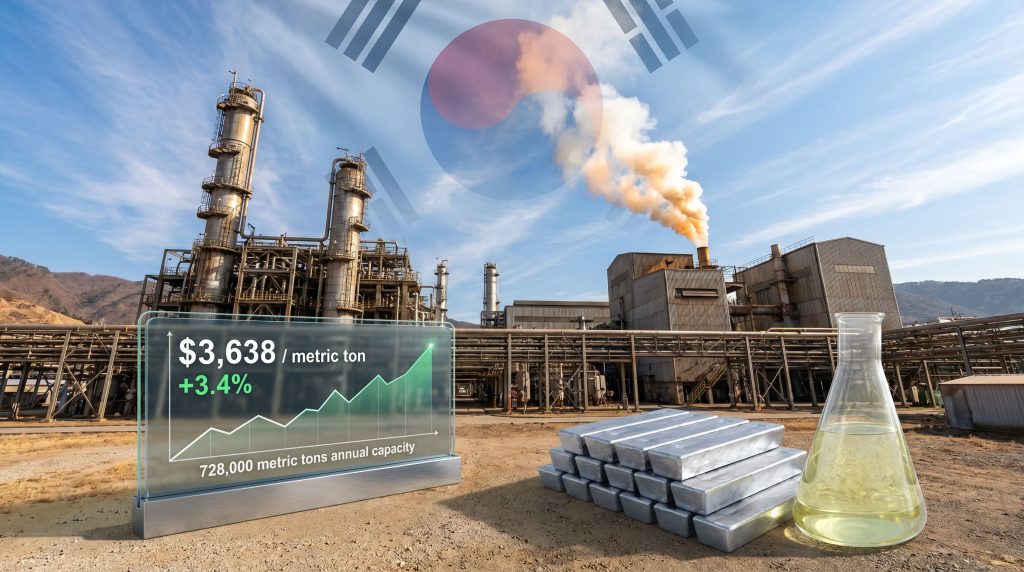
Markets responded swiftly. Zinc prices on the London Metal Exchange surged as much as 3.4% on the day of the incident, reaching $3,638 per metric ton, the highest level recorded since mid-June and placing zinc within proximity of a four-year peak.
| Market Indicator | Detail |
|---|---|
| LME Intraday Price Surge | +3.4%, reaching $3,638 per metric ton |
| Price Context | Highest since mid-June; approaching four-year peak |
| Seokpo Zinc Ingot Capacity | ~400,000 metric tons per annum (stated) |
| Potential Full Recovery Timeline | Up to 4 months for high-purity ingot restoration |
A 3.4% single-session move on a major base metal is not noise. It is a signal. What it reveals is that the zinc market had very little buffer capacity to absorb an unplanned outage of this magnitude. Markets that are well-supplied and elastic in their sourcing do not lurch 3.4% on a single facility fire that was extinguished within an hour.
The speed and scale of this reaction tells analysts something important about the underlying tightness of zinc supply before this event even occurred. Indeed, commodity price impacts of this nature ripple throughout mining company valuations and forward contract positions almost immediately.
Industry observers have noted that restoring high-purity zinc ingot production to pre-disruption levels following a significant acid plant shutdown can require up to four months, even after physical repairs are completed. This is because recertification of product purity, catalyst system integrity, and emissions compliance all require time that physical reconstruction timelines alone do not capture.
Sulphuric Acid: From Byproduct to Bottleneck
One of the least appreciated dynamics in the metals sector right now is the transformation of sulphuric acid from a low-margin smelting byproduct into a strategically critical commodity in its own right. This shift has been driven by converging demand pressures from multiple industrial sectors simultaneously.
The downstream consumers of sulphuric acid from zinc smelters include:
-
Copper refiners that depend on sulphuric acid for heap leach and solvent extraction-electrowinning (SX-EW) operations, particularly in large-scale open-pit copper mines across South America and Africa. In fact, copper leaching operations are among the most acid-intensive processes in the entire base metals industry.
-
Nickel processors utilising hydrometallurgical refining pathways, including high-pressure acid leach (HPAL) technology increasingly used for battery-grade nickel sulphate production
-
Phosphate fertilizer manufacturers who require sulphuric acid to process phosphate rock into monoammonium phosphate (MAP) and diammonium phosphate (DAP), both essential to global agricultural input markets
The HPAL connection is particularly worth noting. As the battery raw materials market scales up to meet electric vehicle supply chain demands, the appetite for high-quality sulphuric acid from reliable smelter sources has grown substantially. Disruptions to acid plant capacity at major smelters now carry implications that extend into the energy transition supply chain.
Compounding this dynamic, ongoing conflict in the Middle East has constrained sulphuric acid supply from several regional production sources and disrupted established trade routes. This geopolitical pressure had already elevated acid's market status before the Seokpo fire introduced a further supply shock. The convergence of geopolitical disruption and industrial accidents at major processing nodes is creating a compounding risk environment for acid-dependent industries globally.
A Pattern of Failures: Seokpo's Safety and Regulatory History
The fire at Young Poong Seokpo zinc smelter cannot be evaluated in isolation. Context matters enormously here, and the context at Seokpo is sobering.
| Incident Type | Year | Outcome |
|---|---|---|
| Wastewater discharge violation | 2019 | Regulatory investigation initiated |
| Arsine gas fatality | December 2023 | 1 subcontractor worker killed |
| Executive accountability | 2023-2024 | CEO and plant director arrested |
| Supreme Court suspension | 2024 | Two-month production halt ordered |
| Sulphuric acid plant fire | Recent | No casualties; significant market disruption |
| Cumulative worker fatalities | 1997 to present | 15 deaths recorded on-site |
The facility has recorded 15 worker fatalities since 1997, a figure that represents one of the more troubling safety records among major global zinc processing operations. In December 2023, a fatal arsine gas exposure incident killed a subcontractor worker on-site. Arsine is an acutely toxic gas that can form during zinc smelting when arsenic-contaminated concentrates contact moisture or acid, and its presence points to specific process chemistry risks within the facility's operations.
Following that fatality, South Korean authorities moved aggressively. Young Poong's CEO and a plant director were arrested under the country's Serious Accident Punishment Act, a piece of legislation specifically designed to impose executive criminal liability for workplace deaths at large enterprises. This represents one of the most significant applications of that law to a major metals producer since its enactment.
In 2024, South Korea's highest court rejected an appeal from the zinc smelter against its shutdown, ordering a two-month operational suspension of the facility in connection with unauthorised wastewater discharge violations. This precedent is critical for understanding the regulatory risk scenario that now confronts the company following the acid plant fire.
Given Young Poong's documented regulatory history, the probability that South Korean authorities use the current fire as a basis for compliance review or further operational restrictions is not a remote tail risk. It is a scenario that market participants must assign meaningful probability weight.
The next major ASX story will hit our subscribers first
Scenario Analysis: How Long Could the Disruption Last?
Zinc buyers, traders, and supply chain planners face genuine uncertainty about the duration and depth of this disruption. Three plausible scenarios frame the range of outcomes:
Scenario 1: Contained Damage, Rapid Restart (One to Four Weeks)
- Physical damage limited to peripheral acid plant equipment
- Core zinc smelting operations resume quickly with temporary acid handling adjustments
- Market impact dissipates; LME price spike proves transient
Scenario 2: Extended Acid Plant Shutdown (One to Three Months)
- Structural damage to catalytic converter systems or acid absorption towers requires sustained repair work
- Sulphuric acid supply into downstream copper, nickel, and fertilizer markets tightens materially
- Zinc production continues at reduced throughput; ingot quality certification timelines extend
Scenario 3: Regulatory-Triggered Extended Suspension (Three to Six Months)
- South Korean regulators, drawing on the facility's compliance history, impose a comprehensive operational review or further suspension
- Full high-purity zinc ingot production restoration requires up to four months even after regulatory clearance is obtained
- Sulphuric acid supply disruption extends across multiple quarters, affecting agricultural input pricing cycles
The third scenario is arguably the most consequential and the most underappreciated by markets focused solely on the physical fire damage assessment. Young Poong's track record means regulators have both the institutional motivation and the legal mandate to act decisively.
What This Means for Zinc Market Participants
For different categories of market participants, the strategic implications diverge considerably. In addition, the broader context of critical minerals demand means the downstream consequences of this disruption touch sectors well beyond traditional base metals.
-
Physical zinc buyers in the galvanised steel and automotive sectors should review spot versus forward contract positioning and assess whether current inventory buffers are adequate for a multi-month disruption scenario
-
LME traders should evaluate whether the 3.4% intraday price spike represents a momentary sentiment reaction or the opening move in a sustained supply-driven re-rating of zinc toward and potentially beyond the four-year peak level
-
Copper and nickel producers operating SX-EW or HPAL facilities should audit their sulphuric acid procurement exposure and identify alternative supply sources given the tightening acid market
-
Agricultural input buyers and fertilizer manufacturers, particularly those sourcing MAP and DAP, should factor potential acid supply tightening into forward procurement planning
Frequently Asked Questions: Young Poong Seokpo Zinc Smelter Fire
What caused the fire at the Seokpo smelter?
The fire originated within the facility's sulphuric acid production unit at approximately 12:36 local time in North Gyeongsang province. The specific ignition cause had not been publicly confirmed at the time of initial reporting.
Were there any casualties?
No casualties or toxic gas leaks were reported. Emergency teams extinguished the fire within approximately one hour of ignition.
How did the fire affect zinc prices?
Zinc prices on the LME rose as much as 3.4% on the day, reaching $3,638 per metric ton, the highest level since mid-June and approaching a four-year peak.
Why does a sulphuric acid plant fire matter beyond zinc production?
Sulphuric acid produced at zinc smelters feeds directly into copper refining, hydrometallurgical nickel processing, and phosphate fertilizer manufacturing. Disruption to a major acid plant therefore carries multi-sector downstream consequences across agricultural, battery metals, and base metals supply chains.
Does Young Poong have a history of safety issues at Seokpo?
The facility has recorded 15 worker fatalities since 1997, experienced a fatal arsine gas exposure in December 2023, and was subject to a Supreme Court-ordered two-month production suspension in 2024 following wastewater violations. The company's CEO and a plant director were arrested under South Korea's Serious Accident Punishment Act following the 2023 fatality.
Key Takeaways for Analysts and Investors
The fire at Young Poong Seokpo zinc smelter is best understood not as a discrete industrial accident but as a stress-test event that has exposed pre-existing structural vulnerabilities across both the zinc and sulphuric acid markets. Several conclusions stand out:
-
The 3.4% LME price reaction confirms that zinc supply buffers were already thin before this event, and markets lacked the absorption capacity to treat a single major smelter disruption as inconsequential
-
Sulphuric acid has completed its transition from peripheral byproduct to strategically significant commodity, with disruptions at major smelter acid plants now carrying multi-sector downstream consequences including for battery metals and food production inputs
-
Young Poong's documented regulatory and safety history elevates the probability of regulatory-driven extended shutdowns beyond what physical fire damage timelines alone would suggest
-
The convergence of geopolitical acid supply constraints from Middle Eastern conflict and this industrial disruption is creating a compounding risk environment that acid-dependent industries may not be fully pricing
-
Market participants across zinc, copper, nickel, and agricultural commodity sectors should treat this event as a signal of broader supply chain fragility rather than an isolated operational incident
This article is intended for informational purposes only and does not constitute financial or investment advice. Commodity markets involve significant risk, and forward-looking statements and scenario analyses presented here are speculative in nature. Readers should conduct their own due diligence before making any investment or procurement decisions.
Want to Know When Zinc Supply Shocks Create ASX Investment Opportunities?
Events like the Young Poong Seokpo fire demonstrate precisely how rapidly commodity supply disruptions translate into significant market movements — and Discovery Alert's proprietary Discovery IQ model ensures subscribers receive real-time alerts on significant ASX mineral discoveries the moment they are announced, turning complex market signals into actionable investment opportunities. Explore how historic mineral discoveries have generated substantial returns by visiting Discovery Alert's dedicated discoveries page, and begin your 14-day free trial today to position yourself ahead of the next major market-moving event.