July 10, 2026
When Peace Feels Certain, Markets Get Burned
Global oil markets have always struggled with one particular cognitive trap: the tendency to price in resolution before it arrives. Across decades of Middle Eastern conflict cycles, from the Gulf crises of the 1970s and 1990s through the Iraq War era, traders have repeatedly front-run diplomatic outcomes that either failed to materialise or proved far more fragile than anticipated. The human instinct to discount future risk once negotiations begin is well documented in behavioural finance, and in commodity markets, that instinct can be expensive.
The Iran war and OPEC market share race now unfolding represents one of the most complex geopolitical stress tests the global oil order has faced in a generation. It combines active military conflict, reimposed sanctions enforcement, contested maritime chokepoints, and internal cartel fracture into a single, compounding risk event. Understanding how each of these forces interacts, and where they are likely to lead, requires moving beyond headline price movements and into the structural mechanics of producer incentives, coalition durability, and demand behaviour under stress.
When big ASX news breaks, our subscribers know first
How Markets Mispriced the Ceasefire and Paid for It
When U.S. and Iranian negotiators struck a preliminary ceasefire agreement in mid-June 2026, oil markets responded with what can only be described as aggressive optimism. Risk premiums collapsed, traders positioned for a supply surge as stranded tankers were expected to clear the Strait of Hormuz, and the dominant narrative shifted almost overnight from supply crisis to looming glut.
That positioning proved costly. When hostilities resumed and the ceasefire was declared void, Brent crude surged more than 7% in a single session — a textbook illustration of what happens when markets treat preliminary diplomatic progress as a fait accompli. The asymmetric price response was notable: the rebound on renewed conflict was sharper than the initial compression had been, reflecting the accumulated uncertainty baked into positions built on shaky diplomatic foundations.
Goldman Sachs had already flagged the risk of fresh supply disruptions, while the IMF, updating its global growth projections amid renewed hostilities, downgraded its forecast to 3%. These were not fringe warnings. Yet the dominant sentiment had already moved past them, pricing in a post-war normalisation that had not been earned through any structural security guarantee. The broader consequences for oil trade and geopolitics were significant, reshaping buyer-supplier relationships across importing economies.
The lesson embedded in this episode is one that repeats across commodity market history: when peace is priced before it is secured, the correction upon renewed conflict is amplified by the unwinding of positions that should never have been built in the first place.
The Strait of Hormuz: Understanding the Physical Chokepoint
Before examining OPEC's internal fractures, it is worth grounding the analysis in the physical geography that makes this conflict so consequential. The Strait of Hormuz is a narrow passage between Iran and Oman through which roughly 20% of globally traded crude oil transits. No other single waterway concentrates so much energy trade risk in so small a geographic space.
When tanker traffic ground to a halt following the latest U.S.-Iran escalation, the consequences were immediate and measurable:
| Metric | Detail |
|---|---|
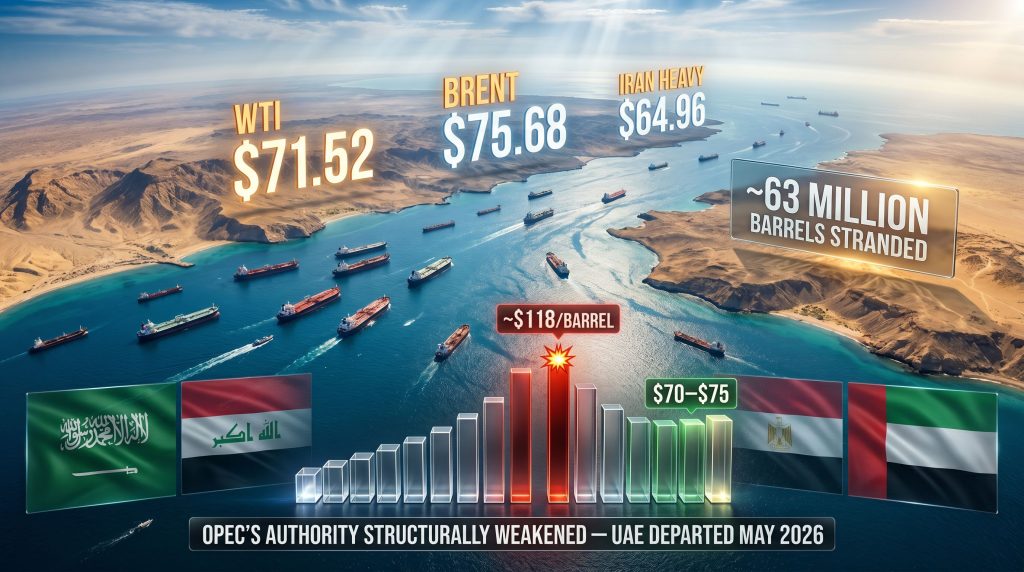
| Estimated crude stranded at sea | ~63 million barrels during peak disruption |
| Saudi Arabia June export volume | ~4.5 million bpd |
| Saudi Arabia July projected exports | ~6.4 million bpd (near pre-war levels) |
| OPEC+ cumulative output increase since war began | ~800,000 bpd |
| Agreed August production increase (7 key producers) | 188,000 bpd |
| Brent peak during conflict | ~$118/barrel |
| Brent post-ceasefire level | ~$70-$75/barrel |
The volume of crude stranded at sea during peak disruption — roughly 63 million barrels — is not an abstract figure. It represents real supply that importing economies were not receiving, and which importers scrambled to replace through strategic reserve draws, emergency procurement contracts, and import rationing. Pakistan's emergency LNG purchase after a Qatari cargo cancellation is one of the more vivid examples of the cascading logistical consequences that radiate outward from a single chokepoint crisis. Furthermore, the LNG supply outlook for the region shifted dramatically as buyers sought alternative sources under urgent conditions.
One detail that receives insufficient attention is how tanker insurance markets respond to Hormuz escalation. War risk premiums on tanker voyages through the strait can spike dramatically within hours of a hostile incident, effectively pricing smaller operators out of the route entirely even before any physical blockade is established. This insurance-driven supply restriction is a form of covert disruption that adds to the headline barrel count without involving a single missile.
The Iran War and OPEC Market Share Race: Defining the Dynamic
The term market share race, as applied to the current Iran war and OPEC market share race dynamic, refers to something specific. It describes the competitive push by Gulf oil exporters to maximise their export volumes and recapture revenue in the period following a supply disruption, when shipping lanes reopen and stored inventory becomes mobilisable.
Historically, every major Hormuz disruption has been followed by precisely this kind of scramble. However, the difference in 2026 is that several complicating factors have arrived simultaneously:
- The UAE formally exited OPEC in May 2026, removing one of the group's highest-capacity members from any quota framework
- Iraq has publicly threatened to pursue an exit of its own if its production quota demands are not accommodated
- Seven key OPEC+ producers agreed to increase collective output by 188,000 bpd from August 2026, even as the conflict continues
- Brent crude, which peaked at approximately $118/barrel during the most intense phase of conflict, had retreated to the $70-$75 range by the time partial ceasefire conditions allowed some tanker flow to resume
The paradox sitting at the heart of the market share race is this: the same producers who are adding supply to recover lost revenue are simultaneously depressing the price they need to balance national budgets. Saudi Arabia's fiscal breakeven is estimated at approximately $80-$85/barrel. Iraq's is estimated above $90/barrel. Both countries are producing at or toward capacity while Brent trades well below those thresholds. According to reporting from Barron's, the Iran conflict has materially hobbled OPEC's power to shape oil markets in the way it once could.
OPEC Member Interests: A Framework for Understanding the Fracture
The internal tensions within OPEC are not new, but the current confluence of war, revenue pressure, and membership defections has brought them into unusually sharp focus.
| Member | Production Ambition | Budget Breakeven (est.) | OPEC Loyalty Risk |
|---|---|---|---|
| Saudi Arabia | Moderate growth, price discipline | ~$80-$85/barrel | Low – leads cartel |
| UAE | Aggressive expansion | ~$65/barrel | Departed May 2026 |
| Iraq | High growth demand | ~$90+/barrel | Elevated – exit threatened |
| Kuwait | Moderate | ~$70/barrel | Medium |
| Russia (OPEC+) | Volume recovery post-sanctions | ~$60-$70/barrel | Medium-High |
Iraq's position is particularly instructive. With a budget breakeven above $90/barrel and a government that depends on oil revenues to fund public sector wages and social spending, Baghdad has structurally misaligned incentives relative to Riyadh. Saudi Arabia's sovereign wealth cushion, combined with its position as the lowest-cost producer in the group, gives it the ability to tolerate prolonged price suppression that would create genuine fiscal crisis for Iraq within months.
This asymmetry is the structural fault line that has always made OPEC vulnerable. Consequently, the UAE's departure accelerated the timeline for confronting it.
Three Scenarios for OPEC's Future
Scenario 1: Prolonged Conflict Preserves Cartel Relevance
If the Iran war extends deep into 2026 and beyond, the supply disruption story dominates. Under this scenario, Gulf producers retain a shared incentive to maintain OPEC coordination as a price support mechanism. The historical parallel from the 1973 and 1990 Gulf crises is relevant: both periods of elevated geopolitical tension ultimately reinforced producer solidarity despite internal disagreements, because the shared threat concentrated minds on collective price management rather than volume competition. OPEC's global influence has historically proved most durable precisely during periods of external pressure.
Scenario 2: Rapid Ceasefire Triggers the Glut Scenario
If hostilities cease quickly and Hormuz fully reopens, the conditions for an oversupply scenario become credible. Some analysts have flagged Brent testing the $60-$65/barrel range under this outcome. The UAE, unconstrained by quota obligations following its May 2026 exit, would be positioned to pursue maximum production targets independently, adding a significant non-coordinated supply vector. OPEC's ability to enforce collective restraint would likely collapse under the combined revenue pressures of individual member states.
Scenario 3: Saudi-Led Rump Coalition
The intermediate outcome sees Saudi Arabia attempt to hold a reduced coordination framework together, potentially anchored around Kuwait and select Gulf Cooperation Council members, while Iraq, UAE, and others pursue independent strategies. Under this scenario, Brent likely stabilises in the $65-$75 range, as partial coordination partially offsets oversupply pressure without eliminating it.
The $40/barrel scenario cited by some forecasters is not a base case. It requires simultaneous OPEC dissolution, demand weakness, and unconstrained non-OPEC supply growth to all materialise at once. Analysts who cite it acknowledge it as a tail-risk outcome designed to illustrate the boundaries of the distribution, not the centre.
The next major ASX story will hit our subscribers first
Why Demand Behaviour Undermines the Glut Thesis
One of the most underappreciated dynamics in the current market debate is how demand actually responds to supply shocks and price swings. The dominant glut narrative assumes demand recovers slowly, allowing supply to outrun consumption. Historical evidence challenges this assumption in a specific and important way.
When oil prices surge sharply, demand does not fall quickly. The reason is structural: petroleum products are embedded deeply enough in global transportation, manufacturing, and logistics networks that consumers and firms absorb higher prices for extended periods before meaningfully changing behaviour. The emergency measures rushed through by governments during the current conflict — including strategic reserve draws, import rationing, and emergency procurement deals — are evidence of this demand resilience. These are not the actions of economies that are easily reducing their oil dependency.
Conversely, when prices fall sharply, demand recovery tends to be faster than analysts expect, again because the underlying demand base is large and price-sensitive in the downward direction.
India's behaviour during the conflict illustrates this clearly. Despite Hormuz shipping risks, Indian refiners resumed Iraqi crude imports, demonstrating that price incentives at the refinery level override logistical caution when the economics are compelling enough. In addition, India has signalled potential interest in returning to Iranian crude purchases if U.S. sanctions waivers are extended, adding another demand-side variable to an already complex picture. The broader trade war oil impacts have further complicated demand forecasting across Asian importing economies.
The LNG Market as a Conflict Spillover Zone
The Iran war has not confined its market disruptions to crude oil. The LNG market, which had already reached record global trade volumes in recent years, has been meaningfully disrupted by Middle East instability.
Several dynamics are worth tracking:
- U.S. LNG exporters have captured windfall revenues as Middle East supply uncertainty elevated shipping fees and spot market premiums
- Pakistan's emergency LNG procurement following a Qatari cargo cancellation illustrates how quickly a single disruption event can cascade through a regional supply chain
- ADNOC signed a 15-year LNG supply deal with Japan's Inpex during the conflict period, a signal that long-term energy security contracting accelerates rather than pauses during geopolitical instability
- Russia's LNG export capacity faces concurrent pressure from Ukraine's drone campaign against energy infrastructure, with Russian diesel exports banned following refinery damage
The LNG market insight worth emphasising is counterintuitive: major supply contracts tend to get signed faster during crises, not slower. Buyers who were previously comfortable with spot market exposure suddenly prioritise long-term security of supply, which plays directly into the commercial strategies of major LNG exporters. ADNOC's deal with Inpex is a direct expression of that dynamic.
Russia's Parallel Crisis and What It Reveals
Russia's position within the OPEC+ framework adds another layer of complexity to the Iran war and OPEC market share race analysis. As an OPEC+ member, Russia agreed to the collective August output increase of 188,000 bpd. However, Russia's domestic situation tells a very different story.
Ukraine's drone strikes on Russian refineries have disrupted domestic fuel production severely enough that Russia has banned diesel exports entirely. Urals crude has crashed to approximately $42/barrel, a dramatic compression that combines Western sanctions pressure with the physical infrastructure damage from the refinery strikes. Russia's oil windfall from the early conflict period has effectively evaporated.
This matters for OPEC+ cohesion because it means Russia's incentives within the coalition are being shaped by entirely different pressures than those affecting Gulf producers. Moscow needs revenue desperately, but its ability to consistently deliver on production commitments is structurally impaired in a way that Saudi or Emirati production capacity is not. The growing divergence between member state interests has accelerated the oil prices and trade war pressures that were already reshaping global energy trade flows before the conflict began.
The Case for OPEC's Long-Term Survival
Despite the structural pressures, the rational self-interest argument for some form of continued producer coordination is stronger than the dissolution narrative suggests. Even the UAE, which departed OPEC in May 2026 to pursue unconstrained production growth, would face severe fiscal stress if Brent fell to $40-$50/barrel. Abu Dhabi's fiscal breakeven, estimated at approximately $65/barrel, sits well above the extreme glut scenario. Maximum production at a price that destroys revenue is not a sustainable strategy.
The collective action problem at the heart of OPEC has always resolved itself eventually, because the alternative — a full price war with no coordination mechanism — damages every participant including the most competitive producers. Saudi Arabia's unique position as the world's lowest-cost producer with the largest proven reserves gives Riyadh the structural capacity to inflict price pain on any competitor that pursues aggressive volume strategies, a credible deterrent that has repeatedly brought wayward members back toward coordination. For instance, Reuters analysis suggests OPEC itself may be the likely loser in the Gulf's post-war race for market share, precisely because this internal contradiction cannot be resolved cleanly.
Three questions will define the post-war oil order:
- Will the conflict end quickly enough to allow a managed and orderly supply re-entry, or will prolonged disruption permanently redirect trade routes and buyer-supplier relationships in ways that are difficult to reverse?
- Can Saudi Arabia rebuild sufficient OPEC discipline following the UAE's departure and Iraq's explicit threats, or has the cartel's governance architecture been fundamentally compromised?
- Will the predicted supply glut actually materialise, or will demand recovery — historically faster than consensus forecasts anticipate — absorb excess supply before prices collapse to the levels some analysts have projected?
Frequently Asked Questions: Iran War and OPEC Market Share Race
What is the OPEC market share race in the context of the Iran war?
The market share race describes the competition among Gulf oil producers to maximise export volumes and recapture revenue following the supply disruption caused by the U.S.-Iran conflict. As tanker flows through Hormuz partially resumed, producers began racing to clear stored inventory and restore their buyer relationships, often at the cost of lower official selling prices.
How much has the Iran war moved oil prices?
Brent crude surged to approximately $118/barrel during peak conflict intensity and retreated to the $70-$75 range following partial ceasefire conditions. Multiple individual sessions saw 6-7% intraday price spikes as ceasefire negotiations collapsed and Iranian attacks on commercial vessels resumed.
Is OPEC breaking apart because of the Iran war?
OPEC's structural authority has been meaningfully weakened. The UAE's formal departure in May 2026 and Iraq's explicit threats to exit have reduced the cartel's cohesion. However, rational self-interest in price floors creates a natural incentive for eventual re-coordination, making full dissolution a risk scenario rather than a base case.
Why does the Strait of Hormuz matter so much to oil markets?
The Strait of Hormuz is the transit point for approximately 20% of globally traded crude oil. Iranian military control over access to the strait gives Tehran significant leverage over global energy flows. During peak disruption, approximately 63 million barrels of crude were stranded at sea, and tanker insurance war risk premiums made the route commercially unviable for many operators even before any formal closure.
Could oil prices fall to $40/barrel after the war ends?
The $40/barrel scenario requires simultaneous OPEC dissolution, meaningful demand weakness, and fully unconstrained non-OPEC supply growth to all converge at once. Most base-case post-war scenarios place Brent in the $60-$75 range, with the outcome depending heavily on the pace of supply re-entry and the speed of demand recovery.
This article contains forward-looking analysis and scenario modelling that involves inherent uncertainty. Price projections referenced reflect third-party analyst estimates and should not be treated as investment advice or guaranteed outcomes.
Want to Stay Ahead of the Next Major Resource Discovery?
While geopolitical shocks continue to reshape global commodity markets, Discovery Alert's proprietary Discovery IQ model delivers real-time alerts on significant ASX mineral discoveries, transforming complex market data into clear, actionable insights for investors at every level — explore historic discoveries and their returns to see what early positioning can mean, then begin your 14-day free trial to secure a genuine market-leading edge.