July 10, 2026
Europe's Industrial Backbone Under Pressure: When Rivers Dictate Steel Supply
Bulk commodity logistics rarely attract the attention they deserve until something goes wrong. Rhine water levels slow EU steel feedstock trade in ways that expose a structural fragility embedded in the very geography of European industry. The movement of steel raw materials across central Europe operates largely out of public view, flowing silently through an arterial network of inland waterways that underpins the continent's manufacturing base. When that network falters, the consequences ripple outward far faster than most market participants expect.
The Rhine River, stretching more than 1,200 kilometres from the Swiss Alps to the North Sea coastline of the Netherlands, is the central nervous system of this logistics architecture. For steel producers, metals recyclers, and raw material traders across Germany, Switzerland, Belgium, and the Netherlands, the river is not merely a transport option. It is the default, and often the only practical, mechanism for moving the enormous volumes of ferrous scrap, metallurgical coal, and iron ore that modern steelmaking demands.
When big ASX news breaks, our subscribers know first
The Kaub Chokepoint: Understanding Europe's Most Consequential Water Gauge
Not all sections of the Rhine carry equal commercial weight. The gauge station at Kaub, situated along the middle Rhine west of Frankfurt, holds an outsized role in European commodity markets precisely because it represents the river's most constrained navigable passage. The geology of the riverbed at this location creates a natural bottleneck, and even modest reductions in water depth translate into disproportionately severe restrictions on barge loading capacity.
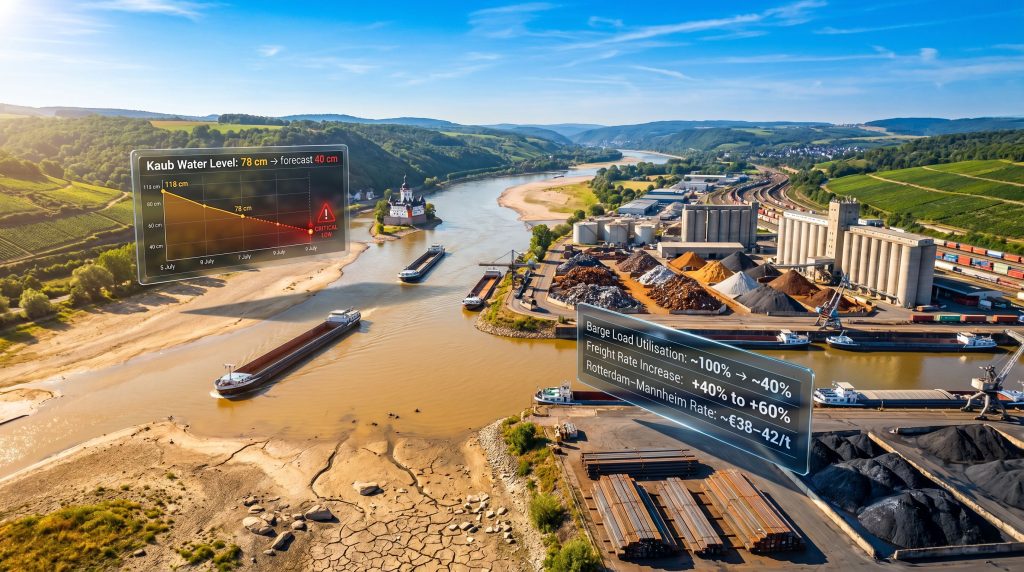
Data from Germany's federal waterways and shipping administration, the WSV, confirm that water levels at Kaub fell sharply to 78 cm as of the afternoon of 9 July 2025, a decline from 85 cm recorded the previous day and a dramatic drop from 118 cm on 5 July. That represents a reduction of more than 33% within four days, a rate of decline that compresses procurement timelines and forces logistics teams into reactive, high-cost decision making almost immediately.
Forecasts pointing toward 40 cm are particularly alarming for the industry. This threshold functions as a practical ceiling below which commercial navigation ceases to be economically viable. At that depth, the tonnage a barge can safely carry shrinks to levels that make the economics of river freight structurally unworkable, regardless of how urgently the cargo is needed downstream.
When Kaub water levels approach the 40 cm mark, the Rhine's role as a bulk freight corridor effectively suspends. This is not a gradual degradation — it is closer to a switch being thrown on a significant portion of central Europe's raw material distribution network.
How Shallow Water Destroys Freight Economics
The relationship between river depth and barge economics is non-linear, and this non-linearity is what makes Rhine low-water events so commercially devastating in practice. A barge operating in shallow water must reduce its draught, which means offloading cargo to maintain the minimum clearance between the hull and the riverbed. The shallower the water, the greater the load reduction required.
Under current conditions, market participants have reported that vessels are capable of loading only around 40% of their standard cargo capacity. This single figure restructures the entire freight equation:
- A single barge voyage that previously moved a full load now requires two to three vessels to replicate the same tonnage
- Vessel demand multiplies simultaneously with supply constraints, creating an acute squeeze on available capacity
- Each additional voyage compounds fuel, crew, lock transit, and port handling costs across the supply chain
- Procurement teams face a choice between paying dramatically elevated freight rates or deferring material inflows entirely
The freight rate data currently circulating in the market reflects this dynamic. Rates for the Rotterdam-to-Mannheim corridor, a critical artery connecting Europe's largest port to the southern German industrial heartland, have risen to approximately €38 to €42 per tonne (equivalent to roughly $43 to $48 per tonne). Furthermore, market participants have reported overall rate increases of 40 to 60% above normal waterway conditions.
| Freight Metric | Normal Operating Conditions | Current Low-Water Conditions |
|---|---|---|
| Barge load utilisation | ~100% of capacity | ~40% of capacity |
| Vessels required per equivalent load | 1 | 2 to 3 |
| Freight rate change vs. baseline | Baseline | +40% to +60% |
| Rotterdam to Mannheim spot rate | Below baseline | ~€38 to €42/t ($43 to $48/t) |
Historical comparisons from extreme low-water events provide a stark illustration of how severe these economics can become. During past drought episodes, distillate barge freight rates along comparable European inland waterway routes escalated from around $5 per barrel to above $30 per barrel, a sixfold increase driven entirely by depth constraints rather than demand fundamentals.
Steel Mills and Recyclers: The Operational Reality of Dual-Mode Failure
The current disruption is compounded by a logistical coincidence that has amplified the pressure on steel feedstock procurement across Germany. Rail services, which would ordinarily serve as the primary substitute for waterway transport during Rhine restrictions, are simultaneously experiencing cancellations and capacity shortfalls. The result is a dual-mode failure scenario in which neither of the two dominant bulk transport mechanisms is performing adequately.
Steel mill operators are reporting that raw material inventories have fallen to critically low levels. The combination of reduced barge loading capacity and lost train services has left procurement teams without viable routes to replenish stocks at the pace required for continuous production. Mills that had calibrated their buffer stock strategies around historical Rhine disruption windows are finding those assumptions insufficient for the current rate of water level decline.
For metals recyclers, the disruption manifests differently but carries similarly serious implications. Inbound scrap collection volumes depend on the same barge capacity that is now operating at a fraction of its normal throughput. Recyclers are finding that their customers — many of whom are the same steel mills struggling with raw material shortfalls — are pivoting toward alternative transport arrangements at speed, accepting the cost premium as a necessary operational expense.
The challenge with that pivot is substantial. Road freight networks are not engineered to absorb bulk commodity volumes at the scale that Rhine barges normally handle. A single standard Rhine barge can carry the equivalent of roughly 40 large trucks worth of cargo under optimal conditions. Replicating that capacity through road transport during a sustained disruption creates congestion effects, driver availability constraints, and infrastructure strain that further limit the effectiveness of modal substitution.
Historical data from comparable Rhine low-water disruption periods suggests that a sustained 30-day restriction can reduce industrial output across Rhine-dependent sectors by approximately 1% and compress total freight transport volumes by between 15% and 25% over the affected period.
What Does This Mean for Broader Steel Markets?
These supply chain pressures do not occur in isolation. Rhine water levels slow EU steel feedstock trade at a time when the China steel and iron ore market is itself navigating significant headwinds, adding another layer of complexity to global supply dynamics. In addition, the global crude steel outlook for 2025 already reflects considerable uncertainty, meaning that European logistical disruptions compound rather than offset existing market pressures.
Furthermore, understanding the iron ore market impacts from trade tariffs alongside these logistics constraints is essential for procurement teams trying to model feedstock costs accurately. The interplay between trade policy and physical supply chain disruption is increasingly difficult to disentangle.
Climate Drivers: Why This Is Becoming Structurally More Frequent
The immediate cause of the current water level decline is the combination of sustained high temperatures and a precipitation deficit across southern and western Germany. Germany's national meteorological service, the DWD, has flagged temperatures exceeding 30 degrees Celsius across the affected regions heading into the weekend of 12 to 13 July, with no meaningful rainfall forecast within the near-term window. Elevated temperatures accelerate evaporation from the river surface and reduce tributary inflows, producing a compounding effect at constrained bottleneck sections like Kaub.
What makes this episode particularly significant from a structural perspective is the trajectory it represents rather than the event itself. Severe low-water restrictions on the Rhine are no longer unusual occurrences.
| Low-Water Event Year | Key Impact on Rhine Freight and Industry |
|---|---|
| 2018 | Severe navigability restrictions; major reductions in industrial output across Rhine corridor |
| 2022 | Near-closure conditions; cascading disruptions in energy, chemical, and steel supply chains |
| 2024 | Repeated low-water episodes; inland transport volume declines of approximately 25% over affected periods |
| 2025 | Rapid depth decline at Kaub from 118 cm to 78 cm within four days; freight rates up 40 to 60% |
The frequency and severity of these events has increased noticeably over the past decade. Climatological analysis points to a long-term decline in baseline Rhine water levels driven by reduced Alpine snowpack, shifting precipitation patterns across central Europe, and the intensification of summer heat events. Each major drought year tends to set a new reference point for how low the river can fall, and those reference points are trending downward over time.
Which Steel Feedstocks Face the Greatest Exposure
The three primary steel feedstocks that flow through the Rhine corridor each carry different exposure profiles to low-water disruptions. However, understanding those differences matters for anticipating where price pressure will emerge first.
Ferrous scrap carries the highest immediate exposure. Significant volumes of collected scrap metal move from German and eastern European collection points to Dutch and Belgian steelmakers via Rhine barge, and this flow is directly interrupted when barge capacity contracts. Scrap is also a spot-traded commodity with relatively thin inventory buffers at mill sites, meaning supply disruptions translate into price pressure faster than for materials held in larger strategic stockpiles.
Metallurgical coal and iron ore face a different but equally real constraint. These materials typically arrive at Rotterdam via ocean-going bulk carriers and are then redistributed inland via Rhine barges to steel plants in Germany and Switzerland. When barge capacity at Kaub is constrained, the inland distribution leg of the seaborne import chain effectively becomes a bottleneck, even if the oceangoing deliveries continue on schedule.
Cross-commodity competition for available barge capacity further compounds the problem for steel feedstock buyers. The Rhine simultaneously serves the chemicals sector, agricultural commodity traders, and energy product distributors. During a low-water event, all of these sectors compete for the same reduced pool of available vessels, and those with the highest-value cargoes can often outbid steel feedstock shippers for available capacity. The broader context of green steel pricing dynamics and the China steel outlook for 2025 add further complexity to how European mills manage input cost pressures during these disruption windows.
The next major ASX story will hit our subscribers first
The Systemic Risk Dimension: Beyond Individual Disruption Events
Each Rhine low-water episode that passes without triggering fundamental changes to supply chain architecture reinforces a pattern of reactive rather than preventive industry behaviour. The economic cost of repeated disruptions is ultimately borne by steel consumers through higher delivered product prices, but the structural investment required to reduce that vulnerability tends to be deferred because the events are episodic rather than continuous.
Several adaptation pathways are gaining traction within the industry, though each carries its own limitations:
- Strategic raw material buffer stocks: Holding larger on-site inventories reduces exposure to short-duration disruptions but requires capital commitment and storage infrastructure that many mill operators have historically been unwilling to fund
- Long-term modal diversification contracts: Pre-negotiated rail and road freight capacity arrangements provide guaranteed alternatives when Rhine conditions deteriorate, but securing these contracts at reasonable rates requires market power that smaller operators may lack
- Port-side storage expansion: Increasing bonded storage capacity at Rotterdam and Antwerp allows importers to decouple seaborne arrival timing from inland distribution scheduling, reducing the urgency of barge movements during shallow-water periods
- Real-time monitoring integration: Embedding Rhine water level data feeds directly into logistics management platforms enables faster modal switching decisions, reducing the lag between condition deterioration and procurement response
The deeper structural issue is that European inland waterway infrastructure investment has not kept pace with either the growing volume of commodity traffic the Rhine is expected to support or the increasing frequency of climate-driven disruption events. Dredging and river management programmes have historically offered limited relief at geological bottlenecks like Kaub, where the river's natural topography constrains engineering solutions.
As Rhine low-water events become statistically more frequent, the logistics risk premium embedded in European steel feedstock pricing will expand. Buyers and sellers who fail to incorporate Rhine disruption probability into their contract structures and procurement models are accepting an increasingly visible and quantifiable unhedged exposure.
Frequently Asked Questions: Rhine Water Levels and Steel Feedstock Trade
What water depth at Kaub signals commercial shipping breakdown?
Water levels at Kaub falling below approximately 40 cm are generally understood within the shipping industry to represent the practical threshold below which commercial barge navigation becomes economically unviable. At this depth, the load restrictions are so severe that freight economics collapse regardless of market demand.
How much have Rhine freight rates increased during the current episode?
Market participants active on Rhine shipping lanes have reported rate increases of 40 to 60% relative to normal conditions. The Rotterdam-to-Mannheim corridor is currently quoted at approximately €38 to €42 per tonne, reflecting the acute capacity squeeze created by vessels operating at roughly 40% of their standard load. Consequently, procurement teams are absorbing significantly higher input costs with limited ability to offset them through alternative logistics arrangements.
Why can't road and rail transport simply replace Rhine barge capacity?
Road and rail networks are not configured to absorb Rhine-scale bulk commodity volumes at short notice. A single Rhine barge under normal conditions carries the cargo equivalent of dozens of heavy goods vehicles. Replicating that throughput via road transport creates immediate capacity, infrastructure, and cost challenges. Rail offers greater bulk-handling suitability but faces its own bottlenecks, as evidenced by the concurrent train cancellations compounding the current Rhine water levels slow EU steel feedstock trade disruption.
Is the current Rhine low-water event an isolated occurrence or part of a longer trend?
The evidence points strongly toward a structural trend. Major low-water disruptions occurred in 2018, 2022, 2024, and 2025, with climatological analysis suggesting increasing frequency, longer duration, and progressively lower baseline water levels over time. Rhine-dependent industries consequently face an escalating risk profile that extends well beyond any individual seasonal event. The broader implication is that Rhine water levels slow EU steel feedstock trade with increasing regularity, demanding a fundamental reassessment of supply chain resilience across the European steel sector.
Disclaimer: This article is intended for informational purposes only and does not constitute financial or investment advice. Market data, freight rate estimates, and scenario projections are based on available reporting and historical precedent. Actual market outcomes may differ materially from the scenarios described. Readers should conduct independent research and consult qualified advisors before making commercial or investment decisions.
Want to Stay Ahead of Commodity Supply Chain Disruptions Affecting ASX-Listed Resources?
Discovery Alert's proprietary Discovery IQ model delivers real-time alerts on significant ASX mineral discoveries across iron ore, metallurgical coal, and ferrous metals — instantly cutting through market complexity to surface actionable opportunities before the broader market reacts. Start your 14-day free trial today and see why subscribers rely on Discovery Alert to stay ahead, or explore the historic returns major mineral discoveries have delivered to understand the scale of opportunity at stake.