
August 22, 2026
When Markets Sleep But Crises Don't: The Case for 24/7 Energy Futures
Every seasoned commodities trader knows the sinking feeling of arriving at their desk on a Monday morning to find that a weekend geopolitical shock has repriced the entire energy complex overnight, with no way to hedge, no way to respond, and no futures contract available to absorb the risk. For decades, this structural gap between geopolitical reality and market operating hours was an inconvenience. In 2026, the CFTC suspends new 24/7 oil contract proposals while active military conflict reshapes Middle Eastern energy flows on a near-daily basis, turning what was once an inconvenience into a genuine market integrity problem.
When big ASX news breaks, our subscribers know first
The Regulatory Machinery Behind U.S. Futures Market Innovation
How New Derivatives Products Get to Market
The U.S. Commodity Futures Trading Commission serves as the primary regulatory authority over the country's derivatives markets, overseeing exchanges, clearinghouses, and the products they offer. When an exchange wants to list a new futures contract, it has two primary pathways available under CFTC rules:
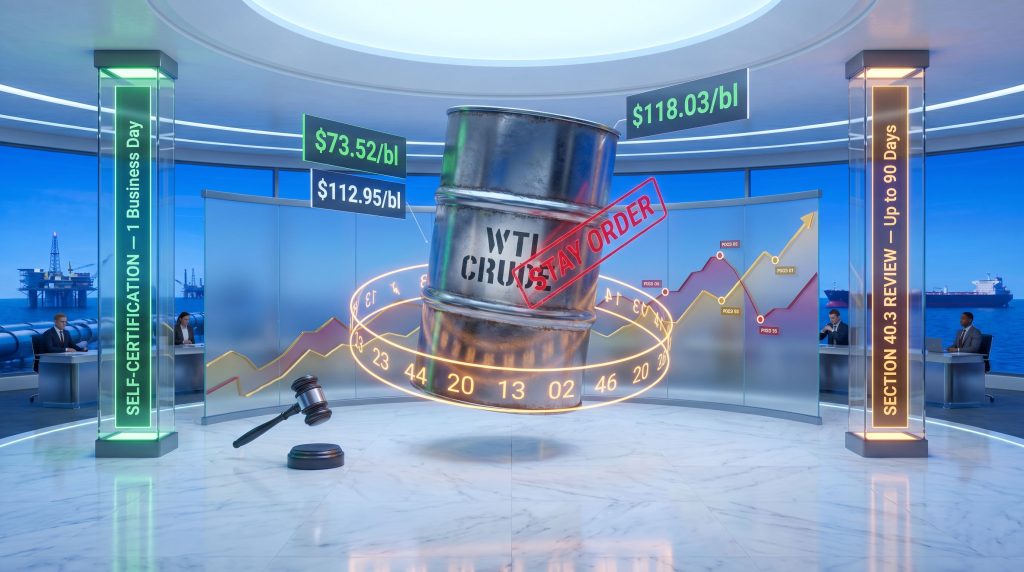
- Self-certification: The exchange certifies internally that a new product complies with applicable federal law and CFTC regulations. Under normal circumstances, a self-certified product can begin trading within a single business day unless the CFTC intervenes with a stay order.
- Section 40.3 voluntary review: The exchange submits the product for a formal CFTC review lasting up to 45 days, extendable by a further 45 days if the product raises what regulators classify as novel or complex issues, bringing the maximum review window to 90 days.
The self-certification pathway exists to allow markets to evolve efficiently without excessive bureaucratic friction. Exchanges use it routinely for straightforward contract variations, minor specification changes, and products that closely resemble existing instruments. The CFTC's authority to stay a self-certification is rarely invoked, which makes each instance a meaningful signal about how the agency views a proposed product's risk profile.
| Review Pathway | Standard Timeline | Extended Review Trigger | Maximum Review Period |
|---|---|---|---|
| Self-Certification | 1 business day | CFTC stay order | Indefinite pending review |
| Section 40.3 Voluntary | 45 days | Novel/complex determination | Up to 90 days |
What Qualifies as a "Novel or Complex" Instrument?
Under CFTC regulatory standards, a product raises novel or complex issues when it introduces structural features, trading mechanics, or market access characteristics that fall outside established precedents. Continuous trading of a physical commodity benchmark, with no defined market close and no expiry date in some proposed configurations, represents a fundamental departure from how U.S. energy futures have historically operated.
No American exchange has ever listed a 24/7 energy futures contract, meaning there is no regulatory template, no existing compliance framework, and no empirical track record to draw upon. That absence of precedent is precisely what triggers extended CFTC scrutiny. Understanding how tariffs affect markets and other regulatory decisions provides useful context for why such interventions carry broad economic implications.
What CME Group Actually Proposed and Why It Matters
Contract Specifications and the Dual-Track Filing Strategy
CME Group's proposed 24/7 WTI crude futures contract was designed to be deliberately accessible. At 10 barrels of West Texas Intermediate crude, the instrument would represent approximately one-tenth the size of CME's existing Micro WTI futures contract, itself already a scaled-down version of the standard 1,000-barrel WTI contract. This micro-sizing strategy was clearly aimed at drawing in retail participants and smaller institutional traders who currently lack cost-effective access to around-the-clock crude price exposure.
CME's target launch date was August 30, 2026, and the exchange took the unusual step of simultaneously filing both a self-certification and a Section 40.3 voluntary review request for the same product. This dual-track approach is uncommon and reflects CME's apparent attempt to preserve optionality: moving quickly via self-certification while also engaging the formal review process.
Alongside the crude oil proposal, CME also submitted a request to list a 1-ounce gold futures contract under a continuous trading structure, signalling that the 24/7 ambition extends well beyond crude oil. For investors considering their exposure, exploring gold investment options across different vehicles can help contextualise these structural market changes.
The Geopolitical Catalyst: Why 2026 Made This Proposal Urgent
The timing of CME's proposal was not coincidental. The U.S.-Iran military conflict, which began in late February 2026, fundamentally altered the geopolitical risk calculus for energy markets. Attacks on infrastructure and shipping lanes across the Mideast Gulf have repeatedly occurred during weekends and overnight hours, precisely when futures markets are closed and hedging is unavailable.
The price impact of these events has been severe. Furthermore, the crude oil price drivers at play during this period illustrate how rapidly geopolitical disruptions can cascade through energy markets. Consider the following data points from the conflict period:
- WTI crude reached a peak of $112.95/bl on April 7, 2026, levels not seen since mid-2022
- Brent crude climbed to $118.03/bl on April 29, 2026, illustrating the sustained upward pressure on global benchmarks
- When the U.S.-Iran ceasefire collapsed and hostilities resumed on July 8, 2026, August Nymex WTI surged $3.08/bl in a single session, settling at $73.52/bl
- Weekend and off-hours attack patterns have repeatedly left traders unable to respond to price-moving events until markets reopen
The proposed 24/7 contract was not simply a product innovation. It was a direct market response to a geopolitical reality in which energy price-moving events are increasingly occurring outside the operating hours of traditional futures exchanges, creating a structural hedging gap that physical market participants cannot currently bridge.
Why the CFTC Intervened: Unpacking the Regulatory Objections
The Stay Order and Its Institutional Significance
On July 9, 2026, the CFTC issued a formal stay order halting CME's self-certification of the 24/7 crude contract. CFTC Chairman Michael Selig stated publicly that CME's decision to pursue self-certification while a formal regulatory review was already underway was wholly inappropriate and required the Commission to act. Selig's language was unusually pointed for regulatory discourse, using the phrase "wholly inappropriate" to describe a major exchange's conduct.
The CFTC's characterisation of the situation as requiring a "thorough review" to assess compliance with federal law signals that the agency views 24/7 energy trading as a genuinely unresolved legal and structural question. In regulatory terms, this kind of public rebuke carries significant weight and is not merely an administrative matter.
Core Regulatory Concerns About Continuous Energy Trading
The CFTC's concerns, as reflected in its public comment request and the stay order, cluster around several interconnected risks:
- Volatility amplification: Thinly traded overnight and weekend sessions could produce exaggerated price swings disconnected from fundamental supply-demand dynamics
- Margin and collateral risk: Rapid price moves during off-hours may trigger margin calls or forced liquidations at times when traditional payment and clearing infrastructure is not fully operational
- Manipulation vulnerability: Reduced liquidity during low-volume sessions creates conditions that could be more susceptible to coordinated price manipulation
- Price discovery integrity: Whether continuous trading would generate prices that accurately reflect real-world supply and demand, or introduce noise from sessions with insufficient participation to anchor price formation
A Regulatory Timeline of Key Events
| Date | Regulatory Action |
|---|---|
| May 29, 2026 | CFTC issues staff advisory on regulatory obligations for 24/7 trading and clearing |
| June 22, 2026 | CFTC opens public comment period; poses 67 questions on 24/7 energy trading and perpetual contracts |
| June 26 – July 8, 2026 | CFTC Chairman Selig conducts at least 9 meetings with oil industry executives and trading firms |
| July 9, 2026 | CFTC issues formal stay order halting CME's self-certification |
| July 27, 2026 | Public comment period scheduled to close |
| August 30, 2026 | CME's originally targeted launch date |
Industry Opposition: Who Met With the CFTC and Why
The Lobbying Landscape Before the Stay Order
Before the CFTC acted, at least nine formal meetings occurred between Chairman Selig and senior figures from the oil industry and commodity trading sector between June 26 and July 8, 2026. Meeting records published by the CFTC identify participants including:
- BP America executive Orlando Alvarez
- ExxonMobil global trading vice president Damon Davis
- Shell Energy North America executive Mario Mendez
- Energy Transfer co-chief executive Tom Long
- Kinder Morgan chief executive Kimberly Dang
- Vitol Americas chief executive Ben Marshall
The consistent framing across these meetings, according to CFTC meeting summaries, centred on concerns, costs, and risks associated with extending energy futures trading to a 24/7 model. The breadth of participation, spanning integrated oil majors, pipeline operators, and trading houses, underscores how broadly the established energy industry is aligned against the proposal in its current form.
Why Physical Market Participants Are Sceptical
The opposition from incumbent energy market participants reflects structural realities that algorithmic traders and fintech-oriented exchanges may underweight. For companies that operate physical assets, the concerns are concrete:
- Operational staffing burden: Continuous markets require around-the-clock risk monitoring, back-office support, and compliance coverage, imposing meaningful fixed cost increases
- Hedging misalignment: Refiners, producers, and utilities make operational decisions during business hours; hedging instruments that trade at 3am on a Sunday create asymmetric risk rather than reducing it
- Clearing system availability: The current architecture of margining and settlement processes is calibrated to business-hour operations; off-hours price dislocations may not be actionable before cascading into the next session
- Systemic contagion risk: A significant off-hours price dislocation in a thin 24/7 session could transmit instability into the following day's liquid session, amplifying rather than absorbing the original shock
The divide between physical hedgers and financial traders is not new. It mirrors earlier conflicts over extended trading hours in equity markets, where institutional participants managing real-world exposures often found that extended sessions introduced volatility without proportional liquidity.
How 24/7 Trading Works in Other Markets
Existing Continuous and Extended-Hours Trading Models
Continuous trading is not without precedent, but its application to physical commodity benchmarks raises questions that pure financial instruments do not. A comparative view helps frame the challenge:
| Market | Trading Hours | Liquidity Profile | Physical Delivery Link |
|---|---|---|---|
| Cryptocurrency | 24/7/365 | Highly variable; thin overnight | None |
| Foreign Exchange (FX) | Near-continuous across time zones | Moderate to high globally | Indirect |
| Equity Futures | Extended but limited | Significantly thinner off-hours | None |
| WTI Crude (current) | ~23 hours/day on CME Globex | Concentrated in U.S. hours | Direct physical delivery mechanism |
The cryptocurrency market is the only major asset class currently operating on a fully continuous basis. Its history offers cautionary data: bid-ask spreads widen substantially during low-volume periods, and instances of significant off-hours price manipulation have been documented in academic and regulatory literature. For a benchmark crude contract that underpins global physical supply agreements, airline fuel hedges, and sovereign budget forecasts, the risk tolerance for price formation noise is considerably lower than for a digital token.
Perpetual Contracts: The Other Innovation in the CFTC's Sights
The CFTC's June 2026 public comment request addressed not only 24/7 trading hours but also the concept of perpetual energy futures contracts. Unlike standard monthly-rolling futures that expire on a fixed schedule, perpetual contracts carry no expiry date. They have become widely used in cryptocurrency derivatives markets, where they allow traders to maintain leveraged positions indefinitely without the friction of rolling into the next contract month.
The CFTC's public consultation signals that the regulatory review extends beyond trading hours to the fundamental structure of energy derivatives. If perpetual crude or natural gas contracts were approved alongside 24/7 trading, the cumulative effect on price discovery, margin dynamics, and market microstructure would be substantial.
This broader scope suggests the CFTC is conducting a systematic market structure review, not simply adjudicating a single contract proposal. In addition, the trade war impact on oil markets has already demonstrated how quickly structural disruptions can cascade across interconnected commodity sectors.
The next major ASX story will hit our subscribers first
What Happens Next: Pathways and Scenarios
The CFTC's Options Following the Stay Order
With the public comment period closing on July 27, 2026, and CME's original launch target of August 30, 2026 creating a compressed decision window, the CFTC faces several possible paths forward:
- Approve the contract through the Section 40.3 process following a completed review, potentially with conditions such as position limits, circuit breakers, or enhanced off-hours margin requirements
- Reject the contract if the review determines it fails to satisfy federal law or CFTC regulations
- Conditional approval with structural modifications designed to address identified risks while preserving the innovation's market access benefits
- Extend the review period beyond August 30 if the novel and complex issues require additional analysis, effectively delaying the launch indefinitely
Scenarios and Their Market Implications
| Scenario | Key Driver | Likely Market Impact |
|---|---|---|
| Approved with conditions | Strong comment support + ongoing geopolitical demand | New hedging tool available; limited initial off-hours liquidity |
| Outright rejection | Industry opposition and manipulation concerns prevail | Status quo preserved; CME likely refiles with structural modifications |
| Delayed beyond August 30 | Complexity of issues extends review | Market uncertainty persists; launch window shifts to Q4 2026 or beyond |
| CME voluntary withdrawal | Regulatory relationship management takes priority | Section 40.3 process continues; self-certification friction avoided |
The Broader Stakes: Price Discovery, Precedent, and Market Structure
The CFTC suspends new 24/7 oil contract activity at a moment when WTI and Brent crude benchmarks serve as global reference points for physical supply contracts, refinery margins, airline hedging programmes, and even sovereign fiscal projections in oil-dependent economies. Any structural change to how these benchmarks are formed, particularly one that introduces a continuous trading dimension, has cascading effects across the entire commodity risk management ecosystem.
If the CFTC ultimately approves a 24/7 energy futures framework, the regulatory template it establishes will almost certainly be applied to natural gas, refined petroleum products, and potentially agricultural commodities. The infrastructure investment required from clearinghouses and brokers to support continuous margining, real-time risk monitoring, and around-the-clock settlement would be substantial.
Consequently, the competitive dynamics between U.S. exchanges and international platforms operating in less regulated environments would shift materially. Traders navigating these uncertainties may benefit from reviewing commodity volatility strategies to position themselves appropriately regardless of the regulatory outcome.
Conversely, a rejection or prolonged delay reinforces the structural gap that the proposal was designed to close: a world in which geopolitical events reshape energy markets on weekends and overnight, but regulated price discovery tools remain unavailable until Monday morning. That gap carries its own costs, costs borne disproportionately by market participants who lack the resources to access less-regulated international alternatives.
Disclaimer: This article is intended for informational purposes only and does not constitute financial or investment advice. The regulatory outcome described involves active ongoing processes, and all timelines, scenarios, and market projections represent analysis based on publicly available information as of the date of publication. Readers should consult qualified financial and legal advisors before making trading or investment decisions.
Want to Stay Ahead of Significant Mineral Discoveries on the ASX?
Discovery Alert's proprietary Discovery IQ model delivers real-time alerts the moment significant ASX mineral discoveries are announced, cutting through complex data to surface actionable investment opportunities for traders and investors alike — explore historic discovery returns to understand the potential at stake, and begin your 14-day free trial at Discovery Alert to position yourself ahead of the market.