
July 10, 2026
The Hidden Economics of Trade Remedy Removal: Why Tariff Decisions Reshape Entire Supply Chains
Most industrial tariffs attract little public attention, yet their removal can trigger cascading effects across manufacturing ecosystems that take years to fully materialise. When a government strips away a protective trade measure affecting a core industrial input, the consequences extend far beyond import statistics. Argentina removes anti-dumping duties on Chinese aluminium tubes in a move that has significant implications for pricing structures, sourcing relationships, and domestic producers who must rapidly reassess their competitive positioning.
When big ASX news breaks, our subscribers know first
What Resolution 883/2026 Actually Does
Argentina's Ministry of Economy formally terminated anti-dumping duties on aluminium tubes imported from China through Resolution No. 883, issued on 3 July 2026. The decision followed the completion of a sunset review combined with a changed circumstances review, a dual-track regulatory mechanism that allowed authorities to simultaneously assess whether the original dumping conditions still existed and whether the economic rationale for protection remained valid.
The scope of the removal is technically precise. Products covered include:
- Unalloyed aluminium tubes conforming to IRAM Standard 681
- Tubes manufactured from 3xxx series aluminium alloys (manganese-based, known for moderate strength and excellent corrosion resistance)
- Tubes manufactured from 6xxx series aluminium alloys (magnesium-silicon based, widely valued for their extrudability and structural performance)
- All covered products must have an external diameter of 130 mm or less
- Products supplied in coil form are included within scope
One technically significant exclusion applies: precision drawn tubing manufactured from the 3xxx series falls outside the scope of Resolution 883. This carve-out is not incidental. Precision drawn tubing commands higher unit values and serves specialised industrial applications, suggesting that authorities may be preserving flexibility for future trade remedy consideration in that specific segment.
The affected products are classified under Mercosur Common Nomenclature tariff codes NCM 7608.10.00 (unalloyed aluminium tubes) and NCM 7608.20.90 (alloyed aluminium tubes), which are the standard customs classifications used across MERCOSUR member states for these product categories.
Six Years of Protection: The Lifecycle of Argentina's Aluminium Tube Duty
To understand the significance of this removal, it is necessary to trace how the duty arose in the first place. Argentina's anti-dumping investigation into Chinese aluminium tube imports was opened in May 2019, during a period when global commodity tariffs were intensifying and several jurisdictions were reassessing their exposure to Chinese export capacity.
The investigation concluded with the imposition of a 75.52% anti-dumping duty in November 2020, one of the steeper protective rates applied to any single aluminium product category in the region. This rate was calibrated to offset the calculated dumping margin, the difference between the export price and the assessed normal value of the product in the Chinese domestic market.
The following timeline captures the full arc of this trade remedy cycle:
| Milestone | Date |
|---|---|
| Anti-dumping investigation opened | May 2019 |
| 75.52% duty imposed on Chinese aluminium tubes | November 2020 |
| Sunset and changed circumstances review initiated | November 2025 |
| Dumping assessment period reviewed | July 2024 to June 2025 |
| Injury assessment reference point | January 2022 |
| Resolution 883/2026 issued, duties repealed | July 3, 2026 |
The review launched in November 2025 examined dumping practices across a twelve-month window from July 2024 to June 2025, while injury assessment was anchored to conditions prevailing from January 2022. This temporal structure reflects standard WTO-consistent anti-dumping review methodology, where dumping margins and domestic injury are assessed across distinct reference periods.
Deregulation as Industrial Strategy Under the Milei Administration
The removal of this duty does not exist in a policy vacuum. Argentina under President Javier Milei has pursued an aggressive programme of economic deregulation and trade liberalisation, with the explicit aim of reducing input costs for domestic manufacturers and dismantling what the administration views as market-distorting protections accumulated over decades.
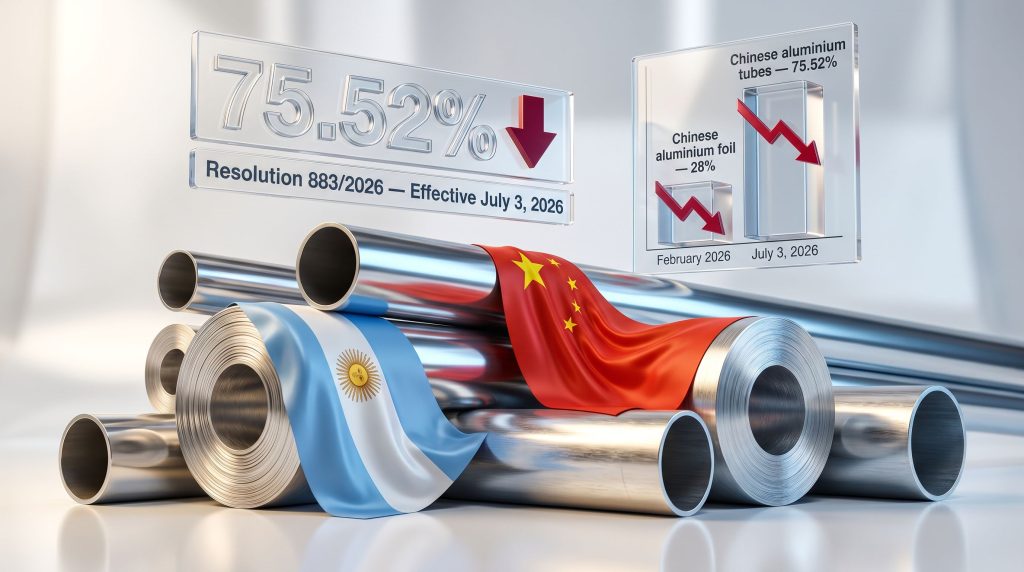
Resolution 883 is not the first aluminium-related trade measure to be unwound under this agenda. In February 2026, Argentina removed a 28% anti-dumping duty on Chinese aluminium foil, establishing a precedent for product-by-product tariff elimination in the aluminium downstream sector.
| Product | Duty Rate Removed | Effective Date |
|---|---|---|
| Chinese aluminium foil | 28% | February 2026 |
| Chinese aluminium tubes | 75.52% | July 3, 2026 |
The contrast between these two figures is instructive. A 75.52% duty removal is categorically more disruptive to domestic competitive dynamics than a 28% adjustment. At that level of protection, Chinese imports were effectively priced out of many procurement conversations entirely. Their return to competitive parity will reshape purchasing decisions across multiple industries simultaneously.
Downstream Sectors Positioned to Benefit
Aluminium tubes classified under the IRAM 681 standard with external diameters below 130 mm are not niche industrial components. They are integral inputs across several high-volume manufacturing sectors in Argentina, each of which will experience different magnitudes of benefit from reduced import costs.
- Automotive manufacturing: Aluminium tubes are critical components in engine cooling systems, transmission oil coolers, and fluid transfer lines. Cost reductions in this input category can meaningfully affect bill-of-materials economics for vehicle assemblers and tier-one suppliers.
- Appliance and white goods industry: Refrigeration and air conditioning systems rely extensively on aluminium tubing, particularly from 3xxx and 6xxx alloy series, for heat exchanger coils and refrigerant circuits. Argentine appliance manufacturers sourcing these inputs domestically may gain a cost advantage over competitors still relying on protected local supply.
- HVAC and building services: The construction sector uses aluminium tubing extensively in climate control infrastructure. As Argentina's construction activity evolves, input cost competitiveness in HVAC components becomes directly relevant to project economics.
The removal of a 75.52% protective duty is not merely a customs adjustment. It represents a fundamental repricing of competitive dynamics across every industry segment that uses these tubes as a manufacturing input.
The Domestic Industry Trade-Off: Competitive Exposure Without a Tariff Buffer
Every trade remedy removal involves an implicit trade-off between upstream producers and downstream consumers of the affected product. Argentina removes anti-dumping duties on Chinese aluminium tubes at a time when domestic manufacturers benefiting from six years of substantial tariff protection now face a materially different competitive landscape.
Chinese aluminium producers carry structural cost advantages that are well documented in trade literature: integrated smelting and fabrication operations, lower energy costs in certain provinces, economies of scale derived from serving the world's largest domestic construction and manufacturing markets, and a sophisticated logistics infrastructure for export. Furthermore, a 75.52% tariff was sufficient to neutralise much of this advantage, and its removal restores Chinese exporters to a position where their inherent cost competitiveness can be expressed directly in Argentine import pricing.
For domestic tube producers, the strategic options are limited but not absent. Specialisation in product segments excluded from the duty removal, such as the precision drawn 3xxx series tubing carve-out, represents one avenue. Investment in higher-value fabricated products or certified supply chains for automotive original equipment manufacturers, where quality assurance and delivery reliability may outweigh pure cost considerations, represents another. The broader effects of tariffs on supply chains across the region further complicate domestic producers' long-term planning.
The next major ASX story will hit our subscribers first
Understanding the Regulatory Mechanics: Sunset and Changed Circumstances Reviews
The legal framework underpinning this decision merits explanation for readers unfamiliar with trade remedy law. Under WTO Anti-Dumping Agreement provisions, anti-dumping duties cannot remain in force indefinitely without periodic justification. Two review mechanisms are particularly relevant here.
A sunset review is triggered after five years of duty imposition and requires authorities to determine whether terminating the duty would likely lead to a continuation or recurrence of dumping and material injury. If the evidence suggests that dumping would not resume at injurious levels, the duty must be terminated.
A changed circumstances review can be initiated at any point when there is evidence that the conditions underlying the original duty determination have materially shifted. This might reflect changes in production costs, export pricing behaviour, domestic industry conditions, or broader market structure.
Argentina's review combined both mechanisms, launched in November 2025 and completed by July 2026. The fact that the outcome was full duty termination rather than continuation or reduction suggests the review found that the conditions justifying the original 75.52% rate no longer applied across the assessed period.
IRAM Standard 681 and the Significance of Technical Specifications in Trade Policy
One dimension of this decision that deserves more attention is the role of IRAM Standard 681 as the technical boundary condition for the scope of the duty removal. IRAM (Instituto Argentino de Normalización y Certificación) is Argentina's national standards body, and IRAM 681 establishes dimensional, mechanical, and compositional requirements for aluminium tubes used in industrial applications.
By anchoring the scope of Resolution 883 to IRAM 681 compliance, the authorities have created a technically defined perimeter. Products that do not conform to this standard, or that fall into the precision drawn category explicitly excluded, remain outside the scope of the removal. This approach reflects a broader trend in trade remedy design toward product-specific granularity, allowing regulators to calibrate the competitive impact of duty removal with greater precision than broad tariff-line changes would permit. Shifts in the wider aluminium and alumina markets globally add further context to why such technical precision matters increasingly in trade policy design.
Frequently Asked Questions: Argentina Removes Anti-Dumping Duties on Chinese Aluminium Tubes
What is Resolution 883/2026 and what does it do?
Resolution 883/2026 is a regulatory instrument issued by Argentina's Ministry of Economy on 3 July 2026 that formally terminates the anti-dumping duty previously applied to Chinese aluminium tube imports falling within specified product parameters.
Which aluminium tube products are now duty-free and which remain excluded?
Unalloyed aluminium tubes and tubes from 3xxx and 6xxx alloy series conforming to IRAM Standard 681, with an external diameter of 130 mm or less including coil-form products, are now duty-free. Precision drawn tubing from the 3xxx series remains explicitly excluded from the removal.
When did the original anti-dumping duty come into force?
The 75.52% anti-dumping duty on Chinese aluminium tubes was imposed in November 2020, following an investigation that commenced in May 2019.
Could Argentina reimpose anti-dumping duties on Chinese aluminium tubes in the future?
Yes. Under WTO trade remedy frameworks, any WTO member retains the right to initiate a new anti-dumping investigation if evidence of fresh dumping and material injury to domestic industry emerges. The termination of a duty does not preclude a new investigation based on future trade conditions. This consideration is particularly relevant given how US aluminium tariffs continue to reshape global trade flows and redirect export volumes toward alternative markets.
How does this compare to Argentina's earlier removal of duties on Chinese aluminium foil?
The February 2026 removal of a 28% duty on aluminium foil established the policy direction, however the July 2026 removal of a 75.52% duty on aluminium tubes is considerably more significant in magnitude. The higher original rate means the competitive impact on domestic producers and the cost benefit for downstream manufacturers is substantially greater in the tubes case. For a detailed breakdown of Argentina's anti-dumping policy reversal and its broader implications, further analysis is available. In addition, steel and aluminium tariffs globally continue to influence how countries like Argentina calibrate their own domestic trade protections.
Key Takeaways
- Argentina formally terminated a 75.52% anti-dumping duty on Chinese aluminium tubes via Resolution 883, effective 3 July 2026
- Covered products must conform to IRAM Standard 681, span unalloyed and 3xxx/6xxx alloy series tubes, and carry an external diameter of 130 mm or less
- Precision drawn 3xxx series tubing is explicitly excluded from the scope of the removal
- The duty originated from a May 2019 investigation and was imposed in November 2020 following a calculated dumping margin determination
- This removal follows the earlier termination of duties on Chinese aluminium foil in February 2026, indicating a consistent policy trajectory toward input cost liberalisation
- Primary commercial beneficiaries include automotive, appliance, and HVAC manufacturing sectors operating in Argentina
- Domestic aluminium tube producers now face intensified import competition without the tariff buffer that shaped their market environment for the previous six years
- The precision drawn tubing carve-out may indicate that higher-value specialty segments retain separate consideration in future trade remedy proceedings
This article is intended for informational purposes only and does not constitute financial, legal, or trade advisory guidance. Readers should consult qualified professionals before making business or investment decisions based on changes to trade policy.
Want to Know Which Commodity Discoveries Are Generating Significant Returns Right Now?
Discovery Alert's proprietary Discovery IQ model scans ASX announcements in real time, instantly identifying significant mineral discoveries across more than 30 commodities — including aluminium and the broader materials sector — and converting complex data into clear, actionable investment insights for traders and long-term investors alike. Explore historic discoveries and their market outcomes on Discovery Alert's dedicated discoveries page, or begin a 14-day free trial at discoveryalert.com.au to position yourself ahead of the next major ASX mineral announcement.