June 25, 2026
The mining industry is witnessing a fundamental shift toward brownfield mining investment strategies as companies prioritise proven assets over speculative exploration ventures. This transformation reflects industry recognition that existing operations offer superior risk-adjusted returns through infrastructure leverage, operational certainty, and accelerated development timelines that new greenfield projects cannot match.
Furthermore, the global demand for critical minerals essential to renewable energy and electrification initiatives requires immediate production capacity increases that only brownfield expansion can deliver within necessary timeframes. Modern mining enterprises are systematically channeling unprecedented capital volumes into established operational frameworks where geological certainty and proven infrastructure create compelling investment advantages.
What Is Strategic Capital Allocation Reshaping Global Resource Development?
Modern mining enterprises are fundamentally restructuring their growth strategies through systematic infrastructure leverage and operational optimisation. Rather than pursuing speculative exploration ventures, industry leaders are channelling unprecedented capital volumes into existing operational frameworks where geological certainty, established infrastructure, and operational expertise create compounding investment advantages.
This strategic pivot reflects deeper market dynamics: regulatory complexity has intensified dramatically across multiple jurisdictions, environmental assessment requirements have expanded exponentially, and social licence obligations now demand years of stakeholder engagement before project approval. Simultaneously, critical mineral demand projections suggest supply shortfalls that require immediate productive capacity expansion rather than decade-long development cycles.
Defining Brownfield Investment in Modern Mining Context
Brownfield mining investment represents capital deployment into existing operational sites for capacity expansion, infrastructure enhancement, or adjacent resource development. Unlike traditional greenfield projects that require complete infrastructure development from initial exploration through production, these mining permitting insights demonstrate how brownfield investments leverage decades of operational data, established processing facilities, and proven geological understanding.
University of Queensland research analysing 366 brownfield mine sites across 57 countries over two decades reveals this approach has evolved from tactical cost management into systematic strategic positioning. The research documents how mining companies are prioritising asset optimisation over exploration-based growth models to address accelerating demand for renewable energy minerals, battery components, and digital infrastructure materials.
Technical characteristics distinguishing brownfield operations include:
- Existing geological databases spanning 20+ years of production performance
- Established tailings storage facilities with proven capacity management
- Operational processing plants with documented metallurgical characteristics
- Pre-constructed power infrastructure and grid connections
- Transportation networks including haul roads, rail connections, and port facilities
- Environmental monitoring systems with baseline data for regulatory compliance
Strategic Advantages Over Greenfield Development Models
The structural complexity surrounding new mine development has created systematic advantages for brownfield expansion strategies. Regulatory approval processes that previously required 5-7 years for new operations can be compressed to 2-4 years for existing site modifications, while capital intensity per unit of production typically decreases by 30-50% compared to equivalent greenfield capacity.
Infrastructure leverage represents the most significant brownfield advantage. Processing plants, tailings facilities, power systems, and transportation networks that required hundreds of millions in initial investment can support substantial capacity increases through incremental upgrades. This capital efficiency enables rapid response to commodity price cycles and demand fluctuations that would render greenfield projects economically unviable.
Operational knowledge accumulated through years of production provides unprecedented technical advantages. Mining teams understand site-specific geological conditions, metallurgical behaviour, and operational challenges that enable precise expansion planning. Safety systems, environmental protocols, and community relationships established over decades eliminate the social licence uncertainties that frequently delay or derail new project development.
When big ASX news breaks, our subscribers know first
How Do Brownfield Projects Deliver Superior Risk-Adjusted Returns?
Infrastructure Leverage and Capital Efficiency Metrics
Brownfield projects achieve superior economics through systematic infrastructure redeployment and proven operational frameworks. Existing facilities designed for specific production capacities often accommodate 40-60% throughput increases through processing optimisation, equipment upgrades, and operational scheduling enhancements without proportional capital investment increases.
Capital efficiency mechanisms include:
- Tailings storage capacity utilisation reduces waste management capital requirements
- Established power infrastructure eliminates energy development timelines
- Pre-constructed water management systems support increased processing volumes
- Operational control systems accommodate expanded production through software upgrades
- Transportation infrastructure supports higher tonnage flows without additional construction
The cumulative effect creates investment profiles where capital deployment per ounce or tonne of additional production significantly outperforms equivalent greenfield development. Industry analysis suggests brownfield expansions deliver 15-25% higher net present values compared to equivalent greenfield projects when adjusted for execution risk and timeline certainty.
Timeline Compression Analysis: 50-70% Faster Production Cycles
Timeline advantages represent perhaps the most compelling brownfield investment characteristic. While greenfield projects typically require 7-10 years from approval to initial production, brownfield expansions achieve production within 2-3 years through elimination of construction, permitting, and commissioning phases.
Timeline compression occurs across all project development stages:
- Regulatory approval: Environmental assessments leverage existing baseline data
- Infrastructure deployment: Equipment installation in operational facilities eliminates construction delays
- Workforce mobilisation: Experienced teams already resident in operational regions
- Supply chain activation: Established vendor relationships enable rapid procurement
- Production ramp-up: Institutional knowledge of processing systems accelerates optimisation
This 50-70% timeline acceleration creates substantial financial advantages through earlier cash flow generation, reduced financing costs, and faster response to commodity price cycles. In volatile market conditions, the ability to bring additional production online within 24-36 months versus 8-10 years provides strategic flexibility that justifies premium valuations for brownfield assets.
Risk Mitigation Through Pre-Existing Operational Data
Risk reduction through operational data represents a fundamental brownfield investment advantage. Twenty years of drilling, sampling, and production records eliminate exploration risk that typically accounts for 15-30% of greenfield project risk premiums. Metallurgical characteristics established through actual processing performance enable reserve estimation with confidence intervals exceeding 90% compared to 60-75% for greenfield projects.
Risk mitigation components:
- Geological certainty: Historical grade performance eliminates resource estimation uncertainty
- Processing optimisation: Proven metallurgical recovery rates based on operational data
- Geotechnical understanding: Pit slope stability and rock mechanics parameters well-characterised
- Environmental compliance: Established monitoring systems and regulatory relationships
- Operational benchmarking: Actual cost and performance data versus theoretical projections
This operational knowledge enables sophisticated mine planning models that incorporate decades of actual performance data rather than theoretical assumptions. The result is investment decision-making based on empirical evidence rather than geological modelling, creating risk-adjusted returns that consistently outperform exploration-dependent alternatives.
Which Global Markets Are Leading the Brownfield Investment Surge?
Chile's Dominance: 25.2% of Global Capital Allocation
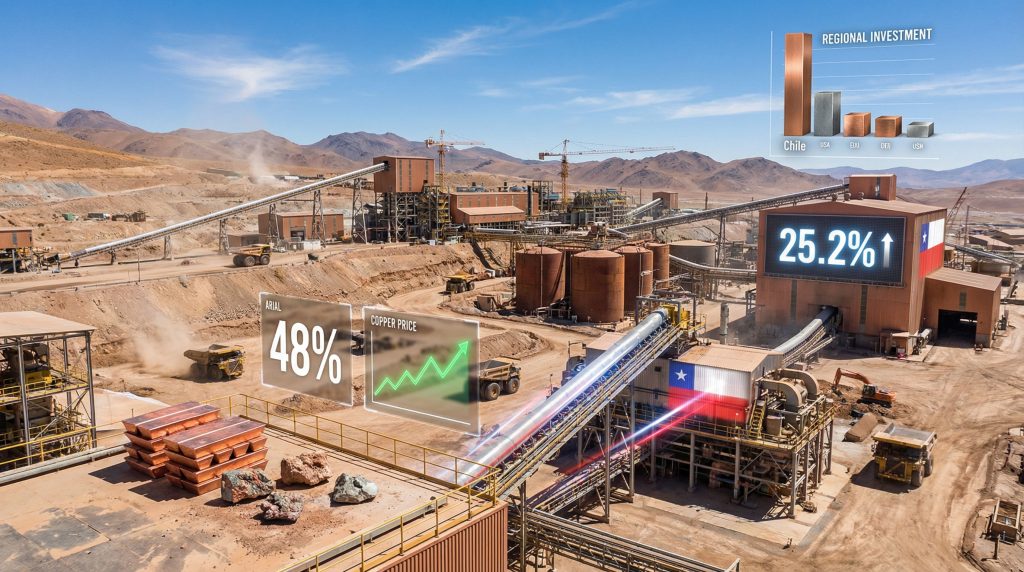
Chile commands global brownfield investment leadership with 25.2% of worldwide capital deployment, reflecting the country's unique combination of mature copper infrastructure and emerging lithium production capabilities. The Atacama region's established mining ecosystem enables rapid capacity scaling for both traditional copper operations and battery mineral production required for global electrification initiatives.
| Region | Investment Share | Key Commodity Focus | Strategic Drivers |
|---|---|---|---|
| Chile | 25.2% | Copper, Lithium | Established infrastructure |
| United States | 11.4% | Gold, Copper | Regulatory stability |
| Australia | 10.1% | Iron ore, Gold | Mining expertise hub |
| Canada | 8.7% | Gold, Base metals | Proximity to US markets |
| Peru | 6.8% | Copper, Silver | Cost-competitive operations |
Chilean dominance reflects several strategic advantages that create compounding investment returns. The country's regulatory framework provides predictable permitting timelines, while decades of large-scale copper production have created concentrated technical expertise and established supply chains. Recent lithium extraction expansion in the Atacama Desert leverages existing mining infrastructure to support battery mineral demand that industry analysts project will increase 400-600% by 2035.
Regional infrastructure advantages include established port facilities capable of handling increased mineral exports, power infrastructure designed for energy-intensive processing operations, and transportation networks connecting multiple mining districts. These factors enable capital deployment that achieves production increases at substantially lower cost per unit compared to equivalent capacity development in less established mining jurisdictions.
North American Investment Patterns: US and Canadian Strategies
North American brownfield investment represents 20.1% of global capital allocation, with the United States capturing 11.4% and Canada 8.7% of worldwide brownfield development. This regional concentration reflects mature regulatory frameworks, established mining infrastructure, and geographic proximity to integrated North American commodity markets.
United States brownfield characteristics:
- Gold-dominant portfolio concentrated in Nevada and Colorado mining districts
- Copper assets leveraging Southwest infrastructure and processing capacity
- Regulatory approval timeframes averaging 2-4 years for expansion projects
- Environmental monitoring systems with decades of baseline data
Canadian brownfield characteristics:
- Gold mining expertise concentrated in Ontario and British Columbia operations
- Base metal developments in established Sudbury and other mining districts
- Transportation advantages through proximity to US smelting capacity
- Established labour pools with specialised mining and processing expertise
The regulatory stability that characterises North American mining jurisdictions enables long-term capital planning with predictable approval processes. This certainty supports investment decision-making that incorporates multi-decade mine life extensions and systematic capacity optimisation programmes that would be impractical in jurisdictions with volatile regulatory environments.
Australia's Position in the Asia-Pacific Brownfield Landscape
Australia captures 10.1% of global brownfield capital allocation, positioning the country as the third-largest brownfield investment destination worldwide. This investment concentration reflects Australia's established iron ore and gold production infrastructure, specialised mining expertise, and strategic proximity to Asia-Pacific demand centres that consume increasing quantities of Australian mineral exports.
Australian brownfield characteristics by region:
- Western Australia: Iron ore expansion in Pilbara region, gold operations across multiple districts
- New South Wales: Coal-to-minerals transition investments, heritage gold operations
- Queensland: Copper and gold capacity expansion in established mining areas
- Victoria: Gold operation modernisation and life extension projects
Australia's mining expertise ecosystem enables sophisticated brownfield development that incorporates advanced technologies, environmental management systems, and operational optimisation techniques. The country's position as an Asia-Pacific mining knowledge hub attracts international investment in brownfield projects that serve as technology demonstration sites for global mining operations.
Geographic proximity to Asian manufacturing centres creates transportation cost advantages that support higher-grade, smaller-scale brownfield developments that would be economically marginal in more remote locations. This proximity premium enables investment in specialised processing technologies and advanced extraction techniques that enhance recovery rates and extend mine life for existing operations.
What Commodity Sectors Drive Maximum Brownfield Value Creation?
Copper's Market Leadership: 48% of Total Capex Allocation
Copper dominates brownfield capital allocation with 48% of global investment, reflecting the metal's critical role in renewable energy infrastructure, electric vehicle production, and digital technology expansion. This commodity concentration represents market recognition that existing copper mining infrastructure can be rapidly scaled to meet structural demand increases projected to reach 2.5x current consumption by 2050.
Renewable energy infrastructure requires unprecedented copper tonnages for electrical systems, with wind turbines consuming 3-5 tonnes per megawatt of capacity and solar installations requiring 4-6 tonnes per megawatt. Electric vehicle adoption creates additional demand through 90+ kilograms of copper per vehicle compared to 20-25 kilograms in traditional internal combustion vehicles.
Copper brownfield project characteristics:
- Geographic concentration in Chile, Peru, and North American copper districts
- Processing complexity utilising established extraction and refining infrastructure
- Operational types including pit deepening, satellite deposit development, and processing upgrades
- Market integration through established commodity markets and offtake agreements
The copper market's liquidity and price transparency enable sophisticated financing structures that support large-scale brownfield expansion. Streaming agreements, offtake prepayments, and commodity-linked financing provide non-dilutive capital that enhances project economics while transferring commodity price risk to specialised financial institutions.
Gold Sector Dynamics: Premium Margin Opportunities
Gold represents 17.5% of brownfield capital expenditure, concentrated in operations that leverage established infrastructure to access higher-grade reserves or extend mine life through advanced extraction technologies. Gold's unique monetary characteristics and consistent demand patterns create investment stability that supports long-term brownfield development programmes.
Gold brownfield advantages:
- Heap leach operations enabling low-grade ore processing through infrastructure expansion
- Underground mine extensions accessing deeper, higher-grade reserves
- Processing plant optimisation increasing recovery rates from existing material
- Tailings reprocessing utilising advanced extraction technologies
Premium margin opportunities arise from operational knowledge that enables precise targeting of higher-grade zones within existing operations. Decades of production data reveal geological patterns that guide expansion decisions toward zones with optimal grade and metallurgical characteristics, creating investment returns that exceed industry benchmarks.
Critical Minerals Strategy: Battery Metal Brownfield Plays
Critical mineral brownfield investment focuses on lithium, cobalt, nickel, and rare earth elements essential for battery production and renewable energy technologies. Government strategic mineral initiatives across multiple jurisdictions create policy support for brownfield development that reduces regulatory risk and accelerates project approval.
Consequently, the evolving critical minerals strategy demonstrates how brownfield projects provide the only viable mechanism for delivering additional production within timeframes required to support global electrification initiatives and renewable energy deployment targets.
Critical mineral brownfield characteristics:
- Lithium brine operations in Chile and Argentina leveraging existing extraction infrastructure
- Nickel laterite processing in Australia and Indonesia utilising established facilities
- Rare earth separation plants in China and Australia optimising existing processing capacity
- Cobalt production integrated with copper operations in Democratic Republic of Congo
Battery metal demand projections suggest supply shortfalls that require immediate capacity expansion rather than decade-long greenfield development. These mining evolution trends highlight how brownfield projects enable strategic positioning in critical supply chains.
How Are Major Mining Companies Restructuring Their Growth Strategies?
Portfolio Optimisation Through Brownfield Acquisitions
Industry leaders are systematically repositioning their asset portfolios through targeted brownfield acquisitions that provide immediate production capacity and expansion optionality. This strategy enables rapid scaling of existing operations while minimising exploration risk and regulatory uncertainty that characterises greenfield development.
Major company brownfield strategies:
- Barrick Gold: Focus on Tier One asset consolidation and life extension programmes
- Newmont: Integration of advanced processing technologies in existing operations
- Rio Tinto: Iron ore expansion through Pilbara infrastructure optimisation
- BHP: Copper capacity increases through Chilean and Australian brownfield development
Portfolio optimisation involves systematic evaluation of existing operations for expansion potential, infrastructure utilisation, and geological upside. Companies utilise sophisticated valuation models that incorporate Net Present Value (NPV) calculations, Internal Rate of Return (IRR) projections, and Analytic Hierarchy Process (AHP) methodologies to identify optimal brownfield investment opportunities.
Moreover, these industry consolidation trends reveal how major operators systematically evaluate acquisition targets based on infrastructure quality and expansion potential.
Mine Life Extension Economics and Valuation Models
Mine life extension represents a specialised brownfield investment category focused on accessing additional reserves through infrastructure expansion rather than capacity increases. These projects typically offer superior economics through fixed cost absorption across extended production periods and incremental capital deployment.
Economic modelling considerations:
- Infrastructure depreciation: Extending useful life of existing assets reduces unit costs
- Regulatory amortisation: Spreading permitting costs across extended production periods
- Workforce optimisation: Retaining specialised labour pools reduces recruitment and training costs
- Community investment: Leveraging established social licence for extended operations
Valuation models for mine life extension incorporate complex interactions between declining ore grades, increasing strip ratios, and rising operational costs offset by infrastructure leverage and operational optimisation. Advanced financial modelling techniques enable precise calculation of optimal extraction sequences that maximise net present value across extended mine life.
Strategic Joint Ventures and Partnership Structures
Complex brownfield projects increasingly utilise joint venture structures that combine operational expertise, financial capacity, and risk distribution among specialised partners. These arrangements enable access to larger development opportunities while optimising capital allocation and technical capabilities.
Partnership structure advantages:
- Risk distribution: Geological, operational, and commodity price risks shared among partners
- Capital efficiency: Reduced individual company capital requirements for large projects
- Technical expertise: Combination of complementary operational and processing capabilities
- Market access: Enhanced commodity marketing and financing relationships
Modern brownfield assessment utilises multi-criteria decision analysis incorporating NPV calculations, IRR projections, and Analytic Hierarchy Process (AHP) methodologies. Leading operators integrate corporate sustainability metrics alongside traditional financial returns to optimise long-term value creation.
What Financing Mechanisms Are Transforming Brownfield Development?
Senior Secured Debt Structures for Plant Modernisation
Brownfield projects utilise sophisticated debt structures that leverage existing assets as collateral while financing infrastructure upgrades and capacity expansion. Senior secured debt provides cost-effective capital for processing plant modernisation, equipment replacement, and facility expansion that extends asset life and increases production capacity.
Debt structure advantages:
- Lower interest rates through asset-backed security
- Extended repayment terms aligned with extended mine life
- Covenant structures based on operational performance rather than exploration milestones
- Integration with existing corporate credit facilities
Processing plant modernisation typically qualifies for favourable financing terms due to predictable cash flows from existing operations and proven operational history. Lenders can evaluate project economics based on historical performance data rather than theoretical projections, reducing risk premiums and enabling larger facility sizes relative to corporate balance sheets.
Streaming and Royalty Agreements as Non-Dilutive Capital
Metal streaming and royalty financing provides non-dilutive capital for brownfield expansion while transferring commodity price exposure to specialised investment firms. These structures enable access to development capital without equity dilution while retaining operational control and majority economics from expansion projects.
Streaming agreement characteristics:
- Upfront capital payment in exchange for fixed-price metal purchase rights
- Commodity price exposure transferred to streaming company
- Operational control retained by mining company
- Enhanced project economics through reduced capital requirements
Royalty agreements provide similar capital access through percentage-based production payments that scale with operational performance. These structures create alignment between financing parties and operational success while providing flexible capital structures that accommodate varying production profiles and commodity price cycles.
Offtake Prepayment Models and Working Capital Solutions
Offtake prepayment financing provides working capital for brownfield development through advance payments for future metal delivery. These arrangements enable rapid project development through immediate capital access while securing commodity marketing arrangements that reduce revenue risk.
Furthermore, these innovative capital raising strategies demonstrate how brownfield projects access diverse financing sources through proven operational history and predictable production profiles.
Working capital solutions include:
- Revolving credit facilities secured by metal inventory
- Equipment financing for processing plant upgrades
- Trade finance facilities for consumables and spare parts procurement
- Letters of credit for regulatory bonding requirements
Prepayment structures typically offer favourable pricing for end users while providing mining companies with development capital and marketing certainty. These arrangements are particularly effective for brownfield projects with predictable production profiles and established operational history that enables accurate delivery forecasting.
The next major ASX story will hit our subscribers first
Which Operational Challenges Require Strategic Risk Management?
Water Resource Management in Expanding Operations
Water management represents a critical challenge for brownfield expansion as increased processing capacity requires proportional water supply increases while environmental regulations demand improved water treatment and recycling. Existing operations must balance production growth with sustainable water consumption and discharge management.
Water management considerations:
- Processing plant expansion requiring additional water supply capacity
- Tailings storage facility expansion impacting water recycling systems
- Regulatory compliance with evolving discharge standards
- Community water rights and environmental impact management
Advanced water treatment technologies enable increased recycling rates that support production expansion while reducing fresh water consumption. Investment in closed-loop systems, advanced filtration, and water recovery technologies often provides operational cost reductions that justify capital expenditure while addressing environmental compliance requirements.
Environmental Legacy Issues and Remediation Costs
Historical mining operations may have environmental legacies that require remediation before or during expansion activities. These legacy issues can significantly impact project economics and require specialised technical solutions that integrate environmental restoration with operational expansion.
Legacy issue management:
- Historical tailings facilities requiring stabilisation or closure
- Groundwater contamination requiring ongoing treatment
- Soil contamination in processing areas requiring remediation
- Waste rock piles requiring long-term management and monitoring
Environmental remediation can be integrated with expansion projects to achieve cost-effective solutions that address regulatory requirements while enabling operational growth. Progressive rehabilitation techniques enable simultaneous remediation and expansion that reduces total project costs while demonstrating environmental stewardship.
Regulatory Complexity in Multi-Jurisdictional Projects
Brownfield operations spanning multiple jurisdictions face complex regulatory environments that require specialised expertise and sophisticated compliance management. Regulatory changes across jurisdictions can impact operational parameters, environmental requirements, and taxation structures that affect project economics.
Regulatory management strategies:
- Proactive engagement with regulatory agencies across all relevant jurisdictions
- Integration of regulatory compliance into operational planning and budgeting
- Monitoring of regulatory developments that may impact operations
- Investment in compliance systems and environmental monitoring capabilities
Regulatory complexity creates both challenges and opportunities for brownfield development. Companies with sophisticated regulatory management capabilities can identify expansion opportunities that competitors cannot pursue due to compliance limitations, creating competitive advantages through regulatory expertise.
How Do Declining Ore Grades Impact Brownfield Economics?
Processing Technology Upgrades for Lower-Grade Resources
Declining ore grades represent a fundamental challenge for brownfield expansion as mines typically access higher-grade resources first, leaving lower-grade material for later extraction. Processing technology upgrades enable economic extraction of lower-grade resources through improved recovery rates, enhanced processing efficiency, and reduced unit costs.
Technology upgrade categories:
- Flotation enhancement: Advanced flotation cells and reagent systems improving recovery
- Grinding optimisation: High-efficiency grinding systems reducing energy consumption
- Sensor-based sorting: Automated ore sorting reducing processing volumes
- Hydrometallurgical processing: Chemical extraction methods for complex ores
Investment in processing technology can transform marginal resources into economic reserves while extending mine life and supporting increased production capacity. Advanced metallurgical techniques enable extraction of metals that were previously unrecoverable using conventional processing methods.
Waste Management Scaling and Infrastructure Requirements
Lower ore grades generate proportionally larger volumes of waste material that require expanded storage capacity and enhanced management systems. Waste management infrastructure must be scaled to accommodate increased tonnage while maintaining environmental compliance and operational efficiency.
Waste management considerations:
- Tailings storage facility expansion to accommodate increased volumes
- Waste rock disposal areas requiring additional capacity
- Water management systems handling increased processing volumes
- Environmental monitoring systems tracking expanded operations
| Company Tier | Investment Focus | Typical Deal Size | Risk Profile |
|---|---|---|---|
| Majors | Mine life extensions | $500M – $5B | Low-moderate |
| Mid-tier | Adjacent property acquisitions | $50M – $500M | Moderate |
| Juniors | Restart opportunities | $5M – $50M | Moderate-high |
Waste management scaling requires sophisticated engineering solutions that optimise storage capacity while minimising environmental impact. Advanced waste characterisation and placement techniques enable efficient utilisation of available storage capacity while maintaining long-term stability and environmental compliance.
Energy Efficiency Optimisation in Mature Operations
Energy consumption typically increases as ore grades decline due to higher processing requirements and longer transportation distances within expanding operations. Energy efficiency optimisation becomes critical for maintaining competitive operating costs while supporting production expansion.
Energy optimisation strategies:
- Renewable energy integration: Solar and wind power reducing operational costs
- Process optimisation: Advanced control systems minimising energy consumption
- Equipment efficiency: High-efficiency motors and drive systems
- Heat recovery: Waste heat utilisation reducing external energy requirements
Energy efficiency improvements often provide immediate operational cost reductions that improve project economics while supporting environmental sustainability objectives. Investment in energy-efficient technologies can significantly impact long-term operational profitability in energy-intensive processing operations.
What Investment Opportunities Exist Across Market Segments?
Major Operator Expansion Projects and Acquisition Targets
Major mining companies pursue brownfield mining investment through systematic expansion of existing operations and strategic acquisition of development-ready assets. These investments typically involve substantial capital deployment ranging from $500 million to $5 billion for comprehensive expansion programmes that extend mine life and increase production capacity.
Major operator investment characteristics:
- Comprehensive infrastructure expansion including processing plant capacity increases
- Advanced technology integration improving operational efficiency and recovery rates
- Multi-decade investment programmes extending mine life and optimising resource extraction
- Integration of sustainability initiatives and environmental management systems
Acquisition targets for major operators include established operations with expansion potential, advanced development projects with proven resources, and complementary assets that enhance existing operational synergies. Due diligence processes focus on resource verification, infrastructure assessment, and regulatory compliance evaluation.
Mid-Tier Company Consolidation Opportunities
Mid-tier mining companies pursue brownfield mining investment through adjacent property acquisitions and operational consolidation that creates economies of scale and operational synergies. Investment ranges typically span $50 million to $500 million for projects that leverage existing infrastructure while expanding resource base and production capacity.
Mid-tier investment strategies:
- Adjacent property acquisition enabling infrastructure sharing
- Processing capacity optimisation through operational integration
- Regional consolidation creating transportation and logistics efficiencies
- Technical expertise application across multiple operations
Consolidation opportunities arise from operational synergies that enable cost reductions and production optimisation across integrated operations. Mid-tier companies with specialised technical capabilities can create significant value through application of advanced extraction and processing techniques to previously marginal operations.
Junior Miner Brownfield Assets: Hidden Value Analysis
Junior mining companies offer unique brownfield mining investment opportunities through restart opportunities and advanced development projects requiring $5 million to $50 million in development capital. These investments typically involve higher risk profiles offset by potentially substantial returns from successful operational restart or expansion programmes.
Junior company opportunities:
- Mine restart projects with established infrastructure requiring operational optimisation
- Advanced exploration projects with proven resources requiring processing facilities
- Regional consolidation opportunities creating integrated operational platforms
- Technology demonstration projects utilising innovative extraction or processing methods
Hidden value analysis for junior brownfield assets requires sophisticated evaluation of historical operational data, infrastructure condition assessment, and market positioning relative to commodity price cycles. Successful junior brownfield investment often depends on identifying operational improvements or market conditions that previous operators could not capitalise upon.
How Will Regulatory Evolution Shape Future Brownfield Strategy?
Permitting Acceleration Initiatives and Policy Changes
Regulatory frameworks globally are evolving to address supply chain security concerns and critical mineral shortages through streamlined permitting processes for brownfield expansion projects. Government initiatives recognise that brownfield development provides the most viable pathway for rapidly increasing mineral production capacity.
Regulatory acceleration mechanisms:
- Fast-track approval processes for critical mineral brownfield expansions
- Simplified environmental assessment requirements for existing operational sites
- Regulatory pre-approval for standardised expansion configurations
- Cross-jurisdictional coordination reducing duplicative review processes
Policy changes supporting brownfield development include tax incentives for infrastructure investment, streamlined permitting for processing plant upgrades, and priority designation for critical mineral projects. These initiatives create competitive advantages for brownfield development while maintaining environmental protection standards.
ESG Compliance Requirements for Expansion Projects
Environmental, Social, and Governance (ESG) requirements are becoming increasingly sophisticated and demanding for brownfield expansion projects. Regulatory frameworks now incorporate climate change considerations, biodiversity protection, and community engagement requirements that significantly impact project design and operational parameters.
ESG compliance components:
- Carbon footprint reduction through renewable energy integration and efficiency improvements
- Biodiversity protection through habitat restoration and conservation programmes
- Community engagement ensuring local benefit and stakeholder consultation
- Water stewardship implementing advanced treatment and recycling technologies
ESG compliance creates both challenges and opportunities for brownfield development. Companies with sophisticated ESG management capabilities can differentiate their projects and access favourable financing while demonstrating long-term sustainability and operational excellence.
International Investment Framework Developments
International trade and investment frameworks are evolving to address supply chain resilience and resource security considerations. These developments create new opportunities for brownfield mining investment through government partnerships, strategic stockpiling agreements, and bilateral commodity trade arrangements.
International framework impacts:
- Preferential trade arrangements for strategic mineral producers
- Government financing support for supply chain diversification
- International development financing for infrastructure expansion
- Bilateral agreements securing long-term commodity supply arrangements
Investment framework evolution creates opportunities for brownfield projects that enhance supply chain security and reduce dependence on single-source commodity suppliers. These frameworks often provide favourable financing terms and market access that improve project economics for strategically important minerals.
What Technology Innovations Are Optimising Brownfield Performance?
Digital Twin Implementation for Operational Enhancement
Digital twin technology enables comprehensive operational modelling and optimisation for brownfield operations through integration of real-time operational data with sophisticated simulation capabilities. These systems provide unprecedented insight into operational performance and enable predictive optimisation that maximises production efficiency and equipment performance.
Digital twin capabilities:
- Real-time operational monitoring integrating sensors throughout processing facilities
- Predictive modelling enabling optimisation of extraction and processing parameters
- Equipment performance analysis identifying maintenance requirements and efficiency improvements
- Scenario modelling evaluating expansion options and operational modifications
Digital twin implementation provides competitive advantages through operational optimisation that reduces costs while increasing production capacity. These systems enable sophisticated decision-making based on comprehensive data analysis rather than traditional operational experience and intuition.
Automation Integration in Legacy Infrastructure
Automation technologies can be retrofit into existing brownfield operations to improve safety, increase efficiency, and reduce operational costs. Advanced automation systems enable remote operation capabilities and precision control that enhances production consistency while reducing labour requirements.
Automation integration opportunities:
- Autonomous haulage systems reducing transportation costs and improving safety
- Automated processing control optimising recovery rates and reducing reagent consumption
- Remote monitoring systems enabling centralised operational control
- Predictive maintenance scheduling reducing equipment downtime and maintenance costs
Legacy infrastructure often provides excellent platforms for automation integration due to established power and communication systems that can support advanced technological implementations. Retrofit automation projects typically offer attractive returns through operational cost reductions and production optimisation.
Predictive Maintenance Systems for Extended Asset Life
Predictive maintenance technologies utilise advanced sensors and data analytics to optimise equipment maintenance scheduling and extend asset life in brownfield operations. These systems provide early warning of equipment degradation while optimising maintenance intervals to minimise production disruption.
Predictive maintenance benefits:
- Extended equipment life through optimal maintenance timing and intervention
- Reduced maintenance costs through condition-based rather than schedule-based maintenance
- Improved operational reliability through early identification of potential equipment failures
- Enhanced production capacity through reduced unplanned downtime
Predictive maintenance systems create substantial value in brownfield operations where equipment replacement costs are significant and production interruptions impact overall operational economics. Investment in predictive maintenance typically provides rapid payback through reduced maintenance costs and improved operational reliability.
Which Geographic Regions Offer Emerging Brownfield Opportunities?
African Copper Belt Expansion Potential
The Central African Copper Belt presents significant brownfield expansion opportunities through existing mining infrastructure and proven geological resources that can support substantial capacity increases. Regional political stability improvements and infrastructure development create favourable conditions for international investment in brownfield projects.
African Copper Belt characteristics:
- Established mining infrastructure in Democratic Republic of Congo and Zambia
- Proven copper-cobalt resources supporting battery mineral demand
- Transportation infrastructure connecting mining areas to export facilities
- Skilled workforce with decades of mining experience
Investment opportunities include processing plant expansion, mine life extension programmes, and integration of advanced extraction technologies that improve recovery rates from existing operations. Government policies supporting foreign investment and mineral processing create favourable conditions for brownfield development.
Latin American Critical Mineral Development
Latin American countries offer substantial brownfield opportunities for critical mineral development through existing mining infrastructure and world-class geological resources. Government policies supporting clean energy transition create favourable regulatory environments for battery mineral production expansion.
Latin American opportunities:
- Chile: Lithium brine expansion in Atacama region utilising existing infrastructure
- Argentina: Lithium triangle development through established operational platforms
- Peru: Copper expansion leveraging established mining districts
- Brazil: Iron ore and critical mineral integration opportunities
Regional expertise in large-scale mining operations, established supply chains, and proximity to international markets create competitive advantages for brownfield investment. Government initiatives supporting mineral processing and value-added production provide additional investment incentives.
Southeast Asian Tin and Nickel Brownfield Projects
Southeast Asian countries present unique brownfield opportunities for tin and nickel production expansion through established mining operations and processing infrastructure. Regional economic development and industrial growth create strong domestic demand for mineral products alongside export opportunities.
Southeast Asian characteristics:
- Indonesia: Nickel processing expansion supporting stainless steel and battery production
- Malaysia: Tin mining modernisation and capacity expansion
- Philippines: Integrated nickel and copper production optimisation
- Thailand: Regional processing hub development for multiple commodities
Investment opportunities focus on processing technology upgrades, environmental compliance improvements, and integration with regional supply chains serving Asian manufacturing centres. Government policies supporting downstream processing and industrial development create favourable conditions for brownfield investment.
How Should Investors Evaluate Brownfield Investment Opportunities?
Due Diligence Framework for Existing Operations Assessment
Comprehensive due diligence for brownfield investments requires systematic evaluation of operational performance, infrastructure condition, and expansion potential based on decades of historical data. This process differs significantly from greenfield evaluation due to availability of actual operational performance rather than theoretical projections.
Due diligence components:
- Historical production analysis: 10+ years of actual production, grade, and recovery data
- Infrastructure assessment: Detailed evaluation of processing plant, tailings facilities, and support infrastructure
- Geological review: Reserve and resource verification based on operational mining experience
- Environmental compliance: Assessment of regulatory compliance history and future requirements
Operational data analysis provides unprecedented insight into actual project economics, operational challenges, and expansion potential. Historical performance data enables sophisticated modelling of expansion scenarios based on proven operational parameters rather than theoretical assumptions.
According to research from the University of Queensland, this comprehensive approach to brownfield assessment has become essential as the industry shifts towards established operational sites.
Valuation Methodologies for Brownfield Assets
Brownfield asset valuation utilises specialised methodologies that incorporate operational history, infrastructure value, and expansion optionality. Traditional net present value calculations are enhanced with real options analysis and operational optimisation scenarios based on actual performance data.
Valuation methodology components:
- Discounted cash flow analysis based on historical operational performance
- Asset replacement cost evaluation for infrastructure and equipment
- Real options valuation for expansion opportunities and resource development
- Comparable transaction analysis for similar brownfield transactions
Sophisticated valuation models incorporate multiple scenarios for operational optimisation, expansion timing, and commodity price cycles based on operational flexibility and infrastructure capacity. These models provide more accurate valuations compared to greenfield projects due to reduced uncertainty and established operational parameters.
Portfolio Diversification Through Brownfield Exposure
Portfolio construction utilising brownfield mining investment provides unique diversification benefits through reduced development risk, predictable cash flows, and shorter investment timelines compared to traditional mining investment strategies. Brownfield exposure offers balance between growth potential and operational stability.
Portfolio diversification benefits:
- Reduced development risk through established operations and proven resources
- Shorter investment horizons enabling more predictable returns
- Operational cash flow providing income during development phases
- Commodity diversification across multiple metals and geographic regions
Strategic portfolio allocation to brownfield mining investment typically ranges from **
Ready to Identify the Next Major Mineral Discovery?
Discovery Alert instantly alerts investors to significant ASX mineral discoveries using its proprietary Discovery IQ model, providing immediate insights into brownfield expansion opportunities and emerging mining projects. Understand why historic discoveries can generate substantial returns by exploring Discovery Alert's dedicated discoveries page, showcasing exceptional outcomes from previous major mineral finds.