June 25, 2026
The Hidden Power of Timing: What Resource Stocks Reveal About Market Cycles
Most investors dramatically underestimate how profoundly the entry point into a commodity-linked stock shapes the eventual outcome. Unlike technology or consumer discretionary sectors, mining companies operate at the intersection of geological scarcity, macroeconomic demand cycles, and currency dynamics, creating windows of extraordinary return potential that are both difficult to predict and even harder to ignore in retrospect.
The question of if i'd invested $5,000 in Rio Tinto shares 12 months ago is more than a curiosity exercise. It is a case study in how blue-chip resource stocks can deliver asymmetric returns during commodity upcycles, and why the conditions enabling those returns are rarely as simple as they first appear.
When big ASX news breaks, our subscribers know first
From $105 to $173.92: Reconstructing Rio Tinto's Remarkable 12-Month Run
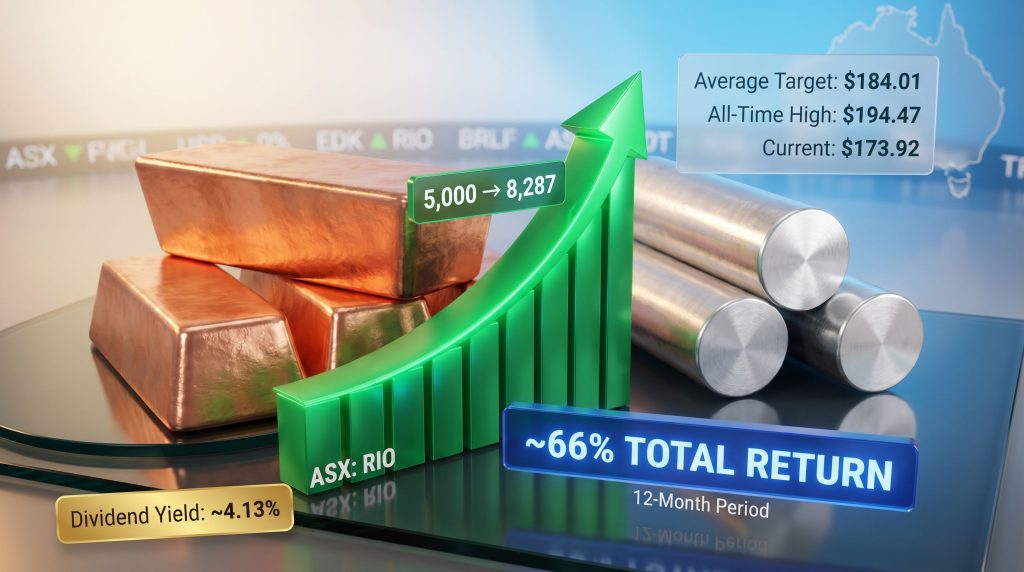
Approximately 12 months ago, Rio Tinto Ltd (ASX: RIO) shares were trading near $105 per share on the Australian Securities Exchange. Fast forward to recent trading sessions, and those same shares changed hands at $173.92, representing a 66% price appreciation over that period on the ASX alone.
The arithmetic for a hypothetical $5,000 position is straightforward but striking. At an entry price of $105 per share, that initial capital would have purchased roughly 47.6 shares. At the recent price of $173.92, those shares would carry a market value of approximately $8,279 to $8,300, depending on the precise entry and exit dates applied to the calculation. You can use Rio Tinto's official share price calculator to verify figures based on your own chosen dates.
When comparing performance across listing venues, the picture varies depending on currency movements and market-specific trading dynamics:
| Listing Market | Approximate 12-Month Return | $5,000 Investment Value |
|---|---|---|
| ASX (Australia) | ~66% | ~$8,300 |
| NYSE ADR (United States) | ~60% | ~$8,013 |
| Broader Equity Benchmarks | ~73% | ~$8,642 |
The divergence between the ASX-listed return and the US ADR performance is not simply noise. It reflects the meaningful influence of AUD/USD exchange rate movements during the period. When the Australian dollar strengthens against the US dollar, Australian-denominated returns can outpace what the same underlying price movement delivers to an American investor holding ADRs, and vice versa. For retail investors thinking across borders, currency translation adds a layer of complexity that pure price charts do not capture.
Importantly, that 66% price appreciation does not yet include the contribution of Rio Tinto's dividend income. With a current dividend yield of approximately 4.13%, shareholders who held their position through dividend payment dates would have received additional passive income on top of capital gains, compounding total returns meaningfully beyond the headline price movement.
For income-oriented investors, the combination of capital appreciation and dividend income over the past 12 months would have produced a total return that materially exceeds what share price charts alone suggest.
Putting the Numbers in Context: Rio Tinto vs. the Broader ASX 200
To appreciate the scale of Rio Tinto's performance, it helps to position it against the market it belongs to. The ASX 200 index overview shows that the S&P/ASX 200 Index delivered approximately 1% year-to-date over the comparable period — a fraction of the return generated by this single large-cap miner.
This performance gap is not a fluke or a statistical anomaly. It is a recurring feature of commodity upcycles, where concentrated exposure to the right industrial metals can generate returns that dwarf diversified index investing over short to medium time horizons. The structural reason is straightforward: commodity prices move in wide, extended swings driven by supply and demand imbalances that take years to correct.
For perspective on what this performance disparity means in dollar terms:
- A $5,000 investment in the ASX 200 over the same period would have grown to approximately $5,050
- A $5,000 investment in Rio Tinto ASX shares over the same period would have grown to approximately $8,300
- The performance gap represents roughly $3,250 in additional wealth creation per $5,000 deployed
What Actually Drove the Rally? Copper, Aluminium, and the Supercycle Argument
Understanding why Rio Tinto's shares performed so strongly requires looking beyond the company itself and into the structural forces reshaping global commodity demand.
The Energy Transition as a Metals Multiplier
Copper and aluminium have emerged as foundational materials in the global energy transition. Electric vehicles require roughly two to four times more copper than their internal combustion equivalents. Grid-scale battery storage, solar panel infrastructure, wind turbine components, and high-voltage transmission lines all consume copper and aluminium in quantities that dwarf traditional industrial applications.
Rio Tinto's strategic positioning across both of these metals is not accidental. The company has deliberately built or acquired assets that position it at the centre of what some analysts describe as a structural demand supercycle. Furthermore, copper market trends 2025 suggest a multi-year period where demand growth for specific commodities outpaces supply capacity, driving sustained price appreciation.
The commodity supercycle investing thesis, while not universally accepted, rests on several observable dynamics:
- Global copper mine supply has grown at less than 2% annually over the past decade, while demand projections tied to electrification suggest growth rates of 3–4% annually through the 2030s
- Long lead times for new mine development (typically 10–15 years from discovery to production) mean supply responses are structurally slow
- Aluminium's role in lightweighting electric vehicles and renewable energy hardware creates parallel demand dynamics
- Rio Tinto's Oyu Tolgoi copper mine in Mongolia, one of the world's largest undeveloped copper deposits, represents a significant long-term production asset that adds optionality to the bullish copper thesis
The supercycle argument is not without sceptics. Critics note that demand forecasts for energy transition metals have historically been revised downward, and that technological substitution could eventually alter the outlook for copper-intensive technologies. Investors should weigh both perspectives carefully.
Iron Ore: The Earnings Anchor That Still Matters
While copper and aluminium drive the forward-looking investment narrative, iron ore remains Rio Tinto's single largest earnings contributor. The Pilbara operations in Western Australia are among the highest-margin iron ore production assets anywhere in the world, benefiting from the ore's naturally high grade and proximity to efficient port infrastructure.
This creates an important distinction in how Rio Tinto's revenue streams interact: iron ore provides the balance sheet stability and dividend funding capacity, while copper and aluminium provide the valuation re-rating potential. Understanding what drives iron ore price trends is therefore essential to understanding Rio Tinto's near-term earnings profile.
However, iron ore also introduces a concentration risk that investors should not overlook. The China steel and iron ore outlook remains a critical variable, given that China accounts for approximately 70% of global seaborne iron ore demand, making it the single most important factor in Rio Tinto's near-term earnings trajectory.
Peak, Pullback, and What Comes Next: Reading the Share Price Pattern
Rio Tinto shares reached an all-time high of $194.47 in early June before entering a consolidation phase. The subsequent pullback to around $173.92 represents approximately 11% below that peak — a move consistent with what market technicians describe as normal post-peak profit-taking behaviour in large-cap stocks.
The question of whether the stock can reclaim and exceed its record high depends on a convergence of conditions that are difficult to predict simultaneously:
- Copper price sustainability: Spot copper prices must remain elevated and ideally continue rising to justify premium valuations
- Chinese demand recovery: Any acceleration in Chinese infrastructure spending would provide a direct boost to iron ore volumes and pricing
- USD direction: A weaker US dollar typically supports commodity prices denominated in that currency, creating a tailwind for miners
- Operational execution: Rio Tinto's ability to deliver production guidance from key assets, including Oyu Tolgoi, matters materially to earnings credibility
Broker Views: Where the Smart Money Stands Right Now
Analyst sentiment on Rio Tinto is notably more cautious now than it was six or twelve months ago, which is itself informative. When a stock has already delivered 66% returns, the bar for further outperformance rises considerably.
| Analyst Stance | Number of Analysts | Price Target Range |
|---|---|---|
| Hold | 8 of 16 (TradingView) | ~$173 to $184 |
| Buy / Strong Buy | 6 of 16 | Up to $215.32 |
| Strong Sell | 2 of 16 | Down to $145.84 |
The average analyst price target of $184.01 implies roughly 6% upside from recent trading levels, reflecting the majority view that most of the easy gains have already been made. Broker-specific positioning adds important nuance:
- Bell Potter remains firmly bullish, characterising Rio Tinto as the highest-quality avenue for gaining copper and aluminium exposure within the ASX mining universe
- Macquarie raised its price target to $188 in mid-June while simultaneously downgrading its rating to hold, signalling that the broker sees the valuation as fair rather than compelling
- Morgans holds a similar hold stance, acknowledging Rio Tinto's robust balance sheet and well-supported dividend profile, but noting that near-term earnings momentum appears balanced rather than decisively positive
The next major ASX story will hit our subscribers first
What New Investors Should Genuinely Consider Before Buying Today
There is a cognitive trap embedded in the "if i'd invested $5,000 in Rio Tinto shares 12 months ago" framework that deserves explicit attention. The scenario is retrospectively compelling, but it tells a fundamentally different story than the risk/reward profile facing a new investor entering today.
Key Risk Factors Worth Examining Carefully
- Commodity price cyclicality: Mining stocks are among the most cyclically sensitive equities available. Commodity prices can reverse sharply on supply announcements, demand downgrades, or macro shocks
- China demand dependency: With approximately 70% of global seaborne iron ore demand flowing through China, any structural weakness in Chinese property or infrastructure investment creates direct downside
- Currency exposure: Australian investors holding ASX-listed RIO shares face AUD/USD movements that can amplify or erode returns independently of underlying commodity prices
- Valuation compression risk: After a 66% rally, the price-to-earnings multiple has expanded. If earnings growth fails to match market expectations, multiple compression can produce negative returns even without a fall in commodity prices
- Post-peak consolidation dynamics: Large-cap mining stocks that have moved sharply from historic lows to all-time highs frequently undergo extended consolidation phases before establishing new highs
Dollar-Cost Averaging as a Risk Management Tool
For investors who hold a genuine long-term conviction on the commodity supercycle thesis but are wary of entering near all-time highs, dollar-cost averaging represents a disciplined alternative to a single lump-sum entry. By spreading capital deployment across multiple purchase dates, investors reduce the risk that a poorly timed single entry captures the worst of any subsequent correction.
This approach does not maximise returns if the stock continues rising immediately; however, it provides meaningful protection against the scenario where near-term profit-taking or macro headwinds drive a deeper consolidation before the next leg higher. Investors can also explore how to buy Rio Tinto shares through various platforms to compare entry options and brokerage costs.
Frequently Asked Questions: Rio Tinto Shares and Investment Returns
How much would $5,000 invested in Rio Tinto 12 months ago be worth today?
Depending on the listing market and specific dates applied, a $5,000 investment in Rio Tinto shares approximately 12 months ago would be worth between $8,013 and $8,642 today, reflecting total returns of between 60% and 73%.
What is Rio Tinto's current dividend yield?
Rio Tinto currently offers a dividend yield of approximately 4.13%, providing meaningful passive income that compounds total returns beyond headline price appreciation figures alone.
What is the analyst consensus price target for Rio Tinto shares?
The average analyst price target sits at approximately $184.01, implying around 6% upside from recent trading levels. Bullish targets extend to $215.32, while the most cautious forecasts sit near $145.84.
Is Rio Tinto currently rated as a buy, hold, or sell?
Broker sentiment is mixed but weighted toward caution. Of 16 analysts tracked by TradingView, 8 rate the stock as hold, 6 as buy or strong buy, and 2 as strong sell.
Why did Rio Tinto shares rise so strongly over the past 12 months?
The rally was primarily driven by rising copper and aluminium prices, structural demand growth linked to energy transition infrastructure, and investor appetite for diversified miners positioned to benefit from a multi-year commodity supercycle. Rio Tinto's operational scale and asset quality made it a preferred vehicle for this thematic exposure.
How does Rio Tinto's return compare to the ASX 200 over the same period?
Rio Tinto's approximately 66% ASX return dramatically outpaced the S&P/ASX 200 Index, which returned approximately 1% over the same year-to-date period, illustrating the significant outperformance potential of resource stocks during commodity upcycles.
Key Takeaways: What the Rio Tinto Return Story Actually Teaches Investors
The scenario of if i'd invested $5,000 in Rio Tinto shares 12 months ago is a powerful reminder of several principles that apply broadly to resource stock investing:
- A well-timed position in a diversified blue-chip miner during a commodity upcycle can generate returns that dwarf broader market indices by an extraordinary margin
- Dividend income layers additional compounding on top of capital gains, making the total return picture richer than price charts suggest
- Analyst consensus is currently cautious at current valuations, with the majority of brokers adopting a hold stance rather than encouraging fresh accumulation
- The risk/reward profile for new investors today is materially different from the retrospective experience of those who entered 12 months ago near $105 per share
- Long-term investors in diversified miners benefit from both commodity price exposure and the structural tailwinds of the global energy transition, but must accept the cyclical volatility that accompanies these positions
Important Disclaimer: Past share price performance, including Rio Tinto's approximately 66% return over the past 12 months, is not indicative of future returns. All investment decisions carry risk. This article contains general information only and does not constitute personalised financial advice. Investors should consider their own financial circumstances, risk tolerance, and objectives before making any investment decision.
Want to Spot the Next Major Resource Opportunity Before the Market Does?
While Rio Tinto's 66% return over 12 months illustrates the extraordinary potential of well-timed resource investments, identifying the next significant opportunity often comes down to speed — and Discovery Alert's proprietary Discovery IQ model delivers real-time ASX mineral discovery alerts the moment they are announced, transforming complex geological and commodity data into actionable insights for investors at every experience level. Explore how historic mineral discoveries have generated substantial market returns and begin your 14-day free trial today to ensure you are positioned ahead of the broader market.