May 20, 2026
Biological Foundations of Bryophyte-Mediated Ecosystem Restoration
Bryophyte-mediated ecosystem restoration represents a cutting-edge approach to rehabilitating mining-disturbed landscapes through the strategic deployment of moss communities. Moss mine rehabilitation utilises these non-vascular plants, comprising mosses, liverworts, and hornworts, to offer unique advantages over traditional revegetation methods through their ability to establish on severely degraded substrates.
The scientific principles underlying moss biomat formation center on the plant's remarkable tolerance to extreme environmental conditions. Unlike conventional vegetation, mosses lack traditional root systems, instead relying on rhizoids for surface attachment and nutrient absorption. This characteristic enables them to colonise areas where topsoil has been completely removed or chemically altered by mining operations.
Moss rehabilitation differs fundamentally from traditional seeding approaches by eliminating the need for extensive soil preparation or organic matter addition. The organisms can establish directly on mineral substrates, creating biological crusts that serve as foundation layers for subsequent ecosystem development.
Ecological Mechanisms of Moss Pioneer Communities
The substrate colonisation process begins with moss propagules establishing on disturbed mining terrain through specialised attachment mechanisms. These pioneer communities initiate biocrust development by trapping airborne particles and organic matter, gradually building soil-like layers over previously sterile surfaces.
As moss communities mature, they create increasingly complex microhabitats that support diverse soil microorganisms. Symbiotic relationships develop between moss rhizoids and beneficial bacteria, enhancing nutrient cycling and creating conditions favourable for broader ecosystem recovery. This process accelerates natural succession compared to passive restoration approaches.
The biological crust formation pathway involves multiple stages, from initial spore germination through establishment of mature moss carpets capable of supporting higher-order vegetation. Each development phase contributes specific functions to overall ecosystem recovery, including moisture retention, erosion control, and habitat provision.
When big ASX news breaks, our subscribers know first
Mining Industry Restoration Challenges and Moss Solutions
Traditional post-mining restoration faces significant limitations when applied to heavily disturbed sites. Conventional topsoil replacement approaches often fail on steep slopes, acid-generating waste rock, or areas with extreme pH conditions. These methods require substantial material transport and ongoing maintenance, resulting in high long-term costs.
Seeding programmes frequently experience poor establishment rates on mining substrates due to inadequate soil development, extreme weather exposure, and chemical toxicity. Furthermore, root penetration becomes impossible in compacted or chemically altered materials, leading to vegetation failure and erosion problems.
Moss-Specific Advantages for Mining Applications
Moss communities demonstrate exceptional tolerance to acidic conditions, with certain species capable of establishing on substrates with pH levels as low as 3.0. This characteristic makes them particularly suitable for acid mine drainage environments where conventional vegetation cannot survive.
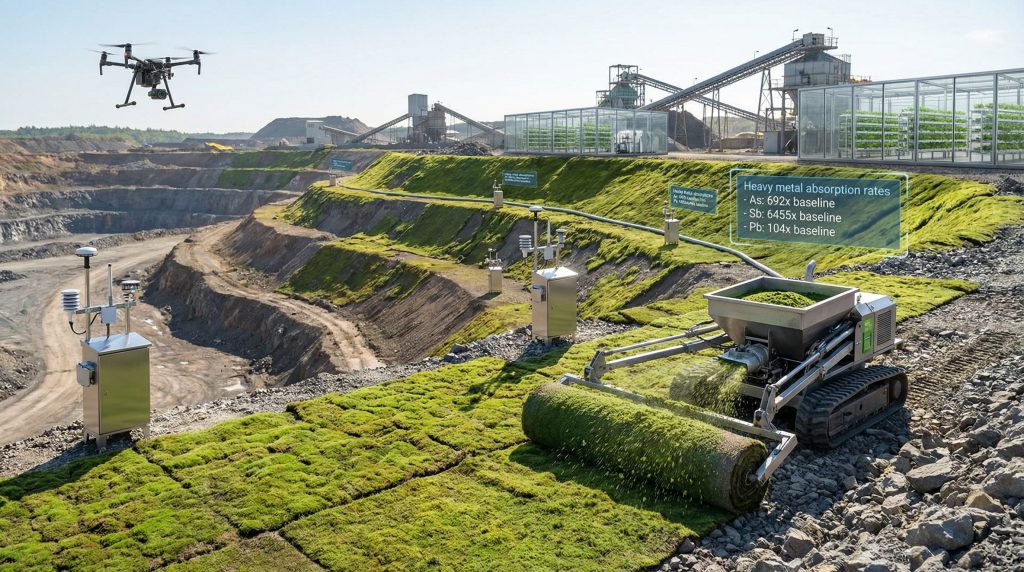
The heavy metal tolerance exhibited by various moss species enables their use in contaminated site rehabilitation. These organisms can bioaccumulate toxic metals while continuing to function normally, effectively removing contaminants from surface waters and preventing their migration to surrounding ecosystems.
Water retention properties prove especially valuable in arid mining regions where moisture limitation constrains restoration success. Moreover, moss biomats can retain significant quantities of precipitation and atmospheric moisture, creating localised humid microclimates that support ecosystem development in otherwise hostile environments.
Scandinavian Mining Sector Implementation
The Nordic region has emerged as a leader in developing practical moss mine rehabilitation protocols for mining applications. Swedish research institutions have collaborated with iron ore operations to develop standardised techniques for moss propagation and deployment on mining-disturbed lands.
LKAB (Luossavaara-Kiirunavaara AB), Sweden's state-owned iron ore producer, has implemented moss-based substrate stabilisation programs at multiple facilities. Their approach focuses on preventing erosion on waste rock piles while establishing foundation conditions for long-term revegetation.
North American Expansion Programs
Teck Resources has initiated methodology transfer programs to apply Scandinavian moss mine rehabilitation techniques at their Red Dog Operations in Alaska. This represents one of the first large-scale applications of moss rehabilitation technology in North American mining operations.
Arctic implementation requires specialised considerations for permafrost conditions and extreme temperature variations. Success depends on selecting moss species adapted to polar environments and timing deployment to coincide with optimal growing seasons.
The technology transfer process involves adapting European moss cultivation protocols to North American environmental conditions and regulatory requirements. In addition, this includes developing new propagation facilities and training local personnel in moss handling and deployment techniques.
Technical Methodologies for Moss Propagation
Laboratory cultivation techniques form the foundation of successful moss mine rehabilitation programs. Controlled environment protocols enable mass production of moss biomats suitable for large-scale mining applications. The cultivation process involves spore germination, vegetative propagation, and biomat formation under precisely controlled conditions.
Hydrophilic polymer integration enhances moss mat development by improving moisture retention and structural integrity. These specialised polymers provide scaffolding for moss growth while ensuring adequate water availability during the critical establishment phase.
Field Implementation Strategies
Site preparation requirements for moss establishment are minimal compared to conventional restoration approaches. Surface preparation typically involves removing loose debris and creating appropriate microtopography for moisture retention without extensive soil modification.
Application timing proves critical for moss establishment success. Optimal deployment occurs during periods when substrate moisture content reaches appropriate levels for rhizoid development. However, in northern climates, this typically coincides with spring thaw periods when snowmelt provides sustained moisture availability.
Field implementation follows this general sequence:
- Site assessment and moss species selection
- Substrate preparation and debris removal
- Moisture optimisation timing
- Biomat deployment and anchoring
- Initial establishment monitoring
- Adaptive management adjustments
- Long-term performance evaluation
Environmental Effectiveness and Biomonitoring Applications
Moss communities demonstrate significant capacity for heavy metal bioaccumulation, making them valuable tools for environmental remediation. Different species exhibit varying affinities for specific contaminants, enabling targeted approaches to site-specific contamination issues. This approach contributes significantly to decarbonisation benefits by reducing environmental impact through natural remediation processes.
The bioaccumulation process occurs through rhizoid uptake and cellular sequestration mechanisms. Heavy metals become concentrated in moss tissues without causing immediate toxicity, allowing these organisms to function as biological filters for contaminated surface waters.
Environmental Risk Assessment Applications
Moss serves as highly sensitive biomonitoring indicators for contamination assessment programmes. Their ability to concentrate pollutants makes them excellent early warning systems for environmental quality changes. Consequently, this characteristic enables detection of contamination at very low concentrations.
Integration with environmental compliance monitoring systems provides mining operators with cost-effective tools for demonstrating regulatory compliance. Moss biomonitoring can supplement traditional water and soil testing programmes while providing continuous contamination assessment.
Economic Benefits and Cost-Effectiveness Analysis
Moss rehabilitation offers significant cost advantages over conventional restoration approaches. The elimination of topsoil transport and placement reduces material costs while simplifying logistical requirements. Equipment needs are minimal, requiring only basic application machinery rather than heavy earthmoving equipment.
Long-term maintenance requirements prove substantially lower than traditional seeding programmes. Once established, moss communities require minimal intervention, reducing ongoing operational costs throughout the mine closure period. This approach aligns well with broader mining sustainability transformation initiatives across the industry.
Regulatory Compliance Advantages
Environmental bond requirements may be reduced when moss rehabilitation demonstrates effective environmental protection. Regulatory agencies increasingly recognise biological restoration approaches as equivalent or superior to conventional mechanical methods.
Mine closure approval processes can be accelerated through demonstrated ecosystem restoration rather than simple site stabilisation. For instance, this approach aligns with modern regulatory preferences for functional ecosystem recovery over passive containment strategies.
The next major ASX story will hit our subscribers first
Environmental Conditions Optimising Success
Climate and substrate requirements vary among moss species, enabling selection of appropriate organisms for site-specific conditions. pH tolerance ranges from highly acidic conditions (pH 3.0) through neutral conditions (pH 7.0), providing flexibility for diverse mining environments.
Moisture retention thresholds prove critical for establishment success. Successful programmes maintain substrate moisture content between 15-20% during the initial establishment phase, requiring careful timing of deployment activities.
Geographic Adaptation Strategies
Arctic and subarctic implementations require specialised approaches accounting for permafrost dynamics and extreme temperature fluctuations. Species selection focuses on cold-tolerant varieties capable of surviving freeze-thaw cycles.
Semi-arid environment modifications emphasise moisture conservation techniques and drought-resistant species selection. These adaptations enable successful moss establishment in challenging climatic conditions typical of many mining regions.
Regional implementation considerations include:
• Temperature tolerance ranges: Species selection based on extreme temperature exposure
• Precipitation patterns: Deployment timing aligned with seasonal moisture availability
• Soil chemistry: Moss varieties matched to substrate pH and salinity conditions
• Growing season length: Programme timing adapted to local climate constraints
• Wind exposure: Protection strategies for exposed slope applications
Biodiversity Recovery and Ecosystem Services
Wildlife habitat restoration represents a major benefit of moss rehabilitation programmes. Established moss communities provide grazing resources for caribou and reindeer populations, particularly important in Arctic mining regions where traditional forage has been disrupted.
Soil invertebrate community development accelerates once moss biomats create appropriate microhabitat conditions. These communities support broader food web recovery and enhance ecosystem functionality beyond simple vegetation establishment.
Ecosystem Service Provision
Carbon sequestration potential through moss rehabilitation contributes to climate change mitigation goals. Established moss communities can sequester substantial quantities of atmospheric carbon while providing other ecosystem services, supporting broader green transition insights for sustainable mining practices.
Air and water quality improvements result from dust suppression, pollutant filtration, and erosion control provided by moss communities. These benefits extend beyond the immediate mine site to surrounding watersheds and airsheds.
Research Frontiers and Technological Innovation
Advanced biotechnology applications are expanding moss rehabilitation capabilities through genetic selection programmes. Research focuses on developing varieties with enhanced metal tolerance, improved establishment rates, and expanded environmental adaptability.
Propagule size optimisation studies seek to determine ideal deployment specifications for different site conditions. This research aims to maximise establishment success while minimising material costs and application complexity.
Integration with Emerging Mining Technologies
Compatibility with autonomous mining operations requires developing deployment systems that function safely alongside automated equipment. This integration enables moss rehabilitation during active mining phases rather than waiting for final closure, particularly important for operations implementing renewable energy transformations.
Real-time monitoring using drone-based assessment provides continuous feedback on establishment success and adaptive management needs. These technologies enable precision application and rapid response to establishment problems.
Current research priorities include:
- Genetic improvement: Enhanced stress tolerance through selective breeding
- Application technology: Automated deployment systems for large-scale operations
- Monitoring systems: Remote sensing for establishment assessment
- Species development: New varieties for extreme environments
- Integration protocols: Compatibility with mining operational sequences
Future Prospects for Moss-Based Mine Rehabilitation
Industry adoption trends indicate growing acceptance of biological restoration approaches among mining companies and regulatory agencies. This shift reflects increasing emphasis on ecosystem functionality rather than simple site stabilisation.
Regulatory frameworks increasingly support biological restoration methods that demonstrate measurable ecosystem recovery. Furthermore, this trend creates favourable conditions for expanded moss rehabilitation implementation across diverse mining sectors. These developments complement broader mine reclamation innovations being implemented industry-wide.
Scaling Challenges and Solutions
Commercial propagation facility development represents a key requirement for widespread adoption. Successful scaling requires establishing regional cultivation centres capable of supporting multiple mining operations within economical transportation distances.
Standardisation of application protocols will enable broader industry adoption while ensuring consistent results across different operators and site conditions. This standardisation must balance technical requirements with operational flexibility.
The success of moss rehabilitation technology depends on continued research investment and industry collaboration to refine techniques and expand applications to new environmental conditions and mining sectors.
Disclaimer: This article discusses emerging restoration technologies and their potential applications. Implementation success may vary based on site-specific conditions, regulatory requirements, and technical execution. Mining operators should conduct thorough feasibility assessments before implementing moss rehabilitation programmes.
Ready to Capitalise on Mining Innovation Breakthroughs?
Emerging restoration technologies like moss rehabilitation represent just one facet of the mining sector's rapid transformation, creating significant opportunities for informed investors. Discovery Alert's proprietary Discovery IQ model instantly identifies breakthrough announcements across all ASX-listed mining companies, ensuring subscribers capture actionable opportunities in innovative mining technologies and traditional discoveries alike. Begin your 14-day free trial today to position yourself ahead of the market and secure your competitive advantage in this evolving landscape.