May 15, 2026
The Two-Phase Architecture That Could Define Buenaventura Tantahuatay Full Capacity in Peru
Few assets in Latin American precious metals mining carry the structural complexity of a deposit that hosts two fundamentally different ore types, each requiring distinct metallurgical treatment, separated by geology rather than geography. This layered architecture, where an oxide gold-silver operation sits atop a copper sulfide resource, creates a sequenced multi-decade opportunity that single-commodity mines rarely replicate. Understanding how this dual-phase design works, and why achieving full processing capacity in the near term matters so profoundly for the longer investment case, requires examining the mine not as a static operation but as an evolving industrial system.
Tantahuatay, located in the Cajamarca region of northern Peru and operated through the Coimolache consortium under Compañía de Minas Buenaventura's controlling interest, is precisely this kind of asset. The path toward Buenaventura Tantahuatay full capacity in Peru is not simply an operational milestone — it is the financial and technical prerequisite for unlocking a generational copper development that could extend the mine's productive life by two decades.
When big ASX news breaks, our subscribers know first
Understanding Tantahuatay's Position Within Peru's Mining Landscape
Cajamarca sits at the heart of one of South America's most mineralogically significant corridors. The region has historically contributed to Peru's standing as one of the world's top-five gold producers and a leading silver producer globally, a position supported by USGS Mineral Commodity Summaries data tracking Andean production over multiple decades.
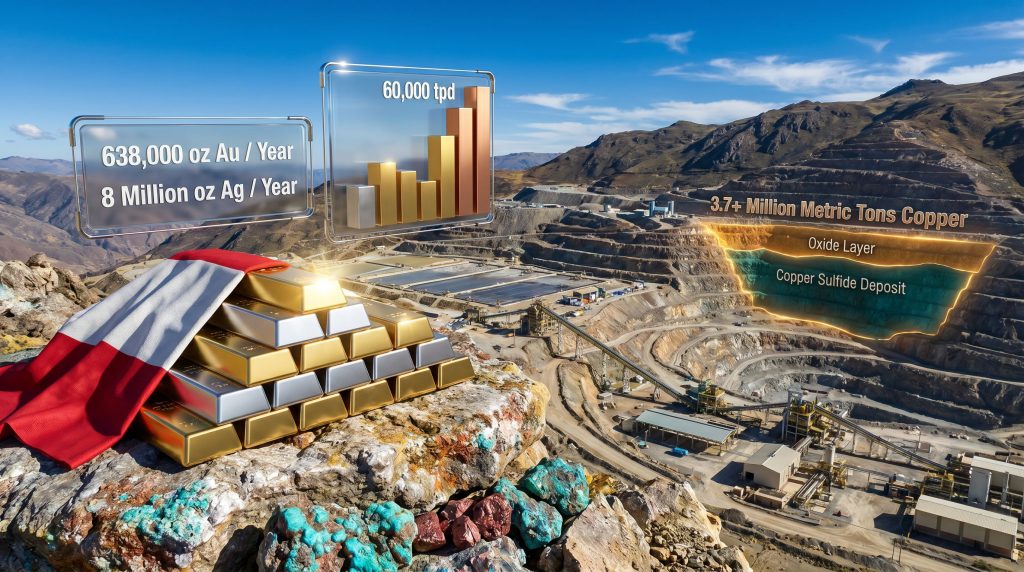
Within this landscape, Tantahuatay functions as a meaningful mid-tier precious metals operation. Current gold production is reported at approximately 638,000 ounces annually, alongside roughly 8 million ounces of silver per year, processed through infrastructure capable of handling up to 8.75 million metric tons per year (MM tm/año). These figures place the mine firmly within the upper tier of Peru's non-giant gold operations, a category defined by sustained throughput and multi-year reserve life rather than exploration-stage promise.
What distinguishes Tantahuatay structurally from many comparable operations is the resource architecture beneath its current oxide workings. The confirmed presence of a copper sulfide deposit containing a reserve base exceeding 3.7 million metric tons of copper transforms the asset's long-term investment narrative entirely. Furthermore, understanding copper investment strategies within this context helps frame why the transition from precious metals to base metals carries such strategic weight.
The Oxide Phase: What Full Capacity Actually Means in Practice
In mining, the phrase full capacity carries more precision than it suggests at first reading. It refers to sustained throughput at or near the maximum design rate of processing infrastructure, achieved without chronic unplanned downtime, reagent supply chain disruptions, or regulatory constraints limiting ore feed.
For Tantahuatay's current oxide operations, full capacity means consistently processing ore at the 8.75 MM tm/year design rate across its gold and silver heap leach circuits. This matters for a reason that often escapes general coverage of mine operations: fixed infrastructure costs — including depreciation, labour, water treatment, power, and tailings management — are spread across the total volume of ore processed.
When throughput falls below design rates, the cost per ounce of gold or silver recovered increases, sometimes dramatically, eroding the economic margin that justifies sustaining capital expenditure. In an environment where gold record highs have supported healthy precious metals margins, maximising throughput becomes even more critical to locking in returns during the oxide phase.
A mine running at full design throughput typically achieves its lowest all-in sustaining cost (AISC) per ounce produced. Conversely, a mine operating at 75–80% of capacity can see AISC increase by 15–25%, depending on the fixed cost structure, transforming an economically sound operation into a marginal one.
This relationship between throughput and unit cost is why Buenaventura's focus on achieving Buenaventura Tantahuatay full capacity in Peru carries financial significance beyond headline production numbers. Current gold and silver oxide operations are projected to continue through approximately 2028, meaning the window for maximising returns from the existing processing circuit is finite and defined.
Regulatory Milestones: The 2024 EIA Modification and What It Unlocked
Peru's environmental permitting architecture is among the more complex in South America. Large-scale mining operations require Environmental Impact Assessments (EIAs) approved by Senace, the Servicio Nacional de Certificación Ambiental para las Inversiones Sostenibles — Peru's primary national environmental authority for significant investment projects. Modifying the original EIA to accommodate infrastructure expansions requires a separate approval process that can span 12 to 36 months, depending on the scope of changes and the quality of stakeholder engagement throughout the review period.
In Q2 2024, Senace approved the third modification of Tantahuatay's Environmental Impact Assessment, a development with concrete operational consequences. The approval expanded the mine's concession area by 67.85 hectares, creating the physical footprint required for additional processing plants and leaching pad infrastructure. Without this approval, the spatial constraints on the site would have capped the operation's ability to reach its design throughput rate.
For investors monitoring the project, the successful navigation of a third EIA modification is worth contextualising properly. In Cajamarca's recent history, community relations and environmental concerns have influenced project timelines at multiple operations. The completion of this regulatory process signals that Buenaventura has maintained the combination of technical compliance and community engagement necessary to advance the project through Peru's multi-layered approval framework.
It is important to note that this regulatory achievement reflects the standard permitting process and does not constitute any form of government-designated project status, accelerated approval pathway, or special strategic classification by Peruvian authorities. However, Peru recently approved the environmental study for Buenaventura's $3.4 billion copper project, reinforcing the company's capacity to navigate the country's regulatory landscape at scale.
The Infrastructure Expansion: Key Metrics at a Glance
| Development Phase | Key Metric | Status |
|---|---|---|
| Current Gold/Silver Operations | 8.75 MM tm/year processing capacity | Active through ~2028 |
| EIA Third Modification | +67.85 hectares concession expansion | Approved Q2 2024 |
| Copper Sulfide Phase | Up to 60,000 tpd mineral processing | Pre-development/feasibility |
| Copper Reserve Base | 3.7+ million metric tons | Confirmed resource |
| Copper Phase Capex Estimate | US$600–700 million | Pre-development estimate |
| Projected Extended Mine Life | Additional ~20 years | Projected upon copper development |
Disclaimer: Forward-looking metrics including copper phase processing rates, capital expenditure estimates, and mine life projections are pre-development estimates subject to change pending feasibility study completion, financing, and regulatory approvals. These figures should not be interpreted as commitments or guarantees of future performance.
The Copper Sulfide Phase: A Metallurgical and Financial Paradigm Shift
The geological boundary between Tantahuatay's current oxide operations and the copper sulfide deposit below is not merely a line on a resource model. It represents a fundamental shift in metallurgical processing requirements, capital intensity, and commodity exposure.
Why Do Oxide and Sulfide Ores Require Different Treatment?
Oxide gold and silver ores are amenable to heap leaching — a relatively capital-light process where crushed ore is stacked on lined pads and irrigated with a cyanide solution that dissolves precious metals for subsequent recovery. The process is well-understood, operationally flexible, and has relatively modest infrastructure requirements compared to sulphide treatment.
Copper sulfide ores, however, cannot be economically processed through heap leaching. They require froth flotation, a more energy-intensive and capital-demanding process that involves grinding ore to fine particle sizes and using chemical reagents to selectively attach copper mineral particles to air bubbles, separating them from gangue material to produce a copper concentrate. This concentrate is then sold to smelters for final metal production.
The engineering transition from a heap leach gold operation to a flotation-based copper operation involves:
- Complete redesign of the primary crushing and grinding circuit
- Installation of flotation cells, reagent dosing systems, and thickening equipment
- Construction of concentrate filtration and storage facilities
- Reconfiguration of tailings management infrastructure to handle finer-ground material
- New water treatment and recirculation systems suited to closed-circuit flotation
This scope of change is why the copper phase carries an estimated capital requirement of US$600 to US$700 million, a figure that reflects genuine infrastructure replacement rather than incremental expansion. Completing a definitive feasibility study will be essential before any final investment decision can be sanctioned.
Scale-Up to 60,000 tpd: What Does That Mean Operationally?
The copper phase is designed to process up to 60,000 metric tons of ore per day, which translates to approximately 21.9 million metric tons per year — representing a more than 2.5x increase over the current oxide processing rate. This scale-up is not unusual for copper operations compared to gold, given that copper ore grades are typically lower, requiring larger volumes of material to generate equivalent revenue per tonne of ore mined.
For context, the copper concentrate produced at that throughput rate from a resource base of 3.7+ million metric tons would generate a production profile capable of sustaining operations for approximately 20 additional years beyond the current oxide phase's closure around 2028.
The next major ASX story will hit our subscribers first
Commodity Markets and the Economic Logic Behind Both Phases
The timing of Tantahuatay's two-phase development intersects with structural trends across three commodity markets simultaneously.
Gold has maintained elevated price levels through 2024 and into 2026, driven by central bank purchasing, geopolitical uncertainty, and real interest rate dynamics. Elevated gold prices improve the all-in sustaining cost margin at Tantahuatay's current operations, generating cash flows that can support sustaining capital and contribute to the feasibility work required for the copper phase.
Silver occupies a position where silver's dual demand — both as a precious metal and an industrial commodity — has strengthened its structural outlook considerably. Industrial consumption, particularly in photovoltaic solar panel manufacturing where silver paste is used as an electrical conductor, has grown significantly alongside global renewable energy investment. The Silver Institute has documented solar industry silver demand as one of the most significant growth vectors in the metal's demand profile over the past decade.
Copper benefits from what many commodity analysts describe as a structural copper supply crunch driven by energy transition infrastructure requirements. Electric vehicles require significantly more copper per unit than internal combustion engine vehicles, and grid modernisation programmes across major economies are intensifying copper demand in transmission and distribution infrastructure. Peru, as the world's second-largest copper producer according to USGS data, sits at the centre of global supply responses to this demand growth.
The combination of these three commodity dynamics creates a rare alignment where both phases of Tantahuatay's development are supported by independent macroeconomic rationale simultaneously.
Risk Factors Investors Should Monitor
No multi-phase mining development of this scale is without material risks. Investors tracking Buenaventura Tantahuatay full capacity in Peru should consider the following risk dimensions:
- Permitting timeline risk: The copper sulfide phase will require its own EIA modification or new EIA submission. Given Senace's typical processing window of 12 to 36 months, any delays in commencing this process could affect the transition timeline between oxide closure and copper startup.
- Community relations continuity: Cajamarca has a documented history of community-level opposition to mining expansions at multiple projects. Sustained engagement is not a one-time achievement but an ongoing operational requirement.
- Capital availability and sequencing: The US$600–700 million copper phase capex must be balanced against Buenaventura's broader portfolio capital requirements across its multiple Peruvian operations. Financing structures, partner arrangements, and debt markets will all influence when a final investment decision can be sanctioned.
- Commodity price sensitivity: The economic viability of the copper phase is sensitive to long-term copper price assumptions embedded in feasibility modelling. A sustained decline in copper prices below development threshold levels could defer the investment decision.
- Metallurgical complexity: Transitioning from oxide heap leach to sulfide flotation introduces engineering execution risk during construction and commissioning phases — a period where cost overruns and schedule delays are statistically more common across the sector.
How Tantahuatay Compares to Peru's Broader Mining Peer Group
| Dimension | Tantahuatay (Current) | Tantahuatay (Copper Phase) |
|---|---|---|
| Primary Output | Gold and Silver | Copper Concentrate |
| Processing Rate | 8.75 MM tm/year | ~21.9 MM tm/year (60,000 tpd) |
| Mine Life Horizon | ~2028 | Additional ~20 years |
| Capital Commitment | Sustaining capital | US$600–700M development capex |
| Commodity Exposure | Precious metals | Base metals (energy transition) |
Within Peru's broader mining context, the current oxide operation positions Tantahuatay as a meaningful contributor to national gold output without approaching the scale of operations like Yanacocha. However, the copper phase, if sanctioned, would move the project into a different competitive tier — more comparable in capital intensity and production scale to mid-tier copper operations — and would represent one of Peru's more significant mining capital commitments of the late 2020s.
The co-location of both ore types within a single concession area, combined with Buenaventura's existing community relationships, workforce, and infrastructure in Cajamarca, furthermore reduces the greenfield development risk that typically inflates capital requirements and timelines for entirely new copper projects. In addition, Buenaventura projects a significant increase of up to 23% in its gold production in Peru, reinforcing the broader strategic context within which Tantahuatay's full capacity achievement sits.
Frequently Asked Questions
What Is Tantahuatay's Current Annual Gold Production?
The mine currently produces approximately 638,000 ounces of gold per year, alongside roughly 8 million ounces of silver, processed through infrastructure rated at 8.75 million metric tons per year.
When Does the Current Oxide Phase Conclude?
Gold and silver oxide operations are projected to continue through approximately 2028, providing a defined window within which full capacity achievement maximises precious metals revenue before the transition to copper development.
What Environmental Approvals Have Been Obtained?
Peru's Senace approved the third modification of Tantahuatay's EIA in Q2 2024, enabling a 67.85-hectare expansion of the concession area to accommodate new processing and leaching infrastructure.
How Much Will the Copper Phase Cost and How Long Could It Last?
Capital expenditure estimates for the copper sulfide development range between US$600 million and US$700 million, with the phase projected to extend mine life by approximately 20 years beyond current operations, supported by a confirmed copper resource exceeding 3.7 million metric tons.
What Is the Planned Daily Processing Rate for the Copper Phase?
The copper sulfide phase is designed to process up to 60,000 metric tons of ore per day, representing a substantial throughput increase from current precious metals processing rates.
This article is intended for informational purposes only and does not constitute financial or investment advice. Forward-looking statements regarding production, mine life, capital expenditure, and commodity demand reflect available projections and estimates at the time of writing and are subject to material change. Readers should conduct independent due diligence before making investment decisions.
Want to Stay Ahead of the Next Major ASX Mineral Discovery?
Discovery Alert's proprietary Discovery IQ model delivers real-time alerts the moment significant ASX mineral discoveries are announced, transforming complex data across 30+ commodities into clear, actionable insights for both short-term traders and long-term investors — explore historic discoveries and their returns to understand the opportunity, then begin your 14-day free trial at Discovery Alert to position yourself ahead of the broader market.