June 10, 2026
Why Procurement Timing Now Matters More Than Price in Marine Fuel Markets
Global commodity supply chains have a long history of absorbing geopolitical shocks through rerouting, substitution, and temporary price premiums. However, the disruption that has unfolded across marine fuel markets since late February 2026 exposes a less commonly understood vulnerability. When a single maritime chokepoint controls access to roughly one-fifth of the world's seaborne crude, the damage does not stop at price. It reaches into the operational mechanics of how ships are fuelled, how far ahead operators must plan, and whether fuel is available at any price at all.
Bunker lead times since the US-Iran war began have emerged as one of the most consequential operational indicators in global shipping. Unlike price signals, which reflect supply-demand imbalances after the fact, lead time extensions reveal where supply chains are beginning to fracture in real time. Understanding what is driving these changes, port by port and fuel grade by fuel grade, is now essential for anyone managing vessel operations or fleet logistics.
When big ASX news breaks, our subscribers know first
What Bunker Lead Times Actually Measure and Why They Have Become Critical
A bunker lead time is the elapsed interval between when a vessel operator or trader places an order for marine fuel and when that fuel is physically delivered to the ship. Under stable market conditions, prompt procurement windows of roughly one to three days were widely available at major hubs, with forward bookings of seven to fourteen days considered the standard planning range. Argus Media's bunker assessments have historically used a maximum delivery window of nine to twelve days, extending to fourteen days for certain African ports, as a proxy for normal market functioning.
When lead times extend materially beyond these baselines, something structurally significant is happening. Longer booking windows signal that suppliers are managing constrained inventory, that blendstock feedstocks are either unavailable or delayed, or that the probability of prompt supply failure has risen enough to change buyer behaviour regardless of whether spot availability technically still exists.
Lead time data functions as a forward indicator of supply system stress. By the time price premiums reach extreme levels, the procurement window for avoiding operational disruption may already have closed.
The transmission mechanism from conflict to lead time extension runs through several interconnected steps. Disruption to Strait of Hormuz transits removes approximately 20% of globally traded crude from normal circulation. This tightens the feedstock pool available to regional blending operations that produce VLSFO and other marine fuel grades. Furthermore, elevated freight costs reduce the economic viability of importing substitute feedstocks from distant origins, compounding the availability constraint. The result is not just higher prices but genuinely reduced supply, forcing buyers to secure product earlier or risk finding none available at all. This situation closely mirrors patterns seen in broader crude oil price volatility events, where feedstock disruptions cascade rapidly into delivered fuel markets.
How Does the Conflict Affect Global Oil Benchmarks?
The oil geopolitics analysis surrounding the US-Iran conflict reveals that benchmark pricing for WTI and Brent futures has responded sharply to transit uncertainty. Consequently, the premium embedded in forward contracts now reflects not just supply concerns but genuine logistics risk across the entire bunkering chain. According to Britannica's coverage of the 2026 Iran war, the conflict has fundamentally reshaped regional energy infrastructure assumptions.
Fujairah: From Regional Anchor to Supply Vacuum
No bunkering hub has experienced a more severe deterioration than Fujairah, the world's fourth-largest bunkering port. Before the conflict, Fujairah occupied a central role in the Gulf's marine fuel supply architecture, drawing on regional crude flows and local blending infrastructure to serve vessels transiting one of the world's busiest shipping corridors.
By early June 2026, most major bunker suppliers at Fujairah had reported zero prompt VLSFO availability through the remainder of the first half of June. The acute shortage was driven by two converging forces: the severance of regional feedstock import flows caused by the Hormuz closure, and the loss of supply from Kuwait's al-Zour refinery, a 615,000 barrels-per-day facility whose output had previously formed a core input into Fujairah's local VLSFO blending pipeline.
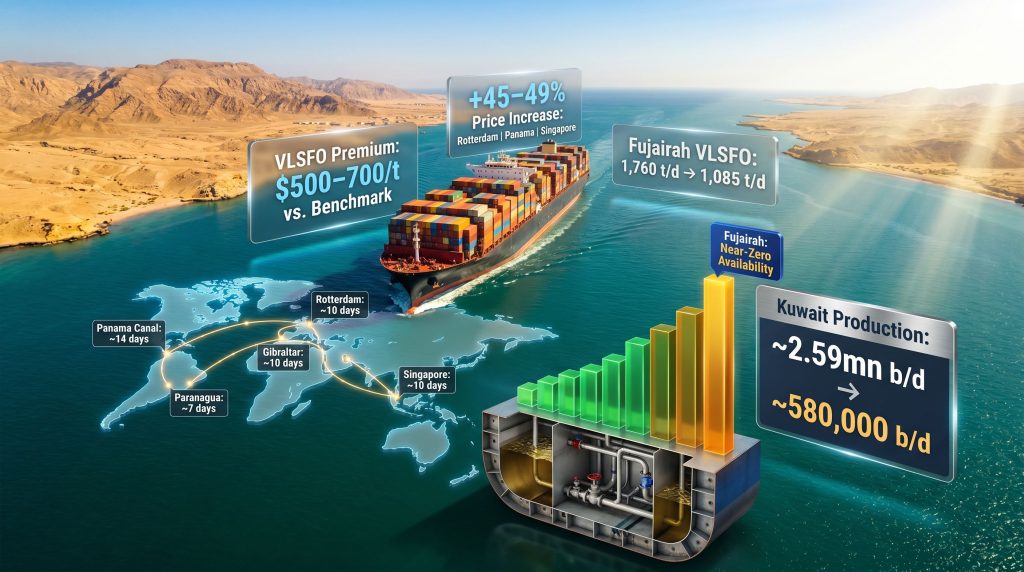
The scale of the demand collapse is visible in volume data. VLSFO sales tracked at Fujairah fell from approximately 1,760 tonnes per day in April to a record low of approximately 1,085 tonnes per day in May, a contraction of roughly 38% in a single month. The premium spike that accompanied this collapse was extraordinary even by crisis standards.
| Metric | Pre-Conflict Normal | Peak Disruption (Early June 2026) |
|---|---|---|
| Typical VLSFO spot premium | ~$10-20/t vs. Singapore cargo | $500-700/t vs. front-month Singapore cargo |
| Prompt VLSFO availability | Widely available | Near-zero across major suppliers |
| Khor Fakkan spot transaction (8 June 2026) | Benchmark-aligned | $450/t premium recorded |
The $450 per tonne transaction recorded at the neighbouring port of Khor Fakkan on 8 June 2026 represents a real-world price discovery event in a market where illiquidity had effectively suspended normal trading. That a transaction could clear at 22 to 45 times the normal premium band underscores how completely the supply architecture had broken down.
Near-term relief was anticipated through the scheduled arrival of a 100,000-tonne low-sulphur straight run residuals (LSSR) cargo from Nigeria's Dangote refinery aboard the vessel Indonesia Prosperity, expected at Fujairah around 16 June 2026. The vessel's charterer, trading firm Vitol, operates a 100,000 barrel-per-day refinery in Fujairah and was understood to hold priority access to the cargo for its own bunkering arm. Importantly, LSSR cannot be delivered directly as marine fuel. Blending the material into deliverable VLSFO specification requires additional days after arrival, meaning even this supply injection offered no immediate resolution to the prompt availability crisis.
Singapore: Differentiated Stress Across Fuel Grades
Singapore, the world's largest bunkering hub by volume, has experienced lead time extensions that differ meaningfully by fuel type, illustrating how the conflict's supply disruption is not a uniform shock but a grade-specific one.
VLSFO delivery windows have extended to approximately 10 to 15 days forward in some cases, compared with a typical range of seven to ten days. The driver is blendstock tightness caused by the diversion of feedstock flows away from Singapore's established import supply chains. Brazilian fuel oil exports, which would historically have supported domestic VLSFO blending in South America, have increasingly been redirected toward Singapore's import demand, partially offsetting the Hormuz-origin shortfall but creating a feedback loop of scarcity at the Brazilian end.
LSMGO (low-sulphur marine gasoil) has encountered a separate, logistics-driven constraint. Cargo arrival delays from South Korean suppliers have tightened available inventory, with the majority of current stock absorbed by previously booked orders and therefore unavailable to spot buyers. Market expectations as of early June 2026 pointed to supply normalisation only in the second half of the month.
HSFO (high-sulphur fuel oil) stands as the notable exception. Lead times for HSFO in Singapore have remained stable at approximately four to five days, reflecting the grade's structural independence from Middle Eastern feedstock supply chains. For operators whose vessels are fitted with exhaust gas cleaning systems (scrubbers) enabling HSFO compliance, this stability represents a meaningful operational advantage in the current environment.
European Hubs and the Americas: Moderate Tightening With Different Root Causes
European bunkering centres have not been insulated from the disruption, but the mechanisms and severity differ from the Gulf region.
| Port | Pre-Conflict Lead Time | Current Lead Time | Change |
|---|---|---|---|
| Gibraltar | ~5 days | ~10 days | +100% |
| Rotterdam | ~7 days | ~10 days | +43% |
| Panama Canal | ~10 days | ~14 days | +40% |
| Santos (Brazil) | ~8 days | ~10 days | +25% |
| Paranagua (Brazil) | ~10 days | ~13 days | +30% |
| Singapore (VLSFO) | 7-10 days | 10-15 days | +43-50% |
| Singapore (HSFO) | 4-5 days | 4-5 days | No change |
| Fujairah (VLSFO) | Prompt / standard | Near-zero availability | Market collapse |
Rotterdam's diversified import infrastructure and access to transatlantic gasoil flows, including US-origin cargoes, has provided a buffer that Gulf ports lacked. Gibraltar's doubling of lead times from five to ten days reflects tighter Mediterranean supply conditions rather than a feedstock crisis of the kind experienced in Fujairah.
The price escalation data across global hubs reveals something analytically significant: the increases have been near-uniform despite geographic dispersion.
| Hub | VLSFO Price Change (28 February to 31 May 2026) |
|---|---|
| Rotterdam | +~45% |
| Panama | +~49% |
| Singapore | +~47% |
When price escalation of approximately 45-49% occurs simultaneously across Rotterdam, Panama, and Singapore, it confirms a systemic supply disruption rather than a regional pricing anomaly. Operators cannot arbitrage their way out of elevated costs by shifting procurement geography.
In the Americas, the Panama Canal has introduced a distinct congestion dynamic. Rising vessel traffic has extended canal crossing wait times, pushing bunker buyers at Balboa and Cristobal to shift toward forward procurement to align fuel delivery with uncertain transit windows. The average bunker lead time at the Panama Canal rose to 14 days in March through May 2026, up from 10 days in the three months ending 28 February 2026, a 40% increase driven by logistics rather than feedstock scarcity.
Brazil's Santos and Paranagua ports have been caught in a feedstock diversion loop. As Brazilian fuel oil exports flow increasingly toward Singapore to meet demand created by the Hormuz disruption, the domestic blendstock pool for VLSFO production has tightened, extending lead times at both ports even though Brazil sits geographically removed from the conflict zone. In addition, effective commodity market hedging has become considerably harder as forward price curves reflect genuine supply uncertainty rather than predictable seasonal patterns.
Kuwait's Pipeline Options and What They Mean for Supply Recovery
An often-overlooked dimension of this supply disruption involves Kuwait's structural dependence on the Strait of Hormuz and the recovery timeline implications for the broader bunkering market. Kuwait has no pipeline bypass and is entirely reliant on the strait to move crude and oil products to export markets.
The conflict forced Kuwait to reduce output to levels required only for domestic consumption, with production falling from approximately 2.59 million barrels per day in February 2026 to approximately 580,000 barrels per day in May 2026, a reduction of roughly 78%. These shifts are consistent with broader global crude supply trends that have been reshaping regional energy balances throughout 2025 and into 2026.
Kuwait's state-owned KPC has been exploring potential pipeline arrangements with Saudi Arabia and the UAE that could provide partial bypass capacity. Saudi Arabia's East-West pipeline carries a capacity of 7 million barrels per day, routing crude from the Eastern Province to Yanbu on the Red Sea. The UAE's ADCOP pipeline carries 1.7 million barrels per day from Habshan in Abu Dhabi to Fujairah.
However, pipeline infrastructure alone does not guarantee supply security. Both pipelines have been targeted in attacks, and as KPC leadership has noted, the vulnerability of export terminals and pipeline compression nodes means bypass routes carry their own operational risks. A compression node strike can disable an entire pipeline segment, and export terminal damage renders the pipeline effectively non-functional.
When Hormuz does reopen, recovery in Kuwait's production is expected to be staged. Approximately 80% of shut-in production, or roughly 1.6 million barrels per day, could potentially be restored within approximately three weeks given the resilience of Kuwait's reservoir geology. The remaining 20%, however, may require an additional three to four months of careful reservoir management to recover safely.
The next major ASX story will hit our subscribers first
How Vessel Operators Should Restructure Procurement Strategy
The data across all major bunkering hubs points toward a set of operational adaptations that are no longer optional for fleet managers operating in this environment. Bunker lead times since the US-Iran war began have fundamentally altered what constitutes prudent forward planning.
- Audit actual booking windows against port-specific lead time data rather than relying on standard assumptions about availability. What was achievable in February 2026 is no longer a reliable baseline.
- Segment procurement risk by fuel grade. VLSFO and LSMGO carry materially higher supply risk than HSFO in the current environment. Procurement timelines and contingency planning should reflect this asymmetry explicitly.
- Prioritise forward booking at high-stress hubs including Fujairah, Singapore for VLSFO and LSMGO, Panama Canal ports, Santos, and Paranagua. All five locations show documented lead time extensions that require order placement significantly earlier than pre-conflict norms.
- Factor in blending lag time when sourcing from hubs receiving LSSR or alternative feedstock cargoes. Mid-June cargo arrivals at Fujairah will require additional days of blending before becoming deliverable fuel.
- Align canal transit procurement with realistic crossing windows at Panama rather than optimistic schedules. Fuel booked too close to a delayed crossing risks creating costly idle time.
- Maintain HSFO optionality wherever vessel compliance permits. HSFO supply chains remain stable and represent the lowest-risk procurement pathway currently available.
- Develop contingency supplier relationships at secondary ports such as Khor Fakkan as an alternative to Fujairah, to preserve access when primary hub availability collapses.
FAQ: Bunker Lead Times and the US-Iran Conflict
What are bunker lead times and why have they increased since the US-Iran war began?
Bunker lead times measure the interval between fuel order placement and physical delivery to a vessel. They have increased across most major bunkering hubs because the disruption to Strait of Hormuz transit has removed approximately 20% of globally traded crude from normal circulation, restricting the blendstock feedstocks needed to produce marine fuel grades. Higher freight costs have further reduced the economic incentive for suppliers to import alternative feedstocks. The BBC's reporting on the conflict provides useful context on how rapidly the situation escalated from early skirmishes to full-scale disruption.
Which bunkering ports have been most severely affected?
Severity varies considerably by location and fuel grade:
- Fujairah has experienced acute supply collapse for VLSFO with near-zero prompt availability
- Singapore has seen moderate-to-significant tightening for VLSFO and LSMGO, with HSFO remaining stable
- Panama and Brazil show moderate lead time extensions driven by congestion and feedstock diversion
- Rotterdam and Gibraltar have experienced mild-to-moderate tightening with resilient underlying supply infrastructure
How much have VLSFO prices increased since the conflict began?
Delivered VLSFO prices rose by approximately 45 to 49% across Rotterdam, Panama, and Singapore between 28 February and 31 May 2026. In Fujairah, spot premiums reached $500 to $700 per tonne above front-month Singapore cargo values, compared with a normal range of approximately $10 to $20 per tonne.
Is HSFO also affected?
HSFO lead times in Singapore have remained steady at approximately four to five days. The grade's supply chains are structurally less exposed to Middle Eastern feedstock disruption, making it the most operationally stable marine fuel option in the current environment.
When might Fujairah return to normal VLSFO availability?
The arrival of a 100,000-tonne LSSR cargo from Nigeria's Dangote refinery in mid-June 2026 was expected to provide near-term relief, subject to several additional days required for blending into deliverable VLSFO. Broader normalisation remains dependent on the pace of regional feedstock flow recovery and the timeline for any Hormuz reopening.
The Deeper Structural Lesson: Lead Times as a Leading Indicator
The disruption that has played out since late February 2026 carries a lesson that extends beyond the immediate conflict. Bunkering supply chains that are heavily concentrated around single-transit-route feedstock dependencies carry a structural fragility that price data alone cannot adequately signal.
By the time VLSFO premiums at Fujairah had reached $500 per tonne above benchmark, the practical window for securing alternative supply at reasonable cost had already closed for many operators. Bunker lead times since the US-Iran war began therefore serve as a far more actionable early warning metric than spot pricing alone.
Lead time data, tracked consistently and interpreted within the context of regional feedstock flows, refinery availability, and logistics constraints, provides an earlier and more operationally actionable warning signal. The procurement adaptations that this crisis has forced on vessel operators — including geographic diversification of suppliers, fuel-type flexibility, and extended forward booking protocols — represent structural upgrades worth retaining permanently rather than abandoning when normal conditions eventually return.
This article contains forward-looking information, forecasts, and third-party data that are subject to change. Readers should conduct independent verification before making procurement or operational decisions based on the figures and timelines discussed. Marine fuel market conditions are evolving rapidly and data referenced herein reflects information available as of early June 2026.
Want To Stay Ahead Of The Next Major Resource Discovery Reshaping Global Supply Chains?
When commodity supply disruptions cascade through energy markets at this speed, the investors best positioned to capitalise are those who receive real-time intelligence the moment a significant discovery hits the ASX — Discovery Alert's proprietary Discovery IQ model delivers exactly that, instantly translating complex mineral data into actionable opportunities for both short-term traders and long-term investors. Explore how historic discoveries have generated substantial returns on Discovery Alert's dedicated discoveries page, and begin your 14-day free trial today to secure a market-leading edge before the broader market catches on.