June 10, 2026
Gulf Energy Logistics at a Crossroads: Understanding KPC's Cautious Return to Spot Markets
Global energy supply chains were never designed with wartime flexibility as their primary feature. The Strait of Hormuz, a narrow waterway barely 33 kilometres wide at its tightest point, has long represented one of the most acute single points of failure in the entire global commodities system. Roughly 17 to 20 million barrels of oil and petroleum products pass through it every day under normal operating conditions, a volume that cannot be meaningfully rerouted without years of infrastructure investment.
When conflict disrupts that corridor, the consequences ripple outward with remarkable speed, touching everything from Asian petrochemical margins to European diesel import costs. Furthermore, commodity market volatility compounds these disruptions, amplifying price swings across interconnected markets in ways that are difficult to predict or contain.
It is within this context that the decision by Kuwait Petroleum Corporation to offer KPC spot fuel cargoes since the Iran war began carries significance far beyond its immediate commercial dimensions. What looks on the surface like a routine trading action is, in reality, a carefully calibrated signal about supply chain adaptation, geopolitical risk management, and the emerging logistics architecture of wartime Gulf energy trade.
When big ASX news breaks, our subscribers know first
The Supply Vacuum KPC Left Behind
When KPC declared force majeure on its export obligations in March 2026, the decision set off a chain reaction across multiple refined product markets simultaneously. The legal mechanism, designed to protect the state entity from contractual liability in extraordinary circumstances, had the practical effect of withdrawing a significant Gulf supplier from markets that had no ready substitute at equivalent scale or specification.
The downstream effects were concrete and measurable:
- Spot gasoil availability from the Persian Gulf tightened materially, with buyers forced into alternative supply chains at elevated premiums
- Naphtha shipments from Kuwait collapsed to near-zero volumes in March and April, according to vessel-tracking data compiled by Kpler, removing a meaningful feedstock source for Asian petrochemical producers
- Diesel exports fell to their lowest levels in five years during the same two-month window
- Term contract buyers were left navigating supply gaps, often sourcing replacement volumes from India, South Korea, and other regional exporters at less favourable netback economics
The broader market impact was amplified by the fact that Kuwait's primary export terminal, Mina Al-Ahmadi, sits squarely within the Persian Gulf, leaving KPC with minimal pre-existing bypass infrastructure compared to peers like ADNOC, which operates the Fujairah terminal outside the strait entirely. In addition, the global supply chain disruption caused by concurrent geopolitical pressures further limited the availability of viable alternative routing options.
How Did Force Majeure Affect Buyer Confidence?
The force majeure declaration damaged counterparty confidence in ways that extended well beyond the immediate supply gap. Buyers who had relied on Kuwaiti term contracts were forced to rapidly rebuild supply chains under adverse market conditions, often accepting inferior specifications or paying significant spot premiums.
What KPC Is Now Offering and Why the Specifications Matter
KPC's re-entry into spot trading centres on two refined product categories, each chosen deliberately for their market positioning and buyer appeal.
| Product | Cargo Size | Specification | Loading Window | Target Markets |
|---|---|---|---|---|
| Gasoil | 10ppm ultra-low sulphur | June 2026 | Asia / Northwest Europe | |
| Naphtha | 55,000-60,000 metric tons (~489,500-534,000 barrels) | Petrochemical grade | June 2026 | Asia |
The decision to offer gasoil at the 10ppm ultra-low sulphur specification is commercially significant in ways that go beyond simple product selection. This grade meets the most stringent emissions standards enforced across European and advanced Asian markets, positioning Kuwait as a premium-grade supplier rather than a distressed seller clearing discounted inventory. It signals that KPC is re-entering markets from a position of quality assurance, not desperation, which matters enormously for rebuilding counterparty confidence after months of force majeure.
Naphtha carries a different kind of strategic weight. Asian petrochemical producers, particularly crackers in South Korea, Japan, and Taiwan, consume Gulf-origin naphtha as a primary feedstock for ethylene and propylene production. The region's appetite for competitively priced, reliable naphtha supply is deep and structural. Kpler vessel-tracking data confirmed that KPC's naphtha exports had already begun recovering in May 2026, rebounding to more than 40,000 metric tons after two consecutive months of near-complete cessation. Consequently, the June spot offering represents a continuation of a data-confirmed, gradual restoration rather than a sudden market return.
Kuwait's first crude cargoes to Asia since the Iran war began have attracted significant buyer interest, particularly among Northeast Asian refiners seeking to diversify away from now-disrupted term supply arrangements.
Reinventing Delivery: How KPC Is Routing Around Hormuz
Perhaps the most operationally innovative dimension of this re-entry is the deliberate avoidance of the Strait of Hormuz as a delivery pathway. KPC is offering buyers three distinct logistical options, each designed to eliminate or minimise exposure to conflict-affected shipping lanes.
Option 1: Ship-to-Ship Transfer off West India
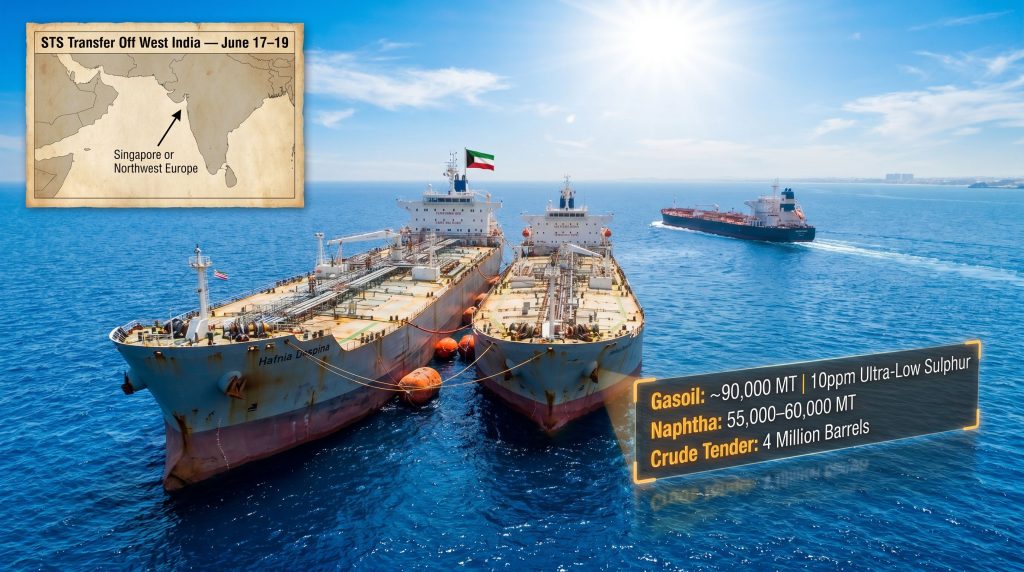
Cargoes are transferred between vessels in international waters off India's western coastline, eliminating the need for buyers to send tankers into the Persian Gulf entirely. The vessel Hafnia Despina has been chartered to execute an STS transfer of approximately 90,000 tons of refined fuels on June 17-19, with onward routing designated for either Singapore or northwest Europe.
Option 2: STS Transfer at Sohar, Oman
Oman's Port of Sohar sits on the Arabian Sea side of the Omani coast, outside the strait's conflict zone. It provides a neutral, geopolitically lower-risk handover point that has seen growing utilisation as Gulf producers adapt to wartime logistics constraints.
Option 3: Loading from Fujairah Tank Storage
Fujairah, the UAE's east coast oil hub, holds pre-positioned product inventories that can be lifted without vessels transiting the Gulf at all. This option gives buyers maximum security, though availability depends on pre-positioning volumes.
What KPC is effectively constructing is a modular logistics architecture capable of adapting to varying levels of Hormuz risk. If the conflict persists, this multi-node approach may become the default template for Gulf state energy exports, not merely a temporary workaround.
The Crude Tender: A Parallel Commercial Track
Running alongside the refined product spot offerings, KPC is simultaneously tendering approximately 4 million barrels of crude oil to Asian buyers, with the crude described as already positioned outside the Persian Gulf. This parallel activity reveals something important about KPC's bifurcated commercial strategy under wartime conditions.
The two tracks diverge in their execution methodology:
- Refined products are being offered through private negotiations, indicating selective engagement with trusted counterparties rather than open competitive bidding
- Crude is being sold via a formal tender process, suggesting greater confidence in crude demand transparency and buyer depth
This distinction reflects a nuanced understanding of market risk. Refined product markets reward relationship capital during periods of supply uncertainty, while crude markets, being more liquid and globally benchmarked, can tolerate open-process tendering even under geopolitically stressed conditions. Moreover, crude oil price trends have shifted considerably since hostilities began, adding further complexity to KPC's pricing calculations.
The orientation of both tracks toward Asian buyers is not accidental. Asian refiners hold the deepest structural appetite for Gulf-origin crude and naphtha, and the STS infrastructure off India's west coast creates a geographically convenient handover architecture for tankers transiting toward Northeast Asian ports.
Market Price Implications Across Three Product Dimensions
KPC's return to spot trading introduces incremental supply into markets that have been operating with a measurable Kuwaiti deficit since March. The pricing implications play out differently across each product category.
Gasoil
The re-entry of Kuwaiti 10ppm gasoil into spot markets adds downward pressure on Middle East gasoil differentials. Asian gasoil crack spreads, which widened during the supply disruption period, face modest compression as Kuwaiti volumes begin to normalise. This grade competes directly with similar-specification material from Indian refiners and South Korean exporters.
Naphtha
Petrochemical buyers in South Korea, Japan, and Taiwan benefit from restored access to Gulf naphtha at competitive pricing. Naphtha crack spreads in Asia had been partly supported by the absence of Kuwaiti supply; partial normalisation may weigh on these margins as availability improves. The anticipated restart of term naphtha deliveries in July adds longer-horizon supply visibility that spot purchasing alone cannot provide.
Tanker Freight
STS operations off west India and at Sohar generate incremental employment for medium-range and long-range tanker classes. The Hafnia Despina charter is an early data point; sustained KPC spot activity at these volumes would translate into meaningful additional freight demand for vessels positioned in the Arabian Sea and Indian Ocean basin.
The next major ASX story will hit our subscribers first
The Force Majeure Paradox
One of the least discussed but commercially significant aspects of KPC's re-entry is the legal structure surrounding it. The force majeure declaration from March 2026 remains technically in place even as the company begins offering spot cargoes. This creates an unusual commercial posture with clear implications for buyers.
KPC retains the contractual right to withdraw from delivery obligations without penalty if security conditions deteriorate. Buyers accepting these cargoes are transacting under conditions that lack the full protective framework of a normal trading relationship. The arrangement is best understood as a market-testing exercise rather than a full commercial normalisation.
This posture also explains why KPC is using private negotiations for refined products rather than open tenders. Selectively engaging counterparties allows KPC to manage reputational and legal exposure whilst gauging market depth and buyer willingness under the current risk environment. The geopolitical risk landscape continues to evolve rapidly, making this cautious approach commercially prudent.
Analysis from Kayrros confirms significant damage to Kuwaiti refineries, providing important context for understanding why KPC's re-entry into spot markets has been gradual and carefully structured rather than a straightforward resumption of normal export operations.
Kuwait's Structural Vulnerability Compared to Gulf Peers
Kuwait's exposure to Hormuz-related supply disruption is among the highest of any Gulf producer, a function of its geography and the limited bypass infrastructure it had developed prior to the conflict.
| Producer | Primary Export Route | Hormuz Bypass Capacity | Relative Conflict Exposure |
|---|---|---|---|
| Kuwait (KPC) | Mina Al-Ahmadi (Gulf) | Limited; developing STS workarounds | High |
| Saudi Arabia | Ras Tanura + East-West Pipeline | Partial (Red Sea via Yanbu) | Medium |
| UAE (ADNOC) | Fujairah (outside Hormuz) | Significant | Lower |
| Iraq | Basra (Gulf) | Minimal | High |
| Qatar | Ras Laffan (Gulf) | Minimal | High |
The UAE's deliberate investment in Fujairah's storage and export capacity, a decision made years before the current conflict, now represents a substantial strategic advantage. Kuwait's current STS workarounds are effective but operationally more complex, costlier per barrel, and dependent on third-party logistics infrastructure that Kuwait does not fully control. Furthermore, oil price movements triggered by these structural vulnerabilities have created additional commercial pressures for Kuwaiti export planning.
Term vs. Spot: How KPC's Sales Architecture Has Shifted
Before the Iran conflict disrupted operations, KPC's commercial model followed the conventional state oil company template: the bulk of volumes moved under long-term offtake agreements, with spot sales used opportunistically to manage surplus production or optimise pricing in favourable market windows.
However, the war has inverted that structure in the near term:
- Spot sales have become the primary vehicle for market re-entry, offering operational flexibility and price discovery without long-term commitment
- Term naphtha deliveries are not expected to resume until July 2026, indicating a deliberate sequencing in which spot re-entry precedes the restoration of full contractual obligations
- Diesel term sales remain absent from the near-term commercial calendar; the last confirmed spot diesel transaction was conducted via tender in January 2026
For KPC's established naphtha offtakers, the July term restart carries operational significance on multiple levels. Supply planning certainty is partially restored. Pricing for reinstated term volumes will likely reflect the elevated market conditions that prevailed during the supply gap. Offtakers who secured alternative supply during the disruption may now hold excess inventory, potentially dampening near-term demand appetite for the initial rounds of resumed term deliveries.
Scenarios for What Comes Next
The trajectory of KPC spot fuel cargoes since the Iran war began will serve as one of the market's most closely watched indicators of Gulf energy supply normalisation over the coming months. Three broad pathways are plausible.
Base Case: Gradual Normalisation
KPC continues selective spot offerings through June and July, restores naphtha term deliveries as planned, begins testing diesel spot sales in Q3 2026, and formally lifts force majeure once security conditions stabilise sufficiently to allow direct Gulf loading without unacceptable vessel risk.
Optimistic Case: Accelerated Re-Entry
Meaningful de-escalation in the Iran conflict reduces tanker risk in the Strait of Hormuz, enabling KPC to resume direct loading from Mina Al-Ahmadi ahead of schedule. Full term delivery programmes across gasoil, naphtha, and diesel are restored by Q4 2026, with STS operations retained as an optional logistics tool rather than a necessity.
Risk Case: Protracted Disruption
The conflict extends or intensifies, forcing KPC to maintain force majeure indefinitely and rely entirely on STS and Fujairah-based logistics for all export activity. Spot offerings remain volume-constrained and intermittent, diesel exports remain suppressed well into 2027, and Asian buyers continue paying a structural premium for Gulf-origin product.
Disclaimer: This article is provided for informational purposes only and does not constitute financial or investment advice. References to price movements, market dynamics, and scenario projections involve forward-looking elements that are inherently uncertain. Readers should conduct independent research before making any commercial or investment decisions based on the information contained herein.
Want to Stay Ahead of the Commodity Disruptions Reshaping Global Markets?
When geopolitical shocks ripple through energy supply chains, the flow-on effects can create significant opportunities across ASX-listed resources and commodity stocks — and Discovery Alert's proprietary Discovery IQ model delivers real-time alerts the moment significant mineral discoveries hit the ASX, turning complex market data into actionable insights for investors at every level. Explore how historic discoveries have generated substantial returns on Discovery Alert's dedicated discoveries page, and begin your 14-day free trial today to position yourself ahead of the next major market move.