June 10, 2026
The Global Energy Chokepoint That Can Flip Oil Markets Upside Down in a Single Quarter
There is a particular category of supply disruption that energy markets consistently misprice: one where the underlying production capacity remains fully intact, but the physical pathway to deliver that supply is temporarily severed. Understanding this distinction is not merely academic. It is the analytical foundation upon which the Fitch Ratings oil market surplus after Strait of Hormuz reopens scenario is built, and it carries meaningful implications for industries far beyond the petroleum sector.
When big ASX news breaks, our subscribers know first
The Strait of Hormuz: More Than Just a Shipping Lane
To understand the scale of what is at stake, consider that roughly 20 to 21% of all global petroleum liquids move through a navigable channel less than 33 kilometres wide at its narrowest point. The Strait of Hormuz, connecting the Persian Gulf to the Gulf of Oman, is not simply a convenient route. It is structurally irreplaceable within the current architecture of global energy logistics.
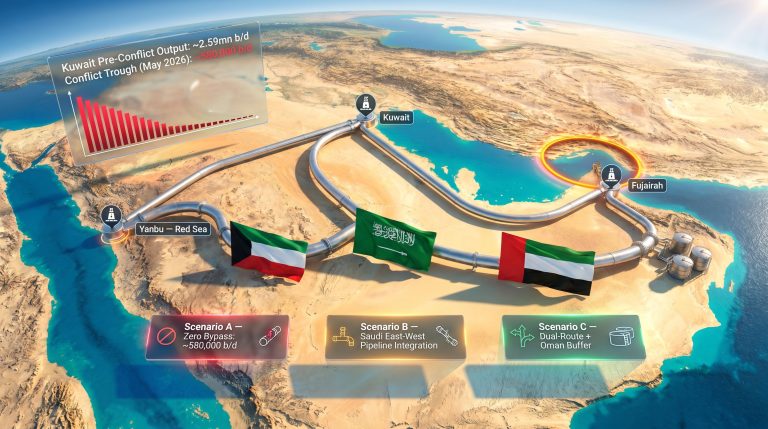
Pipeline alternatives such as the Petroline across Saudi Arabia and the Abu Dhabi Crude Oil Pipeline carry meaningful volumes, but their combined capacity falls well short of substituting for Hormuz-dependent flows at full scale. When this corridor closes or is severely disrupted, the market does not face a production problem. It faces a delivery problem. That nuance is critical to understanding what happens next.
Why Logistical Shocks Behave Differently Than Production Losses
Oil markets have a long history of responding to chokepoint disruptions with sharp price spikes that prove difficult to sustain. The 2019 drone strikes on Saudi Aramco's Abqaiq processing facility sent Brent crude surging by roughly 15% in a single trading session, yet prices largely normalised within weeks as production recovered. The 2021 Ever Given grounding in the Suez Canal generated significant freight cost disruptions without causing any lasting shift in energy price fundamentals.
The pattern reveals a structural truth: when production capacity is not permanently destroyed, the supply that was delayed rather than lost tends to return to market rapidly, and often in concentrated volumes. This creates a price reversal dynamic that can be just as sharp as the initial spike.
Analysts who frame a logistics-based disruption as equivalent to a long-term production loss will systematically overestimate how long elevated prices can persist. The physical constraint and the economic constraint are fundamentally different problems requiring fundamentally different forecasting frameworks.
This is precisely the analytical lens that Fitch Ratings has applied to the current Strait of Hormuz closure in its mid-2026 assessment. Furthermore, understanding these geopolitical oil price trends is essential context for interpreting how quickly market conditions can shift once a logistical constraint is removed.
Fitch Ratings' Oil Market Surplus Forecast: The Numbers Behind the Call
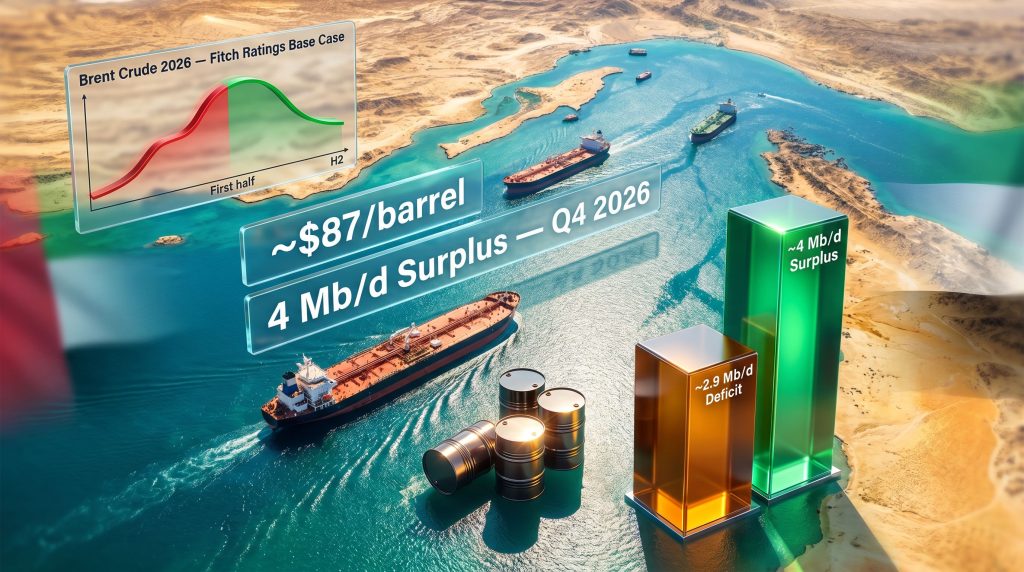
Fitch Ratings' base case scenario rests on a clearly defined set of assumptions. The ratings agency projects the Strait of Hormuz will reopen by the end of July 2026, that Brent crude will average approximately USD $87 per barrel across the full calendar year, and that global oil markets will shift back into oversupply beginning in September 2026.
The scale of the projected swing is what makes this forecast particularly significant for market participants. According to Fitch Ratings' own research, the transition is expected to be swift and substantial.
| Metric | Estimated Figure | Timeframe |
|---|---|---|
| Supply reduction vs. 2025 baseline | ~2.9 million barrels/day | 2026 disruption period |
| Projected market surplus | ~4 million barrels/day | Q4 2026 (post-reopening) |
| Brent crude average price forecast | ~USD $87/barrel | Full-year 2026 average |
| Assumed Hormuz reopening date | End of July 2026 | Base case scenario |
The transition from a supply shortfall of roughly 2.9 million barrels per day to a surplus approaching 4 million barrels per day within a single quarter is not a gradual normalisation. It reflects the near-simultaneous convergence of multiple supply drivers that have been building independently during the disruption period.
Three Converging Forces Driving the Projected Surplus
Fitch's forecast is not a single-variable projection. It is built on three structural supply forces expected to align in close succession following any reopening.
1. Rapid re-entry of suppressed Middle Eastern volumes
Closure of the Strait restricts the movement of oil but does not shut down reservoirs, wells, or upstream production operations. Gulf producers continue extracting crude even when export pathways are constrained, which means significant volumes accumulate in onshore storage. Once transit resumes, this pent-up supply enters global markets in a compressed timeframe rather than spreading across multiple quarters.
2. Uninterrupted non-OPEC supply growth
Producers in the Americas, offshore West Africa, and deepwater basins in South America have continued expanding output independent of Hormuz access. The United States, Brazil, Guyana, and Canada have all maintained or grown production during the disruption window. This baseline supply expansion does not pause while geopolitical tensions resolve, meaning the global supply floor has risen even during the crisis period.
3. Potential OPEC quota adjustments
Fitch's analysis incorporates the scenario in which OPEC members elect to raise production targets following the reopening. Whether motivated by a desire to recapture market share or respond to political pressures from within the cartel, OPEC's market influence could amplify the surplus trajectory considerably if any upward revision to output levels is enacted.
Comparing Logistical Shock vs. Structural Production Loss
The distinction between a transport disruption and a genuine production crisis is not well understood outside specialised energy analysis circles. The table below illustrates why the difference matters so profoundly for price forecasting.
| Factor | Logistical Shock (Current Scenario) | Structural Production Loss |
|---|---|---|
| Underlying production capacity | Intact | Permanently reduced or damaged |
| Price spike duration | Short to medium term | Potentially multi-year |
| Market recovery mechanism | Shipping route restoration | New investment cycle required |
| Post-event price trajectory | Sharp reversal likely | Gradual, supply-dependent recovery |
| Inventory drawdown pattern | Temporary acceleration | Sustained depletion |
This framework has direct practical implications for energy traders, industrial procurement managers, and downstream manufacturers. A business that commits to long-term hedges at crisis-level oil prices, under the mistaken assumption that supply has been permanently impaired, risks locking in elevated input costs just before a significant downward price correction materialises. Consequently, the broader oil market disruptions stemming from trade tensions further complicate the hedging landscape for procurement professionals.
The Risk Scenarios: What Could Change the Outcome
Fitch Ratings has explicitly flagged that uncertainty surrounding its forecast is unusually elevated, with the trajectory of geopolitical developments remaining the key variable. Three distinct scenarios bracket the range of possible outcomes.
Scenario 1: Reopening occurs on schedule (Base Case)
- Hormuz access restored by end of July 2026
- Brent averages approximately $87/barrel for the full year
- Surplus conditions emerge from September 2026
- Q4 2026 oversupply approaches 4 Mb/d
- Downward price pressure intensifies through H2 2026
Scenario 2: Reopening is delayed into Q3 or Q4 2026
- Each additional month of closure extends the supply deficit
- The surplus timeline compresses or disappears entirely
- Full-year Brent average exceeds the $87/barrel base case
- Industrial buyers face a more prolonged period of elevated energy costs
Scenario 3: Reopening coincides with aggressive OPEC supply response
- OPEC accelerates output increases in anticipation of or immediately following reopening
- Surplus could substantially exceed 4 Mb/d
- Most aggressive downward price correction scenario
- Brent could fall materially below the blended annual average forecast
Fitch has been explicit that the timing and conditions of any Hormuz reopening depend on regional developments that remain highly fluid. The base case should be treated as a central probability estimate, not a certainty.
Why Aluminium and Energy-Intensive Industries Are Watching Closely
The downstream implications of the Fitch Ratings oil market surplus after Strait of Hormuz reopens forecast extend well beyond the crude oil complex. Aluminium production is among the most energy-intensive industrial processes on earth, with electricity and fuel costs typically comprising 30 to 40% of primary smelting operating costs in regions where power pricing has meaningful fossil fuel exposure.
Sustained elevated oil and gas prices squeeze smelter margins, particularly in markets where industrial electricity tariffs are linked to natural gas benchmarks. The Middle East, parts of Asia, and certain European smelting operations all face meaningful indirect exposure to oil price movements through their energy procurement structures. Indeed, aluminium energy costs have become an increasingly critical factor in determining the competitiveness of smelting operations globally.
A return to surplus conditions and softening Brent prices in H2 2026, as Fitch projects, would deliver a cost relief catalyst for these producers. The timing matters enormously. Smelters operating on thin margins during the disruption period would benefit from a price normalisation cycle that reduces input cost pressure heading into 2027 planning horizons.
Other energy-intensive sectors with comparable sensitivity include:
- Petrochemical and refining operations, where feedstock costs track closely with crude benchmarks
- Cement and building materials manufacturing, particularly in oil-producing regions where domestic energy is priced against export parity
- Shipping and bulk freight, where bunker fuel costs tied to residual fuel oil have risen sharply alongside crude
The Broader Commodity Market Feedback Loop
One underappreciated dynamic in the current environment is the reflexive relationship between oil price normalisation and broader industrial commodity costs. When energy input costs fall across multiple heavy industries simultaneously, it creates deflationary pressure on manufactured goods and processed materials. This can partially offset the demand support that lower energy costs provide, particularly in export-oriented manufacturing economies.
Furthermore, European gas price pressure adds another layer of complexity, given how interconnected natural gas and oil pricing mechanisms have become across key manufacturing regions. For metals markets specifically, the combination of easing energy costs and potential post-disruption economic stimulus in affected regions could create a mixed demand signal in late 2026. As Business Today reports, investors tracking base metals alongside energy markets would benefit from monitoring how the surplus-to-price transmission plays out across interconnected commodity sectors.
The next major ASX story will hit our subscribers first
Frequently Asked Questions
What is Fitch Ratings forecasting for oil markets after the Strait of Hormuz reopens?
Fitch Ratings projects that global oil markets will transition from a supply deficit into surplus conditions beginning in September 2026, based on the assumed reopening of the Strait by the end of July 2026. The projected surplus could reach approximately 4 million barrels per day during Q4 2026.
Why does Fitch expect oil prices to soften after the Strait reopens?
The current price elevation reflects a temporary transport disruption rather than a permanent loss of production capacity. Once shipping resumes, suppressed Middle Eastern volumes are expected to re-enter markets rapidly alongside ongoing non-OPEC supply growth and potential OPEC output increases.
What is Fitch's Brent crude price forecast for 2026?
The base case forecasts a full-year average Brent crude price of approximately USD $87 per barrel, blending elevated prices during the disruption period with anticipated softening in H2 2026.
How large was the supply impact of the Strait of Hormuz closure?
Fitch estimates the prolonged disruption reduced global oil supply by approximately 2.9 million barrels per day relative to 2025 levels across the 2026 period.
What are the biggest risks to the forecast?
The primary risk is the timing and conditions of any reopening. A delayed reopening sustains the deficit and supports higher prices for longer. An accelerated OPEC supply response post-reopening could amplify the surplus and deepen any price correction. Fitch emphasises that uncertainty remains very high.
Key Takeaways
The Fitch Ratings oil market surplus after Strait of Hormuz reopens scenario rests on a conceptually important distinction that market participants should internalise:
- The current disruption is a logistical shock, not a production destruction event, meaning suppressed supply will return rapidly once the constraint is removed
- Fitch's base case assumes Hormuz reopening by end of July 2026, producing a full-year Brent average of approximately $87/barrel
- Global oil markets are projected to move into surplus from September 2026, with potential oversupply of ~4 Mb/d in Q4 2026
- Three forces converge simultaneously to drive the surplus: Middle Eastern production recovery, non-OPEC supply expansion, and potential OPEC output increases
- The transition from a 2.9 Mb/d deficit to a 4 Mb/d surplus within a single quarter illustrates how rapidly logistics-based disruption dynamics can reverse
- Energy-intensive industries including aluminium smelting face meaningful downstream exposure to this price trajectory, with potential cost relief materialising in H2 2026 if the base case holds
- Elevated geopolitical uncertainty means the base case should be treated as a central scenario with meaningful tail risk in both directions
This article contains forward-looking forecasts and analytical projections based on publicly available information from Fitch Ratings. Such projections are inherently uncertain and subject to change based on geopolitical, macroeconomic, and supply-side developments. Nothing in this article constitutes financial or investment advice.
Want to Stay Ahead of the Next Major Commodity Market Shift?
When energy price dynamics reverse as sharply as Fitch projects for H2 2026, the downstream effects on mining and mineral exploration stocks can be equally swift — Discovery Alert's proprietary Discovery IQ model scans ASX announcements in real time, delivering instant alerts on significant mineral discoveries so subscribers can identify actionable opportunities before the broader market reacts, just as early investors did with discoveries like De Grey Mining and WA1 Resources. Explore Discovery Alert's historic discoveries page to understand the scale of returns major finds can generate, and begin a 14-day free trial to position yourself ahead of the next market-moving event.