
June 10, 2026
When Geography Becomes Destiny: Understanding China's Aluminium Export Surge
Global commodity markets have long operated on the principle that supply disruption in one region creates opportunity in another. Rarely, however, does this dynamic play out as clearly and rapidly as it has in the aluminium market during the first half of 2026. China aluminium exports surge amid Middle East supply disruptions has become the defining trade story of this period, driven by a convergence of geopolitical friction, price mechanics, and structural production advantages. Understanding how this has unfolded, and where it leads, requires looking beyond the headline export numbers to the underlying mechanisms driving them.
When big ASX news breaks, our subscribers know first
How Middle East Supply Disruptions Are Reshaping Global Aluminium Trade Flows
The Geographic Concentration Problem
The Persian Gulf region has quietly become one of the world's more consequential aluminium production zones over the past two decades. State-backed smelting capacity across the Gulf Cooperation Council countries, combined with access to competitively priced energy, has built a production base that collectively represents roughly 9% of global aluminium output. That concentration, beneficial during periods of stability, transforms into a systemic vulnerability when conflict disrupts either the production itself or the shipping corridors through which the metal reaches international buyers.
Conflict-related disruptions in the broader Middle East region, coupled with elevated risk around key maritime chokepoints, have created precisely this type of fragmentation. When metal that would ordinarily flow from the Gulf to markets in Europe, South Asia, and Southeast Asia becomes either unavailable or logistically impaired, those markets do not simply absorb the shortage. Instead, buyers actively seek alternative sources, and China's metals trade dynamics demonstrate how swiftly Chinese producers respond to such international price signals.
The LME Arbitrage Mechanism
The London Metal Exchange aluminium price functions as the global reference point against which all physical trade is ultimately benchmarked. When supply tightens in ex-China markets, LME prices rise to reflect the scarcity premium. The critical dynamic for Chinese producers is the spread between the LME benchmark and China's prevailing domestic aluminium price, known in industry shorthand as the export arbitrage or export window.
When LME prices climb materially above Chinese domestic prices — after accounting for freight, insurance, value-added tax adjustments, and export processing costs — the financial logic of directing production toward overseas buyers becomes compelling. Chinese smelters and semi-fabricators operate on relatively thin margins domestically, so even a moderate widening of the international premium can shift the optimal sales destination from home market buyers to foreign importers. The Middle East disruption of 2026 has done exactly that, widening this spread and sustaining it long enough to drive a multi-month acceleration in outbound shipments. Furthermore, green metals pricing trends are adding another layer of complexity to how international buyers are sourcing supply.
What Does China's Export Data Actually Tell Us? A Month-by-Month Breakdown
March to May 2026: Tracing the Export Acceleration
The customs data, collated by Morgan Stanley and reported through industry channels in June 2026, tells a clear directional story when viewed month by month.
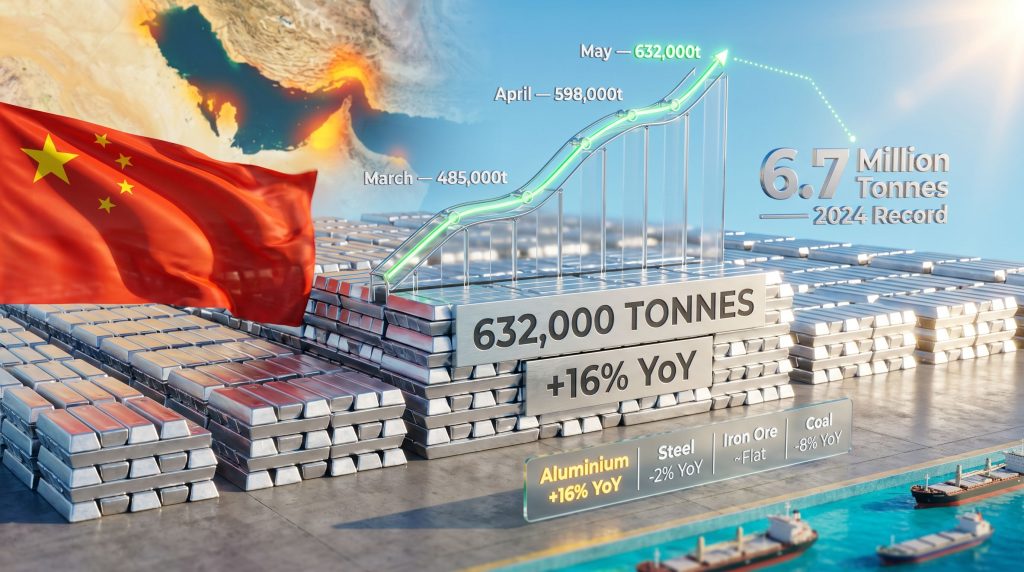
| Month | Export Volume (Tonnes) | Year-on-Year Change |
|---|---|---|
| March 2026 | 485,000 | Ahead of prior year pace |
| April 2026 | 598,000 | +15% YoY |
| May 2026 | 632,000 | +16% YoY |
| Q1 2026 Total | 1,460,000 | Above prior year pace |
May 2026's figure of 632,000 tonnes is not merely a monthly record for 2026. It represents the highest single-month export volume since November 2024, a period when Chinese producers were last responding aggressively to favourable international price conditions. The cumulative Q1 2026 total of 1.46 million tonnes already tracking above the prior year's comparable period signals that this is not a short-term spike but a sustained directional shift.
Why May 2026 Stands Out as a Structural Inflection Point
Three forces converged simultaneously in May 2026, making it particularly significant as a potential inflection point in the annual export trajectory:
- Geopolitical disruption in the Middle East continued to restrict ex-China supply availability, sustaining the LME price premium.
- Chinese domestic aluminium inventories began declining on an onshore basis, consistent with increased outbound shipment activity for semi-finished aluminium products.
- Downstream buyers in key import markets, particularly in Europe and South Asia, accelerated procurement to secure supply as forward availability from alternative sources remained uncertain.
The composition of China's exports in this period is also notable. Semi-fabricated aluminium products, commonly referred to as semis within the industry, make up the bulk of outbound volumes. These include rolled sheet, extrusions, and billets destined for automotive production, packaging applications, and industrial manufacturing. This is not raw ingot being dumped into overseas markets; it is value-added processing capacity being monetised at internationally competitive prices.
Is China Positioned to Break Its Own Aluminium Export Record?
Contextualising the 2024 Benchmark
China set a record annual aluminium export volume of approximately 6.7 million tonnes in 2024, a figure that became the baseline against which all subsequent years are measured. Annualising the current monthly run-rate, which has reached 632,000 tonnes in May alone, implies a full-year 2026 trajectory that could plausibly approach or test that record, provided the conditions supporting elevated exports persist through the second half of the year.
If Middle East supply disruptions remain unresolved through H2 2026 and the LME price premium over China's domestic market stays materially elevated, the structural incentive for Chinese exporters to maintain high shipment volumes stays firmly intact. Market analysts consider annual export volumes approaching the 6.7 million tonne record as a plausible outcome under this scenario.
China's Structural Advantage as the World's Largest Producer
China produces more aluminium than any other country, and by a substantial margin. Its smelting capacity dwarfs that of the next largest producers, and crucially, it maintains a layer of latent production capacity that can be brought online relatively quickly when price signals justify the incremental output. This is sometimes described as a domestic overcapacity buffer, and in practice it functions as a reserve of potential export supply that other producing nations simply cannot match for speed or scale.
When an international price premium emerges, Chinese producers do not need to build new capacity. They need only redirect existing production, accelerate utilisation rates at underemployed facilities, and shift the destination of semi-fabricated output from domestic buyers to overseas importers. The speed and scale of this response capability is a structural advantage that explains why China's export data responds so rapidly to international price signals. In addition, leading aluminium producers outside China are watching closely to determine how long this competitive dynamic persists.
What Are the Constraints Limiting China's Export Upside?
The Shipping and Insurance Cost Problem
There is a paradox embedded in the current trade environment that is not always apparent in headline export data. The same geopolitical disruption driving Middle East supply tightness is also elevating maritime insurance premiums across affected shipping lanes. For Chinese exporters routing shipments through or around areas of elevated risk, these higher logistics costs reduce the net export margin even as LME prices rise.
The relationship between gross LME premium and net realised export margin is therefore more complex than it appears. A widening international price advantage can be partially or fully eroded by higher freight and insurance costs, particularly for shipments destined for markets that require transit through elevated-risk corridors. This cost compression does not appear to have been sufficient to deter export growth through May 2026, but it represents a meaningful cap on the degree to which Chinese producers can capture the full international price premium.
Domestic Market Considerations and Policy Risk
Two additional constraints deserve attention from a forward-looking perspective:
- Domestic inventory depletion: As Chinese onshore aluminium stocks decline alongside rising export volumes, the question arises of whether domestic consumption will re-accelerate and absorb supply currently directed overseas. A meaningful domestic demand recovery, particularly in construction and automotive sectors, could redirect production back toward home market buyers.
- Policy intervention risk: Chinese authorities have historically been willing to adjust export tax structures, VAT rebate policies, and trade licensing conditions when domestic industrial supply conditions tighten significantly. While there is no current indication of such intervention, producers and investors should treat this as a background risk that becomes more relevant if domestic prices begin rising sharply.
How Does Aluminium Compare to China's Other Major Commodity Export Flows?
A Cross-Commodity Snapshot: May 2026 Trade Data
Viewing aluminium's performance against China's broader commodity trade complex in May 2026 underscores just how divergent its trajectory has been.
| Commodity | May 2026 Volume | Month-on-Month Change | Year-on-Year Change |
|---|---|---|---|
| Aluminium and Products | 632,000 tonnes | Highest since Nov 2024 | +16% |
| Steel | 10.3 million tonnes | +9% | -2% |
| Copper and Products (Imports) | 446,000 tonnes | -1% | +4% |
| Iron Ore (Imports) | 98 million tonnes | -6% | ~Flat |
| Coal (Imports) | 33 million tonnes | +1% | -8% |
Across this commodity complex, aluminium emerges as the clear outperformer. Steel exports, despite a strong monthly rebound of 9% from April, are still running 2% below year-ago levels on an annual basis, and the cumulative January to May 2026 figure of 44.6 million tonnes represents an 8% decline versus the same period in 2025. Iron ore import softness and the year-on-year decline in coal imports both point to moderation in China's broader industrial activity, making aluminium's export acceleration all the more notable as a diverging data point.
The Yangshan Premium as a Demand Confidence Indicator
In the copper market, the Yangshan premium — which reflects the additional cost buyers pay for physical copper delivered into bonded warehouses in China — has held within a range of USD 60 to USD 75 per tonne during this period. A stable premium within this band is a recognised indicator that underlying physical demand for the metal remains resilient, even if headline import volumes are not accelerating materially. This nuance matters for interpreting commodity market health: stable premiums signal that existing inventory channels are functioning adequately rather than that demand is weakening.
Why Aluminium Is Decoupling from the Broader Commodity Trend
The divergence between aluminium's export acceleration and the general softness in other Chinese commodity flows is not coincidental. It reflects two specific characteristics that differentiate aluminium from iron ore, coal, and even steel in the current environment:
- Aluminium has a direct and measurable supply disruption in ex-China markets that is creating genuine import demand from overseas buyers.
- Aluminium's downstream demand base is unusually broad, spanning automotive lightweighting, flexible packaging, construction profiles, and industrial equipment, which distributes export volume across multiple buyer sectors rather than concentrating it in one cyclically sensitive area.
However, it is worth noting that US aluminium tariffs continue to complicate trade routing decisions for producers seeking to maximise returns across different destination markets.
The next major ASX story will hit our subscribers first
Who Is Buying China's Aluminium? Demand-Side Geography and End-Use Analysis
Key Import Markets Absorbing Chinese Supply
The regional markets most affected by Middle East supply disruption are logically the most active buyers of Chinese alternative supply. According to Bloomberg's coverage, Southeast Asian manufacturing hubs, which source aluminium semi-finished products for automotive and electronics assembly, have been expanding Chinese procurement as Gulf supply has become less reliable. European buyers, facing a combination of reduced Middle Eastern imports and elevated domestic energy costs that constrain local smelting economics, have also increased their draw on Chinese semi-fabricated products. South Asian markets, particularly India's packaging and construction sectors, represent a third geographic pillar of demand.
End-Use Sector Breakdown: Where the Metal Is Going
- Automotive: Aluminium sheet and extrusion products for vehicle body panels, structural components, and battery enclosures in electric vehicles, where lightweighting demands are intensifying.
- Packaging: Aluminium foil and can stock for food and beverage applications, a sector characterised by relatively inelastic demand regardless of broader economic conditions.
- Construction and Infrastructure: Structural aluminium profiles, window frames, and fabricated architectural components, where demand is driven by urbanisation in developing economies across Asia and Africa.
- Industrial Manufacturing: Billets and ingots for downstream processors who convert primary forms into precision components for machinery, aerospace subassemblies, and consumer durables.
Furthermore, aluminium sector investment trends are increasingly reflecting this demand diversification, with capital being deployed to serve precisely these end-use segments at competitive cost points.
What Could Reverse the Export Surge? Scenario Analysis
Scenario 1: Middle East Disruption Resolves Quickly
If Persian Gulf shipping normalises and regional aluminium production resumes undisrupted, the LME price premium that has been incentivising Chinese exports would compress rapidly. Export arbitrage windows in commodity markets can close as quickly as they open, and Chinese producers would find domestic market sales increasingly competitive relative to overseas shipments. Under a rapid resolution scenario, monthly export volumes could retreat toward the 450,000 to 500,000 tonne range that characterised the pre-disruption baseline within two to three months of supply normalisation.
Scenario 2: Disruption Persists Through H2 2026
This is the scenario most consistent with the current trajectory. Sustained Middle East supply tightness keeps LME prices elevated relative to Chinese domestic prices, maintaining the export incentive through the second and third quarters. Consequently, full-year 2026 export volumes accumulate toward the 6.7 million tonne record, and China's share of global aluminium trade rises materially. Secondary effects under this scenario include accelerated import market dependency on Chinese supply and potential trade policy responses from governments in major consuming regions seeking to protect domestic producers. Indeed, China aluminium exports surge amid Middle East supply disruptions would extend well into the second half of the year under this outcome.
Scenario 3: Shipping Costs Escalate Further
If the geopolitical situation in the Persian Gulf intensifies beyond current levels, maritime insurance and freight costs could rise sharply enough to compress Chinese export margins despite elevated LME prices. Under this scenario, export volumes plateau or decline even though overseas demand remains strong. The primary beneficiaries would be aluminium producers in geographically advantaged locations with lower-risk shipping routes, including Canada, Australia, and Norway. The Middle East supply chain disruptions feeding this scenario remain a closely watched variable across global commodity desks.
Analytical note: The balance of current evidence points toward Scenario 2 as the near-term base case, with Scenario 3 risks increasing incrementally if Persian Gulf disruption intensity escalates. Scenario 1 remains possible but requires a geopolitical resolution that does not appear imminent based on publicly available information as of mid-2026.
This article contains forward-looking analysis and scenario projections based on publicly available trade data and market commentary. These projections are not investment advice and actual market outcomes may differ materially from the scenarios described. Readers should conduct independent research before making any investment or commercial decisions based on commodity market analysis.
Want To Stay Ahead of Major Commodity Discoveries Before the Market Catches On?
Discovery Alert's proprietary Discovery IQ model scans ASX announcements in real time, instantly identifying significant mineral discoveries across aluminium, copper, and 30+ other commodities — turning complex data into clear, actionable opportunities for traders and investors alike. Start your 14-day free trial today and explore historic discovery returns that demonstrate just how transformative early positioning can be.