May 25, 2026
Fiscal Signals From the Sahel: Reading Burkina Faso's Q1 2026 Budget Surplus in Context
Across West Africa, the relationship between commodity cycles, institutional reform, and public finance outcomes is rarely linear. Landlocked economies with significant mineral endowments face a structural paradox: natural resource revenues can fund fiscal consolidation, yet the same dependency creates volatility that undermines long-term budget stability. Understanding how governments navigate this tension requires looking beyond headline numbers to the mechanisms underneath them.
That analytical lens is essential when examining the Burkina Faso budget surplus in Q1 2026, a result that represents one of the most significant short-term fiscal reversals the country has recorded in recent years. Yet the surplus, as meaningful as it is, needs to be placed within a broader framework of annual deficits, structural risks, and multilateral programme commitments before its full significance can be assessed.
When big ASX news breaks, our subscribers know first
From Deficit to Surplus: The Q1 2026 Fiscal Reversal
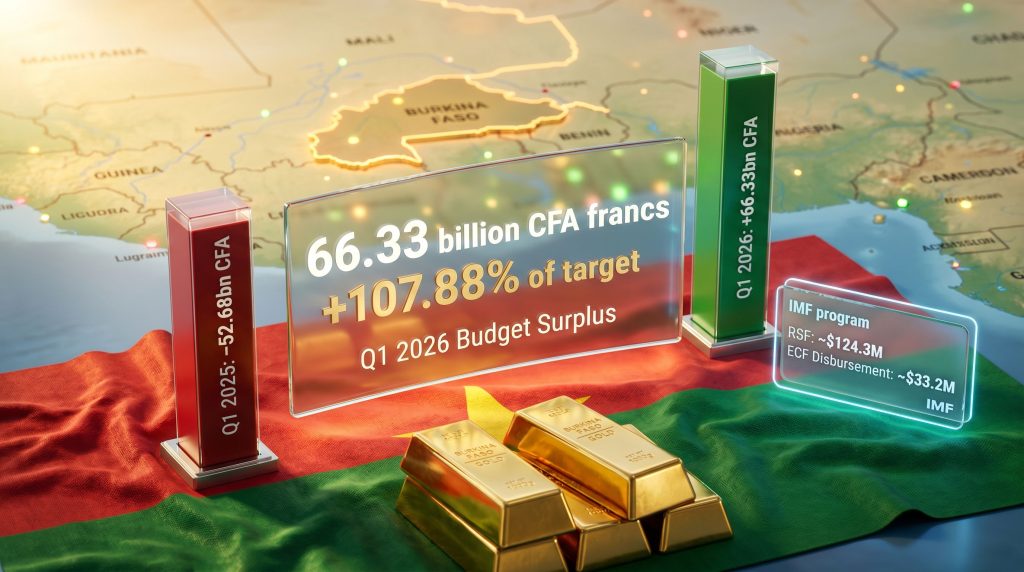
Burkina Faso recorded a global budget surplus of 66.33 billion CFA francs, equivalent to approximately $117.4 million USD, at the close of the first quarter of 2026. This was reported at a cabinet meeting on 21 May 2026. The contrast with the same period a year earlier is striking: Q1 2025 produced a deficit of 52.68 billion CFA francs, meaning the year-on-year fiscal swing totals approximately 119 billion CFA francs.
The numbers extend beyond the headline surplus figure. Budget savings surplus reached 239.45 billion CFA francs in Q1 2026, nearly tripling from 86.32 billion CFA francs recorded during the same period in 2025. Treasury cash receipts also rose sharply, generating a credit balance exceeding 208 billion CFA francs, a level well above the prior year's comparable position.
| Fiscal Indicator | Q1 2025 | Q1 2026 | Change |
|---|---|---|---|
| Budget Balance (CFA bn) | -52.68 | +66.33 | +119.01 |
| Revenue vs. Target (%) | Below target | 107.88% | Overperformance |
| Budget Savings Surplus (CFA bn) | 86.32 | 239.45 | +177.13 |
| Treasury Credit Balance (CFA bn) | Below 208 | 208+ | Strong improvement |
| Annual Deficit Forecast (% GDP, 2026) | ~6.9% (2023 base) | ~3.7% (projected) | Narrowing |
A single-quarter surplus does not override long-term fiscal imbalances. Burkina Faso's 2023 full-year deficit was approximately 6.9% of GDP. The annual deficit is forecast to narrow to around 3.7% of GDP by end-2026, still above the WAEMU convergence threshold of 3% of GDP. The Q1 result should be read as a directional indicator, not a declaration of fiscal health.
How Revenue Overperformance Drove the Surplus
Total government revenue in Q1 2026 reached 807.56 billion CFA francs, surpassing the quarterly target of 748.60 billion CFA francs and achieving a collection rate of 107.88% of target. This level of overperformance is not accidental. It reflects deliberate structural interventions across three interconnected reform pillars:
-
Tighter monitoring of public expenditure flows across ministries, reducing leakage and improving budget discipline at the point of spending.
-
Enhanced oversight of budget execution, ensuring that implementation aligned more closely with approved allocations.
-
Improved treasury operations management, addressing cash flow inefficiencies that had previously distorted quarterly fiscal positions.
Beyond administrative reforms, two macro-level forces amplified revenue collection capacity. Elevated global gold prices in 2025–2026 significantly increased mining sector fiscal contributions through royalties, corporate income tax, and customs duties. Furthermore, reforms targeting VAT on digital and online commerce expanded the indirect tax base into previously undertaxed commercial activity. Both factors worked in parallel to push revenues above target.
Why Mining Revenue Is Central to This Story
Burkina Faso is one of West Africa's most significant gold producers, and the fiscal arithmetic of the sector is worth understanding in detail. The historic gold price surge seen across 2025–2026 has been a powerful tailwind for mineral-dependent economies like Burkina Faso. Gold mining revenues flow to the government through several channels simultaneously: production royalties, corporate income taxes on mining company profits, withholding taxes on dividends and service payments, and customs duties on imported equipment.
When gold prices rise, this multi-channel structure creates a fiscal multiplier effect where even modest production increases generate disproportionately large revenue gains. The IMF's 2026–2028 economic outlook for Burkina Faso explicitly cited higher gold prices as a driver of stronger mining activity, export performance, and broader fiscal improvement. This is not simply a commodity price story. It is also a structural story about how effectively a government captures resource rents during price upswings.
The IMF's Role in Burkina Faso's Fiscal Architecture
Burkina Faso's fiscal consolidation trajectory does not exist in isolation. It is embedded within a multilateral programme framework that provides both financing and reform conditionality. In March 2026, the IMF completed the fourth review of its Extended Credit Facility (ECF) arrangement with Burkina Faso, releasing an immediate disbursement of approximately $33.2 million.
Concurrently, the IMF approved a new arrangement under the Resilience and Sustainability Facility (RSF), worth approximately $124.3 million, designed to support the country's climate resilience and external stability through September 2027.
| IMF Programme | Status | Disbursement |
|---|---|---|
| Extended Credit Facility (ECF) | Fourth review completed, March 2026 | ~$33.2 million |
| Resilience and Sustainability Facility (RSF) | Newly approved, active to Sept 2027 | ~$124.3 million |
Completing a fourth IMF programme review carries weight beyond the disbursement itself. These reviews involve rigorous assessment of quantitative performance criteria, structural benchmarks, and macroeconomic targets. A completed review signals that a government has broadly met its reform commitments, which lends independent credibility to domestically reported fiscal data.
For Burkina Faso, this external validation matters significantly given the complexity of operating under active security pressures. The IMF's country assessment documentation provides detailed context on programme conditionality and performance criteria underpinning these reviews.
The IMF's macroeconomic projection for Burkina Faso over 2026–2028 includes annual GDP growth of approximately 5%, inflation remaining below target, strengthening mining activity, and active fiscal support for agricultural investment. These projections were made with full acknowledgement of persistent structural challenges, including ongoing insecurity, elevated poverty rates, and climate-related shocks affecting agricultural output.
Structural Risks That Complicate the Surplus Narrative
Reading the Q1 surplus in isolation risks overstating Burkina Faso's fiscal position. However, several structural risk factors remain active and could erode fiscal gains in subsequent quarters:
-
Security environment: An ongoing insurgency affecting large portions of the country's territory elevates defence and security spending while disrupting economic activity in agricultural and mining zones. Defence expenditure pressure is difficult to compress without worsening the security situation.
-
Climate vulnerability: Burkina Faso's agricultural sector is highly exposed to rainfall variability and drought. Climate shocks reduce agricultural GDP, compress rural tax bases, and increase fiscal pressure from food import requirements.
-
Commodity price dependency: The same gold price tailwind that supported Q1 2026 revenues is a source of structural fiscal volatility. Consequently, a significant decline in gold prices would simultaneously reduce mining royalties, corporate tax receipts, and export earnings. Understanding gold as an inflation hedge helps explain why institutional and sovereign actors continue to value gold-linked revenue streams despite this inherent volatility.
-
WAEMU compliance gap: Remaining above the 3% deficit-to-GDP convergence threshold restricts Burkina Faso's access to certain regional financing mechanisms and signals ongoing fragility relative to WAEMU peers.
Burkina Faso's fiscal improvement is real but fragile. A reversal in gold prices, an escalation in security expenditures, or a significant climate shock could rapidly unwind Q1 gains. Achieving structural surplus over a full year would require sustained multi-year reform execution under challenging operating conditions.
Burkina Faso Within the Broader WAEMU Fiscal Landscape
Contextualising Burkina Faso's performance against regional peers adds analytical depth to the Q1 result. The West African Economic and Monetary Union (WAEMU) imposes a convergence criterion requiring member states to maintain budget deficits at or below 3% of GDP. Burkina Faso's projected 3.7% deficit for full-year 2026 places it among member states still working toward compliance.
The regional picture is varied:
-
Benin, Guinea-Bissau, and Niger recorded negative inflation in March 2026, indicating diverse macroeconomic trajectories across member states even within a shared monetary framework.
-
Togo is progressing toward a $110 million IMF ECF disbursement, reflecting similar programme-supported fiscal trajectories across the zone.
-
The BCEAO manages approximately $67 billion in foreign reserve assets, providing a regional monetary buffer that underpins CFA franc stability across all member states.
The broader geopolitical mining landscape across the Sahel also shapes how international partners and multilateral institutions assess Burkina Faso's creditworthiness and programme compliance. Burkina Faso's quarterly surplus performance, combined with continued IMF programme adherence, strengthens its credibility profile with multilateral creditors and development finance institutions.
Regional bond markets and bilateral financing partners interpret successful IMF reviews as governance signals that reduce perceived counterparty risk. However, moving from improved credibility to actual financing cost reductions requires sustained annual-level fiscal discipline, not merely quarterly wins. For further context on regional debt market activity, the WAEMU debt market provides insight into how Burkina Faso has accessed regional financing mechanisms.
What Agricultural Investment Adds to the Equation
The IMF's 2026–2028 outlook specifically references investment in agriculture as a stabilising force alongside gold-sector performance. This is a meaningful distinction. Agricultural sector growth supports indirect tax revenues through VAT and trade taxes, reduces fiscal pressure from food import subsidy requirements, and strengthens rural livelihoods that underpin broader economic stability.
Climate resilience investments under the RSF arrangement are partly targeted at improving agricultural productivity under adverse weather conditions. This creates a channel through which the IMF facility directly supports the diversification of Burkina Faso's revenue base away from pure gold dependency. In addition, the critical minerals demand surge occurring globally positions resource-rich nations like Burkina Faso to potentially benefit from expanded mining activity beyond gold alone.
The next major ASX story will hit our subscribers first
Key Takeaways: Assessing Burkina Faso's Fiscal Trajectory
The Burkina Faso budget surplus in Q1 2026 is a genuinely significant data point in the country's fiscal story. But its importance lies not in what it proves about the present, but in what it suggests about the direction of travel. Furthermore, the case for strategic investment in gold as a sovereign revenue anchor is reinforced by Burkina Faso's experience of translating elevated gold prices into measurable budgetary gains.
-
Q1 2026 surplus of 66.33 billion CFA francs (~$117.4 million) marks a decisive quarterly turnaround from the Q1 2025 deficit of 52.68 billion CFA francs.
-
Revenue collection at 107.88% of target reflects meaningful governance improvements across expenditure monitoring, budget implementation, and treasury management.
-
Budget savings surplus surged to 239.45 billion CFA francs, nearly tripling the Q1 2025 level of 86.32 billion CFA francs.
-
IMF fourth review completion and new RSF approval provide external validation of reform progress and ongoing institutional support.
-
Annual deficit remains above the WAEMU 3% threshold, projected at 3.7% of GDP for 2026, confirming that full fiscal consolidation is a multi-year process.
-
Gold price sensitivity remains the primary structural risk, with commodity revenue swings capable of significantly altering fiscal outcomes.
-
IMF projects approximately 5% GDP growth for 2026–2028, supported by gold sector strength, agricultural investment, and continued fiscal discipline.
The Q1 result is best understood as credible early-stage evidence that Burkina Faso's fiscal reform programme is producing measurable outcomes. Translating quarterly performance into durable annual improvement, particularly against a backdrop of active security pressures and climate exposure, remains the central challenge ahead.
Readers seeking broader context on West African public finance developments and WAEMU-region fiscal dynamics can find ongoing coverage at Ecofin Agency, which provides sector-focused economic reporting across African markets.
This article contains forward-looking projections sourced from IMF programme documentation and publicly available economic forecasts. These projections involve assumptions about future conditions and should not be interpreted as guaranteed outcomes. Readers should conduct independent assessment before drawing investment or policy conclusions from forecast data.
Want To Catch the Next Major ASX Mineral Discovery Before the Market Does?
Discovery Alert's proprietary Discovery IQ model delivers real-time alerts on significant ASX mineral discoveries — including gold producers driving the kind of fiscal multiplier effects explored in this article — turning complex mineral data into actionable insights for traders and investors alike. Explore historic discoveries and their returns, then start your 14-day free trial at Discovery Alert to position yourself ahead of the broader market.