August 22, 2026
The Hidden Architecture of Frontier Sovereign Finance
When conventional capital markets become inaccessible or prohibitively expensive, governments face a fundamental question: where does productive investment capital come from? For frontier economies navigating constrained access to multilateral lending, rising debt service costs, and reduced foreign direct investment, the Burkina Faso diaspora bond increasingly points inward — toward the savings of citizens living abroad.
This dynamic is reshaping how African governments think about sovereign financing. Rather than treating diaspora populations purely as sources of household remittances, a growing number of administrations are engineering formal capital market instruments that transform diaspora loyalty into investable, yield-bearing instruments. Burkina Faso's Emprunt Patriote, or Patriotic Loan, represents one of the most structurally sophisticated and commercially successful examples of this model to emerge from West Africa in recent years.
When big ASX news breaks, our subscribers know first
Why Diaspora Capital Is Structurally Different From Remittances
Understanding the Burkina Faso diaspora bond requires first understanding what makes diaspora capital analytically distinct from other cross-border financial flows.
Sub-Saharan Africa received an estimated $56 billion in remittances in 2024, according to World Bank data, a figure that surpasses official development assistance received by multiple countries in the region. Yet remittances, despite their scale, are fundamentally consumption-oriented transfers. They flow to individuals and households, financing food, education, healthcare, and housing, but rarely accumulating in ways that can be directed toward national infrastructure or industrial capacity.
Diaspora bonds occupy an entirely different position in the financing architecture:
- They convert diaspora savings rather than income flows into long-duration capital
- They carry formal repayment obligations, defined interest rates, and fixed tenors, making them structurally closer to sovereign debt instruments than to philanthropic transfers
- They create a citizen-investor relationship where the bond purchaser has a financial stake in national economic outcomes
- They can be structured across multiple tranches to attract investors with different time horizons and liquidity preferences
An Afrobarometer survey conducted across 34 African countries found that 65% of respondents preferred financing national development through domestic resources, even if this required higher taxes, rather than expanding reliance on external borrowing. This public sentiment, furthermore, creates a receptive environment for diaspora bond programmes that explicitly frame themselves as patriotic, citizen-led development tools.
The transition from treating diaspora populations as remittance pipelines to recognizing them as a structured investor constituency represents one of the more significant evolutions in African sovereign financing strategy over the past decade.
The Patriotic Loan: Structure, Design, and Execution
Burkina Faso officially launched its Patriotic Loan on May 6, 2026, under the direction of Minister of Economy and Finance Aboubakar Nacanabo. The instrument was structured by Vista Group in collaboration with brokerage firms SBIF and Oragroup Securities, giving it institutional credibility within the WAEMU capital markets framework.
The bond was designed with a dual-tranche architecture to maximise accessibility across different investor profiles:
| Tranche | Target Volume | Tenor | Annual Interest Rate |
|---|---|---|---|
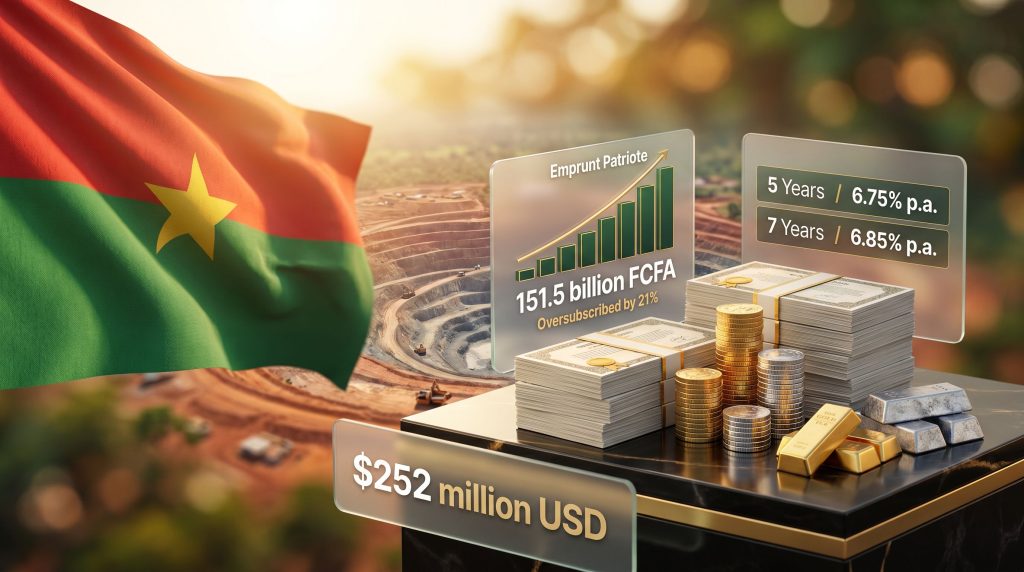
| Short-duration tranche | 45 billion FCFA | 5 years | 6.75% per annum |
| Long-duration tranche | 80 billion FCFA | 7 years | 6.85% per annum |
| Combined target | 125 billion FCFA |
The subscription window ran for 31 days, closing on June 6, 2026. What occurred within that window is analytically significant: the Patriotic Loan raised 151.5 billion FCFA, approximately $252 million USD, exceeding its original target by more than 21%. This oversubscription rate, achieved within a single month, positions the instrument as one of Africa's most commercially successful diaspora financing initiatives of 2026.
The dual-tranche design deserves particular attention. By offering both a five-year and a seven-year option, the structure captured two meaningfully different investor profiles simultaneously: diaspora savers with medium-term liquidity needs and those willing to commit capital for longer periods in exchange for marginally higher yield. This is a level of product sophistication rarely seen in first-issuance diaspora bond programmes.
The two-phase aggregate programme target of 240 billion FCFA indicates that Phase 1 was designed as the first instalment of a repeatable financing programme, not a one-off capital raise. Phase 1 proceeds of 151.5 billion FCFA already cover more than half of that aggregate target.
Deploying the Capital: Four Strategic Financing Agreements
On July 6, 2026, the Burkinabè government formalised four distinct financing agreements totalling CFA 85 billion (~$148 million), representing the first tranche of project deployments from Patriotic Loan proceeds.
Project Allocation Breakdown
| Recipient Entity | Sector | Allocated Capital | Strategic Purpose |
|---|---|---|---|
| CIM SAHEL | Cement / Manufacturing | ~$26 million | Expand domestic cement production; reduce import dependency |
| SN BRAFASO | Industrial / Manufacturing | ~$52.2 million | Construct new industrial facility in Bobo-Dioulasso |
| SOPAMIB (Perkoa Mine) | Mining | Part of ~$69.7 million combined | Reopen zinc mining operations |
| SOPAMIB (Taparko Mine) | Mining | Part of ~$69.7 million combined | Restart gold production |
Cement: Import Substitution as Industrial Policy
Burkina Faso's construction sector has historically depended on imported cement, creating persistent trade leakage that diverts economic value away from the domestic economy. The $26 million allocation to CIM SAHEL targets expanded local production capacity, with downstream effects on construction costs, local employment, and value retention within the national economy.
This is a textbook import-substitution play, and one that aligns with broader Sahel industrialisation goals of reducing dependence on coastal supply chains that have become increasingly fragile in the current security environment. In addition, the broader critical minerals demand surge across global markets further reinforces the strategic logic of building domestic industrial capacity.
Bobo-Dioulasso: Building a Western Industrial Anchor
The largest single project allocation, $52.2 million to SN BRAFASO, funds the construction of a new industrial facility in Bobo-Dioulasso, Burkina Faso's second-largest city. This is not merely a capacity expansion decision. It reflects a deliberate strategy of regional economic decentralisation, positioning Bobo-Dioulasso as an industrial hub for the western region rather than concentrating productive capacity in the capital.
Industrial facilities of this type typically generate employment across multiple tiers: direct manufacturing roles, logistics and supply chain services, and ancillary service businesses that develop around a working industrial hub. The broader economic multiplier effect of this investment is likely to extend well beyond the facility itself.
Mining Revival: State Reclamation of Strategic Assets
The combined $69.7 million allocation to SOPAMIB (Société de participation minière du Burkina Faso) for the reopening of both Perkoa and Taparko represents the single largest sectoral deployment of Patriotic Loan proceeds, and arguably the most strategically significant.
Perkoa is a zinc-producing operation previously operated under international concession. Its reopening under state-led financing through SOPAMIB signals something beyond a simple operational restart: it represents an assertion of state ownership over strategic mineral assets. Zinc is a critical industrial metal with strong demand in galvanising, batteries, and construction materials.
Taparko is a gold-producing asset whose restart is expected to increase the mining sector's contribution to national fiscal revenues at a time when Burkina Faso's public finances are under considerable strain. This mirrors trends seen in Pakistan's mineral investment drive, where resource-rich states are increasingly asserting control over strategic assets to capture greater fiscal returns.
The SOPAMIB dual-mine financing reflects a pattern visible across the Sahel: a deliberate policy shift toward greater state participation in mineral wealth, moving away from the pure concessionary model that characterised earlier decades of African mining governance.
How Does Burkina Faso's Bond Compare to African Precedents?
The Patriotic Loan does not exist in isolation. African governments have experimented with diaspora bond instruments for over two decades, with varying degrees of success.
| Country | Instrument | Capital Raised | Tenor | Key Features |
|---|---|---|---|---|
| Ethiopia | Millennium Bond | ~$350 million | 5 years | Hydropower financing (Grand Renaissance Dam) |
| Kenya | Infrastructure Bond | Multiple issuances | 12 to 25 years | Domestic and diaspora eligible |
| Nigeria | Diaspora Bond | $300 million (2017) | 5 years | SEC-registered; USD-denominated |
| Burkina Faso | Patriotic Loan (2026) | $252 million | 5 and 7 years | FCFA-denominated; 21% oversubscribed |
Several features, however, distinguish the Patriotic Loan from these predecessors:
- Local currency denomination: Unlike Nigeria's USD-denominated bond, the Patriotic Loan is issued in FCFA. This reduces currency mismatch risk for the Burkinabè government but places exchange rate exposure on diaspora investors earning in euros, US dollars, or British pounds. This is a meaningful consideration for investors in European diaspora communities.
- Speed of execution: A 31-day subscription window that achieved oversubscription suggests demand that substantially exceeded what the government may have anticipated, pointing to an underserved investor constituency.
- Named project transparency: The direct linking of proceeds to specifically named projects and entities creates a level of use-of-proceeds transparency that has historically been a pain point for frontier market sovereign instruments.
- Institutionalised diaspora infrastructure: The creation of a dedicated one-stop investment platform for Burkinabè citizens abroad signals an intent to treat diaspora engagement as a permanent financing channel rather than an opportunistic capital raise.
The Patriotic Risk Premium: Investor Psychology in Conflict-Affected Markets
One of the most analytically interesting dimensions of the Patriotic Loan's oversubscription is the context in which it occurred. Burkina Faso has experienced significant security challenges across its northern and eastern regions, conditions that have materially constrained conventional foreign direct investment inflows and complicated commercial lending assessments.
That diaspora investors oversubscribed a sovereign bond in this environment by more than 21% within 31 days introduces a concept worth examining closely: the patriotic risk premium. This describes the willingness of diaspora investors to accept levels of sovereign and operational risk that purely commercial investors would price out of their models, in exchange for non-financial utility derived from national identity, community belonging, and legacy investment in their country of origin.
This dynamic has been observed in other conflict-affected or economically constrained economies where diaspora bond programmes have outperformed commercial expectations. It is not irrational behaviour. It reflects a utility function that conventional risk-return models are structurally unable to capture.
For sovereign finance practitioners and development economists, this insight has significant implications: diaspora capital markets may be most robust precisely when commercial capital markets are most withdrawn, creating a counter-cyclical financing channel that activates during periods of elevated sovereign stress.
The next major ASX story will hit our subscribers first
Risks Investors and Policymakers Cannot Ignore
The Patriotic Loan's commercial success does not eliminate the structural risks inherent in this financing model. Both investors and the Burkinabè government face meaningful challenges. Consequently, understanding these risks is essential before drawing broader conclusions about the model's replicability.
For investors:
- Currency risk: FCFA-denominated returns can erode significantly in real terms for diaspora investors whose income and living costs are denominated in stronger currencies
- Liquidity constraints: Diaspora bonds typically lack functioning secondary markets, meaning investors are effectively locked into the full five or seven-year tenor
- Project execution risk: The deployment of capital into mining and industrial projects in a security-constrained environment carries genuine operational uncertainty
- Information asymmetry: Diaspora investors located in Europe or North America may have limited visibility into project progress and financial reporting
For the government:
- Reputation management: Oversubscription creates expectations. If Phase 1 projects underperform or proceeds are not deployed as committed, future issuances could face significantly weaker demand
- Concentration risk: Heavy allocation to two mining assets through a single state entity creates sectoral concentration in the deployment portfolio
- Reporting obligations: Sustaining investor confidence across subsequent issuances requires robust, transparent, and timely disclosure frameworks that are not yet standard practice in WAEMU frontier sovereign instruments
The involvement of Vista Group, SBIF, and Oragroup Securities provides institutional credibility to the structuring process. However, ongoing governance of the programme will be critical to its long-term viability. Analysts familiar with management red flags in frontier investment contexts will recognise that institutional credibility at launch does not automatically guarantee sustained governance quality throughout project execution.
What This Model Signals for West African Sovereign Finance
The Patriotic Loan's results carry implications that extend well beyond Burkina Faso's borders. Across West and Central Africa, governments face mounting pressure to reduce reliance on WAEMU regional bond markets and multilateral lending facilities. Furthermore, the broader geopolitical mining landscape is accelerating these trends, as resource-rich states seek greater control over strategic asset deployment. The Patriotic Loan demonstrates that citizen-investor alignment — where bond purchasers are also stakeholders in national outcomes — can generate demand that purely commercial instruments cannot replicate at comparable cost.
The African Development Bank has increasingly developed frameworks for diaspora bond credit enhancement, recognising that with appropriate structuring, these instruments can meet investor protection standards sufficient for institutional participation. The Burkinabè model, if it executes cleanly on its project commitments and maintains transparent reporting, could accelerate the adoption of similar programmes across the Sahel and broader West Africa.
The programme's two-phase design targeting a combined 240 billion FCFA also signals something important about long-term intent. This is a financing architecture designed to be repeated and scaled, not a liquidity measure responding to a short-term fiscal gap. For those assessing the mining investment risks and rewards across frontier markets, this Burkina Faso diaspora bond model represents a compelling case study in citizen-backed sovereign finance.
If African governments can institutionalise diaspora capital mobilisation as a recurring, professionally structured financing channel, it represents one of the more durable solutions to the structural financing gap that has constrained infrastructure investment across the continent for decades.
Disclaimer: This article is intended for informational purposes only and does not constitute financial or investment advice. All financial figures, projections, and comparisons involve inherent uncertainty. Readers should conduct independent due diligence before making any investment decisions related to sovereign instruments, frontier market bonds, or African capital markets.
Ready to Capitalise on the Next Major Mineral Discovery Before the Market Does?
While sovereign financing models like Burkina Faso's Patriotic Loan demonstrate how strategic capital can unlock transformative resource projects, Discovery Alert's proprietary Discovery IQ model delivers real-time alerts the moment significant ASX mineral discoveries are announced — instantly translating complex geological data into actionable investment insights for traders and long-term investors alike. Explore how historic discoveries have generated extraordinary returns and begin your 14-day free trial today to position yourself ahead of the broader market.