August 20, 2026
The Hidden Architecture of India's Oil Vulnerability
Few economic relationships carry as much consequence as the one between a major emerging economy and the volatile waterways of the Persian Gulf. For India, that relationship is not merely transactional — it is foundational. The country's industrial base, consumer price stability, fiscal planning, and monetary policy all sit downstream of a single, uncomfortable reality driven by US-Iran tensions and India crude import costs: India cannot fuel itself.
With 85–90% of its total crude oil requirements sourced from international markets, India occupies a position of structural exposure that geopolitical events repeatedly test. The current deterioration in US-Iran relations is not simply a diplomatic story. For India's economy, it is a pressure test applied simultaneously to the import bill, the rupee, the current account, and the inflation trajectory — all at once.
When big ASX news breaks, our subscribers know first
What the Strait of Hormuz Actually Means for India's Supply Chain
A Waterway That Cannot Be Substituted
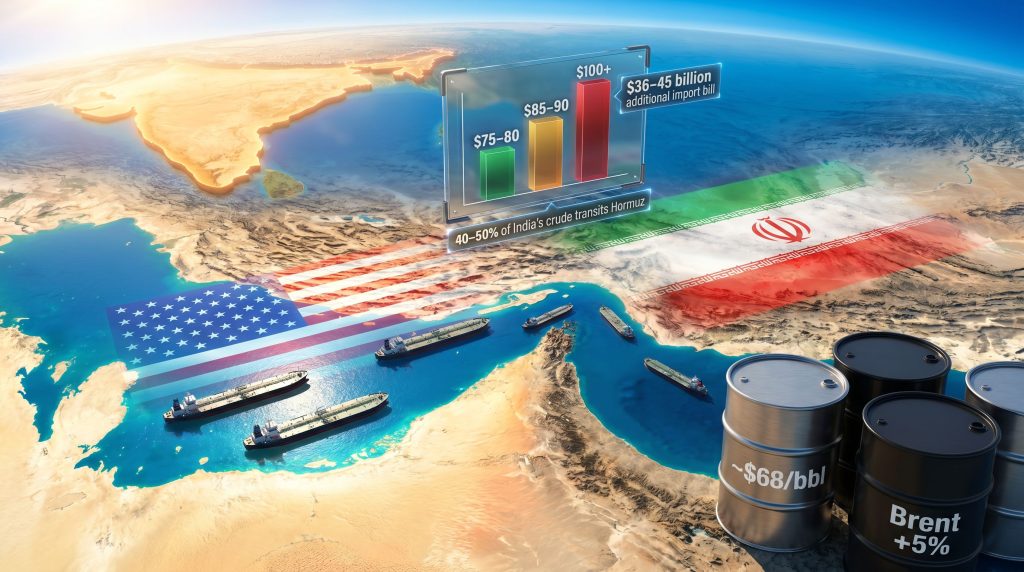
The Strait of Hormuz is a narrow maritime corridor between the Persian Gulf and the Gulf of Oman, stretching no wider than 33 kilometres at its tightest point. Through it flows an estimated 20% of the world's total oil supply, including crude exports from Saudi Arabia, the UAE, Kuwait, Iraq, and Iran. For India, approximately 40–50% of all crude oil imports transit this corridor.
What makes this particularly consequential is that Hormuz vulnerability is not Iran-specific. Even if India purchases zero Iranian crude — which it currently does — a sustained disruption to the waterway affects every Gulf barrel India receives, regardless of seller. The geopolitical risk is therefore broader than the sanctions narrative suggests.
"Tanker traffic through the Strait of Hormuz fell to 60–70% below pre-conflict levels at peak disruption following recent vessel attacks," according to market analysis from Kotak Securities. This compression alone signals how rapidly physical supply fears can translate into benchmark price pressure. For further context on how these dynamics are playing out, oil market trade tensions are also reshaping global supply expectations in parallel.
The Three Vessels That Moved Global Markets
The recent escalation was sharply accelerated by attacks on three commercial vessels near the Strait of Hormuz, including crude tankers and an LNG carrier. These incidents were not symbolic — they triggered an immediate recalibration of geopolitical risk premiums across energy markets:
- Brent crude surged approximately 5% to around $76 per barrel
- NYMEX WTI climbed above $72 per barrel
- European natural gas prices spiked following the LNG carrier attack
- Market expectations for higher US LNG export volumes strengthened as buyers sought alternative supply routes
Understanding the Transmission Chain: From Gulf Conflict to Indian Consumer
How a Geopolitical Shock Becomes a Household Cost
The pathway from a Middle East escalation to economic stress on Indian households follows a well-defined sequence that policymakers, refiners, and currency traders all monitor simultaneously.
- Global crude benchmark prices rise on supply disruption fears and geopolitical risk premium rebuild
- India's crude import basket cost increases — the basket was priced at approximately $68 per barrel before the latest escalation
- The annual import bill expands — each $10 per barrel rise adds an estimated $13–15 billion to India's total crude import costs
- The current account deficit widens by approximately 40–50 basis points per $10 per barrel increase
- The Indian rupee faces depreciation pressure, which further compounds import costs when denominated in domestic currency
- Fuel, transport, and logistics costs rise, feeding into the consumer price index
- Oil marketing companies experience margin volatility as the gap between import cost and regulated retail fuel prices widens
Furthermore, the impact on oil prices from broader geopolitical friction reinforces each of these transmission steps, making the domestic economic burden harder to absorb.
Quantifying the Scenarios: A Structured Price Impact Table
| Crude Price Range | Additional Annual Import Bill | CAD Impact | Estimated CPI Uplift | Policy Implication |
|---|---|---|---|---|
| $75–80 per barrel | ~$13–20 billion | Modest widening | Manageable | RBI holds current stance |
| $85–90 per barrel | ~$20–30 billion | ~40–50bps wider | ~0.5 percentage points | RBI faces policy dilemma |
| $100+ per barrel | ~$36–45 billion | Significant widening | Compounding pressure | Fiscal and monetary stress |
India's Diversification Strategy: Genuine Resilience or Overconfidence?
How India Rebuilt Its Supply Chain After 2022
Following the outbreak of the Russia-Ukraine conflict in 2022, India executed one of the most significant crude sourcing pivots of any major importing nation. Capitalising on heavily discounted Russian crude made available by Western sanctions, India rapidly scaled up purchases to an all-time high of approximately 2.35–2.66 million barrels per day from Russia. Simultaneously, procurement relationships were expanded with the United States, Venezuela, and other non-Gulf producers to reduce West Asia concentration risk.
This structural shift meaningfully improved India's supply resilience. As Debopam Chaudhuri, Chief Economist at Piramal Group, observed, India has significantly diversified its crude sourcing away from West Asia, reducing exposure to temporary supply disruptions or policy-related shocks from that region. He noted that the economy is now materially less vulnerable to such developments than it was historically — while also cautioning that a prolonged standoff would nonetheless push the crude basket well beyond $75 per barrel.
Where Diversification Has Limits
Despite these gains, several structural constraints mean India cannot fully insulate itself from a sustained Gulf disruption:
- Russian supply faces its own sanctions uncertainty. If US waiver arrangements tighten further, India's access to discounted Russian crude at current volumes could be curtailed without warning
- Hormuz transit risk applies universally. Saudi, Emirati, Kuwaiti, and Iraqi crude all transits the Strait of Hormuz — India's diversification away from Iran does not reduce this chokepoint exposure
- Price contagion needs no physical disruption. Even when supply reaches buyers intact, the geopolitical risk premium is priced into every barrel globally. India pays more regardless of origin when market fear is elevated
- Saudi pricing support has limits. While Saudi Arabia's decision to implement its deepest crude price cut for Asian buyers in two decades offers meaningful near-term relief, pricing concessions are a cyclical tool — not a structural hedge
Deveya Gaglani, Senior Research Analyst – Commodities at Axis Direct, noted that India is unlikely to face a significant supply disruption given Saudi Arabia's aggressive pricing stance for Asian markets. However, he identified $90 per barrel as the threshold above which sustained prices would generate genuine supply-side concern for India. According to EPIC at the University of Chicago, India's oil supply vulnerabilities in the context of Middle East conflict are already being tested in ways that go beyond headline crude price movements.
The War Risk Premium: A Market Psychology Problem
Why Markets Were Caught Flatfooted
Perhaps the most analytically interesting dimension of the current episode involves not the geopolitics but the market psychology preceding it. Anindya Banerjee, Head of Commodity and Currency Research at Kotak Securities, identified a critical structural vulnerability: crude oil had already fully unwound its war risk premium, retracing from approximately $120 per barrel at the peak of prior conflict concerns all the way back to the low $70s. This complete reversion left the market with almost no buffer against re-escalation.
"When geopolitical risk premiums are fully unwound, markets trade as though a return to stability is guaranteed rather than probable. This creates asymmetric vulnerability — small escalation triggers disproportionate repricing."
This pattern is not unprecedented. Energy markets have a well-documented tendency to under-price tail risk during extended periods of relative calm. The crude oil volatility trends of recent years demonstrate precisely this dynamic — creating conditions where a single event triggers outsized price moves. The current episode fits this pattern precisely.
The LNG Dimension: A Secondary Inflationary Channel
One underappreciated consequence of the current escalation is the parallel disruption spreading through natural gas markets. The attack on an LNG carrier near the Strait of Hormuz triggered a spike in European natural gas prices and strengthened expectations for higher US LNG export volumes as buyers sought supply routes that bypass the Persian Gulf.
For India — whose LNG import dependency has grown materially in recent years — this represents a secondary inflationary vector that sits largely outside the crude oil pricing debate. The disruptions to global LNG supply compound the crude price burden in ways that aggregate inflation models may underestimate.
As Manav Modi, Commodities Analyst at Motilal Oswal Financial Services, noted, developments surrounding the Strait of Hormuz, US-Iran relations, and weekly inventory data will remain the primary drivers for global energy markets in the period ahead.
Downstream Pressure: What This Means for OMCs, Refiners, and Policymakers
The Oil Marketing Company Dilemma
India's oil marketing companies occupy an uncomfortable position in a high-price environment. Caught between rising international crude input costs and government sensitivity to domestic fuel price increases — particularly in an election-sensitive fiscal environment — OMCs face a familiar but acute margin compression risk.
Key pressure points include:
- Working capital requirements expand as the per-barrel import cost rises
- The spread between import cost and regulated domestic retail pricing narrows or inverts
- Earnings visibility deteriorates, creating equity market volatility for listed OMCs
- Government fuel subsidy obligations can rise sharply if retail prices are held below cost-recovery levels
Devarsh Vakil, Head of Prime Research at HDFC Securities, highlighted that higher crude prices would translate into a larger import bill, renewed pressure on the current account, and upside risk to inflation — with refiners and OMCs facing margin volatility as a direct consequence. An oil price rally driven by geopolitical shocks, as distinct from demand fundamentals, creates particularly difficult conditions for OMC planning.
The Reserve Bank of India's Policy Bind
For the RBI, a sustained crude price elevation above $85–90 per barrel creates a genuine policy dilemma. The central bank would face simultaneous pressure from:
- Imported inflation requiring a hawkish monetary response to contain CPI
- Currency depreciation demanding active foreign exchange management
- Growth support imperatives pulling toward an accommodative stance
This three-way tension is characteristic of energy shock episodes and historically results in policy half-measures that satisfy none of the competing objectives fully — a dynamic worth monitoring carefully as the situation evolves. As reported by CNBC, the knock-on effects for India's aviation sector and consumer economy are already attracting significant analytical attention.
The next major ASX story will hit our subscribers first
Scenario Outlook: Three Price Paths and Their Consequences
If crude stabilises at $75–80 per barrel: The impact is meaningful but manageable. The import bill rises by $13–20 billion annually, inflation faces modest upward pressure, and the RBI is unlikely to deviate from its current rate trajectory. The rupee faces headwinds but stabilises within a manageable range.
If crude sustains at $85–90 per barrel: The calculus changes materially. Import costs surge by $20–30 billion annually, the current account deficit widens by 40–50 basis points, and consumer price inflation could rise by approximately 0.5 percentage points. OMC margin volatility becomes significant, and the RBI faces its first genuine policy conflict of the cycle.
If crude breaches $100 per barrel: India enters territory not seen since the post-COVID commodity supercycle peak. The annual import bill expansion of $36–45 billion would stress both fiscal and external accounts simultaneously. Rupee depreciation would compound import cost inflation in a self-reinforcing loop, and supply normalisation — even after any diplomatic resolution — could take several months to fully restore.
Key Takeaways for Investors and Policymakers Monitoring US-Iran Tensions and India's Crude Import Costs
- India's 85–90% import dependency makes it structurally sensitive to any sustained Middle East escalation, even without direct trade with the sanctioned party
- The Strait of Hormuz remains the single most consequential chokepoint in India's energy supply chain, with 40–50% of crude imports transiting this corridor
- $90 per barrel is the widely identified threshold above which supply concern becomes more acute and macroeconomic stress begins compounding across multiple frameworks
- Supply diversification toward Russia, the US, and Venezuela has improved resilience but provides no protection against price contagion in globally integrated benchmark markets
- Natural gas markets are experiencing parallel disruption, adding a secondary inflationary channel that standard crude-focused analysis tends to underweight
- The war risk premium that markets had fully unwound is now being rebuilt — suggesting elevated price volatility will persist until a durable diplomatic resolution emerges
Disclaimer: This article contains forward-looking analysis, scenario modelling, and market commentary drawn from publicly available expert commentary. It does not constitute financial advice. Readers should conduct their own research and consult qualified financial advisers before making investment decisions. All price figures and economic impact estimates are based on data and commentary available at the time of writing and are subject to change as conditions evolve.
Want to Stay Ahead of Major Commodity Discoveries Driven by Shifting Energy Markets?
Discovery Alert's proprietary Discovery IQ model scans ASX announcements in real time, translating complex commodity data into actionable investment insights — ensuring subscribers identify high-potential opportunities the moment they emerge. Explore how historic mineral discoveries have generated substantial market returns on Discovery Alert's dedicated discoveries page, and begin your 14-day free trial today to secure a market-leading edge.