
August 4, 2026
The Hidden Architecture of Gold Theft: Why West Africa's Most Valuable Commodity Is Also Its Most Exploited
Across the Sahel, gold does not simply move through the earth and into the hands of buyers. It travels through a shadow economy so deeply embedded in the region's commercial fabric that distinguishing the legitimate from the illicit has become one of the continent's most consequential governance challenges. Long before any enforcement agency opens a case file or seizes a shipment, tonnes of gold have already been absorbed into informal networks operating with the discipline of commercial enterprises. Understanding how and why this system persists is the starting point for understanding the Burkina Faso gold fraud crackdown currently reshaping the country's mineral governance landscape.
When big ASX news breaks, our subscribers know first
Gold's Structural Role in Burkina Faso's Economy and Why That Creates Vulnerability
Gold is not merely Burkina Faso's largest export. It is the single most important variable in the country's fiscal arithmetic. Royalties, export levies, and corporate taxes paid by formal mining operators form a substantial share of government revenue, making the integrity of the gold supply chain a macroeconomic issue rather than a regulatory footnote.
This concentration of economic weight in one commodity creates a structural vulnerability that sophisticated criminal networks have learned to exploit. When a government depends heavily on a single export earner, every kilogram of gold that moves through unofficial channels represents a direct reduction in public revenue. Multiply that loss by years and across thousands of artisanal mining sites, and the fiscal damage becomes systemic.
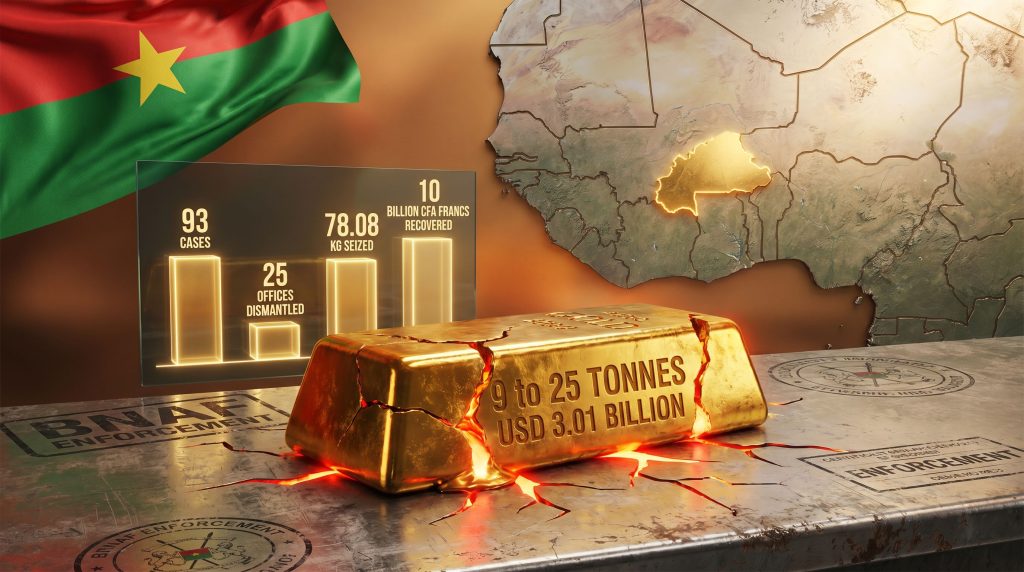
Studies of illicit financial flows linked to gold and four other minerals in Burkina Faso estimated cumulative losses of approximately USD 3.01 billion between 2012 and 2021, with gold-related diversions accounting for roughly 61% of total mineral illicit outflows across that period. Annual diversion estimates range between 9 and 25 tonnes, a range that reflects the inherent difficulty of quantifying activity that is, by design, invisible to formal tracking systems.
Furthermore, the broader gold market outlook for the region underscores just how much is at stake when illicit flows undermine formal sector confidence.
These figures reframe gold fraud not as a law enforcement problem with a policing solution, but as a structural economic crisis requiring institutional architecture across the entire value chain.
How the Illicit Gold Supply Chain Actually Works
The mechanics of gold fraud in Burkina Faso follow a four-stage pattern that mirrors the structure of any commodity supply chain, except that every stage operates outside legal frameworks and each transition point adds a layer of obfuscation that makes prosecution difficult.
Stage One: Misreporting at Artisanal Mining Sites
Artisanal and small-scale gold mining, known in the sector as ASGM, accounts for a significant and growing share of Burkina Faso's total gold output. The ASGM sector is characterised by minimal documentation, cash-based transactions, and a workforce that is largely unregistered. This combination creates the ideal conditions for production misreporting.
Artisanal operators may simply declare lower output volumes to reduce their royalty obligations, or they may route production entirely outside official purchasing systems. Because there is no independent verification of output at most small-scale sites, the declared figure becomes the only figure that exists on paper.
Stage Two: Illegal Buying Offices as Aggregation Infrastructure
Informally produced or diverted gold does not travel directly to an international buyer. It moves first to aggregation points, which enforcement authorities have now formally identified and dismantled as illegal gold-buying and selling offices. Between 2023 and 2026, 25 such offices were shut down as part of the Burkina Faso gold fraud crackdown.
These offices function like unlicensed commodity brokers. They consolidate gold sourced from multiple producers, price it outside regulated markets, avoid tax registration, conduct no anti-money laundering reporting, and process transactions entirely in cash. Their existence indicates that illicit gold networks maintain fixed commercial infrastructure, not just informal handshakes at roadsides.
Stage Three: Cross-Border Smuggling Through Porous Corridors
Burkina Faso borders six countries, including Mali, Niger, Côte d'Ivoire, Ghana, Togo, and Benin. Each border represents a potential exit corridor for gold that has been aggregated through illegal offices and is now moving toward international markets. Cross-border smuggling routes exploit both geographic porosity and the limited enforcement capacity that insecurity in mining regions creates.
The broader issue of mining geopolitics across the Sahel has, however, intensified scrutiny of these corridors, as regional powers increasingly recognise the connection between mineral smuggling and instability. Gold smuggled across these borders bypasses export duties entirely and enters international trading systems in ways that make origin tracing exceptionally difficult. Once gold crosses a border and is mixed with legitimately traded material from another jurisdiction, the chain of custody is effectively broken.
Stage Four: Financial Integration and Money Laundering
The final stage converts illicit commodity proceeds into usable financial assets. This typically involves layered transactions through informal money transfer systems, cash-intensive businesses, or cross-border financial flows that exploit weak due diligence standards. BNAF officials have explicitly connected gold fraud proceeds to broader money laundering activity, and Burkina Faso's national strategy formally acknowledges links between illicit gold revenues and the financing of non-state armed groups operating in the Sahel region.
This security dimension elevates the enforcement problem beyond financial crime. It places gold fraud at the intersection of fiscal governance, organised crime, and counterterrorism, which is precisely why the national response has involved multiple institutional actors.
The BNAF Enforcement Record: Measuring Three Years of Operations
The Brigade Nationale Anti-Fraude de l'Or (BNAF) serves as Burkina Faso's specialist investigative unit for gold marketing offences. It operates alongside ANEEMAS, the national agency responsible for regulating artisanal and semi-mechanised mining, creating a dual-track architecture in which regulatory oversight and criminal investigation function as complementary disciplines.
The enforcement figures released for the 2023 to 2026 period provide the most detailed public accounting of BNAF's operational results to date:
| Enforcement Metric | Recorded Figure |
|---|---|
| Investigations opened (2023 to 2026) | 93 cases |
| Illegal gold-trading offices dismantled | 25 offices |
| Physical gold seized | 78.08 kilograms |
| Financial recoveries via fines and penalties | 10 billion CFA francs (~USD 16.8 million) |
| Counterfeit gold bars seized (EITI-linked, 2022) | Valued at over USD 15 million |
| Fraud cases recorded in EITI reporting (2022 fiscal year) | 39 cases |
The numbers reveal something important about how the enforcement strategy has been calibrated. Rather than focusing exclusively on physical seizures, BNAF has pursued financial penalties alongside commodity recovery. The USD 16.8 million recovered through fines and penalties dwarfs the market value of the 78.08 kilograms of gold physically seized, suggesting the brigade is targeting financial flows, not just commodities.
The gap between estimated annual diversion volumes of up to 25,000 kilograms and the 78 kilograms seized over three years is not a measure of failure. It is a measure of the scale of the challenge that remains.
The National Strategy: From Ad Hoc Enforcement to Institutional Architecture
In November 2023, Burkina Faso's Ministry of Energy, Mines and Quarries formally validated what became the country's first comprehensive policy document dedicated to mining-sector financial crime. The National Strategy to Combat Gold Fraud, Money Laundering and the Financing of Terrorism in the Mining Sector established a multi-agency framework accompanied by a three-year implementation roadmap.
The strategy's core pillars include:
- Expanding enforcement capacity within BNAF and aligned agencies
- Improving coordination between judicial authorities, gendarmerie units, and mining regulators
- Implementing traceability systems that follow gold from artisanal production through to export
- Aligning national frameworks with Financial Action Task Force (FATF) recommendations on high-risk jurisdictions
A particularly significant element of the implementation approach was the two-day awareness workshop conducted in Bobo-Dioulasso for approximately 700 trainee Judicial Police Officers from the National Training Centre for Gendarmerie Non-Commissioned Officers. This training initiative represents a force-multiplication model rather than a specialist-only approach.
By embedding anti-fraud competency within general law enforcement training, the strategy distributes investigative awareness across the broader security apparatus. BNAF officials used the workshop to reinforce the importance of inter-agency collaboration, stressing that fraud networks spanning multiple jurisdictions and institutional boundaries cannot be addressed by any single unit operating in isolation.
How Burkina Faso's Approach Compares Across the Region
The Burkina Faso gold fraud crackdown sits within a broader pattern of resource sovereignty assertion that has accelerated across the Sahel and West Africa in recent years.
| Country | Key Enforcement or Policy Action | Scale of Impact |
|---|---|---|
| Burkina Faso | BNAF dismantles 25 illegal offices; 93 investigations over three years | USD 16.8 million recovered |
| DRC | Jinchuan mining fraud scheme uncovered at Congo mine | USD 145 million fraud scheme |
| Burkina Faso (cumulative) | EITI-linked illicit flow study across five minerals | USD 3.01 billion in gold-related IFFs (2012 to 2021) |
Under President Ibrahim Traoré, Burkina Faso has pursued an expanded state and local ownership model for its gold mines, a policy direction that mirrors approaches adopted in Mali, Guinea, and Niger. The common thread across these military-led administrations is an assertion of state primacy over mineral supply chains, including through tighter export controls and renegotiated mining contracts.
What distinguishes Burkina Faso's enforcement model from comparable West African approaches is the explicit connection drawn between gold fraud, money laundering, and terrorist financing. This linkage reflects the country's security environment, where revenues from illegal resource trading have been documented as a funding mechanism for armed non-state actors. The World Customs Organization has acknowledged BNAF and ANEEMAS as meaningful enforcement structures while also noting that ongoing insecurity and resource limitations continue to constrain operational reach.
The next major ASX story will hit our subscribers first
The Fiscal Feedback Loop: Why Gold Fraud Is a Self-Reinforcing Problem
The macroeconomic consequences of unchecked gold fraud in Burkina Faso extend well beyond the direct revenue losses captured in illicit financial flow estimates. The dynamic operates as a self-reinforcing cycle that compounds over time. In addition, the role of safe-haven gold in global markets means that artificially suppressed formal production figures can distort international pricing signals, further disadvantaging compliant operators.
- Revenue erosion reduces the government's capacity to fund security operations in mining regions.
- Reduced security presence in those regions allows illegal mining and trading operations to expand with lower risk of detection.
- Expanded illegal operations generate larger illicit financial flows, increasing the resources available to criminal and armed networks.
- Stronger criminal networks further undermine formal sector investment by raising perceived sovereign risk.
- Lower formal investment reduces legitimate tax revenues, increasing pressure on an already constrained fiscal base.
Large-scale gold smuggling also removes a critical source of foreign exchange from the formal banking system. When significant export volumes bypass official channels, central bank reserve capacity is diminished, monetary policy transmission is weakened, and currency stability becomes harder to maintain. These are second-order effects that rarely appear in enforcement statistics but materially affect the broader investment climate.
What Genuine Progress Requires: The Three Critical Gaps
The enforcement results from 2023 to 2026 represent genuine institutional progress. However, closing the gap between estimated diversion volumes and actual enforcement outcomes requires addressing three structural weaknesses that the current framework has not yet fully resolved.
Scaling Seizure Capacity to Match Diversion Volumes
The disparity between an estimated 9 to 25 tonnes diverted annually and 78 kilograms seized over three years underlines the operational deficit. Scaling BNAF's capacity requires investment in personnel, surveillance technology, and analytical infrastructure capable of mapping the networks that connect artisanal production sites to cross-border exit points.
Implementing End-to-End Gold Traceability
Without a robust traceability system that follows gold from the point of extraction through to export certification, illegal producers can blend fraudulently obtained material with legitimately sourced gold at aggregation points, making origin verification effectively impossible. The OECD Due Diligence Guidance for Responsible Mineral Supply Chains provides a technically sound and internationally recognised framework that could be adapted to Burkina Faso's specific regulatory and security context.
Regional Enforcement Cooperation Across Sahel Borders
Unilateral enforcement against a fundamentally cross-border problem has inherent structural limits. Deepening intelligence-sharing arrangements with neighbouring states, harmonising legal definitions and prosecution standards for transnational gold fraud, and coordinating border operations would materially enhance the effectiveness of enforcement efforts across the entire Sahel corridor.
Consequently, understanding gold as ultimate money helps contextualise why so many actors — from artisanal miners to transnational criminal networks — are motivated to circumvent formal systems in the first place.
Burkina Faso's national strategy has created the institutional foundation. Translating that foundation into enforcement outcomes at the scale of the problem requires resources, regional cooperation, and sustained political commitment that extends well beyond any single three-year action plan.
Frequently Asked Questions: Burkina Faso Gold Fraud Crackdown
What is the BNAF and what does it investigate?
The Brigade Nationale Anti-Fraude de l'Or is a specialist enforcement unit operating within Burkina Faso's mining governance framework. Its mandate covers investigations into fraud across the gold marketing chain, from artisanal production sites through to export. It coordinates with judicial authorities and gendarmerie units and operates alongside ANEEMAS, the national artisanal mining regulator.
How much gold is estimated to be fraudulently diverted each year?
BNAF estimates place annual diversion volumes between 9 and 25 tonnes, a range that reflects the difficulty of precisely measuring informal sector activity. For context, the total gold physically seized during the three-year enforcement period from 2023 to 2026 was 78.08 kilograms.
What is the connection between gold fraud and terrorist financing in Burkina Faso?
Proceeds from illicit gold trading are frequently integrated into the formal economy through layered financial transactions. Burkina Faso's security environment has raised documented concerns that some portion of illegal mineral revenues may be directed toward non-state armed groups active in the Sahel region, making enforcement a dual financial crime and national security priority.
How significant are illicit gold flows relative to the broader mineral sector?
Gold-related illicit financial flows accounted for approximately 61% of total illicit outflows across five minerals studied between 2012 and 2021, with a cumulative estimated value of USD 3.01 billion. Furthermore, central bank gold reserves globally are increasingly scrutinised in this context, as illicit supply chains can quietly distort official reserve valuations, underlining gold's dominant role in both Burkina Faso's formal economy and its shadow financial ecosystem.
Disclaimer: This article contains forward-looking analysis, forecasts, and estimates sourced from enforcement data, institutional reporting, and third-party research. These figures involve inherent uncertainty, particularly where they relate to informal sector activity. Nothing in this article constitutes financial or investment advice. Readers should conduct independent research before drawing conclusions about investment or policy decisions.
Want to Spot the Next Major ASX Mineral Discovery Before the Broader Market Does?
Discovery Alert's proprietary Discovery IQ model delivers real-time alerts on significant ASX mineral discoveries, transforming complex mineral data into clear, actionable insights for both short-term traders and long-term investors — explore historic discoveries and their returns to understand what's at stake, then start your 14-day free trial at Discovery Alert to position yourself ahead of the market.