August 4, 2026
The Economics of Landlocked Resource Wealth: Why Converting Gold Into Infrastructure Is Harder Than It Looks
Across sub-Saharan Africa, a persistent paradox has defined the development experience of mineral-rich nations for decades. Countries sitting atop extraordinary natural wealth have struggled to translate export earnings into the roads, railways, energy systems, and water networks their populations need. Mali mining revenues for infrastructure represent one of the most ambitious attempts to break this cycle. The challenge is not simply one of political will — it is structural. Commodity revenues are volatile, often captured at the point of extraction by a narrow set of actors, and historically difficult to redirect toward long-cycle infrastructure investment without deliberate institutional architecture.
Mali's current approach to this challenge deserves serious analytical attention. As Africa's second-largest gold producer, the country has moved beyond rhetoric and built a dedicated financial mechanism specifically designed to capture mining revenues and convert them into bankable infrastructure financing capacity. The mechanics of how this works, and the scale of what it could achieve, reveal a model with implications well beyond Mali's borders.
When big ASX news breaks, our subscribers know first
Gold as the Foundation of Mali's Public Finances
Gold is not simply an export commodity for Mali. It is the structural backbone of government revenue, foreign exchange earnings, and economic planning. The metal accounts for the overwhelming majority of the country's export income and remains the primary lens through which international investors and development financiers assess Mali's fiscal health. Furthermore, gold as an inflation hedge continues to underpin its global demand, reinforcing the metal's central role in Mali's economic planning.
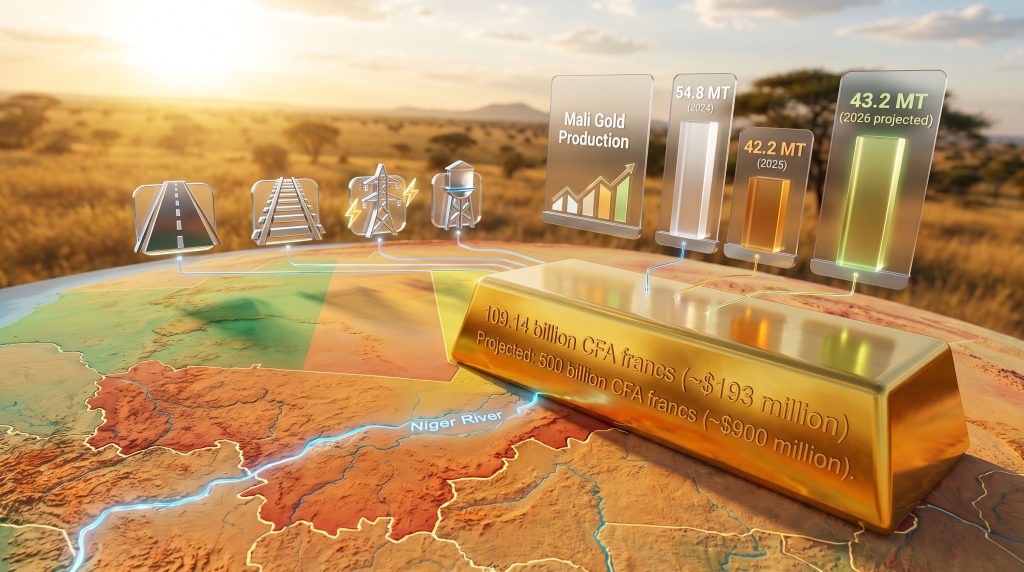
Mali's industrial gold production trajectory over recent years illustrates both the sector's importance and its fragility:
| Year | Industrial Gold Output | Year-on-Year Change |
|---|---|---|
| 2024 | 54.8 metric tonnes | Baseline |
| 2025 | 42.2 metric tonnes | -23% |
| 2026 (projected) | 43.2 metric tonnes | +2.4% |
The 2025 contraction of roughly 23% was partly attributable to operational disruptions at Barrick Mining's Loulo-Gounkoto complex, one of the country's most significant producing assets, during a prolonged dispute with the government. That a single mining complex could generate such a pronounced national-level production decline underscores a key risk embedded in Mali's infrastructure financing model: revenue concentration.
When the fund's income is disproportionately reliant on a small number of large operators, any dispute, operational setback, or force majeure event at one site ripples directly into the public finance base.
Despite this contraction, Mali retained its position among Africa's leading gold producers, and the projected 2026 recovery to 43.2 metric tonnes signals a degree of sectoral resilience. The gold sector's continued dominance in the national accounts makes its stabilisation and reform a fiscal priority of the first order.
How the Energy, Water and Transport Infrastructure Development Fund Actually Works
Established in 2023, the Energy, Water and Transport Infrastructure Development Fund represents the institutional core of Mali's strategy to redirect mali mining revenues for infrastructure priorities. Understanding its mechanics requires going beyond the headline figures.
The fund's financing architecture is built on two complementary contribution streams from mining permit holders:
- Turnover-based levy: Each permit holder contributes 1% of quarterly turnover to the fund, creating a recurring obligation tied directly to operational output.
- Ad valorem tax component: Set at 1% during a mine's first five operational years, then rising to 2% thereafter, this tiered structure increases the state's take as mines mature and capital recovery periods conclude.
This design is deliberately constructed to generate predictability. Unlike royalty structures that fluctuate with commodity prices alone, a turnover-based contribution means the fund accumulates revenue as long as operations continue, regardless of short-term gold price movements.
Financial Performance to Date
| Metric | Value |
|---|---|
| Collection period | January 2025 to June 2026 |
| Total funds raised | 109.14 billion CFA francs (~$193 million) |
| Annual generation floor | 50 billion CFA francs (~$88 million) |
| Target infrastructure financing capacity | Up to 500 billion CFA francs (~$900 million) |
The gap between the $193 million already collected and the $900 million financing target is not a shortfall — it is a leverage calculation. Mali's Finance Minister Alousseni Sanou has indicated that the fund's predictable annual inflows of at least 50 billion CFA francs provide sufficient debt-service capacity to support borrowing of up to 500 billion CFA francs from development financiers and sovereign lenders.
The $193 million functions as a demonstrated track record, the $88 million annual floor functions as collateral, and the $900 million is the debt envelope that track record and collateral can underpin.
This is the critical insight most coverage of the fund misses. The power of the mechanism is not in what it has accumulated. It is in the predictability that allows external lenders to price and structure long-term debt against a revenue stream they can model with reasonable confidence.
Where the $900 Million Is Targeted: Sector-by-Sector Breakdown
Infrastructure and Transport Minister Dembele Madina Sissoko has outlined the categories of investment the fund is expected to finance. For a landlocked country where transport costs act as a structural tax on every economic activity, the priority sequencing is revealing.
Transport Infrastructure
- Road construction and rehabilitation: Reducing overland freight costs is the single highest-leverage intervention available to a landlocked economy. Lower transport costs directly translate into more competitive agricultural exports, cheaper imported inputs for industry, and reduced cost of living for urban consumers.
- Railway infrastructure: Rail rehabilitation and expansion offers step-change reductions in bulk freight costs, particularly for minerals, agricultural commodities, and construction materials. Mali's existing rail network is limited and ageing, making investment here potentially transformative.
- Waterway and vessel investment: The Niger River system runs through Mali and historically served as a major freight and passenger corridor. Investment in vessels and waterway infrastructure could revive this low-cost transport option.
- Mali Airlines: The state-owned carrier has been identified as a beneficiary. Improving domestic and regional air connectivity reduces the economic isolation of interior regions and supports business travel — a precondition for attracting investment beyond the mining sector.
Energy and Water
Electricity supply constraints and water access limitations affect both household welfare and productive sector competitiveness. Fund allocations targeting these areas would address two of the most cited barriers to private sector development across rural and peri-urban Mali.
What Could $900 Million Actually Build?
To contextualise the scale, consider regional infrastructure cost benchmarks:
| Infrastructure Type | Estimated Cost Range | Potential Scale at $900M |
|---|---|---|
| Paved road construction | $500,000 to $1M per km | 900 to 1,800 km of road |
| Rural electrification | $1,000 to $3,000 per household | 300,000 to 900,000 households |
| Railway rehabilitation | $1M to $3M per km | 300 to 900 km of rail |
| Rural water supply systems | Variable | Multi-region coverage |
Note: These benchmarks are illustrative estimates based on regional project data and are not confirmed project budgets.
The Local Mining Development Fund: Community-Level Investment Running in Parallel
Separate from the national infrastructure mechanism, Mali operates a Local Mining Development Fund that channels revenues directly to municipalities situated near active mining operations. According to reporting from Africa Business Insider, approximately 18.4 billion CFA francs (around $33 million) has been allocated to local authorities for public infrastructure, social services, and community development.
This dual-track architecture addresses a failure mode common to single-channel resource revenue models. When all funds flow to the national level, communities bearing the environmental and social costs of mining operations often see minimal direct benefit. This fuels resentment, increases social licence risk for operators, and can disrupt production. By running a parallel local fund, Mali's framework attempts to align community interests with continued mining activity.
The two mechanisms serve distinct but complementary purposes:
- The national fund targets macro-level connectivity, productivity, and economic integration.
- The local fund targets community equity, social licence maintenance, and municipal service delivery.
Together, they represent a more sophisticated resource-to-development conversion architecture than approaches that treat infrastructure finance as purely a central government function.
The 2023 Mining Code: Regulatory Architecture Behind the Revenue Push
The infrastructure financing ambition cannot be understood without examining the 2023 mining code that reshaped the sector's fiscal terms. The revised framework increased royalty rates, expanded mandatory government equity participation in mining ventures, and created the contribution obligations that feed the infrastructure fund. In addition, government intervention in mining has become an increasingly prominent theme across West Africa, with Mali's approach representing one of the more structured examples.
The code's impact on international operators was significant. Barrick Mining, the Canadian major with substantial Malian assets, became the most prominent example of a dispute arising from the revised terms, with the prolonged standoff at Loulo-Gounkoto contributing directly to the 2025 production decline.
A December audit finding added further complexity. Government officials disclosed that an audit had identified 761 billion CFA francs (approximately $1.34 billion) in alleged unpaid obligations owed by mining companies to the state. To contextualise this figure: it is roughly seven times the current fund balance of 109.14 billion CFA francs. If even a fraction of these alleged arrears were recovered, it would represent a substantial augmentation of Mali's infrastructure financing capacity beyond the dedicated fund alone.
The audit figure of 761 billion CFA francs in alleged arrears dwarfs the fund's current balance. Its resolution, in whole or in part, could meaningfully accelerate Mali's infrastructure financing timeline.
The next major ASX story will hit our subscribers first
Artisanal Gold and the Formalisation Frontier
One of the least-discussed dimensions of Mali's gold economy is the scale of artisanal and small-scale mining (ASM). This sector operates largely outside formal reporting structures, meaning a significant volume of gold leaves the country without generating royalties, taxes, or fund contributions. Consequently, mining industry consolidation trends across the continent are making formalisation of ASM an increasingly urgent priority for governments seeking to maximise their revenue base.
In July 2026, the government established the Malian Office of Precious Substances specifically to bring formal regulatory oversight to artisanal gold trading and reduce the prevalence of undeclared exports. This matters fiscally for several reasons:
- Undeclared exports directly reduce the contribution base feeding the infrastructure fund, as artisanal output bypasses the permit holder contribution obligations entirely.
- Official production statistics understate actual output, making it difficult to assess the true size of the revenue opportunity.
- Formalisation precedents elsewhere in West Africa are instructive. Burkina Faso's move to channel artisanal gold through official structures resulted in more than $6 billion recorded through official channels within a single six-month period, demonstrating the scale of value that formalisation can capture.
If Mali achieves meaningful formalisation of its ASM sector, the annual revenue flowing into infrastructure-linked mechanisms could increase substantially beyond current projections.
Comparing Mali's Approach Across the Continent
Mali is not operating in isolation. A broader continental shift toward resource-backed infrastructure finance is underway:
| Country | Mechanism | Status |
|---|---|---|
| Mali | Energy, Water and Transport Infrastructure Development Fund | Active: 109.14 billion CFA francs raised (Jan 2025 to Jun 2026) |
| Ghana | Mineral income-to-infrastructure allocation framework | Approved 2025 |
| Burkina Faso | State gold channel formalisation | Over $6 billion recorded in six months through official channels |
What distinguishes Mali's model from adjacent approaches is its combination of three structural features: a ring-fenced fund with a defined, formula-based contribution mechanism; a leverage architecture that multiplies direct collections into larger borrowing capacity; and a dual-track structure that addresses both national and community-level infrastructure simultaneously. However, gold's strategic investment role remains a critical variable influencing how much revenue these mechanisms can realistically generate over time.
Risk Factors: What Could Prevent the $900 Million Vision from Being Realised
Any honest assessment of Mali's infrastructure financing plan must engage with the constraints that could limit execution.
Production Volatility Risk
The 2025 output decline demonstrates that the fund's revenue base is exposed to operational disruption at individual mines. With a small number of large complexes accounting for the majority of production, concentration risk is real. Greater diversification of the active mine base would reduce this vulnerability over time.
Geopolitical and Financing Access Risk
Mali's military-led government operates under a set of international sanctions and has experienced reduced access to certain multilateral financing channels. Development financiers evaluating whether to lend against mining fund inflows must factor political risk into their pricing and structuring decisions. This does not preclude borrowing, but it affects cost and availability.
Investor Confidence in the Sector
The disputes arising from the 2023 mining code have tested the confidence of international mining operators. A deterioration in the operating environment, or further unresolved disputes, could reduce future mine development activity and constrain the fund's long-term contributor base. Furthermore, the completion of definitive feasibility studies for new projects will be essential to demonstrate that Mali's pipeline remains attractive to international capital despite these tensions.
Implementation Capacity
Converting mobilised capital into completed infrastructure requires procurement systems, project management expertise, and anti-corruption safeguards that are challenging to maintain in any developing economy context. The gap between funds raised and infrastructure delivered is a persistent challenge across similar mechanisms on the continent. According to analysis from The Conversation, policy changes in Mali's mining sector continue to reshape both investor behaviour and the state's capacity to execute on its infrastructure ambitions.
Frequently Asked Questions: Mali Mining Revenues for Infrastructure
How much has Mali's infrastructure fund raised from mining revenues?
Between January 2025 and June 2026, the fund collected 109.14 billion CFA francs (approximately $193 million) from mining permit holders.
How does Mali plan to reach $900 million in infrastructure financing?
The fund generates a minimum of 50 billion CFA francs annually. Mali's Finance Minister has indicated this recurring revenue stream can support borrowing of up to 500 billion CFA francs (~$900 million), using predictable annual inflows as the basis for infrastructure debt.
What infrastructure projects will the fund finance?
Identified categories include roads, railways, river vessels, aviation through Mali Airlines, energy supply improvements, and water infrastructure.
How are mining companies contributing to the fund?
Permit holders contribute 1% of quarterly turnover plus ad valorem taxes set at 1% during the first five years of a mine's operation, rising to 2% thereafter.
What is the Local Mining Development Fund?
A separate community-focused mechanism that has allocated approximately 18.4 billion CFA francs (~$33 million) to municipalities near mining operations for local infrastructure and social services.
What happened to Mali's gold production in 2025?
Industrial output fell by approximately 23%, from 54.8 metric tonnes in 2024 to 42.2 tonnes in 2025, partly due to disruptions at Barrick Mining's Loulo-Gounkoto complex. A recovery to 43.2 metric tonnes is projected for 2026.
What is the Malian Office of Precious Substances?
Established in July 2026, it is a regulatory body created to formalise artisanal gold trading and reduce undeclared exports, thereby expanding the taxable base feeding Mali's public finances.
Disclaimer: Forward-looking production figures, infrastructure cost estimates, and financing projections cited in this article are based on government planning documents, ministerial statements, and regional benchmarks. They do not constitute financial advice and are subject to material revision based on operational, regulatory, and macroeconomic developments.
Want To Stay Ahead of Major Mineral Discoveries Before the Broader Market Catches On?
Discovery Alert's proprietary Discovery IQ model delivers real-time alerts on significant ASX mineral discoveries, transforming complex mineral data into actionable investment insights for both short-term traders and long-term investors. Explore how historic discoveries have generated substantial returns on Discovery Alert's dedicated discoveries page, and begin your 14-day free trial today to position yourself ahead of the market.