
August 24, 2026
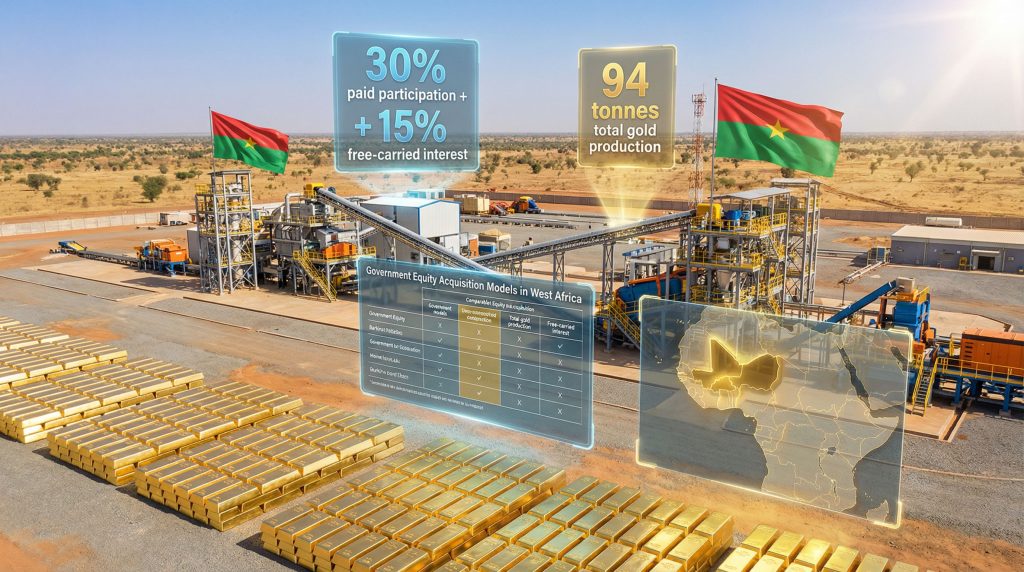
Mining sector dynamics across West Africa reveal complex patterns of resource nationalism and evolving government participation frameworks. The Burkina Faso government Kiaka gold project negotiations exemplify these trends, reflecting broader shifts in how mineral-rich nations seek to maximise returns from their natural endowments while maintaining attractive investment environments for international capital.
Understanding State Participation in West African Mining Operations
The evolution of government equity acquisition frameworks in West Africa represents a fundamental shift in resource sector governance. Rather than relying solely on traditional taxation and royalty structures, governments increasingly pursue direct ownership stakes to capture enhanced value from mining operations.
Furthermore, the exploration licenses process has become increasingly sophisticated across the region. The requirement for Council of Ministers decree authorisation creates institutional checks on government equity acquisitions, ensuring transparency in the process.
This procedural framework emerged clearly during February 2026 discussions regarding the Burkina Faso government Kiaka gold project, where legal authorisation mechanisms took precedence over unilateral government action. The mining permitting guidelines have evolved to accommodate these new participation models.
The role of Société de Participation Minière du Burkina Faso (SOPAMIB) as the government's designated mining sector representative demonstrates institutional capacity building. SOPAMIB's mandate extends beyond simple equity acquisition to encompass strategic cooperation on new project development, indicating a comprehensive approach to state participation in mining activities.
Key Operational Principles:
- Formal decree requirements for government equity increases
- Explicit protection of existing shareholder and lender interests
- Maintenance of operational continuity during ownership negotiations
- Focus on collaborative development of future mining projects
Government Equity Structures Across the Region
Table: Government Mining Participation Models in West Africa
| Country | Typical State Stake | Authorisation Process | Operational Impact |
|---|---|---|---|
| Burkina Faso | Negotiated basis | Council of Ministers decree | Production continuity maintained |
| Ghana | Optional participation | Parliamentary approval | Market-driven valuations |
| Mali | Structured requirements | Presidential decree | Development cost basis |
| Senegal | Mandatory minimums | Mining ministry authorisation | Free-carried components |
This framework variation reflects different national approaches to resource sector governance. Each jurisdiction balances revenue optimisation against investment attraction considerations, with recent developments showing alignment with broader industry evolution trends.
When big ASX news breaks, our subscribers know first
Financial Implications of Government Stake Acquisitions
Valuation methodologies for government equity acquisitions present complex challenges for mining companies and investors. Traditional market-based valuations often conflict with development cost approaches favoured by government entities seeking to maximise their participation at reasonable entry points.
The financial structure implications extend beyond simple equity pricing. Mining operations typically operate under complex financing arrangements with multiple lenders and covenant requirements. Government equity increases must navigate these existing obligations whilst preserving debt service capabilities and maintaining lender confidence.
Critical Financial Considerations:
- Development cost basis for government entry pricing
- Lender covenant compliance during ownership transitions
- Debt service capability preservation throughout negotiations
- Shareholder dilution protection mechanisms
Recent negotiations in Burkina Faso highlight the importance of maintaining operational financing structures during ownership discussions. The explicit commitment to respect existing shareholder and lender interests indicates recognition of these financial complexities in government participation frameworks.
Production Context and Economic Impact
Burkina Faso's gold sector demonstrates significant production capacity that provides context for government participation strategies. The country's mining sector contributes substantially to national revenues through both industrial and artisanal production channels.
Production Performance Indicators:
- Large-scale industrial mining operations across multiple regions
- Significant artisanal mining contribution to total output
- Established infrastructure supporting mining activities
- Experienced workforce in both technical and operational roles
The economic rationale for enhanced government participation centres on capturing greater value from these productive assets. Direct equity participation provides dividend income streams that complement traditional taxation approaches, particularly relevant given broader executive mining mandates affecting international investment flows.
Strategic Cooperation and Future Development Opportunities
Government interest in mining sector participation extends beyond existing operations to encompass new project development opportunities. This forward-looking approach reflects strategic thinking about long-term sector growth and national economic development objectives.
The cooperation framework emphasised in recent Burkina Faso government Kiaka gold project negotiations indicates government willingness to partner with established mining companies on future exploration and development initiatives. This collaborative approach contrasts with more adversarial nationalisation strategies employed in some jurisdictions.
Cooperative Development Elements:
- Joint venture structures for new exploration projects
- Shared investment in infrastructure development
- Enhanced local employment and skills development
- Increased community investment and social benefits
Stakeholder Interest Alignment
Successful government participation requires careful balance of multiple stakeholder interests. Recent discussions demonstrate recognition that effective partnerships must address concerns of existing shareholders, lenders, and operational management whilst achieving government participation objectives.
The constructive engagement approach reflects a shared vision to develop a strong and sustainable mining industry that benefits local populations whilst delivering long-term value for all stakeholders, according to company leadership statements.
This alignment strategy focuses on mutual benefit creation rather than zero-sum redistribution of existing value. The emphasis on new project development provides opportunities for government participation that support rather than compete with existing investor interests.
Risk Management and Investment Climate Implications
The predictable legal framework for government equity participation provides important risk management benefits for international mining investors. Clear procedural requirements and institutional oversight mechanisms reduce uncertainty around potential government participation in mining projects.
Risk Mitigation Factors:
- Transparent legal authorisation processes
- Institutional checks on government actions
- Explicit protection of lender and shareholder interests
- Operational continuity assurance during negotiations
These frameworks contrast favourably with jurisdictions where government participation occurs through sudden decree or emergency legislation without stakeholder consultation or protection mechanisms. Moreover, strategic resource financing models continue evolving to accommodate these participation frameworks.
Regional Competitive Positioning
Burkina Faso's structured approach to government participation positions the country competitively within the West African mining landscape. The balance between state participation objectives and investor protection creates conditions that may attract rather than deter international mining investment.
Competitive Advantages:
- Predictable legal frameworks for government participation
- Institutional capacity for complex negotiation management
- Operational stability during ownership transitions
- Collaborative approach to new project development
The precedent established through recent negotiations may influence regional standards for government mining sector participation. This potentially creates spillover benefits across West African mining jurisdictions.
Technical and Operational Considerations
Government equity participation raises important questions about operational decision-making and technical management in mining operations. The balance between state ownership interests and operational efficiency requirements must be carefully managed to preserve production performance and asset values.
Operational Management Framework:
- Preservation of technical expertise and management capabilities
- Maintenance of international operational standards
- Protection of existing contractual relationships
- Continuity of supply chain and marketing arrangements
The commitment to operational continuity during ownership negotiations demonstrates recognition of these technical requirements. Mining operations require specialised expertise and established relationships that must be preserved through ownership transitions.
Infrastructure and Development Implications
Enhanced government participation in mining projects creates opportunities for broader infrastructure development and economic integration. State ownership stakes provide government entities with direct influence over investment decisions and development priorities.
This influence can support national development objectives including local procurement requirements, skills development programmes, and community infrastructure investment. The cooperative framework approach facilitates alignment between mining company capabilities and national development priorities.
The next major ASX story will hit our subscribers first
Long-term Sector Development Prospects
The evolution toward enhanced government participation in West African mining reflects broader trends in resource nationalism and economic diversification strategies. Countries seek to maximise value capture from mineral resources whilst building domestic capacity in mining sector activities.
Strategic Development Objectives:
- Technology transfer and local skills development
- Downstream processing and value addition
- Enhanced infrastructure development
- Increased government revenue diversification
The success of these initiatives depends on maintaining balance between state participation objectives and the technical and financial requirements of modern mining operations. The collaborative approach demonstrated in Burkina Faso government Kiaka gold project negotiations provides a framework for achieving this balance.
Investment and Policy Implications
Future mining investment in West Africa will likely need to accommodate enhanced government participation expectations. Companies that proactively engage with government participation frameworks may gain competitive advantages in securing development opportunities and maintaining operational stability.
The institutional development represented by entities like SOPAMIB indicates government commitment to professional management of mining sector participation. This professionalisation reduces political risks associated with government involvement in mining operations, as noted in recent mining sector analyses.
Investment Strategy Adaptations:
- Early engagement with government participation frameworks
- Flexible ownership structures accommodating state participation
- Integration of national development objectives in project planning
- Collaborative approaches to new project development
The precedent established through structured negotiation processes provides a model for future government participation initiatives across the region. This predictability reduces investment risks whilst supporting government revenue optimisation objectives.
This analysis reflects the evolving nature of government participation in West African mining sectors and should be considered alongside current market conditions and regulatory developments when making investment decisions.
Are You Positioned for the Next West African Mining Discovery?
Discovery Alert's proprietary Discovery IQ model delivers instant notifications on significant ASX mineral discoveries, including companies with substantial West African operations, empowering subscribers to identify actionable opportunities ahead of the broader market. Begin your 14-day free trial at Discovery Alert today and secure your market-leading advantage in this rapidly evolving sector.