May 22, 2026
Africa's Mineral Wealth Problem: Why Extraction Rarely Equals Development
Across sub-Saharan Africa, a paradox has persisted for decades. Nations sitting atop some of the world's most valuable mineral deposits routinely rank among the lowest on human development indices. The disconnect between what lies beneath the ground and what materialises above it is not simply a function of corruption or mismanagement, though both play roles. It reflects a deeper architectural flaw in how resource revenues flow through state finances, get absorbed by short-term fiscal demands, and ultimately fail to accumulate into productive long-term capital.
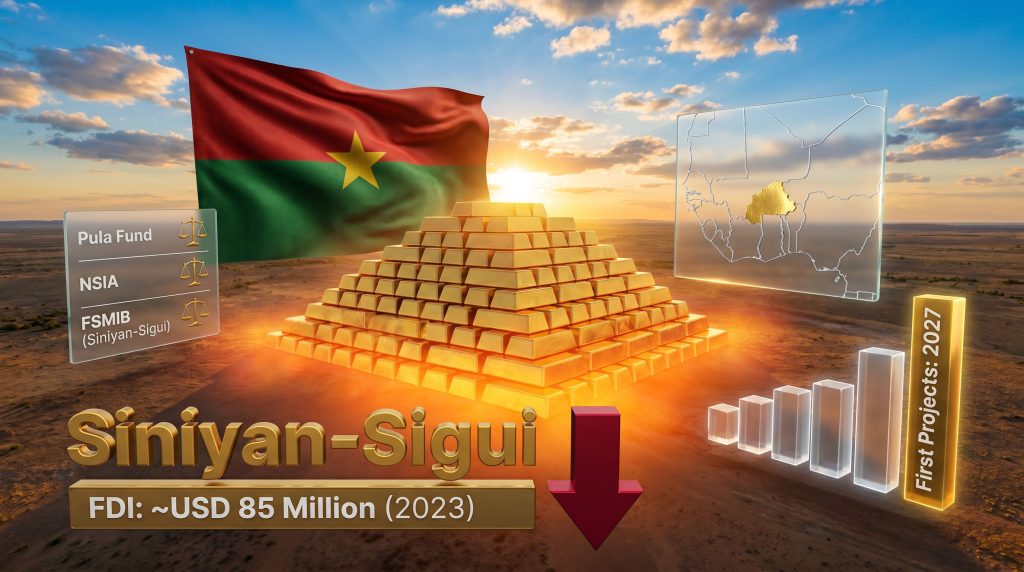
Burkina Faso has lived this contradiction intimately. Gold dominates the country's export profile, and the recent gold price surge has generated substantial windfalls. Yet those windfalls have not translated into proportional improvements in infrastructure, industrial capacity, or sovereign credit standing. The country's latest policy response to this structural problem is the creation of the Fonds souverain minier d'investissements du Burkina Faso (FSMIB), officially named Siniyan-Sigui, a dedicated Burkina Faso sovereign mining investment fund established by Council of Ministers decree in May 2026.
Understanding what this fund is, how it works, and what it reveals about Burkina Faso's broader resource governance ambitions requires stepping back from the announcement itself and examining the deeper economic logic it is attempting to correct.
When big ASX news breaks, our subscribers know first
What Is the Burkina Faso Sovereign Mining Investment Fund?
Structure, Mechanics, and Strategic Purpose
The FSMIB is not a budget supplementary allocation or a development bank. It is a structurally ring-fenced public investment vehicle, purpose-built to intercept mineral revenue surpluses before they can be absorbed into recurrent government expenditure.
The funding mechanism operates on a price-trigger model. The Burkinabe state establishes internal benchmark pricing thresholds for key minerals, primarily gold. When global market prices exceed those benchmarks, the additional revenue generated above that threshold is classified as surplus and legally redirected into the FSMIB rather than flowing into consolidated government accounts.
This design choice is deliberate and technically significant. By tying fund contributions to price outperformance rather than a fixed revenue percentage, the architecture ensures that only genuine commodity windfalls — income that was not anticipated in the state budget — become development capital. It prevents the fund from competing with essential public services for baseline revenue.
Key structural features at a glance:
| Feature | Detail |
|---|---|
| Full Name | Fonds souverain minier d'investissements du Burkina Faso |
| Operational Name | Siniyan-Sigui |
| Established By | Council of Ministers decree |
| Funding Mechanism | Surplus revenues above state-set mineral price benchmarks |
| Primary Investment Focus | Strategic infrastructure, industrialisation |
| First Project Deployments | Anticipated from 2027 |
| Oversight | Finance Ministry under Minister Aboubakar Nacanabo |
| Strategic Objective | Economic sovereignty, reduced external financing dependency |
Step-by-Step: How Surplus Mining Revenue Becomes Development Capital
-
Benchmark monitoring — The state tracks global commodity prices, principally gold, against internally set pricing thresholds in real time.
-
Surplus identification — Revenue flows exceeding those benchmarks are flagged as eligible for FSMIB contribution and separated from general budget revenue.
-
Mandatory transfer — By decree, surplus amounts are legally redirected to the fund, bypassing consolidated revenue accounts entirely.
-
Investment review — An investment governance process assesses candidate projects against infrastructure and industrialisation criteria.
-
Capital deployment — Approved projects receive funding, with the first deployments expected from 2027 onward.
-
Performance accountability — The fund's governance structure requires reporting on deployment outcomes, though the maturity of this accountability framework remains to be tested.
Why Burkina Faso Needs a Sovereign Fund: The Gold Dependency Problem
A Single-Commodity Trap
Gold constitutes the dominant share of Burkina Faso's export earnings, making the country's fiscal position acutely sensitive to international commodity price cycles. During periods of elevated gold prices, the government theoretically receives elevated revenues. In practice, those revenues have consistently been absorbed by recurrent expenditure pressures, security costs, and debt servicing obligations, leaving little to show in terms of durable national assets.
This pattern is recognised in development economics as a manifestation of the "resource curse," a phenomenon where commodity-dependent states paradoxically struggle to convert mineral wealth into sustainable development. Academic literature on the subject, including foundational work by economists such as Jeffrey Sachs and Andrew Warner, identifies price volatility, institutional weakness, and the crowding out of non-resource economic activity as the primary transmission mechanisms through which resource abundance becomes a developmental liability.
The data from Burkina Faso's recent experience reinforces this diagnosis. Foreign direct investment in the country's mining sector fell sharply to approximately USD 85 million in 2023, a significant contraction from prior-year levels, despite gold prices trending upward globally during much of this period. The divergence signals that something beyond commodity market dynamics was deterring capital — specifically the combined effect of policy uncertainty, regulatory overhaul, and ongoing security challenges.
The Boom-Bust Fiscal Cycle
Without a formal revenue stabilisation mechanism, Burkina Faso's public finances have historically amplified rather than smoothed commodity price cycles. When gold prices rise, spending pressures rise in parallel, often faster. When prices correct, fiscal gaps open that require either austerity or external financing to bridge.
This dynamic has kept the country dependent on multilateral institutions and bilateral creditors in ways that constrain policy autonomy — precisely the dependency the FSMIB is designed to reduce. The strategic role of gold in national wealth-building is increasingly central to how governments in resource-rich nations are rethinking fiscal architecture.
The absence of a rules-based revenue quarantine mechanism has been a structural vulnerability in Burkina Faso's fiscal architecture for years. The FSMIB represents the first institutionalised attempt to insert a circuit breaker between commodity windfalls and the political economy of public spending.
Burkina Faso's Mining Policy Overhaul: A Timeline of Escalating State Control
The FSMIB does not exist in isolation. It is the latest institutional expression of a multi-year policy trajectory that has fundamentally reoriented Burkina Faso's relationship with its mining sector and the foreign companies operating within it.
| Year | Policy Action | Significance |
|---|---|---|
| 2015 | Original Mining Code in force | Framework designed to attract foreign investment |
| 2024 | New Mining Code adopted | Increased state participation, higher taxes, stronger oversight |
| 31 July 2024 | Local Content Law enacted | Mandates national capacity in mining supply chains |
| September 2024 | Boungou and Wahgnion mines announced for nationalisation | Direct state asset acquisition begins |
| 11 June 2025 | Council of Ministers approves transfer of foreign mining assets to state control | Formal transition of majority foreign-owned operations |
| May 2026 | FSMIB (Siniyan-Sigui) established by decree | Sovereign fund architecture formalised |
The 2024 Mining Code: A Structural Break from the Investment-Friendly Era
The revised Mining Code replaced a 2015 framework explicitly designed to attract foreign capital through favourable fiscal terms. The 2024 code introduced mandatory state participation thresholds, increased royalty and tax obligations on operators, and embedded local benefit provisions broadly consistent with UNCTAD investment policy frameworks for resource-rich developing nations.
Critically, the new code also created the regulatory architecture enabling the state to assume operational control over strategic assets — a provision that was quickly exercised with the nationalisation of the Boungou and Wahgnion mines following the September 2024 announcement.
The Local Content Law: Retaining Value Within Borders
Enacted on 31 July 2024, the Local Content Law requires mining operators to source goods, services, and labour from national providers wherever operationally feasible. This measure targets a well-documented leakage problem in African mining economies, where a substantial share of the economic value generated by extraction is captured by foreign service providers, equipment suppliers, and expatriate workers rather than circulating within the host country's economy.
The Local Content Law complements the FSMIB by expanding the domestic economic base that benefits from mining activity, rather than simply redirecting a larger share of the same revenue stream. Furthermore, this approach echoes broader mining industry consolidation trends seen across the continent, where states are increasingly asserting greater control over how value chains are structured.
The Investment Climate Paradox: Sovereignty vs. Capital
A Fundamental Tension
Burkina Faso's assertive resource nationalism has produced a structural contradiction that no sovereign fund architecture can fully resolve on its own. The state needs sustained gold production volumes to generate the surplus revenues that will finance the Burkina Faso sovereign mining investment fund. Sustaining those volumes requires ongoing exploration activity, mine development capital, and operational expertise — most of which currently originates from foreign mining companies. Yet the policy environment being constructed is systematically increasing costs and risks for those same companies.
Foreign mining operators have raised concerns across multiple dimensions:
- Retroactive changes to fiscal terms creating uncertainty over project economics
- Nationalisation risk undermining the security of existing asset tenure
- Security instability in active mining regions disrupting operations and complicating revenue monitoring
- Higher compliance costs under the new regulatory framework
- Reduced appetite for exploration commitments pending clarity on the long-term policy direction
The FDI contraction to approximately USD 85 million in 2023 is the quantitative expression of this tension. A reduced exploration and development pipeline today means fewer new mines entering production over the following decade, which directly constrains the production volumes the FSMIB depends upon. Legal experts have also highlighted the complexities of mining nationalisation in Burkina Faso, noting the potential for protracted disputes with former asset holders.
The Sahel Resource Nationalism Cluster: A Regional Phenomenon
Burkina Faso is not operating in isolation. Mali, Niger, and Guinea have all pursued materially similar policy trajectories over the same period — increasing state participation requirements, revising fiscal terms, and in some cases asserting direct control over mining assets. The collective shift represents a regional ideological reorientation away from the investment frameworks that shaped African mining governance through the post-colonial era.
This clustering matters for multinational mining companies in a way that individual country policy changes do not. When a single jurisdiction tightens terms, companies can redirect capital elsewhere. When multiple adjacent jurisdictions tighten simultaneously, available alternatives shrink and the negotiating dynamic shifts in favour of host states — at least temporarily. The broader mining geopolitical landscape is consequently being reshaped across West Africa in ways that will have lasting implications for capital allocation decisions.
If the Sahel cluster of resource-nationalist states successfully sustains production volumes while asserting higher fiscal claims, the model becomes exportable across the continent. If production declines materially, it becomes a cautionary tale about the limits of sovereignty without operational capacity.
How Does the FSMIB Compare to Other African Resource Funds?
Benchmarking Against Established Models
| Country | Fund Name | Funding Source | Scale | Key Feature |
|---|---|---|---|---|
| Botswana | Pula Fund | Diamond revenues | ~USD 5.7 billion | Long-standing intergenerational savings model |
| Nigeria | Nigeria Sovereign Investment Authority (NSIA) | Oil surplus revenues | ~USD 2.5 billion | Three-fund structure: stabilisation, infrastructure, future generations |
| Ghana | Ghana Petroleum Funds | Oil revenues | Stabilisation + Heritage Fund | Legislated revenue allocation rules |
| Angola | FSDEA | Oil revenues | ~USD 3 billion+ | Diversification-focused investment mandate |
| Burkina Faso | FSMIB (Siniyan-Sigui) | Gold/mineral price surplus | Nascent, first projects 2027 | Price-trigger surplus mechanism; infrastructure focus |
What Makes the FSMIB Structurally Distinct
Several features differentiate the FSMIB from its African peers in ways that matter for long-term governance outcomes:
-
Price-threshold trigger vs. percentage allocation: Most peer funds receive a fixed percentage of resource revenues regardless of price level. The FSMIB's trigger model means the fund only accumulates capital during genuine price outperformance, theoretically making it more resilient to political pressure.
-
Explicit exclusion from budget support: The fund's design prohibits using accumulated capital for recurrent expenditure — a discipline that several African sovereign funds have struggled to maintain under fiscal stress.
-
Dual mandate tension: Pursuing both infrastructure investment returns and sovereign credit profile improvement simultaneously creates competing objectives that governance frameworks will need to manage explicitly.
Lessons From Botswana's Pula Fund
Botswana's Pula Fund, established decades earlier and built on diamond revenues, offers the most instructive long-run case study for Burkina Faso. The fund's success depended on three institutional conditions consistently maintained: a rules-based contribution mechanism limiting political discretion, operational independence from the annual budget cycle, and a long-term investment horizon resisting pressure for short-term deployment.
The structural differences between Botswana's institutional environment and Burkina Faso's current context — including transitional governance arrangements, active security challenges, and nascent institutional capacity — mean directly transplanting the Pula model is neither possible nor appropriate. What is transferable is the underlying principle: that the rules protecting the fund from political spending pressures matter more, over time, than the initial size of the fund itself. In addition, Congo's resource wealth governance challenges offer further cautionary context for how institutional design can determine whether mineral abundance becomes national prosperity.
The next major ASX story will hit our subscribers first
Scenario Analysis: What Happens If Gold Prices Stay Elevated?
Gold prices have remained historically elevated through 2024 into 2026, trading well above USD 2,000 per ounce for extended periods and reaching new highs above USD 3,000 per ounce at points during this period. If prices remain sustained at levels meaningfully above the state's internal benchmark thresholds, the FSMIB's trigger mechanism could generate meaningful capital accumulation relatively quickly.
Three scenarios worth considering:
-
Bull case: Gold prices sustain above USD 2,500/oz, production volumes hold steady or grow, and governance structures function as designed. The FSMIB accumulates sufficient capital to fund multiple major infrastructure projects before 2030, materially improving Burkina Faso's development trajectory.
-
Base case: Prices remain elevated but production volumes stagnate due to reduced exploration investment. The fund accumulates more slowly than anticipated, limiting project scope but still delivering incremental infrastructure improvement.
-
Bear case: A combination of gold price correction below benchmark thresholds, production disruption from security instability, and governance stress eliminates surplus trigger conditions. The fund receives minimal inflows and the FSMIB becomes a structural framework without deployable capital.
Disclaimer: These scenarios are analytical projections only. They do not constitute financial advice, and actual outcomes will depend on variables including commodity price movements, geopolitical conditions, and institutional developments that cannot be predicted with certainty.
Risks That Could Undermine the FSMIB's Effectiveness
Even well-designed sovereign fund architectures can fail if the operating conditions they depend upon deteriorate. For the Burkina Faso sovereign mining investment fund, the meaningful risk factors include:
- Security disruption at active mining sites reducing production volumes and revenue generation
- Governance capture converting the fund from a development tool into a politically directed spending vehicle
- FDI contraction compressing the exploration pipeline and constraining future production capacity
- Gold price reversal eliminating surplus trigger conditions and halting fund contributions
- Institutional capacity gaps within a transitional governance environment limiting investment decision quality
- Legal disputes with nationalised asset former owners creating contingent liabilities that drain state resources
What the FSMIB Signals for Africa's Resource Governance Landscape
The creation of the Burkina Faso sovereign mining investment fund carries significance beyond the country's borders. It represents one of the more technically sophisticated attempts within the Sahel bloc to institutionalise resource revenue management rather than simply assert state control over assets.
Whether the FSMIB achieves its stated objectives will be determined not by the elegance of its design but by three practical variables: whether gold production volumes are sustained at levels generating meaningful surpluses above benchmarks, whether governance structures protecting the fund from political spending pressures hold under fiscal stress, and whether the country can resolve the fundamental tension between sovereign ambition and the practical capital requirements of keeping an active gold mining sector functioning.
The first project deployments expected from 2027 will provide the earliest meaningful test of whether the Siniyan-Sigui fund is genuinely transforming Burkina Faso's relationship with its mineral wealth, or whether it joins the long list of resource governance initiatives across the continent that were sound in conception but constrained in execution.
For analysts and investors tracking West African resource governance, the FSMIB is credible in design. Its long-term effectiveness will ultimately be determined by governance quality, production sustainability, and the government's capacity to balance sovereign ambition with the pragmatic requirements of an active extractive sector.
Want to Track the Next Major Mineral Discovery Before the Market Does?
Discovery Alert's proprietary Discovery IQ model delivers real-time alerts on significant ASX mineral discoveries, translating complex mineral data into actionable investment insights for both short-term traders and long-term investors — explore historic discovery returns to understand what early positioning in a major find can mean, and begin your 14-day free trial today to stay ahead of the market.