May 22, 2026
The Structural Economics of Primary Aluminium Production and Why Margins Are Always Under Pressure
Few industrial manufacturing processes expose their operators to the kind of dual-sided cost vulnerability that primary aluminium smelting creates. Unlike most heavy industries where either input costs or output prices dominate financial performance, aluminium producers face a simultaneous squeeze from two structurally independent forces: the electricity markets that power their operations and the commodity exchanges that determine what their metal is worth. These two variables move independently of each other, respond to entirely different macroeconomic signals, and offer limited scope for producers to offset weakness in one with strength in the other.
Understanding how Century Aluminum earnings pressure from energy costs and aluminium price swings develops requires first understanding the underlying economics of the production process itself. The Hall-Héroult electrolytic process, which remains the universal method for converting alumina into primary aluminium, consumes between 13,000 and 15,000 kilowatt-hours of electricity per metric tonne of metal produced. This energy intensity is not a design inefficiency that better engineering can eliminate; it is an electrochemical requirement baked into the fundamental chemistry of aluminium reduction.
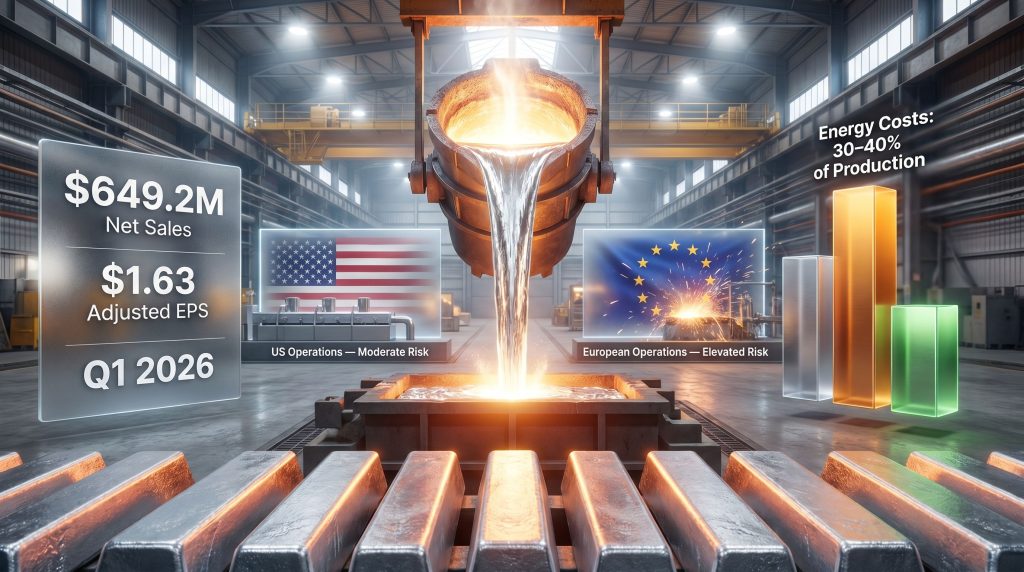
The industry has improved from approximately 16,000 kWh per tonne in earlier decades, but the remaining gap between current performance and theoretical minimum energy consumption is narrow enough that transformational efficiency gains are unlikely in the near term. The practical consequence is that electricity costs typically represent 30 to 40% of total production expenses at most smelting operations. This figure is substantially higher than for steel, copper, or zinc production and creates a cost exposure profile that behaves asymmetrically.
When energy prices rise by 20%, smelting margins compress by a disproportionate 6 to 8 percentage points because that cost increase cannot be absorbed through operational flexibility or passed through to customers trading at LME-linked prices.
How Electricity Intensity Creates an Asymmetric Cost Problem
The operational physics of aluminium smelting compound the cost exposure significantly. Electrolytic cells must maintain continuous current to keep the bath molten at approximately 950 degrees Celsius. Power input tolerances are narrow, operating within a range of roughly plus or minus 5%, meaning production volumes cannot be meaningfully reduced during periods of high electricity prices without risking equipment damage and incurring substantial restart costs.
Approximately 75% of energy consumption in a smelter is effectively fixed regardless of market conditions, leaving only a quarter of energy use subject to any form of operational optimisation. This operational inflexibility creates what analysts describe as a structural timing mismatch. Energy costs are often reset on a quarterly or annual basis through contract renegotiation cycles, while London Metal Exchange aluminium prices fluctuate daily in response to demand signals, inventory data, currency movements, and speculative positioning.
When energy costs reset higher before LME prices recover, the compression period can extend for the full duration of the new energy contract, creating prolonged earnings pressure that financial hedging instruments struggle to fully offset.
LME Price Sensitivity: Why Metal Producers Cannot Fully Control Their Own Revenue
Primary aluminium is a commodity product with pricing determined almost entirely by LME benchmark rates plus applicable regional premiums. Unlike differentiated manufacturers who can adjust selling prices in response to cost pressures, smelters are price-takers on their core product. When LME prices decline by 10%, revenue falls proportionally for standard-grade output, regardless of what has happened to electricity tariffs, alumina costs, or capital expenditure commitments.
Regional premiums, which reflect transportation costs, local market supply-demand balances, and import tariff structures, provide a secondary revenue lever. However, these premiums are themselves subject to disruption from trade policy changes and geopolitical events, making them an unreliable buffer against persistent commodity price weakness. Furthermore, the aluminum and alumina markets add another layer of complexity, as alumina input pricing directly affects smelter cost structures independent of electricity dynamics.
When big ASX news breaks, our subscribers know first
How Energy Cost Volatility Translates Into Smelting Margin Erosion
The Electricity-to-Metal Cost Ratio: What the Numbers Reveal
The numbers that define aluminium smelting economics are stark in their implications for margin management. During the 2022 European energy crisis, electricity prices reached levels exceeding 200 euros per megawatt-hour in spot markets, pushing power costs past 50% of total production expenses for many European facilities, well above the structural baseline of 30 to 40%.
At the same time, LME aluminium prices, while elevated by historical standards, did not increase proportionally to offset the energy cost surge, resulting in operating losses at multiple smelters across the continent. North American operations maintained substantially better cost positions during this period, with US-based smelters averaging production costs in the range of $1,900 to $2,100 per metric tonne compared to European costs that, under extreme energy market conditions, reached $2,800 or higher.
This divergence illustrates why Century Aluminum's US and European operations carry materially different risk profiles and why the regional breakdown of capacity matters when evaluating consolidated earnings exposure.
"The fundamental challenge for aluminium smelters is not that energy is expensive in absolute terms, but that energy costs follow an entirely different pricing cycle than metal prices, creating windows of severe margin compression that can persist for months or years."
Long-Term Power Agreements: A Hedge or a Liability?
The traditional response to energy cost volatility in the aluminium industry has been long-term power purchase agreements that lock in electricity pricing over extended periods. These arrangements provided substantial protection when contract durations of 10 to 15 years were common, effectively insulating producers from short-term market disruptions for a full generation of operating cycles.
The landscape has shifted considerably. Average contract durations in the aluminium industry have shortened from 10 to 15 years in the early 2000s to 3 to 5 years under current market conditions, as utilities seek to reflect evolving energy market dynamics and reduce their own long-term pricing exposure. This contraction means smelters face contract renegotiation cycles at approximately twice the frequency of previous decades, increasing the probability that any given renegotiation coincides with a period of elevated energy pricing.
Long-term agreements also carry their own form of liability. When signed at unfavourable price levels during periods of energy market distress, they can lock in elevated costs even as spot markets normalise, creating a reverse penalty where competitors on shorter agreements or spot exposure benefit from declining prices while contracted smelters remain burdened.
Regional Energy Market Dynamics: US vs. European Smelting Operations
The contrast between US and European operating environments for aluminium smelters extends well beyond current electricity price levels:
| Cost Factor | US Operations | European Operations |
|---|---|---|
| Energy Price Stability | Relatively stable via long-term and regulated contracts | Higher exposure to spot and short-term market volatility |
| Regulatory Environment | Tariff-supportive domestic manufacturing policy | Tightening carbon compliance and emissions regulations |
| Energy Source Mix | Mixed grid, natural gas, and contracted supply | Higher pressure to integrate renewable energy sources |
| Contract Duration Trends | Moderate-term contracts more accessible | Shorter terms increasingly common due to market uncertainty |
| Margin Risk Profile | Moderate and improving | Elevated and structurally challenged |
| Competitive Position | Strengthening under domestic supply preference | Under pressure from regulatory cost burden |
Century Aluminum's US operations are strategically positioned in a relatively more favourable energy cost environment, though ongoing contract renegotiations mean that cost stability cannot be assumed indefinitely. European facilities face a fundamentally more challenging operating context as carbon compliance costs layer onto already volatile electricity pricing.
What Drove Century Aluminum's Q4 2024 and Q1 2026 Earnings Dynamics
Adjusted EBITDA Improvement: What Actually Moved the Needle in Q4 2024?
Fourth quarter 2024 earnings improvement for Century Aluminum reflected a combination of factors that temporarily aligned to produce better financial outcomes:
- Favourable realised LME prices contributed positively to adjusted EBITDA as metal markets strengthened during the period
- Regional premiums, particularly in the North American market, provided an additional layer of margin contribution above the LME benchmark
- Offsetting pressures included elevated raw material costs, particularly alumina input pricing, which continued to reflect tightening global supply conditions
- Incremental operating expenditure increases associated with ongoing capital programmes added to the cost base
The improvement in adjusted EBITDA during this period should be understood as a cyclical alignment of favourable price conditions rather than a structural change in the company's cost exposure, a distinction that becomes important when evaluating forward earnings durability.
Q1 2026 Financial Snapshot: Strong Revenue, Fragile Investor Confidence
Century Aluminum's first quarter 2026 results presented an apparent paradox for investors. According to the Q1 2026 earnings call transcript, the company reported $649.2 million in net sales alongside $1.63 in adjusted earnings per share, headline figures that by most conventional measures represent solid financial performance. Yet market reaction following the announcement indicated that investors were focused on something other than the top-line numbers.
"Strong revenue figures in commodity manufacturing do not automatically translate into confidence about earnings quality. When investors question whether current margins are sustainable given the cost trajectory, the headline number becomes secondary to the spread between realised prices and total production costs."
Why Did Investors Sell Despite Positive Headline Numbers?
The divergence between headline financial metrics and investor sentiment in Century Aluminum's Q1 2026 results reflects a pattern common in commodity-linked equities during periods of cost uncertainty:
- Market attention shifted from gross revenue to the sustainability of the cost-versus-price-realisation spread, with analysts questioning whether current margins could be maintained as energy cost contracts roll over
- Ongoing pressure from elevated raw material pricing, particularly alumina, raised concerns about input cost trajectories independent of electricity market conditions
- Forward guidance incorporating continued high spending on capital projects and low-carbon production initiatives introduced near-term earnings dilution concerns for investors with shorter time horizons
- The broader macroeconomic environment created uncertainty about whether the LME price levels supporting Q1 revenue could be sustained into subsequent quarters
This disconnect between headline performance and investor confidence is not unique to Century Aluminum earnings pressure from energy costs and aluminium price swings. It represents a recurring feature of equity markets for energy-intensive commodity producers where the quality of earnings, defined by margin durability rather than absolute revenue, is the primary valuation driver.
The LME Aluminium Price Mechanism: Opportunity and Risk in Equal Measure
How Spot Price Swings Flow Through to Realised Producer Revenue
The London Metal Exchange aluminium price functions as the universal benchmark for primary metal transactions globally, with virtually all commercial contracts referencing LME cash or three-month prices plus or minus negotiated premiums or discounts. This means that LME price movements flow through to producer revenue with minimal lag for spot-linked sales, while contract customers may experience smoothed exposure depending on pricing structures agreed at the time of contract execution.
For a producer like Century Aluminum, which supplies industries including automotive, packaging, construction, and manufacturing, the revenue impact of LME price movements is substantial and largely unavoidable. A $100 per tonne change in LME aluminium prices translates directly into significant revenue variation across total annual production volumes, with limited ability to offset through selling price adjustments for commodity-grade output.
Regional Premiums as a Secondary Earnings Lever
Regional premiums, sometimes called Midwest premiums in the US context, represent the additional amount buyers pay above the LME benchmark to account for delivery costs, local market supply dynamics, and import tariff structures. These premiums have become an increasingly important component of total realised revenue for US-based producers as domestic supply preference policies have influenced local market pricing.
In addition, US aluminium tariffs have further shaped the competitive dynamics between domestic and imported supply, reinforcing the premium environment for American smelters. However, premiums are subject to their own volatility driven by factors that can shift rapidly, including changes in import duty structures, shifts in domestic demand patterns, and geopolitical events affecting import flows. Treating premiums as a reliable long-term margin buffer therefore requires caution.
The Timing Problem: When Price Rallies Do Not Fully Offset Cost Spikes
Perhaps the most structurally challenging aspect of aluminium smelting economics is the timing mismatch between cost resets and price movements. Energy costs, once locked into a new contract, persist at the contracted rate regardless of what happens to LME prices. If prices decline after a cost reset at elevated levels, the margin compression is both immediate and durable for the contract duration.
"Aluminium producers operate with a structural lag: energy costs are often locked in or slow-moving, while LME prices can move rapidly in either direction. When costs reset higher before prices recover, the compression can be severe and prolonged. Conversely, when prices rally ahead of a cost reset, the temporary margin expansion may create the false impression of structural improvement."
Geopolitical and Supply Disruption Factors: Short-Term Tailwinds With Long-Term Uncertainty
How Supply Disruptions Have Historically Triggered Aluminium Price Rallies
Geopolitical disruptions to global aluminium supply have historically created sharp, short-duration price spikes that temporarily improve producer revenue while underlying cost structures remain unchanged. Supply disruptions affecting major producing regions can remove meaningful tonnage from global markets rapidly, creating inventory drawdowns that drive LME prices higher and expand regional premiums simultaneously.
The critical analytical point is that these improvements in realised revenue are typically not accompanied by equivalent improvements in production costs, meaning that the margin expansion during supply-driven price rallies, while real, does not reflect a change in the structural cost position of the affected producers. Furthermore, shifts in China industrial demand can amplify or dampen these global price signals considerably, adding another unpredictable layer to the market outlook.
Why Geopolitical Tailwinds Are Structurally Unreliable for Earnings Planning
The table below illustrates the asymmetry between short-term price impacts and longer-term earnings durability across different scenarios facing aluminium producers:
| Scenario | Short-Term Price Impact | Earnings Durability |
|---|---|---|
| Supply disruption (geopolitical) | Positive: prices spike on reduced availability | Low: typically reverses as supply normalises |
| Energy cost reset at higher levels | Neutral to negative on revenue, highly negative on margins | High: persists for full contract term |
| LME rally driven by genuine demand growth | Positive: sustained upside potential | Moderate: depends on duration of demand cycle |
| Global demand slowdown or recession | Negative: price compression across commodity complex | High: demand cycles are prolonged and slow to reverse |
| Regional premium expansion from tariff changes | Positive: immediate revenue uplift for domestic producers | Variable: subject to policy reversals |
This framework illustrates a fundamental asymmetry: cost pressures tend to be persistent once locked in, while price tailwinds from geopolitical or supply-side events are characteristically temporary. Earnings planning models that embed geopolitical supply disruptions as durable revenue support consistently overestimate long-term margin sustainability.
How Century Aluminum Is Repositioning Its Product Mix to Defend Margins
Value-Added Products: Billet and Foundry Alloys as a Margin Premium Strategy
One of the more significant strategic responses to commodity margin pressure involves shifting production capacity toward higher-specification output that commands prices above standard LME-linked commodity rates. Century Aluminum has increased its focus on value-added products including billet and foundry alloys, which carry several structural advantages over standard-grade primary aluminium:
- Higher-specification products typically command per-unit margins that exceed commodity-grade equivalents, partially decoupling revenue from pure LME benchmark movements
- Automotive and engineered component sectors tend to favour longer-term supply contracts with price mechanisms that provide more revenue predictability than spot-market commodity sales
- Foundry alloy customers in particular often require consistent metallurgical specifications that create switching costs and support more durable commercial relationships
- Transitioning a portion of total output to value-added products reduces the percentage of revenue directly exposed to short-term LME spot price fluctuations
The strategic logic is sound, though the execution involves its own challenges. Value-added product markets are smaller in absolute volume than commodity aluminium markets, meaning the percentage of production that can realistically be converted to higher-specification output is constrained by end-market demand capacity.
Low-Carbon Aluminium: Demand Signal and Emerging Margin Premium
Growing demand for verified low-carbon aluminium from automotive manufacturers, consumer electronics producers, and renewable energy infrastructure developers has created a nascent premium market for production certified against recognised carbon intensity standards. Producers capable of demonstrating credible decarbonisation pathways and verified low-carbon output may access pricing premiums that improve margins independently of LME movements.
The aluminium decarbonisation efforts being pursued across the industry signal a broader structural shift that Century Aluminum is actively navigating through its own low-carbon production investments. These investments are therefore not purely cost-reduction exercises but also represent positioning for a premium product category that did not exist at meaningful commercial scale a decade ago.
The Automotive and EV Supply Chain as a Structural Demand Anchor
Electric vehicle production requires substantially more aluminium per unit than conventional internal combustion vehicles, driven by battery enclosures, structural components, and thermal management systems. As EV production volumes grow across major automotive markets, this structural demand shift creates a long-duration growth pathway for aluminium producers with established automotive supply relationships. Century Aluminum's focus on billet and foundry alloys specifically targets the automotive supply chain, positioning the company to benefit from this demand evolution.
The next major ASX story will hit our subscribers first
What Role Do Tariffs, Trade Policy, and Carbon Regulation Play in Century's Competitive Position?
US Domestic Supply Policy: How Tariff Structures Benefit American Smelters
Import tariffs on primary aluminium entering the United States create a structural pricing advantage for domestically produced metal by imposing additional costs on imported supply. For Century Aluminum's US operations, this policy environment supports regional premium levels and reduces the competitive pressure from lower-cost international producers that might otherwise compress domestic pricing.
The domestic supply preference dynamic extends beyond pure tariff mechanics. Manufacturers in automotive, aerospace, and defence sectors have increasingly prioritised supply chain security and reduced import dependency, creating commercial preference for US-produced aluminium independent of price advantages alone. Consequently, aluminium industry leaders with established domestic capacity are increasingly well-positioned to benefit from this evolving policy environment.
European Carbon Compliance: Regulatory Cost Burden vs. Green Premium Opportunity
European smelting operations face a dual regulatory dynamic that adds complexity to the cost structure. Carbon compliance requirements under the European Emissions Trading System impose additional costs on carbon-intensive production processes while simultaneously creating a framework within which low-carbon producers can potentially access green premium pricing.
"Policy frameworks in both the United States and Europe are increasingly rewarding lower-emission, domestically produced aluminium. Producers with established domestic smelting capacity and credible decarbonisation pathways are positioned to access structural competitive advantages as both trade and carbon regulations continue to tighten."
For Century Aluminum's European facilities, the net effect of carbon regulation depends critically on the carbon intensity of their specific operations relative to European averages. Facilities with lower per-tonne carbon footprints benefit from reduced compliance costs and potential premium access, while higher-intensity operations face an accumulating regulatory cost burden.
Capital Expenditure and Expansion: Growth Investment vs. Near-Term Earnings Dilution
Low-Carbon Production Projects: Long-Term Value, Short-Term Cost Pressure
Century Aluminum's pursuit of projects linked to low-carbon aluminium production represents a capital allocation decision with a fundamentally long-duration payback profile. The investments required to modify smelting processes, secure lower-carbon energy sources, and achieve certification against recognised sustainability standards involve upfront capital expenditure that appears in near-term financial statements before the corresponding revenue benefits materialise.
This creates a predictable tension in investor communications. Projects with compelling 10-year strategic rationale produce near-term earnings dilution that is difficult to present favourably to investors with quarterly or annual performance horizons.
How Elevated Capex Cycles Affect Free Cash Flow and Investor Sentiment
"Capital-intensive expansion phases in commodity-linked industries frequently create a disconnect between strategic long-term value creation and near-term earnings per share performance. Investors with shorter time horizons may interpret elevated capital expenditure as a risk signal even when the underlying strategic rationale is demonstrably sound."
The combination of ongoing operational capex requirements and incremental spending on low-carbon projects keeps free cash flow generation constrained during the investment phase. For equity investors, reduced free cash flow limits the company's capacity for debt reduction, dividend payments, or share repurchases, factors that directly influence near-term valuation multiples regardless of longer-term growth potential.
Bullish vs. Bearish Investment Case: Framing the Century Aluminum Margin Debate
The Bull Case: Structural Tailwinds That Could Expand Margins Over Time
- US domestic aluminium supply preference driven by manufacturing policy and supply chain security concerns supports regional premium levels and pricing power for American producers
- Accelerating demand for low-carbon aluminium from automotive and clean energy sectors creates a premium product category with superior margin potential compared to commodity-grade output
- The strategic product mix shift toward billet and foundry alloys reduces proportional exposure to LME commodity price swings on an increasing share of total output
- Long-term power agreements, where successfully negotiated, provide cost stability advantages relative to competitors exposed to spot market energy pricing
- EV adoption growth structurally expands per-vehicle aluminium content requirements, supporting volume demand for automotive-grade alloys over a multi-decade horizon
The Bear Case: Persistent Risks That Could Keep Margins Under Pressure
- European energy market volatility with limited short-term hedging flexibility creates ongoing margin uncertainty for the company's non-US operations
- LME price corrections driven by global demand slowdowns or recessionary conditions would compress revenue across all product categories simultaneously
- Ongoing capital expenditure commitments for low-carbon projects and facility development limit near-term free cash flow generation regardless of operating performance
- Raw material cost inflation, particularly alumina input pricing, introduces an additional cost variable independent of energy market conditions
- Shortened energy contract durations increase the frequency of renegotiation risk, elevating the probability of cost resets at unfavourable market levels
Frequently Asked Questions: Century Aluminum Earnings and Cost Pressures
What is the biggest cost driver for aluminium smelters like Century Aluminum?
Electricity is the dominant cost input for primary aluminium production, typically representing 30 to 40% of total production expenses. The electrochemical reduction process requires approximately 13,000 to 15,000 kilowatt-hours per metric tonne of metal produced, and this energy requirement cannot be significantly reduced through operational adjustments, making electricity pricing the single most structurally significant variable in smelting economics.
How do LME aluminium prices affect Century Aluminum's quarterly earnings?
LME benchmark prices determine the base revenue for commodity-grade primary aluminium sales, with regional premiums adding a location-specific component above the benchmark. Because primary aluminium is a commodity product, smelters are largely price-takers and cannot adjust selling prices independently of market movements. A $100 per tonne change in LME prices flows directly through to revenue at scale across total production volumes.
Why did Century Aluminum's stock fall after reporting strong Q1 2026 sales figures?
Despite reporting $649.2 million in net sales and $1.63 in adjusted earnings per share, investor concern centred on margin durability rather than headline revenue. The market focused on cost trajectory sustainability, ongoing capital expenditure commitments, and whether the LME price levels supporting Q1 revenue could be maintained in subsequent periods. This pattern reflects the tendency for commodity equity markets to prioritise margin quality over absolute revenue figures. For broader context, Century Aluminum's investor outlook has been closely examined by analysts tracking this transformative earnings cycle.
What are regional aluminium premiums and why do they matter for profitability?
Regional premiums are additional amounts paid above the LME benchmark price to account for transportation costs, local supply-demand balances, and applicable import tariff structures. For US-based producers, Midwest premiums provide a meaningful revenue contribution above global commodity pricing. These premiums have been elevated by domestic supply preference policies, though they are subject to rapid change from trade policy adjustments or shifts in import availability.
How is Century Aluminum reducing its exposure to energy cost volatility?
The company has pursued a combination of long-term power agreements, lower-carbon energy sourcing arrangements, and strategic product mix shifts toward value-added output. The transition toward billet, foundry alloys, and certified low-carbon aluminium reduces the proportion of revenue directly linked to LME commodity pricing while the energy strategy aims to reduce sensitivity to spot market electricity volatility.
What is the outlook for US primary aluminium producers under current trade policy?
The domestic supply preference environment created by import tariff structures and manufacturing policy provides structural pricing support for US-based smelting operations. Manufacturers seeking supply chain security and reduced import dependency have created commercial preference for domestically produced aluminium beyond pure price considerations. This policy environment favours producers with established US smelting capacity over the medium term, though the durability of specific tariff structures remains subject to policy evolution.
Key Takeaways: Understanding the Margin Pressure Framework for Primary Aluminium Producers
- Energy cost intensity remains the single most structurally significant cost risk for smelting operations, capable of rapidly compressing margins regardless of prevailing metal price conditions due to the electrochemical inflexibility of the production process
- LME price volatility creates both upside and downside earnings swings that are difficult to fully neutralise through hedging alone, particularly given the structural timing mismatch between cost resets and price movements
- Regional premiums provide a secondary revenue lever but are subject to disruption from geopolitical events and trade policy changes, making them an unreliable long-term margin anchor
- Value-added product strategies targeting billet, foundry alloys, and certified low-carbon output offer a partial structural defence against commodity price exposure while creating access to premium market segments
- Capital investment cycles in low-carbon production create near-term earnings drag and free cash flow constraints that may diverge substantially from longer-term strategic value creation potential
- Investor sentiment in commodity-linked equities consistently diverges from headline financial metrics when margin trajectory and cost sustainability are uncertain, as demonstrated by Century Aluminum earnings pressure from energy costs and aluminium price swings following the Q1 2026 post-earnings price movement despite strong reported revenue figures
This article contains forward-looking analysis and scenario assessments that involve assumptions about future market conditions, energy pricing, and commodity price trajectories. Actual outcomes may differ materially from projections discussed. This content is provided for informational purposes only and does not constitute financial advice or a recommendation to buy or sell any security. Readers should conduct their own research and consult qualified financial advisers before making investment decisions.
For additional context on aluminium market dynamics and primary aluminium price trends, industry coverage is available through AL Circle and Century Aluminum's investor relations materials at centuryaluminum.com.
Want to Spot the Next Major Mineral Discovery Before the Broader Market Does?
While understanding the margin pressures facing aluminium producers is essential for informed investing, the real wealth-creation opportunities in resources often emerge at the moment of a significant new mineral discovery — and timing is everything. Discovery Alert's proprietary Discovery IQ model scans ASX announcements in real time, instantly translating complex geological data into actionable insights for both short-term traders and long-term investors, much like the transformative early-mover opportunities seen with De Grey Mining and WA1 Resources. Explore historic discovery returns on Discovery Alert's dedicated discoveries page and begin your 14-day free trial today to position yourself ahead of the market.