May 22, 2026
The Structural Energy Argument Most Investors Keep Overlooking
The global energy landscape is undergoing a fundamental reassessment. Decades of policy instability, geopolitical disruption, and the relentless rise of power-hungry technologies like artificial intelligence have forced governments and utilities alike to confront a single uncomfortable truth: intermittent renewables alone cannot anchor a modern grid. The search for reliable, low-carbon baseload power has led decision-makers back to a fuel source that was, until recently, politically toxic.
That fuel is uranium. And the investment thesis surrounding it, most forcefully articulated by veteran resource investor Rick Rule, has evolved from a contrarian provocation into one of the most structurally grounded commodity arguments of the decade. Understanding the Rick Rule uranium investment thesis requires more than a surface reading of supply and demand. It demands an appreciation of history, energy physics, utility economics, and the psychology of markets that move in long, grinding cycles.
When big ASX news breaks, our subscribers know first
Why the 1973 Oil Embargo Still Shapes Today's Nuclear Narrative
History does not repeat, but it rhymes with unusual precision in the energy sector. When the Arab oil embargo of 1973 sent shockwaves through import-dependent economies, Japan and France responded not with rhetoric but with construction. Both nations embarked on aggressive nuclear build-out programmes, deliberately insulating themselves from the volatility of fossil fuel markets. Today, Japan operates one of the largest reactor fleets in the world, a direct legacy of that geopolitical shock.
The parallel to present conditions is not subtle. Geopolitical energy disruptions across multiple regions, from European dependence on Russian gas to Middle Eastern supply uncertainty, have reignited exactly the same calculation among policymakers: energy independence is a national security issue, not merely an economic one. Countries that once dismissed nuclear power as a relic of Cold War infrastructure are revisiting their positions with notable urgency.
This historical context forms the foundation of the Rick Rule uranium investment thesis. Rule has consistently pointed to the Japanese and French nuclear build-outs as evidence that energy security shocks translate directly into nuclear demand, and that the current geopolitical environment is generating an identical policy response on a global scale.
What the Rick Rule Uranium Investment Thesis Actually Claims
At its core, the Rick Rule uranium investment thesis rests on several interlocking propositions:
- Nuclear power is the only proven source of reliable, carbon-free baseload electricity at industrial scale.
- Uranium's extraordinary energy density provides a strategic storage advantage unmatched by any fossil fuel.
- Structural underinvestment in new mine development has created a uranium market deficit that higher prices alone can resolve, but only over multi-year timelines.
- The shift from spot-market pricing toward long-term utility contracting creates a more stable and investable price environment.
- The political climate has completed a near-total reversal, moving from vilification to active subsidy discussion.
Rule distinguishes between the early phase of this thesis, when uranium was genuinely despised and the re-rating potential was explosive, and the current phase, which he characterises as investment-grade rather than purely speculative. The easy money, generated when institutional and retail capital alike refused to touch the sector, has already been made. What remains is a multi-year structural return driven by fundamental supply-demand mechanics rather than sentiment alone.
The uranium bull case no longer requires a dramatic shift in market perception to generate returns. The structural supply-demand imbalance, combined with the long lead times of mine development, provides a fundamental foundation that does not depend on optimism.
Energy Density: The Strategic Advantage Nobody Talks About
One of the most underappreciated dimensions of the uranium thesis is not financial but physical. Nuclear fuel possesses energy density so extreme that it creates strategic options unavailable to any fossil fuel. Japan, as Rule has highlighted, can store enough uranium in a single warehouse facility to sustain national power generation for up to five years. No equivalent exists in the oil, gas, or coal sectors.
This matters enormously for energy security planning. A country running on natural gas must maintain pipelines, shipping routes, and continuous supply chains. A country running on nuclear power can accumulate a multi-year fuel reserve in a facility smaller than a suburban industrial estate. For island nations, resource-poor economies, and countries with adversarial neighbours, this difference is not incremental. It is existential.
The Baseload Problem and Why Nuclear Is the Only Solution
The global energy conversation has been dominated by renewables for over a decade, yet a fundamental technical challenge remains largely unresolved: intermittency. Solar generates power when the sun shines. Wind generates power when the wind blows. Neither can be dispatched on demand. The table below illustrates the core differentiators across major energy sources:
| Energy Source | Baseload Reliability | Carbon Emissions | Energy Density |
|---|---|---|---|
| Nuclear | High | Near-Zero | Extremely High |
| Wind | Intermittent | Low | Low |
| Solar | Intermittent | Low | Low |
| Natural Gas | High | High | High |
| Coal | High | Very High | High |
Nuclear stands alone as the only option that satisfies all three critical criteria simultaneously. Furthermore, as artificial intelligence data centres proliferate and electricity demand accelerates beyond existing grid capacity, the pressure on baseload power supply intensifies. Utilities and hyperscalers are already exploring direct nuclear power agreements, further embedding uranium and nuclear growth into the long-term demand picture.
Japanese Reactor Restarts: A Demand Catalyst Already in Motion
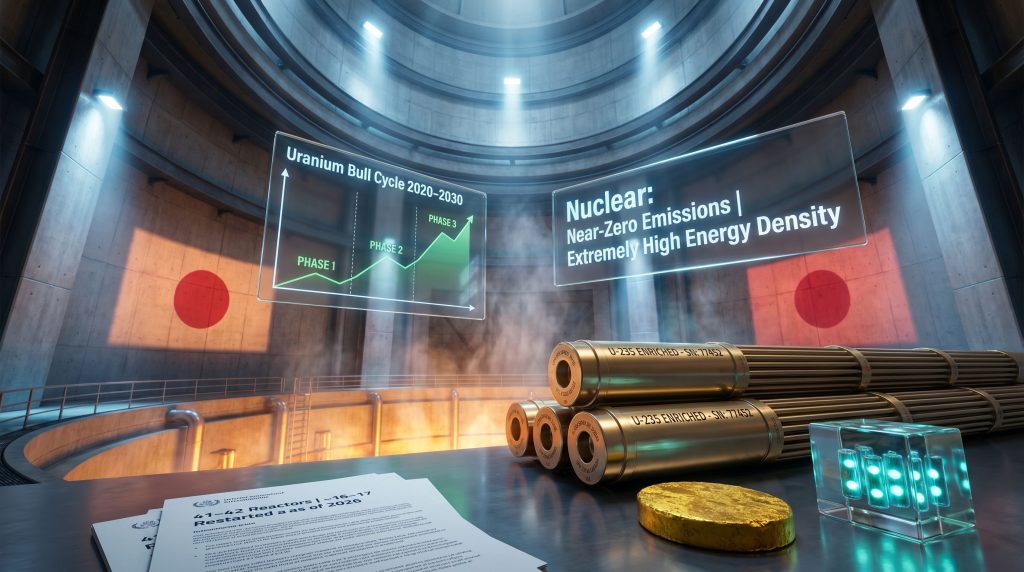
The Japanese reactor restart programme represents one of the most concrete near-term demand drivers in the uranium market. Japan operates between 41 and 42 reactors in total. As of 2026, approximately 16 to 17 have been restarted. Rule's assessment points toward a trajectory in which roughly 40 of those reactors return to service, excluding the small subset that face genuine seismic constraints.
The demand implications are substantial, but the most important dynamic is frequently overlooked by standard supply-demand modelling. Uranium inventories held by Japanese utilities were previously categorised as surplus available for market sale. As those reactors return to service, the same physical inventory is reclassified from surplus to operational fuel reserve. A source of secondary supply effectively disappears from the market precisely as demand rises.
There is a second, more subtle layer. A meaningful portion of the uranium supply that reached the market over the preceding two to three years from Japanese sources arrived via lease arrangements rather than outright sales. Leased uranium must be repaid in physical uranium. This means a significant volume of future demand has already been pre-committed in arrangements largely invisible to conventional market analysis. The embedded demand floor this creates is a genuine structural factor that standard inventory calculations fail to capture.
Key Japanese Market Statistics at a Glance
| Metric | Data Point |
|---|---|
| Japan's total reactor fleet | 41 to 42 reactors |
| Reactors restarted as of 2026 | Approximately 16 to 17 |
| Projected near-term restarts | Up to 40 of 41 to 42 |
| Strategic fuel storage potential | Up to 5 years of national supply |
| Uranium fuel cost as share of plant operating costs | Low single-digit percentage |
The next major ASX story will hit our subscribers first
The Supply Side: Why New Mines Cannot Respond Quickly
The supply response to higher uranium prices is structurally constrained in ways that distinguish the uranium market from most commodities. New mine development in the uranium sector carries lead times of between seven and fifteen years from discovery to production. This means that decisions made, or not made, during the period of low uranium prices in the 2010s have already determined the supply landscape through much of the 2030s.
Compounding this is the broader inflation in mining capital costs. At industry gatherings in London in late 2025, major copper producers disclosed that capital cost inflation for building new mines had been running at between 8 and 12 percent compounded annually. This dynamic applies across the resource sector and directly raises the long-run uranium price required to incentivise new supply. Paradoxically, this is constructive for established producers whose sunk capital costs were incurred at lower price levels.
The full-cycle cost problem is central to the Rick Rule uranium investment thesis. If the prevailing uranium price does not cover the full cost of bringing new supply to market, no rational capital allocator will build new mines. Consequently, the market must either accept a structural deficit or allow prices to rise to levels that incentivise construction. Given the lead times involved, even a price signal today would not translate into material new supply for most of a decade.
The Investment Spectrum: Matching Exposure to Risk Tolerance
Accessing uranium exposure is not a single decision but a spectrum of choices, each carrying distinct risk and return characteristics. Understanding the broader dynamics of uranium supply-demand volatility is essential before selecting a position. Rule's framework for thinking about this is instructive:
Tier 1: Low-Complexity, Institutional-Grade Exposure
- Major uranium producers such as Cameco offer direct commodity leverage with institutional-grade balance sheets and liquidity.
- Physical uranium trusts, such as the Sprott Physical Uranium Trust, provide commodity price exposure without operational or management risk.
- Appropriate for investors unwilling or unable to conduct deep sector due diligence.
Tier 2: Producer and Developer Equities
- Mid-tier and emerging producers offer leverage to both uranium prices and operational execution quality.
- Require analysis of jurisdiction risk, resource scale, permitting status, and management track record.
- Higher volatility profile, but potential for returns that exceed commodity price appreciation.
Tier 3: Exploration and Early-Stage Development
- Suitable only for investors with deep sector knowledge and genuine high-risk tolerance.
- Requires assessment of geological merit, capital structure efficiency, and management credibility.
- Capable of multi-fold returns in a favourable scenario, but equally capable of total capital loss.
A critical investment principle drawn from decades of resource investing applies here: everything that can go wrong with a small mining project can also go wrong with a large one. For investors willing to absorb development-stage risk, the potential upside must be proportionate. Size of the underlying resource base matters as a screening criterion, not an afterthought.
Market Phase Analysis: Where Are We in the Uranium Cycle?
Understanding the current position within the broader uranium investment cycle is essential for calibrating expectations and position sizing. Exploring well-considered uranium investment strategies can help investors align their approach with the current market phase.
| Market Phase | Sentiment | Risk/Reward Profile | Primary Driver |
|---|---|---|---|
| Pre-2020 (Hated) | Deeply Negative | Extreme Upside Potential | Contrarian Re-rating |
| 2020 to 2023 (Discovery) | Improving | High Upside, Elevated Risk | Supply Squeeze Awareness |
| 2024 to 2026 (Mainstream) | Broadly Positive | Moderate Upside, Lower Risk | Structural Demand Confirmation |
| 2027 to 2030 (Projected) | Institutionally Accepted | Investment-Grade Returns | Long-Term Contracting Cycle |
The uranium thesis has migrated from fringe contrarian territory to broadly accepted institutional narrative. This transition has meaningful implications. The magnitude of potential re-rating from sentiment alone has diminished substantially. The next phase of uranium price appreciation is more likely to be driven by the grinding mechanics of supply-demand imbalance than by any sudden awakening of market perception.
As the nuclear bull case becomes more widely understood, the character of the investment changes. What was once a bet on a hated asset re-rating to fair value becomes a structural position in a commodity with a durable supply deficit and rising demand. Both can generate returns, but they require different patience thresholds.
The Macro Backdrop: Sovereign Debt, Interest Rates, and Energy Policy
The broader macroeconomic environment adds a further dimension to the uranium thesis. Western governments carrying structurally elevated debt burdens have a powerful incentive to prioritise energy sources that reduce import dependency and constrain long-term fiscal exposure to energy price volatility. Nuclear power's long operational life, low fuel import requirements, and predictable cost profile make it politically attractive in a high-debt, high-interest-rate environment.
The interest rate trajectory also affects the economics of uranium mine development directly. Higher capital costs raise the hurdle rate for new projects, further extending the timeline before new supply can reach the market. For existing producers already in operation, this dynamic is broadly constructive. However, for junior developers seeking project financing, it represents a genuine headwind that requires attention in any investment analysis.
The 10-Year Outlook: Three Scenarios
The uranium investment thesis does not depend on an optimistic scenario to generate returns. Even a base case of gradual nuclear expansion, driven by energy security mandates and decarbonisation policy, implies a sustained period of supply tightness that should support uranium prices well above current full-cycle production costs.
Scenario 1: Accelerated Nuclear Adoption (Bull Case)
New reactor builds accelerate across Asia, Europe, and North America. AI data centre demand creates additional baseload urgency. Japanese restarts complete ahead of schedule. Uranium prices rise to levels that incentivise new mine development, but supply response lags by seven or more years. Existing producers generate exceptional returns throughout the supply gap.
Scenario 2: Steady Structural Growth (Base Case)
Japanese restarts proceed on the current trajectory. Long-term contracting absorbs available supply, with spot versus term pricing dynamics playing a key role in shaping producer revenues. Mine development proceeds slowly at incentive prices. Uranium delivers investment-grade returns over a seven to ten year horizon without requiring an extraordinary price spike.
Scenario 3: Policy Reversal or Technology Disruption (Bear Case)
A significant nuclear incident triggers political reversal in key markets. Fusion energy achieves commercial viability ahead of projections, or direct energy storage technology resolves the intermittency problem at scale. Supply deficits fail to materialise. The thesis underperforms, though existing reactor operating costs remain low enough to sustain continued operation.
Lessons From the Best Resource Investors That Apply to Uranium
The principles that have guided the most successful multi-decade resource investors carry direct relevance to how uranium exposure should be approached. Rick Rule's outlook on natural resources provides further context for applying these principles across the commodity sector. Several lessons stand out:
- Political risk is not inherently disqualifying. The question is always whether the price paid reflects that risk appropriately. Jurisdictions that others avoid can offer superior returns precisely because of the perception discount.
- Scale is a strategic objective in itself. Larger companies attract passive capital flows, benefit from index inclusion, and command valuation premiums that compound over time.
- Contrarian discipline generates the most durable returns. Buying assets that markets despise and holding through the recovery cycle is the mechanism by which the greatest resource fortunes have been built.
- Corporate culture is a financial asset. Companies with low employee turnover, strong community relationships, and reputations for integrity operate at lower costs, face fewer regulatory obstacles, and secure preferential access to acquisition targets.
Frequently Asked Questions: Rick Rule Uranium Investment Thesis
Is uranium still a good investment in 2026?
The structural case for uranium remains intact. The easy money from the initial re-rating has been captured, but the supply-demand imbalance and long mine development timelines support a multi-year period of elevated prices. Furthermore, analysis of the uranium case for a breakout suggests the thesis has shifted from speculative to investment-grade in character.
What is the difference between investing in uranium producers versus physical uranium?
Physical uranium trusts provide direct commodity price exposure without operational risk. Producer equities offer leverage to both the commodity price and the quality of management and asset execution, with correspondingly higher volatility and potential return.
How does nuclear power compare to renewables as a long-term energy investment?
Nuclear provides baseload reliability that intermittent renewables cannot match. The two are complementary rather than competitive in a well-designed grid, but nuclear's dispatchability and energy density give it structural advantages for industrial-scale, continuous power demand.
What risks could derail the uranium bull case?
A major nuclear incident triggering political reversal, breakthrough energy storage technology resolving renewable intermittency at scale, or faster-than-expected new mine development are the primary risk factors. None appear imminent, but all warrant monitoring.
What role do Japanese reactor restarts play in uranium demand?
Restarts convert existing inventory from surplus-for-sale to operational fuel reserve, removing secondary supply from the market while simultaneously increasing demand. The lease repayment obligations embedded in recent supply arrangements create an additional hidden demand floor.
Why does energy density matter when evaluating uranium as a strategic commodity?
Energy density determines the physical and logistical feasibility of strategic fuel stockpiling. Japan's ability to maintain a five-year national power reserve in a single facility is a direct consequence of uranium's extraordinary energy density, a strategic buffer no fossil fuel can replicate.
This article is intended for informational and educational purposes only. It does not constitute financial advice, a recommendation to buy or sell any security, or a solicitation to invest. All investment decisions carry risk, including the potential loss of capital. Past performance of any commodity, sector, or investment strategy is not indicative of future results. Readers should conduct their own due diligence and consult with a qualified financial adviser before making any investment decisions. Forecasts, scenarios, and projections discussed in this article are speculative in nature and subject to material uncertainty.
Want To Be First When the Next Major Uranium Discovery Hits the ASX?
Discovery Alert's proprietary Discovery IQ model delivers real-time alerts on significant ASX mineral discoveries, instantly cutting through complex data to surface actionable opportunities the moment they're announced — explore historic examples of what major discoveries can return and begin your 14-day free trial to position yourself ahead of the market.