May 22, 2026
Why Geopolitical Risk Destroys Mining Value Faster Than Any Commodity Downturn
Most investors in the mining sector spend their analytical energy on commodity price cycles, grade reconciliation, and capital cost overruns. These are legitimate concerns. But history consistently demonstrates that the fastest and most irreversible destruction of mining company value does not come from falling metal prices or failed metallurgy. It comes from political decisions made thousands of kilometres away from the orebody itself.
The collapse in shareholder value at companies exposed to sanctioned or contested jurisdictions tends to be sudden, asymmetric, and deeply resistant to recovery through operational improvement alone. No increase in throughput or reduction in unit costs can offset an executive order that makes it functionally illegal to conduct business. This is the structural vulnerability at the heart of the Sherritt International Cuba sanctions crisis, and it carries lessons that extend far beyond a single Canadian mining company.
When big ASX news breaks, our subscribers know first
A Century of Operations, Undone in a Single Month
Founded in 1927 and named after Carl Sherritt, a trapper who identified copper prospects in what is now Manitoba, the company spent its first six decades as a conventional Canadian base metals refiner. Its transformation into a Cuba-focused nickel and cobalt producer began in the early 1990s, driven by then-CEO Ian Delaney following a proxy contest that gave him control of the board in 1990.
Delaney negotiated an arrangement with the Cuban government in 1991 whereby the Cuban state would supply unprocessed nickel from the Moa mine in eastern Cuba to feed Sherritt's refinery in Fort Saskatchewan, Alberta. That relationship was formalised into a joint venture in 1994, giving Sherritt a 50% stake in the Moa nickel-cobalt operation alongside Cuba's state mining enterprise.
The logic was commercially sound at the time. Sherritt had the refining infrastructure; Cuba had the ore. The Fort Saskatchewan facility remains one of only a handful of nickel processing operations in all of North America, a fact that has grown considerably more significant as governments across the Western world race to build critical minerals strategy independent of Chinese refining dominance.
Beyond nickel and cobalt, Sherritt expanded into Cuban power generation through an approximately one-third interest in Energas S.A., a Cuban electricity producer, as well as involvement in oil and gas exploration on the island. The result was a business model with deep operational integration into a single sovereign territory that was simultaneously subject to escalating US legal pressure.
The Asset Concentration Problem
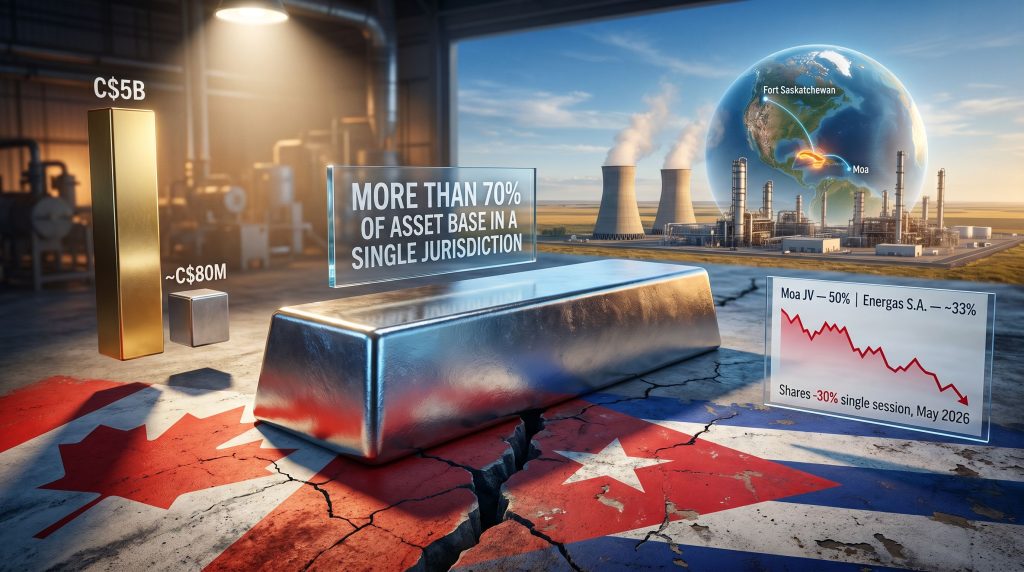
By the time Sherritt reached its peak market capitalisation of approximately C$5 billion (roughly US$3.6 billion) in 2008, with shares trading as high as C$18, Cuba accounted for the overwhelming majority of the company's earning capacity. That concentration was not a temporary transitional state. It was the permanent architecture of the business.
| Asset | Sherritt's Interest | Sector |
|---|---|---|
| Moa Joint Venture (Cuba) | 50% | Nickel and Cobalt Mining |
| Energas S.A. | ~33% | Electricity Generation |
| Fort Saskatchewan Refinery (Alberta) | Majority | Nickel Processing |
Today, Cuba accounts for more than 70% of Sherritt's total asset base on a book value basis. That figure alone explains why the May 2026 sanctions expansion proved so immediately destabilising.
How the Balance Sheet Was Destroyed Before the Sanctions Arrived
Understanding the Sherritt International Cuba sanctions crisis requires understanding the financial fragility that preceded it. The company did not enter 2026 from a position of strength. It arrived there already weakened by a sequence of strategic missteps that unfolded over more than a decade.
At the height of its Cuba-driven success, Sherritt made an aggressive bet on a nickel project in Madagascar. That decision proved catastrophic. Total debt climbed to nearly C$2.5 billion at its peak in 2013, and a prolonged global nickel price slump left the company cycling through periods of near-insolvency. Assets including the Canadian coal division were sold off to fund debt service. The Madagascar venture was eventually written off entirely.
Jeffrey Gavarkovs, managing partner at Northstream Capital, has noted publicly that Sherritt had meaningful opportunities to eliminate its debt obligations entirely but failed to do so. According to Gavarkovs, the combination of its Cuba concentration and an overly heavy debt structure proved ultimately fatal to the company's long-term financial resilience.
The governance record during this period compounded the operational problems. Furthermore, these management red flags were visible well before the sanctions crisis materialised:
- Board directors were reported to have prioritised vesting of cash-settled stock options over mandatory interest payments owed to unsecured noteholders under debt covenants
- More than C$100 million was committed to a higher-risk offshore oil well exploration program that was ultimately written off as uneconomic
- Millions were spent over several years defending against multiple activist investor campaigns, diverting management attention and cash
- Corporate overhead remained structured for a diversified multinational rather than what had effectively become a single-asset operation
In 2025, investment firm Pala Assets Holdings succeeded in its activist campaign, resulting in the resignation of CEO Leon Binedell and a significant restructuring of the board. Interim CEO Peter Hancock, a former Glencore engineer with commodities trading experience, stepped into the role in December 2025.
The Mechanics of the Sanctions Expansion and Its Immediate Impact
The trigger event for the current crisis was the Trump administration's expansion of Cuba-targeted sanctions on May 1, 2026. The executive order extended restrictions across the metals and mining, energy, defence, financial services, and security sectors. According to Reuters, Sherritt described the order as materially altering the company's ability to participate in its Cuban joint ventures in any normal operational capacity.
The market reaction was immediate. Sherritt shares fell as much as 30% in a single trading session, a decline that reflected investor recognition that the company's dominant asset had been effectively placed beyond reach by regulatory fiat.
The Sherritt International Cuba sanctions situation did not emerge from a vacuum. It followed a sequence of escalating pressure:
- A worsening fuel shortage in Cuba caused by US restrictions on Venezuelan fuel exports to the island, which disrupted mining operations at Moa beginning in February 2026
- A public announcement in late March 2026 that Sherritt was seeking an emergency cash injection of up to C$50 million to sustain Moa operations
- The May 1 executive order triggering an initial announcement that Sherritt would dissolve its Cuban joint venture stakes entirely
- A rapid reversal of that decision within days, after an unexpected approach from a US-connected investor
The Helms-Burton Act, passed by the US Congress in 1996, had created the original legal architecture targeting companies operating in Cuba using nationalised assets. Sherritt executives had been among the first individuals formally barred from entering the United States under that legislation. The 2026 sanctions expansion represented a significant escalation of that three-decade pressure campaign.
The Venezuela Connection: A Warning Signal That Preceded the Crisis
When US forces captured Venezuelan leader Nicolas Maduro in January 2026, investors paying close attention began drawing a geopolitical trajectory. The pattern suggested Cuba could be next. In Venezuela's case, diversified energy companies including Chevron Corp. were positioned to benefit from the resulting political opening due to their pre-existing asset diversification.
Sherritt had no comparable buffer. Its single-jurisdiction concentration meant that the same political logic that created opportunity for diversified multinationals in Venezuela created only existential risk for Sherritt in Cuba. Consequently, this episode reinforces how geopolitical risk in mining can reshape an entire company's prospects within weeks.
The Gillon Capital Proposal: Rescue or Repositioning?
The sequence of events leading to the Gillon Capital term sheet carries its own significance. On a Canadian public holiday in May 2026, interim CEO Peter Hancock was at his home in Halifax when Ray Washburne called with an unsolicited acquisition proposal. Washburne is a Dallas-based real estate executive who was appointed by President Trump in 2017 to lead the Overseas Private Investment Corporation (OPIC), the US government's development finance body.
His family office, Gillon Capital LLC, subsequently signed a non-binding preliminary agreement that would give the firm a controlling stake in Sherritt International. Hancock acknowledged the approach was entirely unanticipated. He has stated publicly that Sherritt found itself as collateral damage in a broader US foreign policy objective, and that the Gillon proposal succeeded because a US-connected party was able to make a case directly to the State Department on Sherritt's behalf.
The US State Department confirmed it had no objections to the discussions proceeding. That confirmation is commercially significant: it suggests the proposed transfer of control to a US-aligned entity may function as a mechanism for extracting Sherritt's assets from the sanctions environment.
The Gillon proposal may represent a template for how politically connected US capital positions itself to benefit from potential future normalisation of US-Cuba relations, acquiring distressed assets at depressed valuations before any diplomatic thaw restores their underlying value.
Former Canadian ambassador to Venezuela Ben Rowswell has publicly characterised this dynamic as consistent with what has been described as the Donroe Doctrine: a contemporary application of historical US hemispheric dominance strategy using economic and extractive leverage rather than direct political intervention. Rowswell, now a consultant with strategic advisory firm Catalyze4, has described the broader pattern as one in which the US functions as an extractive force using its geopolitical weight over regional economies.
Risks That Remain Even With a Deal in Place
The non-binding nature of the Gillon term sheet leaves substantial uncertainty unresolved. The operational clock continues to run:
- Fort Saskatchewan refinery inventory of Cuban feedstock is expected to be exhausted around mid-June 2026 without resumed Cuban supply
- Three board members have resigned, leaving only two directors including Hancock
- The company's CFO and external auditor both departed in May 2026
- Sherritt now trades as a penny stock with a market capitalisation of approximately C$80 million, representing a decline of roughly 98% from its 2008 peak
- Sourcing critical operational inputs including fuel and sulfur for resumed operations remains unresolved
Canada's Critical Minerals Policy Creates a Secondary Obstacle
Even if the commercial terms of the Gillon transaction are agreed, a significant regulatory hurdle exists at the Canadian federal level. In 2024, the Canadian government introduced a more stringent policy framework making it materially more difficult for foreign entities to acquire control of Canadian critical minerals assets.
The Fort Saskatchewan nickel refinery is precisely the type of asset this framework was designed to protect. As one of only a small number of nickel processing facilities in North America, it carries genuine strategic significance to Canadian industrial sovereignty at a moment when Western governments are competing aggressively to build domestic critical minerals demand processing capacity.
Ben Rowswell has suggested that Prime Minister Mark Carney's government may be reluctant to block the Gillon deal in order to avoid complicating ongoing Canada-US free trade agreement renewal negotiations. This creates a direct tension between industrial policy objectives and diplomatic pragmatism. Canada's industry department has stated publicly that it welcomes foreign investment benefiting the Canadian economy but declined to comment on the specific Sherritt transaction.
The next major ASX story will hit our subscribers first
What This Means for Critical Minerals Investors
The Sherritt International Cuba sanctions crisis functions as a stress test for a set of investment assumptions that are widely held but rarely interrogated until they fail. The core lesson is structural: geopolitical risk in single-jurisdiction mining companies is systematically underpriced by conventional valuation models that focus on commodity price sensitivity and operational metrics.
| Risk Factor | Sherritt (Cuba) | Diversified Multinational |
|---|---|---|
| Geopolitical concentration | Extreme (70%+ in one jurisdiction) | Low to moderate |
| Sanctions exposure | Direct US target | Managed through diversification |
| Supply chain resilience | Fragile, single feedstock source | Multiple supply pathways |
| Regulatory arbitrage capacity | Minimal | Substantial |
| Recovery pathway | Dependent on political normalisation | Multiple independent levers |
Trafigura, the Singapore-based commodities trading firm, operates a lead-and-zinc mining joint ventures and asset sales arrangement in Cuba alongside the Cuban state. However, Trafigura's Cuba exposure represents a fraction of its global business. The company has stated it complies with all applicable sanctions and maintains dialogue with relevant authorities. The contrast between Trafigura's position and Sherritt's is not geological or operational. It is structural: one company built a business around Cuba, and the other built a business that happens to include Cuba.
For investors evaluating single-jurisdiction critical minerals companies, the Sherritt case suggests several analytical disciplines worth applying:
- Apply a geopolitical risk premium to discount rates for companies with more than 40-50% of assets in a single politically sensitive jurisdiction
- Assess whether the company's debt structure provides sufficient buffer to survive a sudden reduction in operating cash flow from a political event
- Examine board governance with specific attention to whether management incentives are aligned with long-term creditor and shareholder interests
- Consider the availability of alternative supply routes and feedstock sources when evaluating processing operations that depend on a single origin
Key Indicators to Monitor
| Indicator | Current Status | Threshold to Watch |
|---|---|---|
| Sherritt market capitalisation | ~C$80 million | Recovery above C$200M suggests deal confidence |
| Fort Saskatchewan inventory | Expires ~mid-June 2026 | Any resumption of Cuban supply |
| Gillon deal progression | Non-binding term sheet only | Binding agreement and regulatory clearance |
| US-Cuba diplomatic signals | Escalating (charges against Raúl Castro) | Any State Department de-escalation language |
| Canadian regulatory review | Pending | Investment Canada Act determination |
The broader implication reaches beyond Sherritt. As US foreign policy increasingly functions as an instrument of critical minerals strategy, the boundary between commercial mining investment and geopolitical positioning is becoming harder to locate. Reporting from The Globe and Mail highlights how companies, creditors, and investors operating in politically contested jurisdictions need analytical frameworks that treat geopolitical risk not as a tail risk to be footnoted, but as a primary variable to be priced.
Disclaimer: This article contains forward-looking statements and analytical commentary based on publicly available information as of May 2026. It does not constitute financial advice. Investors should conduct their own due diligence before making investment decisions. The Gillon Capital transaction remains subject to negotiation, regulatory review, and binding agreement. Outcomes discussed are speculative and subject to material change.
Want To Identify ASX Mineral Discoveries Before the Broader Market Does?
Discovery Alert's proprietary Discovery IQ model delivers real-time alerts on significant ASX mineral discoveries, cutting through complex data to surface actionable investment opportunities the moment they are announced — explore historic discovery returns to understand the scale of what early positioning can mean, and begin your 14-day free trial today to gain a structural edge over the market.