
June 20, 2026
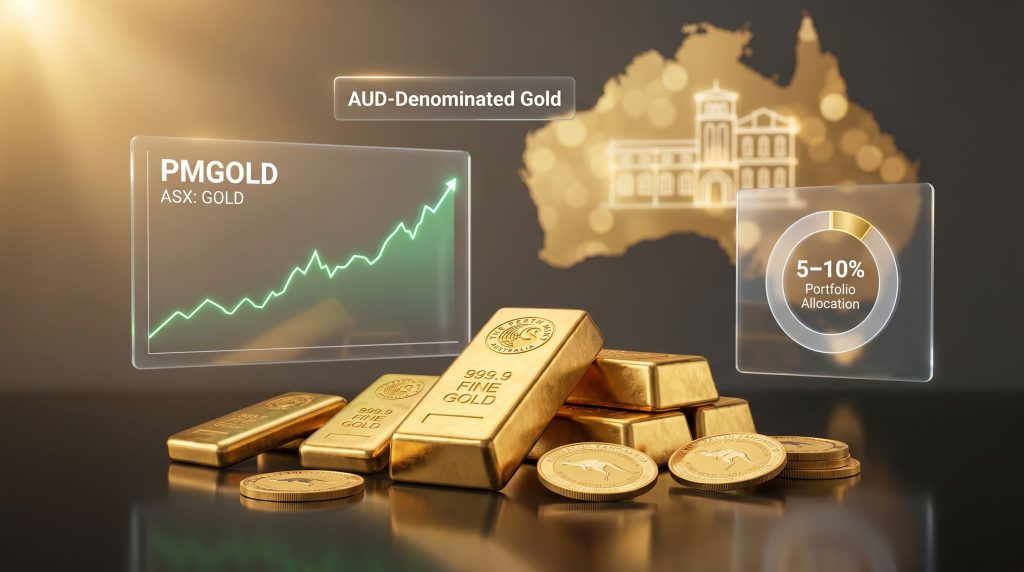
Why Australian Investors Think Differently About Gold
Few asset classes generate as much debate among portfolio strategists as gold. In periods of economic calm, it is frequently dismissed as a relic with no yield and limited upside. Yet when financial systems wobble, gold consistently reasserts its relevance in ways that few other assets can replicate. For Australian investors specifically, knowing how to buy and invest in gold in Australia extends beyond the universal store-of-value argument. It involves a unique interaction between domestic currency dynamics, local production dominance, and a tax framework that, when navigated correctly, can meaningfully enhance net returns.
Understanding why gold behaves the way it does, and how to access it efficiently, requires moving beyond the surface-level narrative of gold as a safe haven. The mechanics matter enormously, and so do the costs, the tax treatment, and the portfolio construction logic underlying any allocation decision.
When big ASX news breaks, our subscribers know first
What Makes Gold Genuinely Different as an Asset Class
The Physical Properties That Underpin Its Financial Role
Gold's investment case is not arbitrary. It is grounded in physical chemistry. Gold is one of the least reactive elements on earth, resistant to oxidation, corrosion, and chemical degradation under almost all naturally occurring conditions. This electrochemical stability means that a bar of gold buried for a thousand years emerges chemically identical to when it was interred. No other commonly traded commodity shares this property at scale.
Combined with its finite terrestrial supply, this permanence creates a natural scarcity premium that fiat currencies cannot replicate. Ancient societies recognised this when they standardised gold as coinage precisely because it retained its mass and integrity over time, unlike organic commodities or base metals that corrode or degrade.
The Australian Dollar Effect: A Hidden Amplifier
One feature of gold investing that is less discussed but critically important for local investors is the currency amplification mechanism. Because gold is priced globally in US dollars, any weakening of the Australian dollar against the USD directly inflates the AUD-denominated gold price, even if the USD gold price remains flat.
During genuine risk-off market events, Australian investors often benefit from a dual tailwind: rising USD gold prices and a depreciating AUD. Both forces simultaneously push the local gold price higher, creating a compounding return effect that investors in USD-denominated markets do not experience in the same way.
This dynamic was evident during the 2020 pandemic shock, when the AUD fell sharply against the USD in March 2020 while gold simultaneously rallied. Australian investors holding gold exposure received a significantly amplified return compared to their American counterparts holding the same underlying asset.
Australia's position as one of the world's largest gold producers adds another dimension to domestic gold investing. Furthermore, the country hosts major producing operations and a deep ecosystem of gold mining stocks on the ASX, giving local investors access to a breadth of gold-related investment structures that most markets cannot match.
The Four Pathways to Gold Exposure in Australia
Before diving into execution mechanics, it is worth mapping the full landscape of available approaches. Each pathway carries a distinct risk profile, cost structure, and degree of exposure to the underlying gold price.
| Investment Method | Price Exposure | Storage Burden | Liquidity | Primary Cost Layer |
|---|---|---|---|---|
| Physical Bullion | Direct | Yes | Medium | Dealer premium, storage, insurance |
| ASX-Listed Gold ETFs | Direct (price-linked) | No | High | Management expense ratio (MER) |
| Gold Mining Equities | Indirect (leveraged) | No | High | Brokerage, company-specific risk |
| CFDs and Derivatives | Speculative (leveraged) | No | Very High | Spread, overnight financing charges |
Each approach suits a different investor profile, and in many cases, a combination of methods serves portfolio goals better than any single pathway alone.
How to Buy Physical Gold Bullion in Australia
Understanding the Market Before You Buy
Physical gold investment in Australia is anchored by the Perth Mint, the country's sovereign gold refiner, which has operated under the guarantee of the Western Australian Government. The Mint produces a range of investment-grade bullion products that meet international purity standards, including the Australian Kangaroo coin series and various cast and minted bar formats.
For a gold product to qualify as investment-grade under Australian tax law and receive GST-free treatment, it must meet a minimum purity threshold of .995 fineness (99.5% pure gold). This distinction matters enormously for buyers, as products falling below this threshold, including most jewellery and many numismatic collector coins, are subject to GST and do not qualify for the same tax treatment.
A point that many first-time buyers overlook is the critical difference between numismatic value and intrinsic value. A rare coin may command a substantial premium above its melt value because of its rarity, age, or historical significance. For investment purposes, however, this premium is largely irrelevant because it cannot be reliably recovered at the time of sale. Investors focused on gold exposure should concentrate on products priced as close as possible to the prevailing spot price.
Step-by-Step: Buying Physical Gold in Australia
-
Verify dealer credentials – Confirm the dealer is an authorised distributor of Perth Mint products or carries London Bullion Market Association (LBMA)-certified inventory. This certification provides assurance of product authenticity and quality standards.
-
Check the live AUD spot price – The Perth Mint publishes real-time pricing in Australian dollars. Cross-reference this with international spot feeds to ensure the conversion is current.
-
Calculate the full dealer premium – The premium above spot price varies significantly by product type. Smaller coins typically carry premiums of 4–8% above spot, while larger cast bars attract lower premiums per gram, sometimes as little as 1–2% for kilogram bars.
-
Select the right product format – Larger bars minimise per-gram premiums but reduce divisibility. If you anticipate needing to sell portions of your holding over time, coins or smaller bars provide greater flexibility.
-
Arrange secure storage – Options range from home safes to bank safe deposit boxes to professional vault services operated by bullion dealers and the Perth Mint's Depository programme.
-
Obtain appropriate insurance – Standard home and contents policies frequently exclude or cap coverage for bullion. Specialist precious metals insurance is often necessary and typically costs between 0.1% and 0.2% of the insured value annually.
The Hidden Cost Stack That Erodes Returns
Physical gold ownership carries a cumulative cost burden that is easy to underestimate. The dealer buy-sell spread, the difference between the price at which you purchase and the price at which you can sell back, typically ranges from 1% to 5% depending on product type and volume. Add annual vault storage fees of approximately 0.1% to 0.5% of asset value, plus insurance premiums, and the total annual holding cost can meaningfully compress returns, particularly for shorter holding periods.
This cost structure makes physical bullion most appropriate for investors with a genuine long-term holding horizon, where the cumulative annual costs are amortised over many years of appreciation.
How to Invest in Gold ETFs on the ASX
How Physically-Backed Gold ETFs Actually Work
A gold ETF is a managed fund listed on the ASX whose value tracks the price of gold. The most important structural distinction for investors is whether an ETF holds allocated or unallocated gold. In an allocated structure, the fund holds specific, identifiable gold bars assigned exclusively to the fund. In an unallocated structure, the investor holds a claim against a pool of gold held by a custodian bank, which introduces a degree of counterparty risk.
Physically-backed ETFs maintain their price alignment with spot gold through a mechanism involving authorised participants, typically large institutional trading firms, who can create or redeem large blocks of ETF units in exchange for physical gold. This arbitrage mechanism keeps the ETF's market price closely aligned with its underlying net asset value. For investors comparing physical gold vs ETFs, understanding this structural difference is an important first step.
ASX-Listed Gold ETF Options Compared
| ETF Name | ASX Code | Backing | Currency Hedging | Key Consideration |
|---|---|---|---|---|
| ETFS Physical Gold | GOLD | Allocated physical gold | Unhedged (USD exposure retained) | Long-established, internationally custodied |
| Perth Mint Gold | PMGOLD | WA Government-backed gold | AUD-denominated | Redeemable for physical gold |
| BetaShares Gold Bullion ETF | QAU | Physical gold | AUD-hedged | Removes currency movement from returns |
| VanEck Gold Miners ETF | GDX | Gold mining equities globally | Unhedged | Equity exposure, not direct gold price |
| BetaShares Global Gold Miners ETF | MNRS | Gold mining equities globally | AUD-hedged | Hedged miner equity exposure |
Always verify current MER figures and fund structures directly in the relevant Product Disclosure Statement before investing, as these details can change over time.
The Currency Hedging Decision
Whether to hold a hedged or unhedged gold ETF depends on how the investor wants to position relative to AUD/USD movements. An unhedged ETF like GOLD preserves the currency amplification benefit described earlier, meaning AUD weakness boosts returns. A hedged ETF like QAU, however, removes this variable, providing purer exposure to the USD gold price without currency noise.
Neither approach is universally superior. During periods when the AUD strengthens, hedged ETFs outperform. During periods of AUD weakness, which historically coincide with risk-off environments where gold also rises, unhedged ETFs can deliver substantially higher AUD-denominated returns. For most long-term investors, the unhedged structure aligns better with gold's role as a portfolio hedge, since AUD weakness typically occurs precisely when gold is most needed.
Step-by-Step: Buying a Gold ETF Through an ASX Broker
- Open an account with an ASIC-regulated brokerage platform.
- Complete identity verification as required under Anti-Money Laundering and Know Your Customer obligations.
- Fund your account via bank transfer.
- Locate the ETF by ASX code (such as PMGOLD, GOLD, or QAU). VanEck's gold investing resources can also help familiarise you with available options.
- Read the Product Disclosure Statement carefully, noting the MER, custodian details, and any redemption conditions.
- Place your order using either a market order for immediate execution or a limit order if you want to specify your entry price.
- Monitor during ASX trading hours (10:00am to 4:00pm AEST), when ETF prices update in real time.
Investing in ASX Gold Mining Companies
Operating Leverage: The Double-Edged Mechanism
Gold mining equities do not move in lockstep with the gold price. They amplify it. Because mining operations carry largely fixed cost bases, including labour, energy, and maintenance, a relatively modest improvement in the gold price can translate into a disproportionately large increase in operating profit. This relationship, however, works in reverse with equal force: a gold price decline squeezes margins from the top line while fixed costs remain constant.
The key metric for evaluating a miner's cost position is the All-In Sustaining Cost (AISC), which captures the full cost of maintaining production including capital expenditure required to sustain current output levels. A miner with an AISC of $1,800 AUD per ounce operating in a $3,200 AUD per ounce gold price environment is generating substantial margin. Compress the gold price toward the AISC, and that margin disappears rapidly.
The Risk Spectrum Within Gold Mining Equities
| Company Stage | Risk Level | Leverage Profile | Primary Risk Factor |
|---|---|---|---|
| Major ASX producers | Medium | Moderate-High | Operational disruption, cost escalation |
| Mid-tier developers | High | High | Permitting timelines, capital requirements |
| Exploration companies | Very High | Speculative | No guarantee of commercially viable discovery |
Junior exploration companies represent the most speculative segment of the gold equity universe. The overwhelming majority of exploration-stage companies do not advance to production. Investors seeking reliable gold price exposure without accepting company-specific existential risk are generally better served by ETFs or established producer equities.
Diversified gold miner ETFs such as ASX: GDX and ASX: MNRS allow investors to access the operating leverage characteristic of mining equities while spreading company-specific risk across a basket of producers. GDX holds global gold mining equities without currency hedging, while MNRS provides similar exposure with the AUD/USD currency movement removed.
The next major ASX story will hit our subscribers first
Gold CFDs and Derivatives: For Advanced Participants Only
Gold Contracts for Difference allow investors to speculate on gold price movements without owning the underlying metal. Profit and loss are calculated on price movement alone, and positions can be held with leverage. Under ASIC's Product Intervention Order, retail Australian investors face a leverage cap of 20:1 on commodity CFDs, meaning a $5,000 deposit can control a $100,000 position.
The risks of this structure compound quickly. Overnight financing charges accumulate on leveraged positions held beyond a single trading session. ASIC has consistently found that the majority of retail clients trading leveraged derivative products lose money over time. Consequently, these instruments are designed for short-term active trading strategies and carry no place in a long-term wealth preservation framework.
Tax Treatment of Gold Investments in Australia
CGT and GST: What Australian Investors Need to Know
| Investment Type | CGT Applicable | 50% Discount Available (12+ months) | GST Applicable |
|---|---|---|---|
| Investment-grade bullion (.995+) | Yes | Yes | No |
| Gold ETFs | Yes | Yes | No |
| Gold mining shares | Yes | Yes | No |
| Gold CFDs | Yes (complex) | Generally No | No |
The Australian Taxation Office classifies investment-grade gold bullion as a capital gains tax asset. Individual investors who hold bullion for more than 12 months before disposal are eligible for the 50% CGT discount on any realised gain. This discount applies equally to gold ETF holdings.
Under the A New Tax System (Goods and Services Tax) Act 1999, the sale of precious metal meeting the .995 fineness threshold qualifies as input-taxed and is therefore GST-free. This applies to Perth Mint products and other LBMA-accredited gold. Jewellery and collector coins that do not meet the purity standard do not receive this treatment.
This is general information only and does not constitute tax advice. Investors should consult a registered tax agent for guidance specific to their circumstances.
Gold in a Diversified Australian Portfolio
Allocation Principles and Portfolio Construction Logic
Academic finance literature and practitioner consensus generally position gold as a defensive allocation within a diversified portfolio, typically representing somewhere between 5% and 10% of total holdings. At this weighting, gold functions as a portfolio stabiliser rather than a primary growth engine. It reduces drawdown severity during equity market corrections without sacrificing enough of the portfolio's growth potential to materially impair long-term compounding.
The distinction between a strategic gold allocation and a tactical one is worth understanding. A strategic allocation is rebalanced annually back to a fixed target weight, treating gold as a permanent portfolio component. A tactical allocation, in contrast, increases gold weighting during specific macroeconomic conditions, such as rising inflation expectations or elevated geopolitical tension, and reduces it when conditions normalise. Furthermore, central bank gold demand is a key macroeconomic signal that many tactical investors monitor closely when determining how to buy and invest in gold in Australia.
Illustrative scenario (not a forecast or guarantee of future returns):
An Australian investor holds a $100,000 portfolio (70% ASX equities, 30% bonds) during a period where the ASX 200 falls 25%, the AUD depreciates 10% against the USD, and the USD gold price rises 15%.
- Without gold: Equity component falls to approximately $52,500; bond component holds at $30,000; total approximately $82,500.
- With 10% gold allocation (replacing 10% equities): Equity component (60%) falls to approximately $55,500; bond component remains at $30,000; gold component (10%) rises to approximately $12,650 in AUD terms due to both the gold price increase and AUD depreciation amplification; total approximately $98,150.
This scenario is illustrative and does not represent guaranteed outcomes. Past performance is not indicative of future results.
Key Risks and Structural Limitations
Gold's genuine weaknesses deserve equal attention to its strengths:
- No income generation: Physical gold and gold ETFs produce zero yield. Returns depend entirely on capital appreciation, making gold unsuitable as an income-producing asset.
- Long-term equity underperformance: Over multi-decade timeframes, diversified equity indices have historically delivered superior total returns compared to gold on a risk-adjusted basis.
- Price volatility despite the safe-haven narrative: Gold experienced a decline of approximately 28% in USD terms between 2011 and 2015, demonstrating that the safe-haven label does not imply price stability at all times.
- Real interest rate sensitivity: When real interest rates rise, the opportunity cost of holding a non-yielding asset increases, creating headwinds for gold prices.
- USD cycle risk: Periods of sustained US dollar strength tend to suppress gold demand globally, creating a challenging environment for USD-priced gold.
Frequently Asked Questions
Can I hold gold in my SMSF?
Yes. Self-Managed Super Funds can hold physical gold bullion, gold ETFs, and gold mining shares, provided the investment aligns with the fund's documented investment strategy and satisfies the sole purpose test under the Superannuation Industry (Supervision) Act 1993. Physical gold held by an SMSF must be stored with an approved custodian and cannot be held personally by a fund trustee or member.
What is the minimum investment needed to buy gold in Australia?
Entry points vary considerably by method. Physical bullion coins can be purchased for as little as $50–$100 AUD from authorised dealers, while some brokerage platforms allow ETF purchases for as little as $1 AUD. Most major platforms set a minimum trade value of around $500 AUD for ASX-listed securities.
Is there GST on gold purchases in Australia?
Investment-grade gold bullion with purity of at least .995 (99.5%) is GST-free under Australian tax law. Gold jewellery, collector coins without the requisite purity, and gold-themed decorative items are subject to the standard 10% GST rate.
Building Your Gold Investment Strategy
Matching Method to Investor Profile
| Investor Profile | Recommended Approach | Rationale |
|---|---|---|
| New investor, limited capital | Gold ETF (PMGOLD or GOLD) | Low cost, ASX liquidity, no storage complexity |
| Long-term wealth preservation | Physical bullion combined with ETF | Tangible ownership plus accessible liquidity |
| Growth-oriented investor | Gold miner ETF (GDX or MNRS) | Operating leverage amplifies gold price upside |
| SMSF trustee | PMGOLD or approved physical custodian | Compliance-friendly, AUD-denominated |
| Active short-term trader | CFDs or futures (advanced only) | High risk, speculative instrument only |
Due Diligence Checklist Before Committing Capital
- Read the full Product Disclosure Statement for any ETF or managed product
- Confirmed dealer accreditation for any physical purchase
- Understood the complete cost structure including premiums, MERs, storage, brokerage, and insurance
- Assessed CGT implications based on your expected holding period and personal tax position
- Confirmed the gold allocation fits within your broader asset allocation framework (typically 5–10%)
- Sought guidance from a licensed financial adviser if uncertain about suitability for your circumstances
This article is intended for general informational purposes only and does not constitute financial, tax, or investment advice. All investment decisions carry risk, and past performance is not indicative of future results. Readers should seek personalised advice from a qualified financial adviser and registered tax agent before making any investment decisions.
Want to Capitalise on the Next Major ASX Gold Discovery Before the Broader Market?
Discovery Alert's proprietary Discovery IQ model scans ASX announcements in real time, instantly identifying significant mineral discoveries and turning complex data into actionable investment insights — explore the historic returns major discoveries have generated and begin a 14-day free trial to position yourself ahead of the market.