
May 11, 2026
When Gold Meets Critical Minerals: The Strategic Logic Behind Dual-Commodity Development
The global mining sector is experiencing a structural shift that goes beyond simple commodity cycles. For decades, investors evaluated gold projects purely on reserve grade, strip ratio, and cost per ounce. That framework still applies, but a new variable has entered the equation: the strategic classification of deposits that sit at the intersection of precious metals and critical minerals. Projects that can deliver both gold economics and rare earth optionality are attracting a different quality of attention from both capital markets and government agencies looking to rebuild domestic supply chains.
This convergence of investment logic is precisely why the completed Bankable Feasibility Study for the Dateline Colosseum gold and rare earths project has drawn such focused scrutiny. The study does not simply confirm that a gold mine can be built in California's San Bernardino County. It frames a project that generates compelling financial returns from gold production while sitting directly adjacent to geological systems associated with one of the most strategically significant rare earth deposits in the Western world.
Understanding the full significance of this BFS requires looking at the economics, the geology, the operational design, and the broader supply chain context together as an integrated picture rather than reviewing each in isolation.
When big ASX news breaks, our subscribers know first
Breaking Down the BFS Numbers: What the Economics Actually Signal
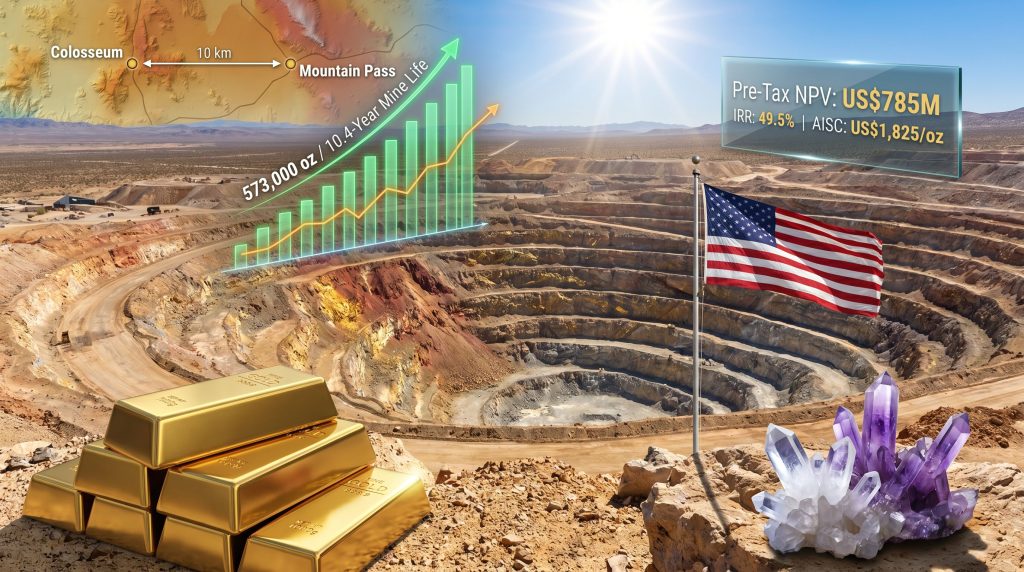
The headline figures from the Colosseum BFS are notable for both their scale and their resilience across different gold price scenarios. At a base case gold price of US$4,200 per ounce, the project generates an undiscounted pre-tax free cash flow of US$1.08 billion across its mine life, with a pre-tax net present value of US$785 million and an internal rate of return of 49.5%. When assessed at the spot price of US$4,700 per ounce at the time of the study's release, those figures strengthen to US$1.36 billion in undiscounted free cash flow, a US$999 million NPV, and a 59.5% IRR.
| Financial Metric | Base Case (US$4,200/oz Au) | Spot Price Case (US$4,700/oz Au) |
|---|---|---|
| Undiscounted Pre-Tax Free Cash Flow | US$1.08 billion | US$1.36 billion |
| Pre-Tax NPV | US$785 million | US$999 million |
| Pre-Tax IRR | 49.5% | 59.5% |
| Start-Up Capital | US$249 million | US$249 million |
| Contingency Allowance | US$25 million | US$25 million |
| AISC | US$1,825/oz | US$1,825/oz |
A 49.5% pre-tax IRR is an exceptional threshold in the context of mining project finance. Project lenders typically look for assets capable of servicing debt under conservative gold price assumptions while still generating meaningful equity returns. An IRR at this level suggests the project can absorb significant cost overruns or gold price softening and still remain commercially viable, which is precisely the risk buffer that debt financiers require before committing capital.
The all-in sustaining cost of US$1,825 per ounce is particularly significant in the current gold price outlook. With gold trading above US$4,600 per ounce at the time of the study's publication, the project's operating margin exceeds US$2,500 per ounce. That margin is not a rounding error. It represents a level of profitability that insulates the operation against input cost inflation, currency movements, and regulatory compliance expenditure while still delivering substantial free cash flow to project stakeholders.
Understanding Gold Price Sensitivity
One of the more instructive details embedded in the BFS is the gold price sensitivity calculation. For every US$100 per ounce movement in the gold price, the project's undiscounted pre-tax free cash flow shifts by approximately US$55 million. This linear relationship allows investors and financiers to stress test the economics across a range of scenarios without needing to reconstruct the full financial model.
"At the current operating margin of greater than US$2,500 per ounce, the Colosseum project represents a rare combination of high-return gold development economics and critical mineral optionality in a Tier 1 jurisdiction."
The start-up capital requirement of US$249 million, which includes US$16 million in capitalised mining costs and a separate US$25 million contingency provision, is relatively modest for a project generating pre-tax NPV approaching US$800 million. The implied capital efficiency ratio is highly favourable, meaning the project creates approximately US$3.15 of pre-tax NPV for every dollar of start-up capital deployed under base case assumptions.
This article is for informational purposes only and does not constitute financial or investment advice. Investors should conduct their own due diligence and seek independent financial counsel before making any investment decisions.
Operational Design: How the Mine Plan Delivers Consistent Gold Output
The production architecture underpinning the Colosseum BFS is built around a straightforward open-pit mining configuration that prioritises consistency and cost control across a 10.4-year mine life. The plan targets 75,000 ounces of gold per year on average across the first six years of operation, before reaching a peak of 102,000 ounces in Year 6 and then tapering through the remainder of the mine life. Total gold production across the full mine plan reaches 573,000 ounces.
Key operational parameters include:
- Total mine life: 10.4 years
- Average annual gold production (years 1-6): 75,000 ounces
- Peak annual gold sales: 102,000 ounces in Year 6
- Total gold production over mine life: 573,000 ounces
- Strip ratio: 3:1 (waste tonnes to ore tonnes)
- Inferred resources within pit shell not in reserve: 55,000 ounces
Why a 3:1 Strip Ratio Matters for Cost Efficiency
Strip ratio is one of the most important but least discussed metrics in open-pit mining economics. It measures the volume of waste material that must be moved for every tonne of ore extracted. A ratio of 3:1 is considered low in the industry, meaning the deposit has a favourable geometry that keeps waste movement costs contained. Lower strip ratios translate directly into lower fuel consumption, reduced equipment wear, smaller haul road networks, and compressed earthmoving cycle times. All of these factors flow through to the AISC calculation.
For context, many open-pit gold operations globally operate at strip ratios between 5:1 and 10:1, with some exceeding 15:1 in their later mine life years as pits deepen. Colosseum's 3:1 configuration consequently suggests the ore body geometry is well-suited to cost-efficient bulk mining from the outset.
The 55,000-Ounce Upside Buffer
One detail that often receives insufficient attention in BFS analyses is the treatment of inferred mineral resources. The Colosseum BFS contains 55,000 ounces of inferred resources within the existing pit shell that have not been incorporated into the ore reserve. These ounces are excluded because inferred resources carry a lower confidence level under mineral resource classification standards and cannot be formally included in reserve-based mine plans.
However, their presence within the pit shell means they could be converted to measured or indicated status through additional drilling, potentially adding to the mine plan without requiring significant expansions to the mining envelope or processing infrastructure. This represents a low-capital pathway to reserve growth that could extend mine life or increase annual throughput.
Beyond the pit shell, ongoing drilling in the northeast portion of the North Pit is targeting mineralisation at depth that has not yet been incorporated into the resource model. The near-vertical geometry of the breccia pipe mineralisation, which Stephen Baghdadi notes demonstrates excellent continuity with depth, suggests these extensions could be material. Furthermore, the definitive feasibility study process itself has already provided a robust foundation for evaluating these potential additions to the resource base.
The Geological Architecture: Why Breccia Pipes Create Predictable Ore Bodies
To understand why the Colosseum deposit has the characteristics it does, it helps to understand the geological system that hosts the mineralisation. The gold at Colosseum is associated with felsite breccia pipes intruded into a Precambrian gneissic basement. Breccia pipes are roughly cylindrical bodies of fragmented rock that form when fluids or gases force their way upward through pre-existing rock, creating a chaotic zone of broken material that is subsequently mineralised as hydrothermal fluids cool and deposit their metal content.
The near-vertical orientation of these pipes has a critically important implication for mining. Unlike tabular or stratiform deposits that flatten out as they deepen, near-vertical bodies maintain their geometry and grade distribution at depth. This predictability reduces geological risk in the later years of a mine life, when ore must be sourced from progressively deeper parts of the pit or from underground extensions.
The JORC-compliant mineral resource underpinning the project comprises 27.1 million tonnes at 1.26 grams per tonne gold, containing approximately 1.1 million ounces. A grade of 1.26 g/t is solid for an open-pit operation, sitting comfortably within the range for economically viable bulk mining at current gold prices. At margins exceeding US$2,500 per ounce, even modest grade dilution scenarios remain economically robust.
The deposit also exhibits characteristics of both epithermal and mesothermal mineralisation styles. Epithermal systems form at relatively shallow crustal depths under low temperature and pressure conditions, while mesothermal systems develop deeper in the crust under higher temperature and pressure. The presence of both styles within the same system suggests mineralising fluids operated across a vertical range, which is consistent with the depth continuity observed in drilling and supports the case for underground resource extensions beneath the open pit.
The Rare Earths Dimension: A Second Commodity Layer That Changes the Strategic Narrative
The financial case for the Dateline Colosseum gold and rare earths project stands on its gold economics alone. However, the rare earth element component of the project introduces a second dimension that has the potential to fundamentally alter how institutional investors and strategic partners assess the asset over time.
The project sits approximately 10 kilometres north of Mountain Pass, the only active rare earth mining and processing facility in the United States, operated by MP Materials Corp. The geological corridor connecting the two properties is part of the Walker Lane trend, an alkaline igneous system that has long been associated with rare earth mineralisation in the western United States. Historical USGS data and airborne radiometric surveys have identified REE signatures consistent with this geological corridor extending into the Colosseum project area.
Crucially, the current BFS does not incorporate any rare earth economic parameters. No REE resource estimate, processing scenario, or revenue contribution has been modelled. This means the project's headline economics are derived entirely from gold, and the rare earth component represents unquantified upside that sits entirely outside the current valuation framework.
"When a project's financial case is fully supported by one commodity and a second strategic commodity remains unmodelled, any future REE resource definition represents pure value addition rather than a restatement of existing economics."
The strategic importance of domestic rare earth supply chains in the United States has intensified considerably as policymakers have examined the concentration of global rare earth processing capacity. China currently dominates rare earth separation and processing globally, handling the large majority of refined rare earth output even for ore mined in other countries. The geographic proximity of Colosseum to Mountain Pass, combined with its REE geological associations, positions it within a policy conversation about building redundancy and depth into the US rare earth supply chain.
| Factor | Colosseum (Dateline Resources) | Mountain Pass (MP Materials) |
|---|---|---|
| Location | San Bernardino County, CA | San Bernardino County, CA |
| Primary Commodity | Gold + Rare Earths | Rare Earths |
| BFS Status | Complete | Active Production |
| REE Economics Modelled | Not yet in BFS | Core operational revenue |
| Proximity Relationship | ~10 km north | Reference operation |
From BFS Completion to Production: The Development Pathway Ahead
The completion of a Bankable Feasibility Study represents a specific milestone in a mining project's development lifecycle. It is the document that transitions a project from a technical concept into a financeable asset, providing the level of engineering detail and cost estimation accuracy that project lenders require before committing debt capital. Dateline's BFS completion therefore marks the beginning of the financing engagement phase rather than the end of the development process.
According to the company's managing director, Front-End Engineering Studies (FEED) are already well advanced. FEED work sits between BFS completion and a formal construction decision, refining engineering specifications, procurement packages, and execution schedules to the level of detail required for contractor engagement and final lender sign-off. In addition, mine permitting and reclamation obligations in California add further layers of regulatory complexity that must be addressed before construction can commence.
The pathway from BFS to first production typically involves:
- FEED completion – refining engineering to construction-ready specifications
- Project financing mandate – engaging lenders with BFS documentation as the basis for term sheets
- Environmental and permitting approvals – California's environmental review process for open-pit mining carries specific timelines and public consultation requirements
- Construction decision – formal board approval following financing commitment
- Construction and commissioning – site preparation, plant construction, and ramp-up to nameplate capacity
California's permitting environment for mining projects involves detailed environmental impact assessment processes under the California Environmental Quality Act (CEQA). These processes can extend project timelines considerably beyond what might apply in other jurisdictions, and investors should factor this variable into any production timeline assessment.
The next major ASX story will hit our subscribers first
Key Risk Factors Investors Should Evaluate
A BFS represents the most rigorous independent technical assessment a pre-construction mining project can produce. However, it does not eliminate the risk profile of a development-stage asset. Investors considering exposure to the Dateline Colosseum gold and rare earths project should understand the following risk categories:
- Permitting timeline risk: California's CEQA process can extend significantly depending on the scope of environmental review required, community engagement outcomes, and any regulatory challenges
- Capital deployment risk: Committing US$249 million in a gold market that has already experienced significant price appreciation introduces timing risk on both the construction cost and commodity price side
- REE delineation risk: The rare earth component remains unquantified and its potential contribution to project value is entirely speculative at this stage
- Gold price sensitivity: While the project generates positive returns at prices well below current spot levels, a sustained decline in gold prices would compress margins and potentially affect financing terms
- Construction execution risk: Any significant cost overrun against the US$249 million capital estimate would reduce project returns, particularly given the capital efficiency ratios currently embedded in the NPV calculation
Furthermore, broader critical minerals strategy considerations at a national level may influence both the regulatory timeline and the availability of government-backed financing mechanisms for projects such as Colosseum.
Forward-looking statements about production timelines, resource expansion, and rare earth potential involve assumptions and uncertainties that may cause actual outcomes to differ materially from those projected. This content is not investment advice.
Frequently Asked Questions About the Dateline Colosseum BFS
What is the Colosseum project and where is it located?
The Colosseum gold mine is a 100%-owned gold and rare earth element asset held by ASX-listed Dateline Resources, situated in San Bernardino County, California, approximately 10 kilometres north of the Mountain Pass rare earth mine.
What were the headline BFS results?
The BFS delivered a pre-tax NPV of US$785 million, a 49.5% IRR, and undiscounted pre-tax free cash flow of US$1.08 billion at a base gold price of US$4,200 per ounce, with all metrics strengthening materially at spot gold prices. Mining Weekly's coverage of the BFS release provides additional context on how the study was received across the industry.
How long is the projected mine life?
The BFS outlines a 10.4-year mine life, with total gold production of 573,000 ounces and average annual output of 75,000 ounces across the first six years.
What is the all-in sustaining cost?
The BFS calculates an AISC of US$1,825 per ounce based on current industry cost benchmarks.
What is the start-up capital requirement?
US$249 million in start-up capital, including US$16 million in capitalised mining costs, with an additional US$25 million contingency allocation.
Is there exploration upside beyond the current mine plan?
Yes. Approximately 55,000 ounces of inferred mineral resources within the pit shell have not been incorporated into the ore reserve, and ongoing drilling in the northeast portion of the North Pit is targeting additional depth extensions not yet included in the resource model.
When did Dateline Resources acquire Colosseum?
Dateline acquired the project in 2021. The original scoping study was completed in October 2024, meaning the project advanced from scoping to a full BFS in approximately seven months, reflecting the strong gold market conditions that prevailed across that period.
Why the Colosseum BFS Represents a Credible Development-Stage Milestone
The Dateline Colosseum gold and rare earths project BFS delivers something that is genuinely uncommon in the current development-stage mining landscape: a project with IRR exceeding 49%, operating margins above US$2,500 per ounce, a technically straightforward open-pit configuration, and an unmodelled critical minerals dimension that sits entirely outside the current valuation.
The progression from a scoping study in October 2024 to a completed BFS represents a disciplined advancement of the project through a gold cycle that has provided meaningful economic validation at every stage. With FEED studies advancing and project financing engagement already underway, the trajectory toward a construction decision is becoming increasingly defined.
The rare earth dimension adds a layer of strategic optionality that gold-focused financial models do not capture. Proximity to the Mountain Pass geological system, combined with historical radiometric and USGS data suggesting REE continuity, means that future exploration work targeting rare earth delineation could fundamentally expand the project's value proposition beyond what the current BFS economics already support.
For investors tracking the intersection of gold development economics and critical minerals strategy in Tier 1 jurisdictions, the Colosseum BFS has consequently established this project as one of the more substantive development-stage assets to emerge from the western United States in recent years.
Want to Be First When the Next Major Discovery Hits the ASX?
Discovery Alert's proprietary Discovery IQ model scans ASX announcements in real time, instantly identifying significant mineral discoveries across gold, rare earths, and more than 30 other commodities — turning complex data into actionable opportunities for both short-term traders and long-term investors. Explore how historic discoveries have generated extraordinary returns on Discovery Alert's dedicated discoveries page, then begin your 14-day free trial to ensure you're positioned ahead of the market.