June 30, 2026
Western US energy markets face unprecedented structural challenges as traditional supply chains buckle under regulatory constraints and infrastructure limitations. Complex maritime regulations originally designed for national security purposes now intersect with environmental policy outcomes to create intricate trade patterns spanning thousands of miles. These dynamics reveal the hidden costs of energy security when domestic production capacity contracts while demand remains steady, particularly as California gasoline imports from Bahamas reshape regional supply chains.
California's Critical Supply Gap Creates Import Dependency
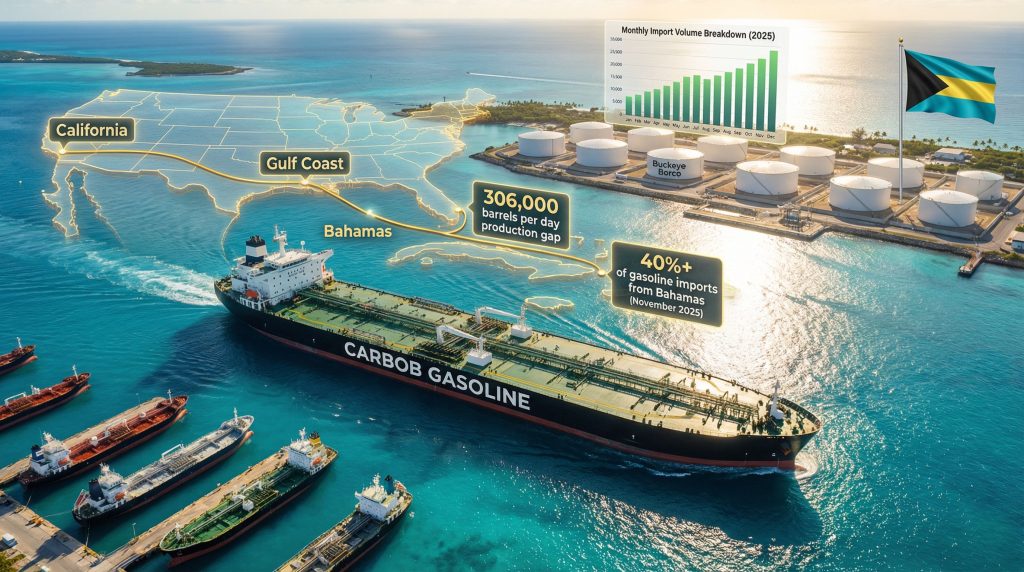
The Golden State confronts a dramatic reduction in domestic refining capacity that fundamentally alters its energy supply equation. Phillips 66's Los Angeles refinery closure in October 2025 eliminated 156,000 barrels per day of production capacity, followed by Valero's pending Benicia facility shutdown in April 2026, removing another 150,000 barrels per day. Combined, these closures represent a 17% reduction in California's refining capacity, creating a 306,000 barrels per day production gap that must be filled through imports.
This capacity reduction stems from multiple converging factors that make West Coast refining operations increasingly uneconomical. California maintains among the strictest environmental regulations in the US, driving operational costs significantly above national averages. The specialized CARBOB (California Reformulated Gasoline Blendstock for Oxygen Blending) specification requirements further limit supply flexibility, as only refineries equipped to produce this emission-reducing blend can serve the California market effectively.
The infrastructure constraints amplify these challenges. Unlike other US regions, no fuel pipelines connect the Gulf Coast's oil-producing powerhouse to the West Coast, creating complete reliance on marine transportation for inter-regional supply movements. This geographic isolation means that when local refining capacity disappears, alternatives must travel thousands of miles by ship.
Patrick De Haan, GasBuddy's head of petroleum analysis, projects that refinery closures could increase gasoline costs for California consumers by 5-15 cents per gallon. However, the economic implications extend beyond direct price impacts. When California's specialized gasoline trades at premium levels during supply disruptions, market incentives favor suppliers who can capture these higher margins through efficient transportation networks.
The Maritime Transportation Bottleneck
California gasoline imports from Bahamas represent a direct response to maritime regulatory constraints that limit domestic shipping options. The 106-year-old Jones Act requires that any goods shipped between US ports must travel on US-built, owned, and operated vessels. This regulatory framework creates severe supply constraints in the tanker market.
Only 55 Jones Act-compliant oil tankers operate worldwide, compared to more than 7,000 oil tankers globally. This represents barely 1.4% of the global tanker fleet, creating an extreme scarcity that drives up charter costs. Martin Davies, director of Tulane University's Maritime Law Center, notes that even when compliant vessels exist, they command significantly higher rates than foreign-flagged alternatives.
The cost differential has fluctuated dramatically based on regional market conditions. Foreign-flagged vessels were nearly $4 per barrel cheaper than US-flagged ones during much of 2024, but this spread compressed to barely $1 per barrel by early 2026 following the US easing of Venezuela sanctions, which increased regional freight rates. Furthermore, these developments coincide with broader oil price movements that affect global shipping dynamics.
When big ASX news breaks, our subscribers know first
The Caribbean Transshipment Solution Emerges
Fuel suppliers discovered that routing US Gulf Coast gasoline through the Bahamas creates a legal pathway to avoid Jones Act restrictions while maintaining cost competitiveness. This transshipment model transforms domestic cargo into foreign-origin imports, allowing the use of foreign-flagged vessels for the final delivery to California ports.
Matt Smith, lead oil analyst at Kpler, observes that this pattern mirrors established East Coast operations: "barrels are shipped from the US Gulf Coast via the Bahamas as a way of avoiding using Jones Act vessels." The regulatory arbitrage works because cargo that leaves US jurisdiction and enters a foreign port can be legally re-imported as foreign-origin product.
Strategic Infrastructure Development
Phillips 66 has recently leased storage tanks in Freeport, Bahamas, positioning the company to manage transshipment flows efficiently. This infrastructure investment signals corporate recognition that the Caribbean route represents a structural solution rather than temporary market anomaly.
The Bahamas operations provide several critical capabilities:
• Storage capacity sufficient to accommodate large tanker deliveries and temporary staging
• Blending capabilities to process gasoline blendstock into California-compliant CARBOB formulations
• Quality control infrastructure including laboratory facilities to verify fuel specifications
• Port logistics with operational throughput to manage cargo transfers between vessels
Recent tanker movements demonstrate the operational scale of this trade route. The Singapore-flagged Silver Moon delivered nearly 300,000 barrels of gasoline blendstock to Los Angeles in early January 2026 after loading in Freeport. The Torm Dulce executed an identical voyage pattern to San Francisco, confirming systematic utilisation across multiple California ports.
Import Volume Growth Signals Structural Shift
California gasoline imports from Bahamas have accelerated dramatically, indicating permanent changes in supply chain architecture. California sourced more barrels from the Bahamas in 2025 than in the prior nine years combined, representing approximately 12% of all gasoline arriving by ship throughout the year.
The monthly progression reveals the supply crisis timeline:
| Month | Import Volume | Context |
|---|---|---|
| May 2025 | 38,000 barrels/day | Record Caribbean sourcing at that time |
| October 2025 | 65,400 barrels/day | Post-Phillips 66 closure surge |
| November 2025 | 40%+ of total imports | Highest Bahamas proportion ever recorded |
This represents an 1,090% increase from the 2024 average of approximately 6,000 barrels per day, demonstrating the crisis-driven transformation of import patterns. Additionally, California imported 524,200 barrels of alkylate annually via Caribbean routes in 2025 for specialised CARBOB blending requirements.
Competitive Position Among Import Sources
While Caribbean transshipment gained prominence, Asian refineries maintained their position as primary foreign suppliers. India and South Korea individually supplied more product to California than the entire Bahamas route, highlighting the competitive dynamics within import markets.
Asian suppliers benefit from several structural advantages:
• Direct Pacific shipping routes avoiding Panama Canal transit costs
• Pre-existing CARBOB-grade production capabilities from established California market relationships
• Scale economies in specialised fuel production for emissions-compliant markets
• Transit time advantages with 18-21 day voyages versus 14-16 days for Caribbean routes
Economic Implications and Market Psychology
The emergence of Caribbean transshipment reflects deeper market psychology around regulatory arbitrage and supply security. Patrick De Haan explains that during premium pricing periods, there's significant incentive for both Gulf Coast (PADD 3) and Asian refiners to supply California markets. The Bahamas route preserves margin opportunities that would otherwise be eroded by Jones Act compliance costs.
However, the economic sustainability faces pressure from evolving freight markets. In addition, trade war strategies continue to influence global commodity flows. The US easing of Venezuela sanctions triggered increased regional shipping rates, compressing the cost advantage that made Caribbean transshipment attractive. If freight costs continue rising, US Gulf Coast gasoline may become uncompetitive against direct Asian imports.
Price Impact Analysis
California consumers face multi-layered cost increases from this supply chain transformation:
• Refinery closure impact: 5-15 cents per gallon from reduced domestic capacity
• Transportation premiums: Additional costs from extended shipping routes
• Market volatility: Price spikes during supply disruptions or seasonal demand increases
• Regulatory compliance costs: CARBOB specification requirements limiting supplier options
The freight cost evolution demonstrates market adaptation to regulatory constraints:
| Period | US-Flagged Premium | Foreign-Flagged Advantage | Market Driver |
|---|---|---|---|
| 2024 Average | $4/barrel higher | Significant cost savings | Venezuela sanctions |
| Early 2025 | $3/barrel higher | Moderate advantage | Sanction easing begins |
| Late 2025 | $1/barrel higher | Minimal savings | Regional freight inflation |
Infrastructure Vulnerability and Energy Security
California's dependence on Caribbean transshipment creates new vulnerability vectors in the state's energy security framework. Single-point-of-failure scenarios in Bahamas infrastructure could disrupt significant portions of gasoline supply during peak demand periods.
Weather and geopolitical risks associated with Caribbean operations introduce variables that domestic refining capacity would avoid. Hurricane seasons, port operational disruptions, or changes in Bahamas trade policies could impact supply continuity. Consequently, the tariffs impact on international trade relationships remains a crucial consideration.
Long-term Strategic Considerations
Matt Smith projects that Caribbean transshipment represents a persistent trend driven by fundamental supply-demand imbalances. The combination of West Coast refinery retirements and infrastructure constraints suggests structural permanence rather than temporary market adaptation.
Corporate infrastructure investments support this assessment. Phillips 66's Bahamas storage lease signals long-term strategic commitment to transshipment operations rather than West Coast refining recovery. This capital allocation pattern indicates industry consensus that import dependency will continue.
Regulatory Framework Evolution
The Jones Act's 106-year enforcement history faces new scrutiny as energy security concerns intersect with maritime policy outcomes. The legislation's original 1920 intent focused on national security through domestic shipbuilding capacity, but current market realities reveal unintended consequences for energy supply chains.
Congressional Research Service data highlights the enforcement gap: requiring US-built, owned, and operated vessels effectively eliminates 98.6% of global tanker capacity from domestic trade routes. This regulatory bottleneck forces elaborate workarounds that add complexity and cost to essential energy supplies.
Interstate Commerce Implications
The California supply crisis demonstrates how maritime law intersects with interstate commerce in unexpected ways. Federal Jones Act enforcement creates state-level energy supply constraints, raising questions about jurisdiction and emergency response mechanisms during supply disruptions.
State energy security versus federal maritime policy represents an emerging tension that may require legislative or regulatory resolution. California's unique environmental compliance requirements compound these challenges by limiting the pool of qualified suppliers.
The next major ASX story will hit our subscribers first
Future Market Scenarios and Adaptations
Multiple scenarios could reshape California gasoline imports from Bahamas and broader West Coast energy supply patterns. Freight cost normalisation represents the most immediate threat to Caribbean route economics, potentially shifting imports toward more cost-effective Asian suppliers.
Infrastructure development scenarios include potential pipeline connectivity studies, though the engineering and permitting challenges would require decades to overcome. Jones Act modification remains politically complex but could dramatically alter shipping economics if implemented. However, these developments occur against a backdrop of broader energy transition challenges affecting regional markets.
Investment and Policy Response
California policymakers face trade-offs between environmental compliance and energy security as supply constraints tighten. Regulatory flexibility discussions emerged following the supply crisis, suggesting potential accommodation for energy security concerns.
Strategic petroleum reserve utilisation options provide temporary supply buffers, but long-term solutions require either restored domestic capacity or permanent import infrastructure development. The Caribbean transshipment model offers a transitional approach that maintains supply security while market forces determine optimal long-term arrangements.
For instance, recent analysis from API's Pacific region data confirms the structural nature of these import patterns. The transformation of California's gasoline supply chain through Caribbean transshipment reveals the complex interplay between regulatory frameworks, market economics, and energy security. As traditional refining capacity contracts and regulatory constraints persist, innovative supply chain solutions emerge to bridge critical gaps in essential energy supplies.
Thinking About California's Energy Future?
Discovery Alert's proprietary Discovery IQ model delivers instant alerts on significant energy and mining discoveries across the ASX, helping investors identify actionable opportunities as supply chain disruptions create new market dynamics. Stay ahead of historic discoveries that can generate substantial returns and begin your 14-day free trial today to position yourself for the evolving energy landscape.