June 11, 2026
The Architecture of Chokepoint Risk: Why the Strait of Hormuz Remains the World's Most Consequential Waterway
Every barrel of oil carries with it an invisible geography of risk. Long before geopolitical headlines move crude prices, the physical pathways through which energy flows quietly determine the structural vulnerability of the global economy. No single point on that geography concentrates more systemic risk than the narrow band of water separating Iran from the Arabian Peninsula. The Iran controlled maritime zone in the Strait of Hormuz, administered by a newly created Persian Gulf Strait Authority, has transformed what were previously periodic rhetorical threats into a permanent institutional claim over one of history's most consequential shipping corridors.
Understanding what this means, who it affects, and how markets should respond requires more than a reading of the immediate headlines. It demands a structured examination of geography, international law, energy economics, and regional geopolitics working simultaneously.
When big ASX news breaks, our subscribers know first
What Is the Strait of Hormuz and Why Does It Define Global Energy Security?
The World's Most Critical Maritime Chokepoint: Key Facts and Figures
The Strait of Hormuz connects the Persian Gulf to the Gulf of Oman, functioning as the sole maritime outlet for the bulk of the Middle East's energy exports. While the geographic distance between the Iranian and Omani coastlines reaches approximately 30 miles (48 kilometres) at its broadest navigable span, the operationally significant detail lies in the traffic separation scheme governing commercial transit.
According to the U.S. Energy Information Administration (EIA), the strait's formalised traffic lanes consist of two 2-mile-wide channels for inbound and outbound tanker traffic respectively, separated by a 2-mile buffer zone. Deep-draft commercial vessels, including very large crude carriers (VLCCs), have no viable alternative to these constrained lanes due to shallow waters on either side.
The EIA has estimated that approximately 21 million barrels per day (bpd) of crude oil, condensates, and petroleum products transited the strait in 2018, representing roughly 21% of global petroleum liquids consumption at that time. Comparable volumes have been sustained in subsequent years, making any disruption to transit here a systemic shock to world energy markets rather than a localised incident.
The primary nations whose export revenues depend on unimpeded Hormuz transit include:
- Saudi Arabia — the world's largest crude oil exporter by volume
- United Arab Emirates — a major crude and refined products exporter
- Kuwait — near-total dependence on Hormuz for energy export access
- Iraq — the second-largest OPEC producer, overwhelmingly Hormuz-dependent
- Qatar — the world's largest LNG exporter, with the majority of its approximately 77 million tonnes per annum (mtpa) of LNG transiting the strait
- Iran itself — heavily reliant on Hormuz for its own sanctioned oil exports
Key Statistic: Roughly one-fifth of all oil traded globally passes through the Strait of Hormuz. Any sustained disruption to navigation is not a regional incident but a global supply-side shock affecting refiners, consumers, and financial markets across every continent.
Traffic Separation Schemes and Established Navigation Norms
The International Maritime Organization (IMO) governs the traffic separation scheme within the strait, establishing the formal lane structure through which commercial shipping transits. Under the United Nations Convention on the Law of the Sea (UNCLOS), the Strait of Hormuz qualifies as an international strait used for international navigation, which triggers a specific and elevated legal standard known as transit passage rights.
The jurisdictional split of the strait is an important detail frequently misunderstood in public discourse. Iran controls the northern shoreline, while Oman controls the southern shoreline. The navigable shipping lanes themselves fall within waters subject to international strait transit passage rules rather than the exclusive territorial sovereignty of either nation. This distinction is legally consequential and directly relevant to assessing the validity of Iran's new declaration.
Transit passage rights under UNCLOS Article 38 differ materially from innocent passage rights applicable in ordinary territorial waters. Innocent passage allows a coastal state to impose conditions and temporarily suspend passage for security reasons. Transit passage through international straits, however, carries a higher threshold of protection for foreign vessels and, critically, cannot be suspended unilaterally by a bordering state.
What Has Iran's Persian Gulf Strait Authority Actually Declared?
Anatomy of the Iran Controlled Maritime Zone in the Strait of Hormuz: Geographic Boundaries Defined
Iran's newly established Persian Gulf Strait Authority announced its declaration via official communications in May 2026. The zone's geographic boundaries are defined with notable precision:
- Eastern boundary: A line connecting Kuh-e Mobarak on the Iranian coast to southern Fujairah in the UAE
- Western boundary: A line connecting the tip of Qeshm Island in Iran to Umm Al Quwain in the UAE
Taken together, these coordinates effectively span the full navigable width of the strait between Iranian and Emirati territorial limits. The geographic specificity, anchored to named UAE landmarks rather than abstract coordinates, is significant. It implicitly incorporates the UAE into the jurisdictional framing of the dispute — a deliberate or at minimum consequential choice given the complex bilateral relationship between Tehran and Abu Dhabi.
What Prior Coordination and Authorisation Means for Vessel Operators
The authority's declaration states that all transit through this defined zone requires prior coordination and authorisation. The practical implications vary by vessel category:
| Vessel Category | Current Transit Norm | Under New Iranian Declaration |
|---|---|---|
| Commercial Oil Tankers | Free transit passage (UNCLOS) | Prior authorisation required |
| LNG Carriers | Free transit passage | Prior authorisation required |
| Naval Vessels | Transit passage rights apply | Disputed authorisation claimed |
| Bulk Cargo Ships | Free transit passage | Coordination required |
| Private/Recreational | Innocent passage | Coordination required |
For shipping operators, the procedural burden of seeking authorisation from an authority whose legal standing is contested creates immediate operational uncertainty. Vessel operators must now weigh compliance — which risks implicitly legitimising the authority's claims — against non-compliance, which risks physical confrontation with Iranian naval or coast guard assets.
Is Iran's Maritime Zone Declaration Legally Enforceable Under International Law?
UNCLOS, Transit Passage, and the Limits of Unilateral Maritime Claims
The legal landscape surrounding the Iran controlled maritime zone in the Strait of Hormuz is unambiguous from the perspective of the dominant international legal consensus. UNCLOS Article 38 guarantees ships and aircraft of all states the right of transit passage through straits used for international navigation. The Strait of Hormuz satisfies the definitional requirements for this classification without meaningful dispute among international legal scholars.
Iran is a signatory to UNCLOS but has historically advanced interpretations that strain against unrestricted transit, particularly regarding military vessels. The United States has consistently and formally rejected any Iranian claim that restricts lawful transit passage, and this position is broadly shared by maritime states including EU members, Japan, South Korea, and Australia.
Legal Framework: Under UNCLOS, the right of transit passage through international straits cannot be suspended or conditioned by a bordering state acting unilaterally. Declarations imposing authorisation requirements on foreign vessels are widely considered non-binding by the international community unless codified through treaty or formally recognised by the IMO.
The legal reality is that the declaration carries significant political weight whilst its enforceability under international law remains highly contestable. The gap between legal authority and physical capability is, however, where the risk actually resides. Iran's naval and coast guard assets have demonstrated a capacity for vessel interception that does not require legal justification to execute.
Precedents: How Have Similar Maritime Assertions Been Handled Historically?
Unilateral maritime assertions by powerful regional states are not without precedent. China's declaration of an Air Defence Identification Zone (ADIZ) over disputed South China Sea territories drew widespread international condemnation but has not been formally withdrawn. Iran itself escalated maritime tensions during 2011 and 2012 when nuclear sanctions tightened, with senior military officials threatening to close the strait entirely. Brent crude surged above $120 per barrel during that period in part due to Hormuz risk premiums.
The 2019 period saw Iranian forces seize a British-flagged tanker and attack several commercial vessels in the Gulf of Oman, demonstrating a willingness to translate rhetoric into kinetic action. Furthermore, questions about whether Iran possesses the legal right to close the strait under international law have been examined extensively by legal scholars, who broadly conclude that unilateral closure claims are untenable. International courts and arbitration panels have consistently rejected such claims, but enforcement of those rulings depends on political and military will rather than legal mechanisms alone.
What Are the Geopolitical Drivers Behind This Declaration?
Reading the Strategic Calculus: Why Iran Is Asserting Control Now
The timing of the declaration in 2026 situates it within a deteriorating Iran-US diplomatic environment. Nuclear negotiations have stalled through multiple rounds of indirect talks, and the sanctions architecture constraining Iranian oil revenues remains substantially intact. Iran has historically employed maritime posturing as an asymmetric leverage tool, using the credible threat of Hormuz disruption to impose costs on adversaries without direct military confrontation.
The establishment of a formal authority with institutional permanence represents a structural escalation beyond the episodic threats of prior years. Rather than a statement by a military commander or government spokesperson, this is the creation of an administrative body with a defined mandate, boundaries, and procedural requirements. This signals longer-term strategic intent to normalise Iranian administrative jurisdiction over the strait's transit regime.
Consequently, the broader geopolitical risk landscape extending across the region is simultaneously shifting in ways that amplify the significance of any Hormuz institutional development.
Iran-UAE Maritime Relations: A Complicated Bilateral Dimension
The UAE occupies an uncomfortable position in this dispute. As a nation deeply integrated into Western-aligned Gulf security frameworks and simultaneously a significant trading partner with Iran, Abu Dhabi faces competing pressures. The geographic anchoring of the controlled zone to UAE landmarks, specifically southern Fujairah and Umm Al Quwain, draws the UAE into the dispute in ways that extend beyond the Iran-US dynamic.
Underlying this is a longstanding territorial dispute over the islands of Abu Musa and the Greater and Lesser Tunb islands, which Iran has occupied since 1971 and which the UAE claims as its sovereign territory. The zone's coordinates effectively treat UAE coastal reference points as delimiting markers for Iranian administrative jurisdiction, which will be interpreted in Abu Dhabi as a provocation layered on top of the existing islands dispute.
The Gulf Cooperation Council Response Calculus
Saudi Arabia, Kuwait, and Qatar collectively depend on Hormuz for the revenues that fund their national budgets and Vision-era diversification programmes. The GCC states are likely to frame Iran's declaration through two competing lenses: as a sovereignty provocation requiring diplomatic condemnation, and as a negotiating tactic whose enforcement probability is low enough to avoid triggering overt military escalation.
The US Fifth Fleet, headquartered in Bahrain, provides the primary deterrent backstop for Gulf state security architecture. Its presence contextualises any Iranian enforcement attempt within the risk of direct US military response, a factor that historically has moderated Iranian operational behaviour even when rhetorical posturing has been aggressive.
How Could This Impact Global Oil Markets and Shipping Operations?
Quantifying the Risk: Energy Market Exposure to Hormuz Disruption
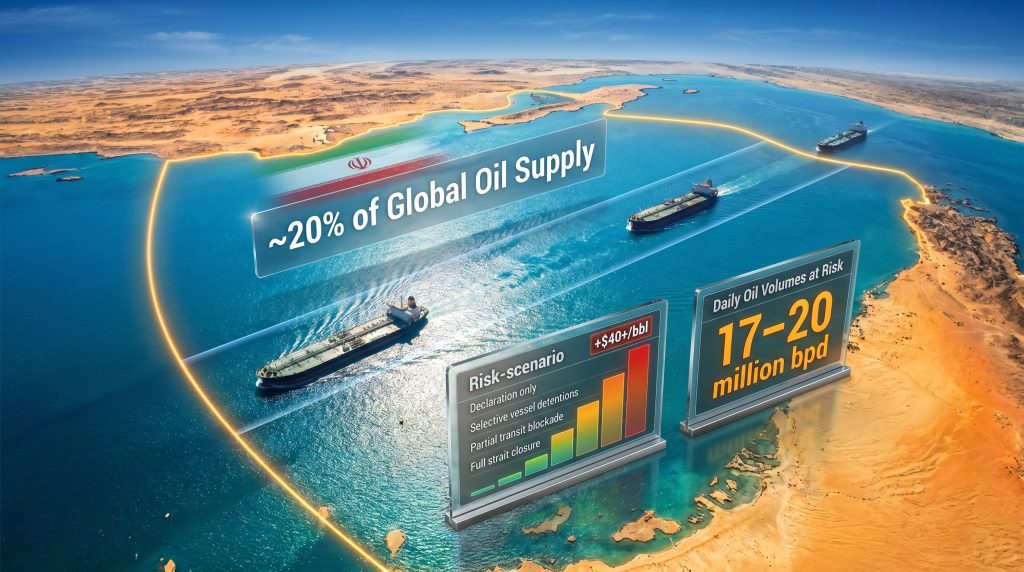
The energy market exposure concentrated at the Strait of Hormuz has no comparable parallel among global maritime chokepoints. Daily volumes at risk include approximately 17 to 21 million bpd of crude oil and petroleum products, alongside the majority of Qatar's 77 million mtpa LNG export programme. The following scenario matrix provides a structured framework for assessing market impact:
| Disruption Scenario | Probability Assessment | Estimated Oil Price Impact | Key Affected Markets |
|---|---|---|---|
| Declaration only, no enforcement | High | Minimal (±$2-3/bbl) | Shipping insurance premiums |
| Selective vessel detentions | Moderate | +$8-12/bbl | Asian importers, EU refiners |
| Partial transit blockade | Low | +$15-25/bbl | Global spot markets |
| Full strait closure | Very Low | +$40+/bbl | Global systemic shock |
War risk insurance premium escalation is likely to be the most immediate market consequence of the declaration alone, drawing precedent from the 2019 tanker attacks in the Gulf of Oman when premiums for Hormuz-transiting vessels spiked materially within days of each incident. Understanding the trade war oil impact alongside Hormuz risk provides a more complete picture of the pressures currently bearing on global energy supply chains.
Shipping Industry Operational Responses: Rerouting, Insurance, and Risk Protocols
The theoretical bypass infrastructure for Hormuz includes the East-West Pipeline across Saudi Arabia and the Abu Dhabi Crude Oil Pipeline (ADCOP). However, a critical and underappreciated constraint is that combined pipeline capacity across these alternatives cannot absorb anywhere near the full volume currently transiting the strait. The pipelines serve as partial pressure relief valves rather than genuine alternatives for the global tanker fleet.
Cape of Good Hope rerouting adds approximately 15 to 20 days to voyage times from the Persian Gulf to European and Asian destinations, substantially increasing fuel costs, voyage expenses, and effective shipping capacity constraints across global tanker markets. Protection and Indemnity (P&I) clubs and specialist war risk underwriters are expected to reassess Hormuz exposure classifications in response to the formal declaration, with knock-on effects for vessel operating economics.
Strategic Petroleum Reserve Activation as a Counterbalance
The US Strategic Petroleum Reserve and the coordinated release mechanisms of the International Energy Agency (IEA) represent the primary institutional tools available to buffer short-term supply disruptions. IEA member states collectively hold emergency reserves equivalent to approximately 90 days of net imports, providing meaningful but finite cushioning capacity. Asian importers including India, China, Japan, and South Korea have expanded their strategic reserve holdings over the past decade specifically in response to Hormuz concentration risk.
The next major ASX story will hit our subscribers first
How Does Iran's Strait Authority Declaration Compare to Past Hormuz Tensions?
A Structured Timeline of Iran-Strait of Hormuz Escalation Events
| Year | Event | Market/Geopolitical Impact |
|---|---|---|
| 1987-1988 | Tanker War during Iran-Iraq conflict | US Navy escort operations; significant oil price volatility |
| 2011-2012 | Iran threatens closure amid nuclear sanctions | Brent crude surges above $120/bbl |
| 2019 | Tanker seizures and attacks in Gulf of Oman | War risk premium spikes; US-Iran near-confrontation |
| 2023-2024 | Houthi Red Sea attacks (Iran-linked proxies) | Global shipping rerouting; insurance cost escalation |
| 2026 | Persian Gulf Strait Authority controlled zone declaration | Institutional escalation; enforcement posture under monitoring |
What Distinguishes the 2026 Declaration From Previous Escalations
Prior Hormuz threats were predominantly rhetorical or mediated through proxy actors. The 2026 declaration differs in three structurally important ways:
- Institutional permanence — The creation of a named administrative authority implies ongoing jurisdiction rather than a temporary pressure campaign.
- Geographic precision — Specific boundary coordinates anchored to named landmarks represent a formalisation of territorial claims that exceeds anything previously declared.
- Procedural architecture — The requirement for prior authorisation establishes a bureaucratic mechanism that, if operationalised, would transform transit from a right into a permission-dependent process.
These characteristics suggest the declaration is designed to outlast any single negotiating episode, establishing a persistent Iranian administrative claim over the strait's transit regime as a baseline negotiating position. In addition, monitoring OPEC's market influence alongside these developments is essential, as OPEC production decisions will interact directly with any supply disruption stemming from Hormuz enforcement actions.
What Does This Mean for India and Major Asian Energy Importers?
India's Hormuz Dependency: Quantifying the Exposure
India imports approximately 80 to 85% of its crude oil requirements, with a substantial proportion of that supply originating from Gulf producers whose export routes transit the Strait of Hormuz. Indian refiners processing Iraqi, Saudi, UAE, and Iranian-origin crude face direct exposure to any transit disruption. India's strategic positioning is further complicated by its maintenance of diplomatic relationships with both Iran and the United States, creating a navigation challenge that extends beyond the purely physical.
India has been expanding its strategic petroleum reserve capacity and accelerating crude import diversification toward Russian, West African, and Latin American sources in recent years. However, the pace of that diversification means Hormuz dependency remains structurally significant for the near to medium term.
China, Japan, and South Korea: The Asian Importer Risk Matrix
The Asian importer exposure profile is concentrated and consequential:
- China imports approximately 3 to 4 million bpd of crude from Gulf producers transiting Hormuz, making it among the most directly exposed importers globally
- Japan maintains near-total dependence on Middle Eastern crude for refinery feedstock, with limited short-term substitution capacity
- South Korea similarly relies on Middle Eastern crude for the majority of its refinery inputs
The collective economic exposure of Northeast Asian importers to a sustained Hormuz disruption would translate rapidly into refinery margin compression, fuel price inflation, and currency pressure, particularly for import-dependent economies operating with limited domestic energy production.
Frequently Asked Questions: Iran's Controlled Maritime Zone in the Strait of Hormuz
What exactly is Iran's controlled maritime zone in the Strait of Hormuz?
Iran's Persian Gulf Strait Authority has declared a formally bounded administrative zone within the Strait of Hormuz, defined on the eastern side by a line connecting Kuh-e Mobarak in Iran to southern Fujairah in the UAE, and on the western side by a line connecting the tip of Qeshm Island in Iran to Umm Al Quwain in the UAE. All vessel transit through this zone is stated to require prior coordination and authorisation from the authority.
Is the Strait of Hormuz in Iranian territorial waters?
The strait straddles two coastal states: Iran on the northern shore and Oman on the southern shore. The navigable shipping channels fall within waters classified as an international strait under UNCLOS, meaning they are subject to transit passage rights rather than the exclusive territorial control of either bordering state.
Can Iran legally close or restrict the Strait of Hormuz?
Under international maritime law as codified in UNCLOS, Iran does not have the legal authority to unilaterally close or impose binding restrictions on transit passage through the strait. However, the gap between legal authority and physical capability is material. Iran's naval and coast guard assets can and have engaged in vessel interception activities regardless of their legal basis. International consensus firmly rejects unilateral closure claims, but enforcement of that consensus requires collective political and military will.
What happens to oil prices if the Strait of Hormuz is disrupted?
Given that approximately 20% of globally traded oil transits the strait, any sustained disruption triggers immediate Brent crude price escalation. The potential for an oil price rally driven by Hormuz supply fears compounds existing market pressures. Historical precedents and scenario modelling suggest price spikes ranging from $8 to $12 per barrel for selective enforcement actions up to $40 per barrel or more under a full closure scenario. SPR releases and alternative pipeline routing provide partial but incomplete buffers.
What is the Persian Gulf Strait Authority?
The Persian Gulf Strait Authority is a newly established Iranian administrative body with a stated mandate to manage transit through the Strait of Hormuz. Its legal standing under international maritime law is disputed by the majority of the international community. Its creation as a permanent institutional structure, rather than a temporary military posture, is what distinguishes the 2026 declaration from prior Iranian escalations.
How wide is the Strait of Hormuz?
The strait spans approximately 21 miles (33 kilometres) at its narrowest navigable point between the Iranian and Omani coastlines according to EIA data, though the broader geographic width including surrounding waters reaches approximately 30 miles (48 kilometres). The operationally critical detail is that formalised traffic lanes compress commercial shipping into two 2-mile-wide channels, making the effective navigational corridor far more constrained than the geographic width suggests.
What Are the Likely Next Steps and Escalation Pathways?
Three Scenarios: How This Declaration Could Evolve
Scenario A: Declaratory Posturing (Most Likely)
The authority issues formal communications and maintains a visible administrative presence, but does not actively intercept or detain commercial vessels. International shipping continues with elevated monitoring and modest insurance premium increases. The declaration functions primarily as a negotiating lever in ongoing nuclear or sanctions discussions, demonstrating Iran's capacity to impose administrative costs without triggering military confrontation.
Scenario B: Selective Enforcement (Moderate Probability)
Iranian naval or coast guard assets begin requesting documentation from select vessels, targeting ships flagged by nations with active sanctions relationships or diplomatic tensions with Tehran. This triggers formal diplomatic protests, potential US Navy escort operation restorations, and significant war risk premium escalation. The scenario creates sustained market uncertainty without necessarily producing a price shock equivalent to physical disruption.
Scenario C: Active Interdiction (Low Probability, High Impact)
Physical interception or detention of commercial vessels produces an immediate and severe global oil price shock. SPR activation mechanisms and IEA coordinated releases would be triggered rapidly. The risk of direct US-Iran military confrontation becomes acute, and the full systemic consequences described in the worst-case price scenario table materialise.
Indicators and Warnings: What Markets and Analysts Should Monitor
Practitioners should track the following signals as early indicators of escalation trajectory:
- Iranian naval patrol activity density and positioning within the defined zone coordinates
- Shipping company route deviation announcements and publicly disclosed war risk premium movements
- Formal statements from the IMO, US Fifth Fleet, and GCC maritime authorities regarding recognition or rejection of the authority's mandate
- Iranian government communications distinguishing administrative framing from enforcement intent
- Tanker market fixtures and voyage instruction patterns from major Gulf crude exporters
Furthermore, tracking crude oil price trends in real time will be essential for practitioners seeking to monitor how markets are pricing in these escalation scenarios as they develop.
Key Takeaways: Strategic Implications of Iran's Hormuz Maritime Zone
The following summary captures the core strategic dimensions of the Iran controlled maritime zone in the Strait of Hormuz declaration for energy markets, shipping operators, and geopolitical risk practitioners:
- The establishment of the Persian Gulf Strait Authority as a permanent institutional mechanism marks a structural escalation beyond episodic rhetoric, creating an enduring administrative claim over a corridor through which approximately one-fifth of globally traded oil transits daily
- The declaration's legal standing under UNCLOS is widely rejected by the international community; transit passage rights through international straits cannot be conditioned by unilateral action of a bordering state
- Energy market exposure is quantitatively significant at approximately 17 to 21 million bpd of oil products and the majority of Qatar's 77 mtpa LNG export programme transiting the strait
- The geographic anchoring of zone boundaries to UAE landmarks introduces a bilateral Iran-UAE dimension that complicates Gulf diplomatic dynamics beyond the primary Iran-US axis
- Near-term enforcement is assessed as unlikely but not impossible; the primary near-term market impact is elevated shipping risk perception and war risk insurance cost pressure
- Asian importers, particularly India, China, Japan, and South Korea, carry the highest direct economic exposure to any sustained Hormuz transit disruption given their structural dependence on Middle Eastern crude
Readers seeking quantitative context on global maritime chokepoints and historical Hormuz transit volumes are encouraged to consult the U.S. Energy Information Administration's dedicated analysis at eia.gov, which provides regularly updated data on transit volumes and disruption scenarios. This article contains forward-looking scenario assessments that involve uncertainty and should not be relied upon as the sole basis for commercial or investment decisions.
Want to Stay Ahead of Commodity Discoveries Driven by Geopolitical Shifts Like the Hormuz Crisis?
As Strait of Hormuz tensions reshape global energy supply chains and redirect capital toward alternative commodity strategies, Discovery Alert's proprietary Discovery IQ model delivers real-time ASX mineral discovery alerts — instantly identifying actionable opportunities across gold, critical minerals, and energy commodities before the broader market reacts. Explore how historic discoveries have generated exceptional returns on Discovery Alert's discoveries page, and begin your 14-day free trial today to position yourself ahead of the next major market-moving announcement.