
July 23, 2026
The Architecture of Energy Resilience: Why Bypass Infrastructure Is Reshaping Gulf Oil Strategy
Energy markets have always rewarded nations that invest in optionality. The ability to reroute, redirect, or replicate export flows during periods of disruption is not merely a contingency measure — it is a structural competitive advantage that compounds in value as geopolitical uncertainty intensifies. Few pieces of infrastructure illustrate this principle more clearly than the UAE pipeline bypassing the Strait of Hormuz, a project whose strategic logic was planted more than a decade ago and is now bearing fruit in real time.
Understanding why this matters requires stepping back from the immediate news cycle and examining the mechanics of how global oil logistics actually function, and why certain geographic choke points hold such outsized influence over energy prices, inflation trajectories, and the economic stability of import-dependent nations worldwide. Monitoring crude oil price trends helps contextualise just how significant these infrastructure decisions truly are.
When big ASX news breaks, our subscribers know first
The Strait of Hormuz: A Single Point of Failure for Global Energy
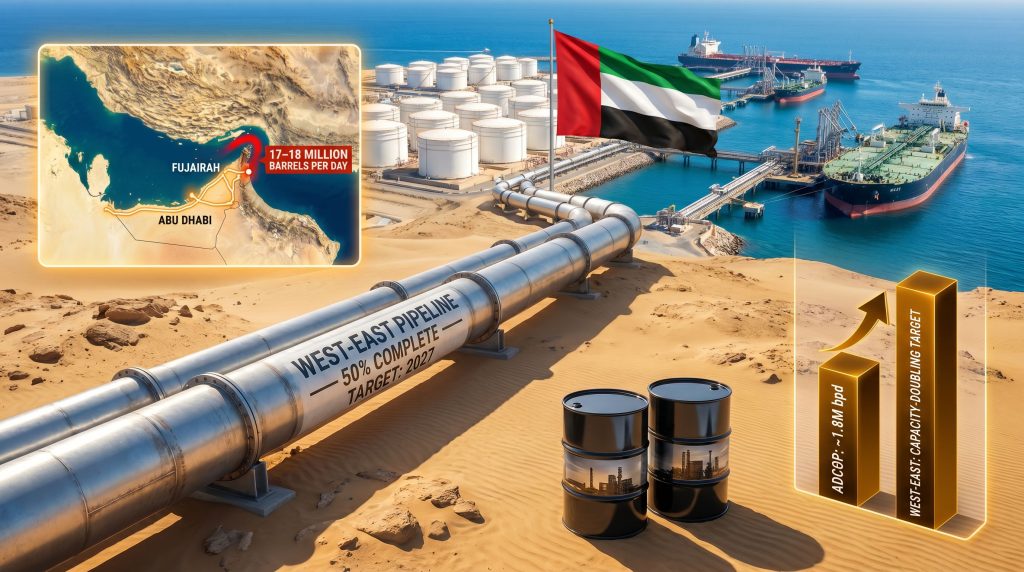
The Strait of Hormuz occupies a uniquely consequential position in the architecture of global energy supply. At its narrowest navigable point, the waterway measures approximately 33 kilometres wide, yet it carries an estimated 20 to 21 percent of total worldwide oil consumption on any given day. In volumetric terms, that translates to roughly 17 to 18 million barrels of crude oil and refined petroleum products transiting this corridor daily, destined for buyers across Asia, Europe, and beyond.
What makes Hormuz structurally irreplaceable is not just its volume throughput, but its geographic position. The strait sits between Iran to the north and the coastlines of Oman and the UAE to the south. This means that any deterioration in relations involving Iran — whether through military confrontation, sanctions enforcement, or deliberate blockade threats — immediately ripples into global energy pricing. The oil logistics and geopolitics surrounding this waterway make it unlike any other chokepoint in the world.
Unlike most supply chain vulnerabilities, the Strait of Hormuz cannot be rerouted or substituted at short notice. For producing nations, the only credible response is building parallel export infrastructure that operates entirely outside the strait's sphere of influence.
Since early 2026, the practical consequences of Hormuz vulnerability have become acute. Following US-Israeli military strikes, Iran moved to severely restrict shipping access through the waterway to vessels other than its own. The resulting supply anxiety drove energy prices sharply higher, reignited inflation concerns across major importing economies, and dramatically accelerated Gulf state investment in bypass capacity. The UAE's earlier infrastructure decisions, made when the threat still seemed theoretical, suddenly looked prescient.
ADCOP: The Original Hormuz Bypass and Its Strategic Logic
The UAE's primary existing mechanism for exporting crude oil without using the Strait of Hormuz is the Abu Dhabi Crude Oil Pipeline, widely known as ADCOP or the Habshan-Fujairah pipeline. This infrastructure was not built reactively — it was the product of deliberate long-term planning that predates the current crisis by over a decade. According to Al Jazeera, the project has since become central to Abu Dhabi's broader energy sovereignty ambitions.
The pipeline originates at Habshan, a major oil processing and gathering hub located in Abu Dhabi's interior, and runs approximately 380 to 406 kilometres to terminate at the Port of Fujairah on the Gulf of Oman. Crucially, Fujairah sits on the eastern coast of the UAE, physically outside the Hormuz maritime jurisdiction, meaning tankers loading there bypass the strait entirely.
| Metric | Detail |
|---|---|
| Operational Since | 2012 |
| Pipeline Length | ~380 to 406 km |
| Throughput Capacity | ~1.5 to 1.8 million barrels per day |
| Construction Cost (estimated) | $3.3 billion to $4.2 billion |
| Terminus | Port of Fujairah, Gulf of Oman |
| Strategic Function | Hormuz-bypass crude export route |
The construction cost alone, estimated between $3.3 billion and $4.2 billion, signals the seriousness with which Abu Dhabi approached energy export diversification. This was not a minor contingency investment — it was a transformational infrastructure commitment that has since shaped the entire strategic identity of the Port of Fujairah.
One underappreciated consequence of ADCOP's existence is how it catalysed Fujairah's evolution into one of the world's largest bunkering hubs. The port's strategic positioning, combined with large-scale storage tank capacity built to support pipeline deliveries, created an ecosystem attractive to ship operators, commodity traders, and storage investors globally. Fujairah today handles significant ship-to-ship transfer operations and refined product storage volumes that would not exist without the original pipeline investment.
The West-East Pipeline: Doubling Down on Export Sovereignty
The next phase of the UAE's bypass strategy centres on a new parallel pipeline, referred to officially as the West-East Pipeline (also designated West-East 1), which was publicly confirmed by the Abu Dhabi Media Office in May 2026. The announcement revealed that the project, which had been under development quietly, had already reached approximately 50 percent completion as of May 21, 2026.
ADNOC CEO Sultan Al Jaber confirmed this progress at a live-streamed Atlantic Council event, stating that construction was nearly half complete and that the organisation was accelerating delivery toward a 2027 target for full operational status. The directive to fast-track the project came directly from Abu Dhabi Crown Prince Sheikh Khaled bin Mohamed bin Zayed during an executive committee meeting, reflecting the highest level of political priority assigned to the infrastructure's completion. Reuters reporting on the project confirms the accelerated timeline and strategic urgency behind the decision.
The pipeline's primary purpose is to double the UAE's total crude oil export capacity through the Port of Fujairah. When combined with ADCOP's existing throughput ceiling of 1.5 to 1.8 million barrels per day, the addition of a parallel pipeline of comparable scale would push total Hormuz-bypass capacity well beyond anything the UAE has previously been able to offer.
What This Means for ADNOC's Operational Resilience
The urgency behind the West-East Pipeline's accelerated timeline is reinforced by the operational damage ADNOC acknowledged sustaining during the 2026 regional hostilities. Al Jaber confirmed that certain ADNOC facilities and infrastructure assets were directly targeted and damaged, with recovery timelines varying by asset type. Some systems are expected to return to full capacity within weeks, while more complex infrastructure may require several months of repair and recommissioning.
This dual reality — managing near-term production disruption while simultaneously investing in long-term structural resilience — explains why the West-East Pipeline is being treated as an emergency infrastructure priority rather than a routine capital project.
How the UAE's Strategy Compares Across the Region
The UAE is not the only Gulf producer with bypass infrastructure ambitions, but its approach is distinctive in several important respects. Furthermore, the broader context of geopolitical trade tensions across the region makes this comparison particularly relevant for understanding long-term energy strategy.
| Country | Pipeline or Route | Capacity (bpd) | Current Status |
|---|---|---|---|
| UAE | ADCOP (Habshan-Fujairah) | ~1.5 to 1.8 million | Operational since 2012 |
| UAE | West-East Pipeline | Capacity-doubling target | ~50% complete, target 2027 |
| Saudi Arabia | East-West Pipeline (Petroline) | ~5 million | Operational but underutilised |
| Iraq | Kirkuk-Ceyhan Pipeline | ~0.35 to 0.6 million | Partially operational |
| Oman | Muscat-Sohar route options | Limited | Discussed, not fully developed |
Saudi Arabia's Petroline technically holds the largest bypass capacity in the region at approximately 5 million barrels per day, but it has historically operated well below its maximum throughput due to a combination of commercial, logistical, and political factors. The UAE's comparative advantage lies not just in pipeline capacity but in its integrated terminal ecosystem at Fujairah, which provides storage, blending, and bunkering services that amplify the commercial value of the bypass route.
Iraq's Kirkuk-Ceyhan pipeline, which routes oil northward through Turkey to the Mediterranean port of Ceyhan, offers a partial bypass of Gulf waterways altogether but has suffered from prolonged operational disruptions tied to legal disputes and regional instability. Oman's bypass options remain largely undeveloped at scale.
The UAE stands out not because its pipeline capacity is the largest in absolute terms, but because it has built an integrated export ecosystem around bypass infrastructure — combining terminal capacity, storage facilities, and bunkering services in a way that no other regional producer has replicated.
Market Implications: How Bypass Capacity Influences Oil Pricing
The relationship between bypass infrastructure availability and oil market pricing is more nuanced than many observers recognise. Functional bypass capacity does not eliminate Hormuz risk premiums from oil futures, but it does meaningfully compress them when operational credibility is high. Consequently, the oil market disruption risks tied to Hormuz are partially, though not entirely, mitigated by expanded bypass infrastructure.
When energy traders and futures market participants know that a producing nation has verified, operational bypass routes, the probability-weighted impact of a Hormuz disruption on that nation's export volumes is reduced. This flows directly into lower risk premiums embedded in forward crude contracts, which in turn moderates the inflationary pressure that oil price spikes generate in import-dependent economies.
However, the events of 2026 have also demonstrated the limits of partial bypass capacity. Even with ADCOP fully operational, the total Hormuz disruption was large enough in scale to drive prices sharply higher, because the strait carries flows from multiple producers simultaneously. The UAE's bypass capacity protects its own export volumes, but the broader market impact of Hormuz restriction extends far beyond any single producer's hedging capacity. In addition, OPEC market influence plays a significant role in shaping how these disruptions ultimately affect global supply and demand dynamics.
Key Dynamics Worth Monitoring
Several market dynamics deserve attention as the West-East Pipeline approaches completion:
- Price sensitivity compression: As UAE bypass capacity doubles, the marginal risk premium for UAE-sourced crude should decline relative to Hormuz-dependent grades
- Asian buyer preferences: Long-term supply contracts with Asian importers, particularly in India, China, Japan, and South Korea, may increasingly specify Fujairah-loadable volumes as a supply chain certainty premium
- Fujairah storage premiums: Traders storing crude at Fujairah benefit from location optionality that Hormuz-dependent storage cannot offer, creating a potential contango structure specific to bypass-terminal inventory
- ADNOC commercial positioning: A doubled bypass capacity gives ADNOC materially stronger negotiating leverage with buyers who are willing to pay a modest premium for supply chain resilience
Note: The above dynamics represent analytical projections based on infrastructure fundamentals and historical market behaviour. They are not guarantees of future market outcomes and should not be construed as investment advice.
The next major ASX story will hit our subscribers first
The Longer Arc: Energy Infrastructure as Geopolitical Currency
There is a less commonly discussed dimension to the UAE pipeline bypassing the Strait of Hormuz that extends beyond pure oil logistics. In an era of fragmenting geopolitical alliances and escalating resource nationalism, nations with diversified, resilient export infrastructure occupy a qualitatively different position in the international system.
The ability to guarantee delivery regardless of regional disruption transforms a commodity exporter into a strategic supply partner — a designation that carries diplomatic weight, preferential trade relationships, and long-term contract premiums that purely Hormuz-dependent exporters cannot credibly offer. For Abu Dhabi, the West-East Pipeline is therefore not merely an operational hedge — it is a foreign policy asset.
This logic also carries lessons for how importing nations evaluate energy security strategy. Countries that have historically relied on market pricing to manage supply risk are increasingly recognising that physical infrastructure diversity — including diverse port access, terminal capacity, and pipeline routing options — provides a form of security that financial hedging instruments cannot fully replicate.
Frequently Asked Questions: UAE Pipeline Bypassing the Strait of Hormuz
What is the UAE pipeline bypassing the Strait of Hormuz?
The primary route is the Abu Dhabi Crude Oil Pipeline (ADCOP), running approximately 380 to 406 kilometres from Habshan in Abu Dhabi's interior to the Port of Fujairah on the Gulf of Oman. Operational since 2012, it allows crude exports to completely avoid the Strait of Hormuz.
How much oil can the UAE export without using Hormuz?
The existing ADCOP pipeline carries up to approximately 1.5 to 1.8 million barrels per day. The new West-East Pipeline, currently around 50 percent complete and targeting a 2027 completion, is designed to double total bypass export capacity through Fujairah.
Why is the Strait of Hormuz so important to global oil supply?
Roughly 20 to 21 percent of global oil consumption — approximately 17 to 18 million barrels per day — passes through the strait. Its narrow navigable width and position between Iran and the Arabian Peninsula make it uniquely exposed to geopolitical disruption.
When will the new West-East Pipeline be completed?
The UAE is targeting full operational delivery by 2027. As of May 2026, construction is approximately 50 percent complete, with the Abu Dhabi Crown Prince directing ADNOC to accelerate the project timeline.
How much did the original Habshan-Fujairah pipeline cost to build?
Construction cost estimates for the original ADCOP pipeline range from approximately $3.3 billion to $4.2 billion, placing it among the most significant energy infrastructure investments in Gulf history.
How does UAE bypass infrastructure affect global oil prices?
Functional bypass capacity reduces the risk premium embedded in oil futures during periods of Hormuz tension. However, when Hormuz access is significantly restricted across multiple producers simultaneously, bypass capacity for a single nation cannot fully offset broader market disruption — as the 2026 price surges demonstrated.
Key Takeaways
The UAE's decision to build, operate, and now aggressively expand bypass pipeline infrastructure represents one of the most strategically coherent long-term energy investments in the contemporary Gulf. Several conclusions stand out:
- The ADCOP pipeline, operational since 2012, was a forward-looking capital commitment that has proven its value precisely when the strategic environment deteriorated most sharply
- The West-East Pipeline, now 50 percent complete and targeting 2027 delivery, will meaningfully reduce Abu Dhabi's exposure to Hormuz disruption and enhance its commercial positioning with Asian buyers
- Fujairah's emergence as a global bunkering and storage hub is a direct downstream consequence of bypass infrastructure investment, illustrating how strategic pipelines catalyse broader commercial ecosystems
- The broader lesson for energy markets is structural: in a world of persistent geopolitical fragmentation, export infrastructure diversity is no longer a premium — it is a prerequisite for maintaining credible supply partner status
- Investors and policymakers alike should treat UAE bypass capacity not as a contingency asset activated only during crises, but as a core structural feature of how Gulf crude will increasingly be priced, contracted, and delivered in the years ahead
This article contains forward-looking analysis based on publicly available information and infrastructure fundamentals. Projections regarding oil market dynamics, pricing behaviour, and pipeline completion timelines involve inherent uncertainty and should not be interpreted as investment recommendations.
Want to Capitalise on the Next Major Resource Discovery Before the Broader Market?
Discovery Alert's proprietary Discovery IQ model delivers real-time alerts on significant ASX mineral discoveries — turning complex data across 30-plus commodities into clear, actionable opportunities for both short-term traders and long-term investors. Explore historic discoveries and their exceptional returns, then begin your 14-day free trial to position yourself ahead of the market.