May 21, 2026
California's offshore energy sector operates within one of the most complex regulatory environments in the United States, where overlapping federal and state authorities create intricate compliance challenges. The interplay between national energy security imperatives and stringent environmental protection mandates has generated unprecedented legal conflicts that reshape how offshore operators navigate permitting requirements.
Sable Offshore legal challenges exemplify these broader systemic tensions, as the company advances production at its Santa Ynez Unit while confronting multiple enforcement actions across different jurisdictional levels. The case illuminates fundamental questions about regulatory authority allocation and the balance between energy production needs and environmental stewardship.
Understanding the Regulatory Framework Behind Offshore Energy Development in California
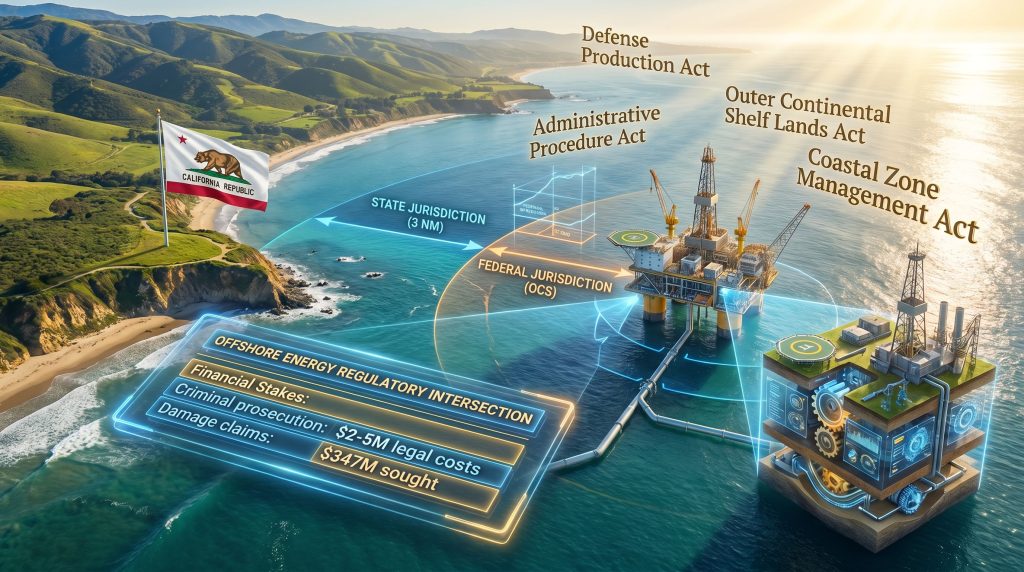
California's offshore regulatory landscape reflects a multi-layered governance structure where federal agencies maintain jurisdiction over outer continental shelf activities while state authorities exercise control over coastal zone management and onshore infrastructure connections. This jurisdictional complexity creates potential conflicts when energy projects span both federal waters and state-controlled coastal areas.
Federal vs. State Jurisdiction in Offshore Pipeline Operations
The Santa Ynez Pipeline System operates across multiple jurisdictional boundaries, creating enforcement challenges when state and federal priorities diverge. Federal oversight typically covers offshore platforms and pipeline segments in federal waters, while state agencies regulate onshore terminals and coastal zone impacts through comprehensive permitting frameworks.
Constitutional commerce clause principles generally favour federal authority over interstate energy infrastructure, yet states retain significant environmental protection powers through coastal zone management programmes. These overlapping authorities can produce regulatory conflicts when federal energy security priorities clash with state environmental protection mandates.
Recent developments in federal energy policy, including executive order on permits for critical infrastructure, provide federal authorities with enhanced powers to prioritise energy projects. However, the application of such emergency powers to private offshore operations remains legally complex and subject to constitutional limitations.
California's Coastal Development Permit Requirements
The California Coastal Commission exercises broad authority over development activities within the coastal zone, requiring permits for major infrastructure modifications or operational changes. These permits evaluate environmental impacts, public access considerations, and consistency with local coastal programmes.
Senate Bill 237 established specific requirements for offshore energy facilities, mandating environmental review processes for idle facilities seeking to resume operations. The legislation creates additional compliance obligations beyond federal oversight, potentially extending approval timelines and increasing operational costs.
State park easement requirements add another layer of complexity, particularly where pipeline infrastructure crosses state-owned lands. Easement renewals require demonstration of environmental compliance and may include updated terms reflecting current environmental standards and public access requirements.
When big ASX news breaks, our subscribers know first
How Do Multi-Jurisdictional Disputes Impact Offshore Energy Projects?
Multi-jurisdictional regulatory conflicts create cascading effects that extend far beyond immediate compliance costs, fundamentally altering project economics and operational timelines. The intersection of federal emergency powers with state environmental authority generates legal uncertainties that complicate long-term planning and investment decisions.
The Anatomy of Federal-State Legal Conflicts
Administrative Procedure Act challenges represent a primary mechanism for contesting federal intervention in state regulatory processes. These challenges typically allege that federal agencies exceeded statutory authority or failed to follow proper rulemaking procedures when asserting emergency powers over state-regulated activities.
State sovereignty claims invoke constitutional principles limiting federal interference with traditional state functions, particularly environmental protection and land use regulation. California's assertion of coastal zone management authority reflects broader federalism tensions between national energy policy and state environmental priorities.
The Sable Offshore legal challenges demonstrate how these constitutional tensions manifest in practice, as federal support for continued operations conflicts with state-level enforcement actions and permit requirements. The resolution of such conflicts often requires extended litigation or negotiated settlements addressing both federal and state concerns.
Criminal vs. Civil Enforcement Mechanisms
Criminal prosecution by county authorities adds a significant dimension to regulatory enforcement, creating potential personal liability for corporate officers and operational personnel. Unlike civil penalties, criminal charges carry imprisonment risks and can fundamentally alter settlement negotiations and compliance strategies.
California Coastal Commission civil penalty structures provide substantial enforcement leverage, with maximum fines reaching millions of dollars for unpermitted activities. The commission's authority extends to ordering cessation of operations pending permit compliance, creating immediate operational risks for non-compliant facilities.
Damage claims represent a third enforcement mechanism, potentially involving massive financial exposure for operators. These claims may seek compensation for environmental harm, lost public access, or restoration costs, often exceeding operational revenues by substantial margins.
| Legal Challenge Category | Estimated Financial Impact | Typical Timeline | Resolution Probability |
|---|---|---|---|
| Criminal prosecution | $2-5M legal costs | 12-18 months | Medium |
| Coastal Commission penalties | Up to $18M assessed | Ongoing appeals | Variable |
| Environmental damage claims | Potentially $300M+ | 24+ months | Low |
| Federal litigation costs | $5-10M expenses | 18-24 months | Medium |
What Environmental Compliance Issues Drive These Legal Disputes?
Environmental compliance forms the foundation of most offshore energy disputes in California, as operators must demonstrate adherence to increasingly stringent standards while maintaining operational viability. Current production at the Santa Ynez Unit involves 40 wells across Platform Harmony and Platform Heritage generating approximately 750 barrels per day per well, representing significant environmental monitoring obligations.
Pipeline Integrity and Environmental Safety Standards
Pipeline integrity management programmes require comprehensive monitoring systems, regular inspections, and immediate response protocols for potential environmental threats. The Santa Ynez Pipeline System resumed transportation under enhanced integrity management protocols designed to prevent future environmental incidents.
Post-incident regulatory requirements often mandate upgraded monitoring systems, increased inspection frequencies, and enhanced emergency response capabilities. These requirements can substantially increase operational costs while providing greater environmental protection assurance to regulatory agencies and affected communities.
Environmental impact assessment obligations extend beyond initial project approvals to ongoing operational monitoring and periodic reassessment of environmental effects. Operators must demonstrate continued compliance with water quality standards, marine life protection requirements, and air emission limitations.
Coastal Zone Management and Habitat Protection
Marine sanctuary considerations significantly influence pipeline routing decisions and operational protocols in California waters. The Monterey Bay National Marine Sanctuary and Channel Islands National Marine Sanctuary create additional regulatory layers requiring specialised consultation processes and enhanced environmental protection measures.
Terrestrial ecosystem impacts from onshore infrastructure require comprehensive habitat assessment and mitigation planning. Facilities crossing sensitive coastal environments must implement protection measures addressing endangered species, wetland impacts, and coastal erosion concerns.
Climate change adaptation requirements increasingly influence coastal infrastructure planning, as operators must demonstrate resilience to sea level rise, increased storm intensity, and changing environmental conditions. These adaptation requirements add complexity to permit applications and operational planning processes, particularly in light of energy security challenges facing the sector.
How Do Emergency Federal Powers Interact with State Environmental Authority?
The application of federal emergency powers to override state environmental regulations represents one of the most contentious aspects of energy infrastructure governance. The Defense Production Act provides broad federal authority to prioritise critical infrastructure projects, yet constitutional limitations and practical considerations constrain its application.
Defense Production Act Applications in Energy Infrastructure
National security justifications for energy project acceleration require demonstration of critical supply chain impacts or strategic resource needs. Federal authorities have supported continued Santa Ynez Unit operations under emergency frameworks emphasising domestic energy supply contributions to national security.
Historical precedent for federal override of state regulations exists primarily in wartime or declared emergencies, with peacetime applications remaining relatively rare and legally complex. The scope of emergency authority application to private energy infrastructure continues evolving through administrative practice and court decisions.
Constitutional limits on federal emergency powers include due process requirements, property rights protections, and federalism principles preserving state authority over traditional local functions. These limitations constrain federal ability to permanently override state environmental regulations without legislative authorisation or clear emergency justification.
Trespass and Property Rights in State-Owned Lands
Gaviota State Park land use restrictions create additional compliance requirements for pipeline infrastructure crossing state-owned property. State park easements typically include specific environmental protection terms, public access considerations, and restoration obligations that may conflict with operational needs.
Easement termination and renewal processes provide state authorities with leverage to impose updated environmental standards and operational requirements. Renewal negotiations often result in enhanced monitoring requirements, increased financial security obligations, and stricter environmental performance standards.
Public trust doctrine applications to energy infrastructure reflect California's broad interpretation of state authority over natural resources and public lands. This doctrine potentially supports state authority to impose environmental conditions even when federal agencies assert primary regulatory jurisdiction.
What Alternative Compliance Strategies Are Available to Offshore Operators?
Innovative technological solutions and regulatory approaches offer potential pathways for resolving complex jurisdictional disputes while maintaining environmental protection and operational viability. Floating treatment vessel technology represents one promising alternative that could address onshore pipeline restrictions while providing equivalent environmental protection.
Floating Treatment Vessel Technology Solutions
Offshore processing capabilities through floating treatment vessels could eliminate reliance on controversial onshore pipeline infrastructure while providing enhanced environmental monitoring and control. These vessels can process produced water, separate oil and gas streams, and implement advanced environmental protection systems without permanent coastal infrastructure.
Technical feasibility considerations include vessel positioning capabilities, weather resistance, and processing capacity relative to production volumes. Advanced floating treatment systems can handle production rates exceeding 10,000 barrels per day while maintaining strict environmental standards and providing real-time monitoring capabilities.
Regulatory pathway advantages include potential expedited permitting through federal offshore authorities rather than complex state coastal zone processes. Federal agencies may view floating treatment systems more favourably as they avoid permanent coastal zone impacts while providing enhanced environmental protection through advanced technology.
Permit Transfer and Operational Succession Models
Requirements for assuming predecessor operator permits involve comprehensive due diligence processes examining environmental compliance history, financial capacity, and technical capabilities. Regulatory agencies typically require demonstration of enhanced environmental protection capabilities and sufficient financial resources for ongoing compliance and potential remediation.
Due diligence standards encompass environmental site assessments, regulatory compliance audits, and financial capacity evaluations. Acquiring operators must demonstrate ability to meet all existing permit conditions while potentially accepting additional requirements based on updated environmental standards or operational changes.
Risk assessment frameworks evaluate predecessor liability exposure, ongoing environmental obligations, and potential regulatory changes affecting future operations. These assessments guide negotiation of acquisition terms, insurance requirements, and financial security obligations, particularly given insights from other sectors experiencing class action lawsuit insights.
"The successful resolution of complex offshore energy disputes requires innovative approaches that address both environmental protection imperatives and energy security needs through collaborative regulatory frameworks and advanced technological solutions."
What Are the Long-Term Implications for California's Offshore Energy Sector?
The resolution of Sable Offshore legal challenges will establish precedents affecting future offshore energy development throughout California and potentially other coastal states. Investment decisions increasingly incorporate regulatory uncertainty costs, potentially deterring capital allocation to California offshore projects relative to more predictable regulatory environments.
Regulatory Certainty and Investment Climate
Prolonged litigation creates investment uncertainty that extends beyond immediate project participants to affect sector-wide capital allocation decisions. The $180 million investment commitment through year-end 2026 for Santa Ynez Unit facility upgrades demonstrates continued operator confidence despite regulatory challenges, yet broader sector investment may decline without resolution clarity.
Insurance and bonding requirements for offshore operations reflect regulatory uncertainty through increased costs and coverage limitations. Operators may face higher premiums, larger deductibles, and more restrictive coverage terms when regulatory disputes create potential liability exposure exceeding traditional operational risks.
Market confidence indicators include permit application volumes, exploration activity levels, and merger and acquisition transaction frequencies. Extended regulatory uncertainty typically reduces these indicators as operators delay investment decisions pending clarity on compliance frameworks and enforcement approaches.
Policy Evolution and Future Compliance Frameworks
Emerging environmental standards continue evolving toward more stringent protection requirements, including enhanced marine life protection measures, advanced monitoring technologies, and climate change adaptation requirements. Operators must anticipate these evolving standards in long-term planning and facility design decisions.
Integration of climate policy with energy security objectives creates complex balancing requirements for regulatory agencies and operators. California's carbon neutrality goals may influence offshore energy permitting decisions while federal energy security priorities support continued domestic production capabilities.
Stakeholder engagement models increasingly emphasise early consultation, transparent communication, and collaborative problem-solving approaches. Successful operators develop comprehensive stakeholder engagement strategies addressing community concerns, environmental group priorities, and regulatory agency requirements through proactive communication and compromise.
The next major ASX story will hit our subscribers first
How Should Industry Participants Prepare for Similar Regulatory Challenges?
Proactive regulatory strategy development enables operators to anticipate and mitigate complex jurisdictional disputes before they escalate to enforcement actions or litigation. Comprehensive compliance planning addresses multiple regulatory layers while building positive relationships with key agencies and stakeholder groups.
Risk Assessment and Mitigation Strategies
Early engagement with multiple regulatory authorities prevents conflicting interpretations and requirements that complicate compliance efforts. Operators should establish regular communication channels with federal agencies, state environmental agencies, local authorities, and affected communities to identify potential conflicts before they become enforcement issues.
Comprehensive environmental compliance planning incorporates current requirements with anticipated regulatory evolution, ensuring facilities can adapt to changing standards without major operational disruptions. This planning includes technology upgrade pathways, monitoring system enhancements, and emergency response capability development.
Legal contingency planning prepares operators for potential disputes through early identification of legal counsel, development of litigation strategies, and establishment of financial reserves for legal costs. Contingency planning should address both defensive strategies and proactive approaches to resolve disputes through negotiation or alternative dispute resolution.
Such planning considerations should also account for broader industry trends, including grade king permitting insights that may influence future regulatory approaches across extractive industries.
Best Practices for Regulatory Relationship Management
Proactive communication with state and federal agencies builds trust and facilitates collaborative problem-solving when disputes arise. Regular briefings, voluntary compliance updates, and early notification of potential issues demonstrate operator commitment to environmental protection while maintaining productive working relationships.
Community stakeholder engagement protocols should identify key community groups, environmental organisations, and local government representatives while establishing regular communication channels and feedback mechanisms. Effective engagement addresses community concerns through transparent information sharing and responsive problem-solving.
Transparent reporting and monitoring systems provide regulatory agencies and communities with confidence in environmental protection efforts while demonstrating operator commitment to accountability. Advanced monitoring technologies enable real-time data sharing and immediate response to potential environmental concerns.
Furthermore, understanding how broader geopolitical factors influence domestic energy policy, such as US policy change impact on international energy markets, can inform strategic planning for regulatory challenges. Additionally, industry participants should monitor pipeline safety developments to understand evolving judicial perspectives on infrastructure operations.
Frequently Asked Questions
Can federal emergency powers permanently override state environmental regulations?
Federal emergency authorities provide temporary intervention capabilities during declared emergencies, but long-term operations typically require resolution of underlying state regulatory compliance issues through negotiated agreements, legislative action, or court decisions establishing jurisdictional boundaries.
What factors determine the success of damage claims against regulatory agencies?
Success in damage claims against regulatory agencies depends on demonstrating regulatory overreach, procedural violations, constitutional rights infringement, or arbitrary and capricious decision-making, with courts applying strict scrutiny to government actions affecting private property rights.
How do criminal charges affect ongoing civil regulatory proceedings?
Criminal proceedings create additional legal exposure and potential personal liability while potentially influencing civil settlement negotiations, though criminal and civil matters operate under different legal standards and burden of proof requirements.
The Sable Offshore legal challenges represent a watershed moment for California's offshore energy sector, establishing precedents that will influence regulatory approaches, investment decisions, and operational strategies for years to come. Understanding these complex regulatory dynamics enables industry participants to navigate similar challenges more effectively while contributing to the development of balanced frameworks that protect environmental resources whilst supporting domestic energy security objectives.
Ready to Capitalise on Energy Sector Opportunities?
Discovery Alert's proprietary Discovery IQ model delivers real-time alerts on significant ASX mineral discoveries, instantly empowering subscribers to identify actionable opportunities ahead of the broader market. Begin your 14-day free trial today and secure your market-leading advantage.