July 11, 2026
The Anatomy of a Sector in Retreat: Cameroon's Hydrocarbon Crossroads
Across sub-Saharan Africa, small-to-mid-tier oil producers face a challenge that rarely makes international headlines: the slow, compounding erosion of production from ageing basins that were developed decades ago, combined with insufficient reinvestment to sustain output. This is not a story about geopolitical disruption or sudden price collapse. It is a story about structural depletion, and few countries illustrate its consequences more clearly than Cameroon.
The Cameroon oil and gas activity drop now formally projected by the government is the visible surface of a much deeper problem. Understanding what is driving that drop, why it is set to intensify in 2027, and whether the anticipated recovery is grounded in realistic assumptions requires examining the sector from multiple angles simultaneously.
When big ASX news breaks, our subscribers know first
Four Decades of Declining Output: The Long View
Cameroon's hydrocarbon sector once occupied a central position in the national economy. At its mid-1980s peak, the sector contributed 14.5% of GDP, generating revenues that underpinned government spending across infrastructure, social services, and public administration.
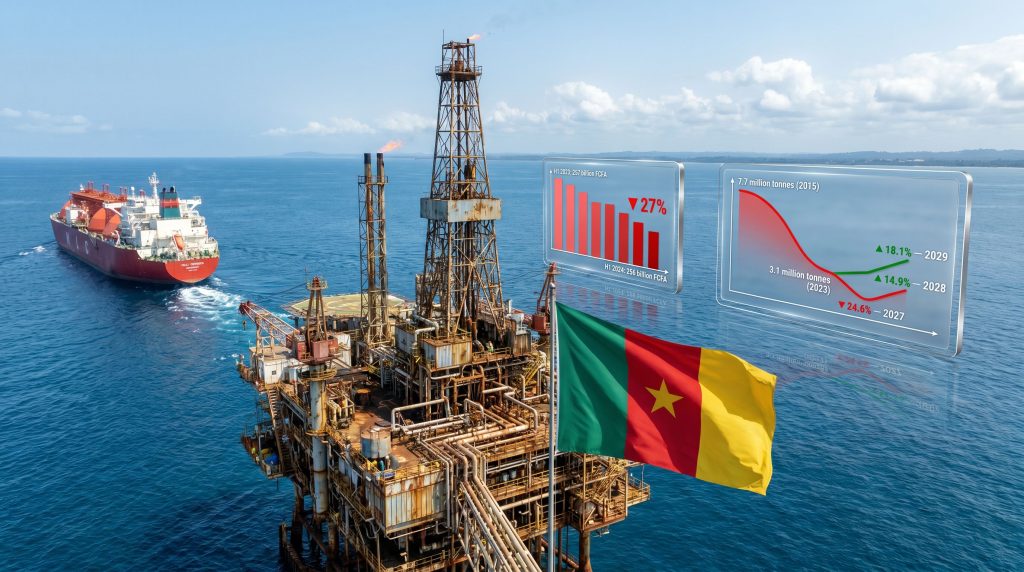
That era is now a distant reference point. By 2022, the sector's GDP contribution had contracted to 5.4%, and total crude oil production had fallen from approximately 7.7 million tonnes in 2015 to around 3.1 million tonnes by 2023, representing a decline of nearly 60% in under a decade.
This trajectory reflects the natural depletion curve of fields developed without adequate reinvestment in exploration or enhanced recovery techniques. When mature fields are not supplemented by new discoveries, output declines are not only predictable but mathematically inevitable. Furthermore, Cameroon now holds the position of the smallest oil producer in sub-Saharan Africa, a ranking that carries disproportionate fiscal consequences for a government still structurally dependent on hydrocarbon revenues.
Revenue Compression Already Underway: The 2024 Data
The fiscal effects of declining production were already measurable well before the projected 2027 trough. In the first half of 2024, Cameroon's hydrocarbon sector delivered a stark demonstration of dual compression — the simultaneous decline of both volumes and prices.
| Metric | H1 2023 | H1 2024 | Change |
|---|---|---|---|
| Oil production (barrels) | 11.9 million | 11.1 million | ▼ 6.7% |
| Marketed volume (barrels) | 7.01 million | 6.1 million | ▼ 13% |
| Gas production (BTU) | 48.5 billion | 42.5 billion | Significant decline |
| Hydrocarbon sales revenue | 351 billion FCFA | 256 billion FCFA | ▼ 27% |
| Full-year target progress (mid-year) | N/A | 33% of 801 billion FCFA | Below target |
The revenue decline of approximately 95 billion FCFA in the first half of 2024 compared to the same period in 2023 was amplified by global Brent crude prices falling below $69 per barrel. The crude oil price trends observed globally during this period compounded the damage for budget-dependent producers with limited financial buffers. The interaction between lower export volumes and lower export prices creates a revenue shortfall that is disproportionately damaging relative to the scale of the production decline itself.
The fact that Cameroon had achieved only 33% of its full-year hydrocarbon revenue target by mid-2024 illustrates just how precarious the fiscal position had become before the projected 2027 contraction even arrives.
The National Hydrocarbons Corporation (SNH) has identified two primary structural drivers behind this deteriorating picture: the continued exploitation of ageing deposits without adequate enhanced recovery investment, and a sustained reduction in capital expenditure directed at exploration. Together, these factors have created a widening gap between what existing fields can produce and what the national budget requires.
The 2027 Contraction: Quantifying the Coming Shock
Cameroon's Ministry of Finance has formally incorporated a 24.6% contraction in oil and gas activity in 2027 into its 2027-2029 Medium-Term Economic and Budgetary Programming Document (DPEB). This projection is not a pessimistic scenario. It is the government's central forecast, reflecting a specific and identifiable catalyst. The commodity price impact on revenue planning adds a further layer of complexity to an already challenging outlook.
The Hilli Episeyo Departure: Losing the Only LNG Export Capability
The single most consequential near-term event for Cameroon's hydrocarbon sector is the scheduled departure of the Hilli Episeyo floating LNG vessel from Cameroonian waters in July 2026. This vessel, a converted floating liquefied natural gas unit, transformed Cameroon into an LNG exporter when it commenced operations in 2018. The broader LNG supply outlook for 2025 and beyond makes Cameroon's position particularly sensitive to this infrastructure loss.
Key facts about the Hilli Episeyo operation:
- The vessel was developed through a tripartite partnership involving Golar LNG (Norway), SNH, and Perenco (France)
- The partnership focused on monetising gas from the Sanaga South and Ebome fields off the coast of Kribi
- Annual LNG production capacity was increased from 1.2 million tonnes to 1.4 million tonnes in 2022
- The vessel's departure after eight years of service eliminates Cameroon's entire LNG export infrastructure
What makes this particularly significant from an analytical standpoint is that floating LNG technology was what made Cameroon's gas monetisation economically viable in the first place. Converting offshore gas reserves into exportable LNG without constructing permanent onshore liquefaction infrastructure was a capital-efficient solution. Its removal leaves a gap that cannot be quickly filled without either a new FLNG vessel contract or substantial permanent infrastructure investment.
Fiscal Mathematics of a 24.6% Sector Contraction
For a government that was already struggling to meet its hydrocarbon revenue targets in 2024, the projected 2027 contraction introduces a compounding fiscal challenge. Budget planners must account for:
- Reduced hydrocarbon transfers to the treasury at a time when the non-oil revenue base is still being developed
- Potential increases in external financing requirements to bridge the revenue shortfall
- Timing risk: the contraction is projected to arrive before new fields reach production-ready status, creating an unavoidable revenue trough
The 2028-2029 Recovery Scenario: Credible or Aspirational?
The government's projections do not end at the 2027 trough. The DPEB forecasts a meaningful rebound in subsequent years.
| Year | Projected Change in Oil and Gas Activity |
|---|---|
| 2027 | ▼ 24.6% |
| 2028 | ▲ 14.9% |
| 2029 | ▲ 18.1% |
This recovery pathway is contingent on new upstream projects moving from the contract negotiation phase to active production within a compressed timeframe. In August 2025, SNH launched an international call for expressions of interest across nine exploration and production blocks in the Rio del Rey and Douala/Kribi-Campo basins. By April 2026, five blocks had been awarded for production-sharing contract negotiations.
| Operator | Block | Basin |
|---|---|---|
| Octavia Energy Corporation Limited | Bolongo | Rio del Rey |
| Murphy West Africa Ltd. | Etinde Exploration | Douala/Kribi-Campo |
| Murphy West Africa Ltd. | Tilapia | Douala/Kribi-Campo |
| Murphy West Africa Ltd. | Elombo | Douala/Kribi-Campo |
| Murphy West Africa Ltd. | Ntem | Douala/Kribi-Campo |
The concentration of four awarded blocks in the Douala/Kribi-Campo Basin reflects its perceived prospectivity for both oil and gas accumulations. Murphy West Africa's multi-block positioning in the basin suggests a strategic commitment to building a material acreage position rather than pursuing isolated exploration targets.
The Execution Dependency Chain
For the 2028 recovery to materialise on schedule, the following milestones must be completed sequentially and without material delay:
- Contract finalisation of production-sharing agreements for all five awarded blocks
- Capital commitment by operators to fund development programmes within a timeline consistent with 2028 first production
- Development execution covering drilling campaigns, subsea or surface infrastructure, and facility commissioning
- First production and ramp-up reaching volumes sufficient to offset the Hilli Episeyo departure and natural field decline
Each stage in this chain carries independent execution risk. In frontier exploration environments, slippage at any single stage can delay the entire recovery timeline by twelve to twenty-four months.
This does not make the recovery impossible, but it does mean the government's timeline should be treated as an optimistic scenario rather than a confirmed outcome.
Structural Reform: The Variable That Determines Long-Term Trajectory
New block awards and recovery projections address the near-term production gap, but they do not resolve the structural conditions that have driven the Cameroon oil and gas activity drop over the past four decades. Three reform dimensions will determine whether any near-term recovery translates into durable sector growth.
Investment Climate and Contract Terms
Production-sharing agreements must offer terms competitive enough to attract operators willing to commit capital to a market with declining legacy production. Fiscal terms, local content frameworks, and regulatory predictability all influence how Cameroon stacks up against peer basins in Central and West Africa. The broader geopolitical risk landscape also shapes how international oil companies allocate exploration budgets across competing markets.
Sustained Exploration Intensity
A single nine-block licensing round, while meaningful, does not constitute the sustained exploration investment required to build a durable production pipeline. Countries in comparable geological settings have demonstrated that consistent multi-cycle licensing activity, combined with technical promotion of under-explored basin areas, can extend productive field life and unlock new resource horizons. However, piracy and security concerns in Cameroonian waters continue to weigh on investor confidence and complicate exploration commitments.
Fiscal Diversification
Cameroon's structural dependence on hydrocarbon revenues for budget funding amplifies the impact of every production cycle. Furthermore, the trade war economic impact on global commodity demand adds yet another variable that budget planners must navigate. Broadening the non-oil tax base, improving revenue administration efficiency, and accelerating the development of non-extractive economic sectors would materially reduce the fiscal shock of future production downturns.
The next major ASX story will hit our subscribers first
How Cameroon Compares to Regional Peers
| Country | Production Trend | Key Dynamic |
|---|---|---|
| Cameroon | Long-term decline | Ageing fields, smallest SSA producer |
| Equatorial Guinea | Declining | Mature offshore assets, gas monetisation challenges |
| Gabon | Moderate decline | Diversified basin portfolio, active relicensing |
| Congo (Brazzaville) | Stable to declining | Deepwater potential partially offsets mature field depletion |
| Nigeria | Structurally challenged but large base | Scale provides resilience; governance issues persist |
Cameroon's status as the smallest oil producer in sub-Saharan Africa means it cannot absorb volume and price shocks the way larger producers can. A 6.7% production decline that would be manageable for Nigeria represents a proportionally far more significant fiscal event for Cameroon. This asymmetry makes the pace and quality of new field development disproportionately important to national budget stability.
Frequently Asked Questions
Why is a 24.6% drop in Cameroon's oil and gas activity projected for 2027?
The contraction reflects two converging factors: the July 2026 departure of the Hilli Episeyo floating LNG vessel, which eliminates Cameroon's only LNG export capacity, combined with the continued natural decline of crude oil output from mature fields. Together these forces are expected to reduce overall hydrocarbon sector activity by nearly a quarter in 2027.
When did Cameroon's oil production begin its long-term decline?
Production has been in structural retreat since the mid-1980s. Output fell from approximately 7.7 million tonnes in 2015 to around 3.1 million tonnes by 2023. The sector's GDP contribution contracted from 14.5% at its peak to 5.4% by 2022.
What new projects could support Cameroon's hydrocarbon recovery after 2027?
Five blocks were awarded for contract negotiations in April 2026: the Bolongo block in the Rio del Rey Basin awarded to Octavia Energy, and four blocks in the Douala/Kribi-Campo Basin awarded to Murphy West Africa. If agreements are finalised and development proceeds on schedule, the government forecasts activity to recover 14.9% in 2028 and 18.1% in 2029.
How significant was the 2024 revenue shortfall?
Hydrocarbon sales revenues fell from 351 billion FCFA in H1 2023 to 256 billion FCFA in H1 2024, a decline of approximately 27%. By mid-2024, only 33% of the government's full-year hydrocarbon revenue target of 801 billion FCFA had been reached.
Key Takeaways
- The 2027 contraction is structural, not cyclical, representing the culmination of decades of production decline and the imminent loss of Cameroon's sole LNG export infrastructure
- Revenue compression was already measurable in 2024, with a 27% year-on-year decline in hydrocarbon sales revenues signalling the fiscal pressure building ahead of the projected trough
- The 2028-2029 rebound is contingent on execution, requiring contract finalisation, capital commitment, development completion, and first production to all proceed on schedule across newly awarded blocks
- New block awards are necessary but not sufficient, representing the starting point rather than the completion of a recovery pathway
- Structural reform remains the missing variable: without improvements to investment climate competitiveness, exploration intensity, and fiscal diversification, Cameroon risks repeating the same cycle of contraction once any near-term recovery plateaus
Disclaimer: This article contains forward-looking projections sourced from Cameroon's Ministry of Finance planning documents. Such projections are inherently uncertain and subject to change based on commodity prices, operator investment decisions, regulatory developments, and broader macroeconomic conditions. Nothing in this article constitutes financial or investment advice.
Want to Track the Next Major Mineral Discovery Before the Broader Market Does?
Discovery Alert's proprietary Discovery IQ model delivers real-time alerts on significant ASX mineral discoveries, transforming complex geological data into actionable investment insights for traders and long-term investors alike — explore historic discoveries and their returns to see what early positioning can mean, then begin your 14-day free trial at Discovery Alert to secure your market-leading edge.