July 21, 2026
The Refining Bottleneck That Battery Supply Chains Cannot Afford to Ignore
Long before a single electric vehicle rolls off a production line, its battery has already passed through one of the most concentrated industrial chokepoints in the modern global economy. The refining of raw lithium ore into battery-grade compounds is a step so technically demanding and capital-intensive that it has become almost entirely dominated by a single nation. Understanding why that concentration matters, and what it takes to break it, is essential context for evaluating what a Canada battery-grade lithium refinery has just accomplished in Delta, British Columbia.
The commissioning of North America's first commercial-scale electrochemical lithium refinery in April 2026 is not simply a corporate milestone. It is a direct response to a structural vulnerability that Western governments and battery manufacturers have spent years acknowledging but largely failing to address. That changes now, at least in part.
When big ASX news breaks, our subscribers know first
How Deep Does China's Lithium Refining Dominance Actually Run?
The Processing Stage Is Where the Real Power Lies
Raw lithium ore is abundant across multiple continents. Australia, Chile, Argentina, Canada, and the United States all hold significant lithium mineral reserves. However, abundance at the extraction stage offers no strategic advantage if the refining infrastructure required to convert that ore into battery-usable compounds sits almost entirely in one country.
According to Wood Mackenzie, China controls approximately 50% of the global lithium market, and that control extends well beyond extraction into the high-value processing and refining stages. As EE Times reported in 2025, China has spent more than a decade deliberately building its position across the entire EV battery supply chain, a consolidation effort that now functions as a formidable competitive barrier protecting Chinese battery manufacturers from external rivals.
The implications of this concentration are layered:
- Nations with substantial lithium mineral reserves are still compelled to export raw ore for processing, then reimport refined compounds at substantially higher prices
- Western battery manufacturers and EV producers face both price risk on refined lithium imports and geopolitical exposure tied to trade relations with Beijing
- Any disruption to Chinese refining capacity, whether through trade policy, diplomatic tension, or industrial accident, flows directly into global battery supply chains with limited alternatives available
The 2026 energy market context has sharpened this concern considerably. With Brent crude surpassing $105 per barrel amid escalating tensions around the Strait of Hormuz, the pressure to accelerate sovereign clean energy supply chains has reached a political intensity rarely seen outside of wartime industrial policy. Furthermore, the battery raw materials market is experiencing a structural shift that makes domestic refining capacity more strategically valuable than ever before.
The "Missing Middle" That Western Investment Skipped Over
There is a particularly instructive pattern in how Western nations have historically deployed capital in the lithium sector. Investment has flowed toward two poles: the extraction end, where mining operations pull lithium-bearing minerals from the ground, and the manufacturing end, where battery cells and EV drivetrains are assembled. The intermediate refining step received comparatively little Western investment for years.
This gap is critical because the refining stage is where raw spodumene concentrate, the hard-rock lithium mineral abundant in Canadian and Australian deposits, is transformed into a compound pure enough to meet cathode manufacturing specifications. Without domestic refining capacity, even mineral-rich countries remain dependent on external processing. Understanding spodumene extraction basics helps clarify just how much value is lost when refining occurs offshore.
Spodumene is a lithium-bearing pyroxene mineral found in pegmatite rock formations. It requires multi-stage processing to convert into battery-grade lithium hydroxide, a form usable in high-performance lithium-ion cathodes. The distinction between spodumene concentrate and refined lithium hydroxide is the difference between a raw agricultural commodity and a finished pharmaceutical, in terms of both value and technical complexity.
What the Delta, BC Facility Actually Represents Technically
North America's First Commercial Electrochemical Lithium Refinery: Key Specifications
| Metric | Detail |
|---|---|
| Facility Location | Delta, British Columbia, Canada |
| Commissioning Date | April 16, 2026 |
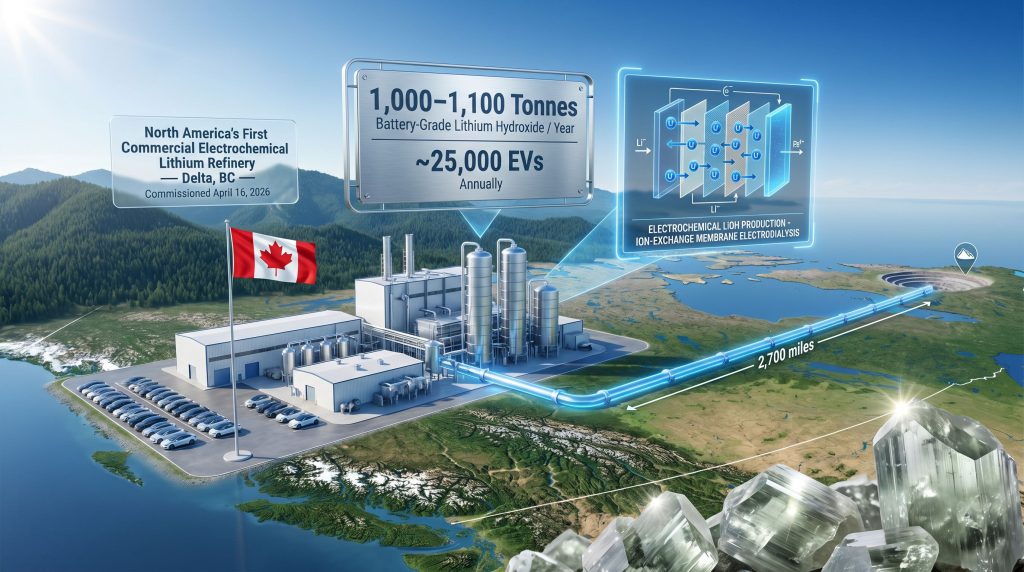
| Annual Production Capacity | 1,000–1,100 tonnes of battery-grade lithium hydroxide |
| EV Support Equivalent | Approximately 25,000 electric vehicles per year |
| Core Technology | Proprietary electrochemical process including electrodialysis |
| Federal Funding Commitment | Up to CAD $21.88 million via Natural Resources Canada Critical Minerals Programme |
| Planned Eastern Canada Expansion | Targeting output sufficient to supply 500,000 EVs annually |
The facility, operated by Mangrove Lithium, is described by its founder as proof that lithium can be refined domestically, sustainably, and at commercially competitive cost. That claim carries weight precisely because it is being demonstrated at commercial scale rather than in a laboratory or pilot setting.
Why Electrochemical Refining Is Genuinely Different
The distinction between conventional lithium refining and Mangrove's electrochemical approach is not merely a marketing differentiation. It reflects a fundamentally different chemistry and engineering philosophy.
Traditional lithium refining follows an acid-leach pathway:
- Spodumene concentrate is roasted at high temperature to convert it to a more chemically reactive form
- The material is leached with sulphuric acid to dissolve lithium into solution
- Lithium is precipitated out of solution using lime or sodium carbonate
- The resulting lithium compound is filtered, washed, and dried to specification
- Significant sulphate waste streams are generated throughout, requiring treatment and disposal
Electrochemical refining, as deployed at the Delta facility, operates through a different mechanism entirely:
- An applied electrical current drives ion-selective separation across ion-exchange membranes, a process known as electrodialysis
- Lithium ions migrate selectively through the membrane based on their charge and size, achieving purification without large volumes of chemical reagents
- Sodium and sulphuric acid generated within the process loop are recovered and recycled internally, eliminating the sulphate waste stream that plagues conventional refining
- The process operates flexibly across different feedstock compositions, including direct processing of spodumene concentrate
- Output per unit of feedstock is reportedly doubled compared to conventional approaches, representing a significant efficiency advantage
The electrodialysis component is particularly well-suited to British Columbia's energy profile. The province generates the overwhelming majority of its electricity from hydroelectric sources, meaning the energy-intensive ion-separation process can run on low-carbon power, dramatically reducing the lifecycle carbon footprint of the refined lithium hydroxide produced.
How Canada Is Building a Mine-to-Cathode Corridor
From Quebec Spodumene to BC Battery-Grade Lithium
The Delta facility does not operate in isolation. Mangrove Lithium has established a supply arrangement with North American Lithium's Quebec mining operation, creating a feedstock corridor that spans approximately 2,700 miles across Canada. This arrangement is the foundation of what would be Canada's first vertically integrated domestic lithium supply chain, running from raw spodumene extraction in the east through electrochemical refining in the west.
The structure matters strategically because it removes a critical dependency. In addition, how lithium mining works at the extraction stage directly influences the quality and composition of the feedstock that refineries like Delta must process, making integrated supply arrangements particularly valuable.
The Eastern Canada Expansion: A 20-Fold Scale-Up
The Delta facility's current output of 1,000–1,100 tonnes of battery-grade lithium hydroxide per year, supporting roughly 25,000 electric vehicles, is commercially significant but not transformative in isolation. Mangrove's planned second facility in Eastern Canada is where the strategic ambition becomes genuinely market-relevant.
The Eastern expansion is designed to deliver output sufficient to supply 500,000 electric vehicles annually, representing approximately a 20-fold increase in throughput. The facility is planned to process both refined lithium streams and raw spodumene concentrate, with feedstock sourced from Canadian mining operations.
Three scenarios frame what this trajectory could mean for North American supply chains:
Scenario A: Delta Only (Current State)
- Annual output: 1,000–1,100 tonnes of battery-grade lithium hydroxide
- EV-equivalent support: approximately 25,000 vehicles per year
- Strategic significance: commercial proof-of-concept for electrochemical refining in North America
- Market impact: minimal near-term effect on China's global refining share
Scenario B: Eastern Canada Expansion Completed
- Annual output scaled to 500,000 EV-equivalent capacity
- Canada established as a Tier 2 global lithium refiner
- North American battery manufacturers gain access to certified, domestically refined lithium
- Regional dependency on Chinese refining reduced by a quantifiable margin for the first time
Scenario C: Full Mine-to-Cathode Integration
- Canadian-sourced spodumene flows through electrochemical refining to cathode-ready lithium hydroxide
- Canada positioned as a vertically integrated critical minerals supplier to allied EV markets
- North American battery gigafactory supply chains supported by sovereign, traceable material with verifiable environmental credentials
These scenarios involve significant assumptions regarding financing timelines, permitting outcomes, feedstock agreement negotiations, and broader lithium market conditions. Investors and industry participants should treat forward projections as illustrative rather than guaranteed outcomes.
Canada's Federal Role: Industrial Policy in Action
What the Government's Financial Commitment Actually Signals
The Canadian federal government has committed up to CAD $21.88 million through Natural Resources Canada's Critical Minerals Infrastructure Programme to support the Delta facility. The funding is conditional and milestone-linked, meaning government capital is deployed in alignment with demonstrated technical progress rather than as an unconditional grant.
This funding model reflects a mature approach to de-risking first-of-kind industrial infrastructure. Early-stage refining facilities face the classic innovator's dilemma: the technology must be proven at commercial scale before private capital will commit fully, but reaching commercial scale requires capital that private investors are reluctant to deploy without proof. Government co-investment at the critical juncture resolves this deadlock without replacing private sector discipline.
Canadian Minister of Energy and Natural Resources Tim Hodgson has publicly framed the Delta facility as representative of the kind of sovereign industrial project Canada needs, emphasising its role in job creation, supply chain security, and low-carbon economic development, as reported by Interesting Engineering in April 2026.
Canada's Position Within the Global Refining Landscape
| Country/Region | Domestic Lithium Refining Status | Strategic Policy Framework |
|---|---|---|
| China | Controls approximately 50% of global market; fully integrated | Dominant; decades of deliberate investment |
| Australia | Emerging capacity at Kwinana and Kemerton facilities | Active government and private investment |
| United States | Limited; early-stage projects under development | Inflation Reduction Act domestic content incentives |
| Canada (post-April 2026) | First commercial facility operational in BC | Critical Minerals Strategy; federal co-investment |
| European Union | Pre-commercial; multiple pilot projects active | Critical Raw Materials Act regulatory framework |
The geopolitical context shaping Canada's approach in 2026 is notable. With national and economic security priorities elevated under Prime Minister Mark Carney's government, a critical minerals strategy has become a central pillar of Canadian industrial policy rather than a peripheral interest. Furthermore, direct lithium extraction technologies are increasingly complementing refining investments, creating a more complete domestic supply chain picture across allied nations.
The Environmental Ledger: What Domestic Refining Gains and What It Does Not Resolve
The Sustainability Case for Onshoring
From a lifecycle carbon perspective, the Delta facility's electrochemical refining approach offers genuine advantages over conventional methods and over importing Chinese-refined lithium processed using coal-heavy grid electricity. The combination of cleaner process chemistry and access to British Columbia's hydroelectric power grid creates a materially lower-carbon refined lithium product.
The specific environmental benefits of the electrochemical approach include:
- Elimination of sulphate waste streams that require separate treatment and disposal under conventional methods
- Internal recovery and recycling of sodium and sulphuric acid, reducing reagent consumption and associated waste
- Compatibility with renewable electricity inputs, enabling Scope 2 emissions reduction at the refining stage
- Reduced water consumption compared to some conventional acid-leach processes, though site-specific data has not been publicly quantified in available reporting
The Extraction-Side Questions That Remain Open
Cleaner refining technology does not neutralise the environmental burden associated with lithium extraction. Mining lithium-bearing spodumene from pegmatite rock formations involves land clearance, ore processing, tailings management, and water resource impacts that are independent of what happens at the refining stage. Academic research published in ScienceDirect has raised important questions about which communities will host lithium extraction sites and under what regulatory protections.
The ethical argument for domestic processing has genuine merit. Keeping the full production chain within jurisdictions that have stronger environmental regulations and Indigenous consultation requirements is preferable to outsourcing harm to communities with weaker legal protections. However, that argument only holds if domestic extraction is genuinely subject to rigorous oversight, meaningful community consent processes, and enforceable remediation obligations. The regulatory framework matters as much as the technology.
The next major ASX story will hit our subscribers first
Why 2026 Was Already Shaping Up as a Pivotal Year for Lithium
Market Dynamics Beyond the Refinery
Even before the Delta facility came online, industry observers had flagged 2026 as a significant year for the lithium sector. MIT Technology Review noted in January 2026 that the year was already shaping up as a hot period for lithium, driven by converging demand growth across EV adoption, grid-scale storage deployment, and consumer electronics.
The energy market backdrop has amplified this dynamic considerably. With oil prices elevated by Middle East supply disruptions and Brent crude trading above $105 per barrel, the economic case for electrification has strengthened in real time. Consequently, every barrel of oil that cannot flow through the Strait of Hormuz is an argument for accelerating domestic clean energy infrastructure, including the battery supply chains that underpin it.
For investors evaluating the critical minerals space, the commissioning of the Delta facility provides a useful data point: electrochemical lithium refining is no longer a theoretical proposition. It is operating at commercial scale in North America. As Motor Trend has noted, the question for market participants is not whether this technology works, but how quickly it can be replicated and scaled, and which companies, jurisdictions, and supply chain participants are positioned to benefit.
This article is intended for informational purposes only and does not constitute financial or investment advice. Forward-looking statements regarding facility expansions, production timelines, and market outcomes involve material risks and uncertainties. Readers should conduct their own due diligence before making investment decisions.
Frequently Asked Questions: Canada's Battery-Grade Lithium Refinery
What is battery-grade lithium and why does purity matter?
Battery-grade lithium refers to lithium compounds, primarily lithium hydroxide or lithium carbonate, refined to the exacting purity specifications required by lithium-ion battery cathode manufacturers. Even minor impurities can degrade battery performance, reduce cycle life, or create safety risks. The refining stage is where these specifications are achieved.
What makes electrochemical refining commercially significant beyond the environmental benefits?
The reported doubling of effective output per unit of feedstock compared to conventional methods has direct implications for production economics. If this efficiency advantage holds at sustained commercial scale, it could shift the cost competitiveness of North American refining relative to Chinese conventional capacity, which is the prerequisite for genuine market impact.
Has Canada produced battery-grade lithium before?
Canada has significant lithium mineral reserves, particularly in Quebec and the Northwest Territories, but has historically exported raw spodumene concentrate for overseas processing. The Delta facility marks the first time a Canada battery-grade lithium refinery has operated at commercial scale on domestic soil.
When might the Eastern Canada expansion become operational?
As of April 2026, the Eastern Canada facility remains in the planning and development phase. No confirmed commissioning timeline has been publicly announced. The scale-up involves financing, permitting, feedstock agreements, and engineering work that make specific timeline projections premature.
How does the Mangrove facility relate to North American Lithium in Quebec?
A memorandum of understanding between Mangrove Lithium and Quebec's North American Lithium mine establishes a feedstock supply corridor stretching approximately 2,700 miles across Canada, providing the spodumene concentrate that the Delta refinery processes into battery-grade lithium hydroxide.
Want to Track the Next Major Critical Minerals Discovery Before the Market Does?
Discovery Alert's proprietary Discovery IQ model scans ASX announcements in real time, instantly identifying significant mineral discoveries across lithium and more than 30 other commodities — turning complex data into actionable investment insights the moment they emerge. Explore why major mineral discoveries have historically delivered extraordinary returns and begin your 14-day free trial to position yourself ahead of the broader market.