June 20, 2026
The Geopolitical Architecture Behind Canada's Critical Minerals Push at the G7
Rarely in modern industrial history has the question of where minerals come from carried the same weight as how much they cost. That balance has now shifted decisively. The accelerating buildout of electric vehicle supply chains, advanced defence systems, and clean energy infrastructure has transformed critical minerals from a commodity category into a tier-1 national security concern. Against this backdrop, Canada critical minerals measures at G7 represent one of the most structurally significant multilateral interventions in resource governance in decades, moving well beyond trade rhetoric into concrete financing commitments, alliance architecture, and domestic project acceleration.
Understanding what Canada actually announced, and more importantly what it will take to deliver on those commitments, requires looking beneath the diplomatic headlines at the project economics, regulatory realities, and capital flows that will determine real-world outcomes.
When big ASX news breaks, our subscribers know first
Why the G7 Has Become the New Centre of Gravity for Minerals Governance
The fundamental vulnerability that forced this level of multilateral coordination is not difficult to identify. A disproportionate share of the world's critical mineral processing capacity is concentrated in a small number of countries, several of which sit outside the allied network. For battery metals, rare earths, and industrial minerals essential to both clean energy transition and advanced defence manufacturing, this concentration creates a structural fragility that no single bilateral trade agreement can adequately address.
The logic of multilateral coordination through the G7 framework rests on a straightforward premise: collective demand signals from allied economies are far more powerful than isolated national procurement strategies. When seven of the world's largest economies align their supply chain priorities, they create investable certainty that individual government commitments cannot replicate. This is the institutional architecture Canada moved to build during its 2025 G7 presidency.
Canada's credibility as an agenda-setter in this space is grounded in its domestic resource endowment. The country holds significant identified deposits of copper, nickel, cobalt, lithium, rare earths, phosphate, and graphite, giving it the standing to function not merely as a policy convenor but as an actual supply chain anchor. That combination of institutional leadership and resource wealth is rare among G7 nations. Furthermore, critical minerals demand continues to accelerate globally, reinforcing the urgency of this multilateral coordination.
Five Structural Pillars: What Canada's Framework Actually Contains
The G7 Critical Minerals Action Plan, launched under Canada's presidency, is organised around five interconnected policy pillars rather than a single headline commitment. Each pillar addresses a different dimension of the supply vulnerability problem.
| Policy Pillar | Core Objective |
|---|---|
| Supply Diversification and Investment | Accelerate responsible project development with local value creation |
| Standards-Based Markets Roadmap | Define traceability standards and minimum trade benchmarks |
| Public-Private Financing Coordination | De-risk projects via export credit agencies, DFIs, and multilateral lenders |
| Circular Economy Integration | Reduce supply vulnerability through recycling, substitution, and redesign |
| Emerging Economy Partnerships | Build capacity and infrastructure in mineral-rich developing nations |
The inclusion of the circular economy pillar is worth examining closely. While recycling and material substitution are frequently discussed in policy documents, their integration into a supply security framework rather than a sustainability framework signals a meaningful conceptual shift. Recycled materials can, under the right conditions, function as a strategic buffer against primary supply disruptions, particularly for metals with high recycling rates like copper and cobalt.
The emerging economy partnerships pillar addresses a less discussed dynamic: many of the world's largest undeveloped critical mineral deposits sit in nations that lack the infrastructure, capital, and technical capacity to bring them to production. Allied investment in those jurisdictions, structured carefully, serves a dual purpose of expanding the global supply base while deepening geopolitical relationships. In addition, energy security and critical minerals considerations are increasingly shaping how allied nations prioritise these partnerships.
13 Alliance Partnerships: The Deals Behind the Declaration
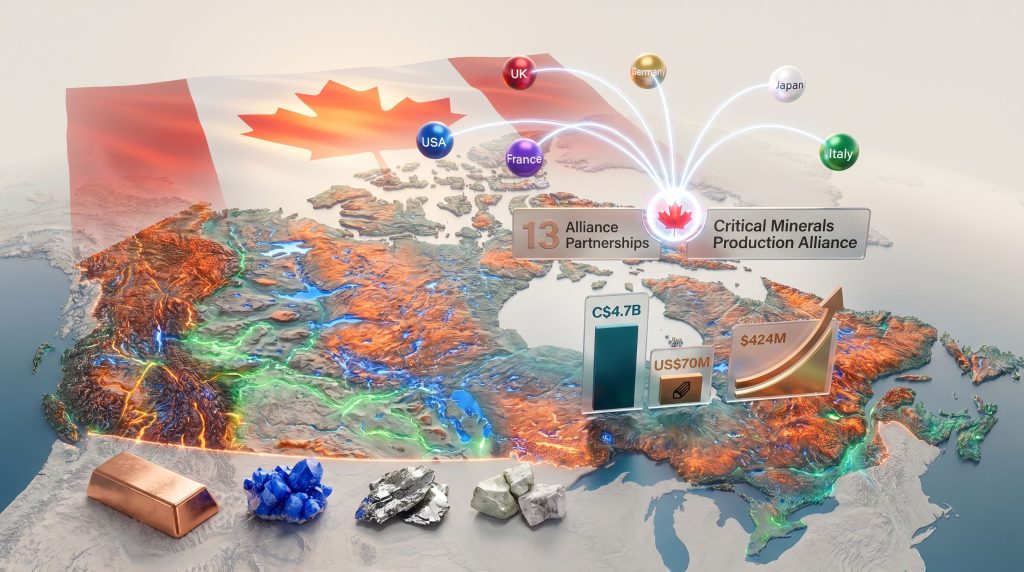
At the G7 summit in France, Prime Minister Mark Carney highlighted 13 new or recent Critical Minerals Resilience and Production Alliance partnerships spanning investments, offtake agreements, and bilateral financing arrangements. Several of the disclosed commitments carry material commercial significance.
- Italian energy major Eni committed US$70 million into Nouveau Monde Graphite's Matawinie graphite mine in Quebec, representing a significant vote of confidence in Canada's battery materials supply chain from a major European energy company
- Denmark's export credit agency entered a financing arrangement with Quebec-based First Phosphate, bringing Scandinavian development finance into Canadian phosphate development
- Japan's Sumitomo Corporation secured a rare earths offtake agreement with Ucore, linking a major Japanese industrial conglomerate to Canadian rare earth production at a time when supply security for these materials is a top priority for Japan's manufacturing sector
- A Canada-France critical minerals stockpile initiative was announced, introducing a strategic buffer mechanism designed to provide short-term supply security during disruption events
The stockpile initiative deserves particular attention because it operates on a different logic than production partnerships. While mines take years to develop, a jointly managed stockpile can provide near-term assurance during supply shocks. Comparable models include the U.S. National Defense Stockpile and the reserve frameworks being developed under the EU Critical Raw Materials Act. The European critical raw materials facility provides useful context here, as does the broader architecture of Europe's critical minerals supply chain. A Canada-France bilateral version of this concept, if operationalised effectively, could serve as a template for broader G7 stockpiling coordination.
The Critical Minerals Production Alliance functions as a coordinated geopolitical instrument, not merely a trade initiative. Its design intent is to reduce leverage held by non-allied resource-dominant economies while accelerating supply for advanced manufacturing and defence applications across allied nations.
Export Development Canada: Translating Policy Into Project Capital
Policy frameworks without capital deployment remain aspirational. The mechanism through which Canada is translating its G7 commitments into actual project financing is primarily Export Development Canada, whose mandate has expanded significantly to encompass direct critical minerals project debt facilities alongside its traditional export insurance role.
Two recent EDC-involved transactions illustrate both the scale of ambition and the complexity of execution.
Generation Mining's Marathon Copper-Palladium Project (Ontario)
Generation Mining secured a $424 million loan package from EDC alongside commercial lenders ING Capital and Société Générale. With this facility in place, total approved funding reaches $769 million toward a total construction cost of $992 million. The project is fully permitted and structured as an open-pit operation with an initial 13-year mine life, with a September construction decision anticipated once remaining funding gaps are closed.
The involvement of two major European commercial banks alongside EDC reflects growing international commercial appetite for Canadian critical minerals projects when regulatory risk is adequately de-risked through public co-financing.
Baffinland Iron Mines' Mary River Project (Nunavut)
EDC's extension of a $153 million bridge loan to Baffinland follows an Ontario Superior Court finding that the company held approximately $1 million in available cash, placing it at immediate operational risk. The bridge loan raises a nuanced policy question that the mining finance community is watching carefully: at what point does the strategic importance of a remote mining asset justify public lending institutions providing liquidity support that commercial lenders have declined to offer?
The answer likely depends on whether the asset's long-term production profile and strategic mineral classification outweigh the near-term credit risk, a calculation that is inherently political as much as financial.
British Columbia's Copper Pipeline: Two Projects, Two Different Stages
Canada's copper production ambitions are advancing most visibly in British Columbia, where two significant projects reached milestones during the same week, providing a useful comparative snapshot of where the Canadian copper pipeline actually sits.
| Project | Operator | Capital Cost | Mine Life | Key Metals | Current Status |
|---|---|---|---|---|---|
| New Ingerbelle Expansion (Copper Mountain) | Hudbay Minerals | Not disclosed | To 2045 | Cu, Au, Ag | Construction underway |
| Berg Project | Surge Copper | C$4.7 billion | 28 years | Cu, Mo, Ag | Prefeasibility complete |
Hudbay Minerals: New Ingerbelle Expansion
The official groundbreaking at Copper Mountain near Princeton, B.C., marks the transition from regulatory process to active capital deployment. The project received environmental and regulatory approvals from B.C.'s Major Mines Office in February 2026 and is expected to extend Copper Mountain's operating life to 2045. Lifetime production targets include approximately 750,000 tonnes of copper, 900,000 ounces of gold, and 5.5 million ounces of silver. The copper-gold-silver profile is commercially attractive because the precious metal by-product revenues materially improve the project economics compared with a pure copper operation.
Surge Copper: Berg Project Prefeasibility Study
Surge Copper's Berg project prefeasibility study reveals a significantly larger-scale development opportunity, though at an earlier stage. The key financial and production parameters are substantial:
- Initial capital cost: C$4.7 billion
- Mine life: 28 years (open-pit operation)
- Copper production: approximately 4.9 billion pounds over mine life
- Molybdenum production: approximately 602 million pounds
- Silver production: approximately 89 million ounces
- After-tax NPV8: C$4.6 billion
- Internal rate of return: 24%
The molybdenum component is strategically significant and often underappreciated in public discussion of copper projects. Molybdenum is a critical alloying metal used in high-strength steel for aerospace, defence, and energy infrastructure applications. A project producing 602 million pounds of molybdenum over its life is not simply a copper mine with a silver credit; it is a meaningful contributor to a metal category facing its own supply concentration concerns. Berg is now advancing toward the environmental assessment process.
The next major ASX story will hit our subscribers first
Bilateral and Subnational Partnerships: The Implementation Layer
Beneath the G7 framework sits a layer of bilateral and subnational agreements that translate multilateral commitments into specific sectoral relationships. The statement of intent signed between Ontario and the United Kingdom to strengthen critical minerals supply chain cooperation is a notable example of this architecture in practice.
The three strategic dimensions of the Ontario-U.K. agreement operate at different scales:
- Supporting direct investment into Ontario's mining sector, targeting nickel, lithium, cobalt, copper, and rare earths
- Advancing collaborative mining research and technology transfer between Canadian and British institutions
- Promoting Indigenous economic participation as a structural component of supply chain governance, not merely a consultation requirement
The third dimension is particularly significant from a governance design perspective. Including Indigenous economic participation as a structural element rather than a procedural checkbox reflects an evolving understanding within the industry that projects structured with genuine Indigenous co-ownership or revenue-sharing from inception tend to face fewer legal challenges and achieve more durable social licence than those where Indigenous engagement is managed primarily as a regulatory step.
Provinces hold primary jurisdiction over mineral rights and land access in Canada, which means subnational agreements like the Ontario-U.K. arrangement function as genuine implementation vehicles for G7-level commitments rather than symbolic gestures.
DRIPA, Consultation Reform, and the Regulatory Risk That Could Undermine Everything
The most material near-term constraint on Canada's critical minerals ambitions may not be capital availability or commodity prices but regulatory clarity, particularly in British Columbia. The B.C. government's April 2026 decision to pause planned amendments to the Declaration on the Rights of Indigenous Peoples Act (DRIPA), opting instead for renewed dialogue with First Nations, leaves a set of legally complex questions unresolved for the province's mining sector.
The regulatory risk landscape in B.C. currently includes several compounding factors:
- A 2025 appeal court ruling rendered parts of DRIPA justiciable, meaning project approval decisions made under the framework are now subject to legal challenge in ways they previously were not
- The B.C. mining claims framework introduced a requirement for Indigenous consultation before claims are issued, which has contributed to a documented decline in new claim volumes
- Industry groups have warned that persistent permitting backlogs and regulatory ambiguity risk redirecting exploration capital to jurisdictions with more predictable approval processes
- Legal experts note that even comprehensive DRIPA amendment would not resolve the underlying constitutional complexity, because the Crown's duty to consult and the constitutional protection of Indigenous rights exist independently of any provincial legislation
Legal analysis consistently points to a fundamental reality: statutory reform can clarify processes, but it cannot extinguish constitutional obligations. Project timelines in B.C. will continue to be shaped by the duty to consult regardless of how DRIPA is ultimately amended.
The Springpole Model: A Potential Template for Indigenous-Led Assessment
In contrast to the regulatory uncertainty in B.C., a development in Ontario offers a potentially instructive alternative model. Cat Lake and Lac Seul First Nations completed an independent, Indigenous-led impact assessment of First Mining Gold's Springpole gold project in northwestern Ontario and provided conditional authorisation to proceed, subject to 35 terms and conditions.
Priorities included water and land protection, community wellbeing, and mental health support infrastructure. First Mining committed up to $4 million toward early engineering, permitting, and design work for an all-season road connecting Cat Lake First Nation to Sioux Lookout, with construction expected to begin in summer 2026.
Whether the Springpole process represents a replicable national framework or a project-specific outcome shaped by the particular relationship between those First Nations and that company remains an open analytical question, but it demonstrates that Indigenous-led assessment processes can reach workable conclusions under the right conditions.
BHP's Jansen Cost Escalation: A System-Wide Warning
BHP's decision to raise the Jansen Stage 2 investment estimate from US$4.9 billion to US$6.9 billion, a 41% increase, carries implications that extend well beyond potash into every large-scale Canadian resource development currently in planning or construction phases. The drivers of the escalation include construction cost inflation, timeline revisions, and scope adjustments, factors that are not unique to Jansen.
Key Jansen Stage 2 metrics following the revision:
- Revised capital cost: US$6.9 billion (up from US$4.9 billion)
- Construction completion: Stage 2 first production now expected late 2031
- Stage 1 status: remains on track for first production mid-2027
- Annual production target: unchanged at 4.36 million tonnes of potash
- Expected impairment charge: approximately US$2.3 billion on the broader Jansen project
The Jansen experience illustrates a pattern that sophisticated mining investors have observed repeatedly: large-scale resource projects in remote Canadian locations are structurally exposed to cost overruns because of the interaction between remote logistics, skilled labour scarcity, long construction timelines, and input cost inflation. The 41% cost increase at Jansen, on a project that had already reached a final investment decision and was 16% complete, demonstrates that even well-capitalised, technically experienced operators are not immune to this dynamic.
For the Canada critical minerals measures at G7 pipeline more broadly, this carries a specific implication: project economic assessments that look compelling at prefeasibility stage may face material erosion by the time construction is complete. Investors and policymakers evaluating projects like Berg or the northern infrastructure commitments should apply significant contingency assumptions to published capital cost estimates.
The $40 Billion Northern Infrastructure Commitment: Unlocking or Aspiring?
Prime Minister Carney's $40 billion northern infrastructure plan, announced in March 2026, generated significant attention in the mining community because of its potential to unlock stranded critical mineral deposits in the Northwest Territories and Nunavut. These are regions where the absence of roads, ports, and reliable energy connections currently makes many known deposits commercially unviable regardless of their geological quality.
The strategic logic is straightforward: northern Canada holds substantial known deposits of battery and defence-relevant minerals, but extracting them requires infrastructure that no individual mining company can economically build alone. Government infrastructure investment, in this context, functions as a supply-side enabler that transforms the investability of entire mineral districts rather than individual projects.
However, the obstacles are equally substantial. Funding gaps between announcement and appropriation, community consent processes, environmental approvals, and the sheer logistical complexity of construction in arctic and subarctic conditions mean that the distance between a $40 billion commitment and operational infrastructure is measured not just in dollars but in years and institutional capacity. Northern leaders have described the situation as still being at the starting line, a candid assessment of the gap between policy ambition and ground-level reality.
Three Scenarios for Canada's Critical Minerals Trajectory
| Scenario | Conditions Required | Likely Outcome by 2032 |
|---|---|---|
| Accelerated Delivery | Regulatory clarity in B.C., northern infrastructure funded and built, alliance capital deployed at scale | Canada becomes a top-3 global critical minerals supplier |
| Managed Progress | Selective project advancement, ongoing consultation delays, partial infrastructure build | Moderate supply growth; G7 commitments partially fulfilled |
| Structural Stall | DRIPA uncertainty persists, capital redirects offshore, infrastructure funding gaps widen | Canada underperforms relative to G7 commitments; strategic credibility erodes |
The scenario that materialises will ultimately be determined by the speed of regulatory reform, the effectiveness of EDC and allied development finance institutions in closing project financing gaps, and the degree to which Indigenous partnership frameworks evolve from conditional approval models toward genuine co-ownership structures. These are not abstract policy questions; they are the practical variables that will determine whether Canada's G7 commitments translate into actual tonnes of copper, graphite, rare earths, and phosphate flowing into allied supply chains. Consequently, the Canada critical minerals measures at G7 will continue to be closely scrutinised by investors and policymakers alike.
Frequently Asked Questions: Canada's Critical Minerals Measures at the G7
What is the G7 Critical Minerals Action Plan?
A multilateral policy framework launched under Canada's 2025 G7 presidency to diversify supply chains, establish mineral traceability standards, mobilise public-private capital, promote circular economy practices, and deepen partnerships with mineral-rich developing nations.
What is the Critical Minerals Production Alliance?
A Canada-led G7 initiative designed to accelerate secure critical minerals supply for advanced manufacturing and defence applications, structured to reduce market concentration risks associated with non-allied resource-dominant producers.
How many partnerships were announced at the G7 in France?
Canada highlighted 13 new or recent alliance partnerships covering investments, offtake agreements, and bilateral financing arrangements across Europe, Asia, and domestic Canadian projects.
What role does Export Development Canada play in project financing?
EDC functions as Canada's primary public financing instrument for critical minerals development, providing debt facilities, bridge loans, and co-financing alongside commercial and multilateral lenders.
What are the primary risks facing Canadian critical minerals projects?
The most material near-term risks include permitting uncertainty related to B.C.'s DRIPA framework, Indigenous consultation requirements under the 2025 mineral claims system, construction cost inflation as demonstrated by BHP's Jansen project, and infrastructure gaps in remote northern jurisdictions.
What is the significance of the Canada-France stockpile initiative?
Strategic mineral stockpiling provides short-term supply security during production disruptions, complementing longer-term production alliance partnerships. The Canada-France bilateral version could serve as a template for broader G7 reserve coordination.
Disclaimer: This article is intended for informational purposes only and does not constitute financial or investment advice. Forward-looking statements, project timelines, production estimates, and financial projections cited herein are subject to material uncertainty and should not be relied upon as predictions of future outcomes. Readers should conduct independent due diligence before making investment decisions.
Want to Know Which ASX Critical Minerals Discoveries Are Happening Right Now?
Discovery Alert's proprietary Discovery IQ model scans ASX announcements in real time, instantly identifying significant mineral discoveries across copper, rare earths, graphite, and other critical commodities reshaping allied supply chains — turning complex data into actionable investment insights for both short-term traders and long-term investors. Explore why major mineral discoveries have historically generated substantial returns on Discovery Alert's dedicated discoveries page, or begin your 14-day free trial at discoveryalert.com.au to position yourself ahead of the market.