June 20, 2026
When Supply Concentration Becomes a Strategic Liability
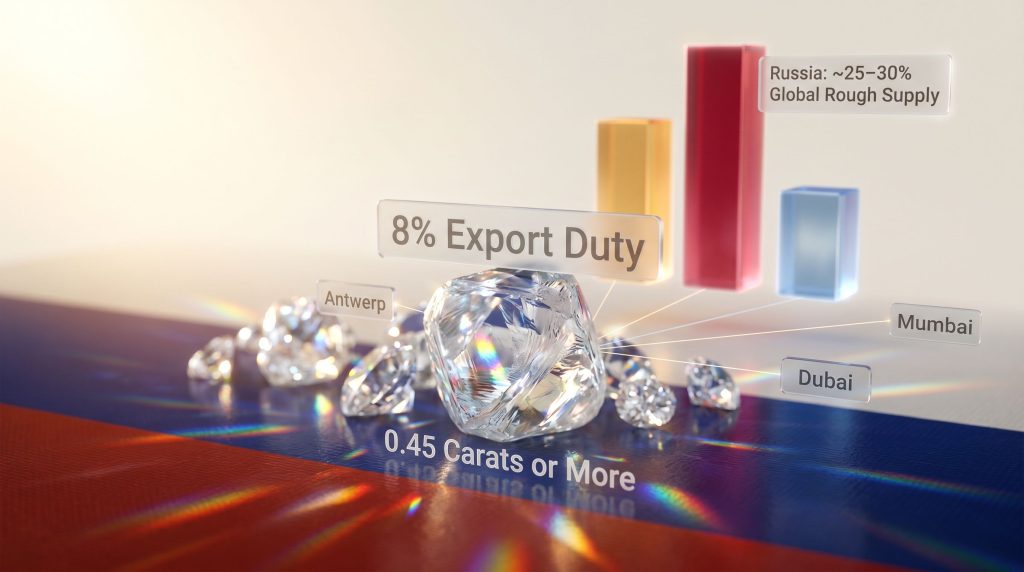
Global commodity markets have long understood that geographic concentration of supply creates structural fragility. Oil markets learned this lesson through OPEC embargoes. Rare earth markets absorbed it through China's rare earth export restrictions. Now, the diamond industry is confronting its own version of this risk, as Russia's decision to impose an 8% export duty on rough diamonds weighing 0.45 carats or more, effective September 1, 2026, forces every node in the global diamond supply chain to reassess its exposure.
Russia is not a minor participant in diamond mining. The country accounts for an estimated 25 to 30% of global rough diamond production by volume, with state-linked producer Alrosa responsible for approximately 90% of domestic output. When a supplier of that scale introduces a fiscal mechanism that alters the economics of exporting, the ripple effects extend far beyond Russian borders, touching cutting factories in Surat, trading floors in Antwerp, and retail showcases in New York, Shanghai, and Dubai.
Understanding what this duty actually means, and what it signals about the longer trajectory of the global diamond trade, requires unpacking multiple layers simultaneously: the fiscal logic, the industrial policy ambition, the geopolitical context, and the market mechanics that determine who ultimately absorbs the cost. Indeed, the shifting geopolitical mining landscape provides critical context for interpreting Russia's motivations.
When big ASX news breaks, our subscribers know first
The Architecture of Russia's Rough Diamond Export Duty
Why the 0.45-Carat Threshold Is More Significant Than It Appears
The specific weight threshold embedded in the decree is not arbitrary. In commercial diamond grading, the 0.45-carat boundary represents an approximate lower boundary for stones that are economically viable candidates for cutting and polishing into faceted gems destined for jewellery. Stones below this weight are typically channelled into industrial applications or lose economic attractiveness when processing costs are factored in.
By targeting the duty at this threshold and above, Russia is effectively calibrating the measure toward gem-quality rough that could theoretically be processed domestically, rather than applying a blanket levy that would indiscriminately hit lower-value industrial material.
| Diamond Category | Weight Range | Export Duty Status | Typical Destination |
|---|---|---|---|
| Premium gem-quality rough | Above 1.0 carat | 8% duty applies | Antwerp, Mumbai, Dubai |
| Standard gem-quality rough | 0.45 to 1.0 carat | 8% duty applies | Mumbai, Dubai |
| Small gem rough | Below 0.45 carats | No duty applied | Mixed global channels |
| Industrial-grade rough | Variable | Excluded | Industrial manufacturing |
| Domestically processed stones | Not applicable | Exempt | Domestic and re-export markets |
This selectivity is a deliberate design choice. The duty is structured as an industrial policy instrument first, and a revenue-raising mechanism second. The underlying logic is to create a financial incentive for Russian rough diamonds to remain within the country's borders for processing, rather than being exported as raw material while the value-added stages of cutting and polishing occur elsewhere.
The Revenue Calculus and Fiscal Context
Russia's finance ministry reportedly consulted with Alrosa during the design of the tariff framework, which industry observers have characterised as a relatively measured approach given the pressure the government is under to extract fiscal value from natural resource exports. Export duties function differently from corporate income taxes or royalties in that they capture revenue at the point of departure, regardless of downstream profitability, making them attractive instruments for governments operating under sanctions-constrained fiscal environments.
The potential revenue yield is non-trivial. Russia's annual rough diamond exports, before the sanctions environment materially contracted its addressable export market, were valued in the billions of dollars annually. An 8% levy applied to remaining eligible export volumes represents a meaningful fiscal contribution at a time when traditional revenue channels face external pressure.
Market Context: Export duties as fiscal tools are not new in Russian commodity policy. The government has applied similar mechanisms to oil, timber, and fertiliser exports at various points, using them both to generate state revenue and to encourage domestic processing. The Russia export duty on rough diamonds follows an established policy pattern rather than representing an experimental intervention.
How the G7 Sanctions Architecture Set the Stage
A Phased Escalation That Reshaped Market Access
The Russia export duty on rough diamonds cannot be understood in isolation from the compounding Western sanctions framework that preceded it. Following the escalation of conflict in Ukraine in February 2022, the global diamond trade began voluntarily distancing itself from Russian supply, with major traders and manufacturers reducing or eliminating purchases before formal restrictions were in place. The broader strategic minerals deal negotiated between Ukraine and the US further illustrates how geopolitics are reshaping global resource flows.
The G7 then implemented a structured, phased sanctions architecture specifically designed to close the routing loopholes that have historically made commodity sanctions difficult to enforce:
-
Phase 1 introduced direct import prohibitions on Russian rough diamonds into G7 member nations.
-
Phase 2 extended restrictions to cover diamonds that had been processed in third countries but originated from Russian sources, directly targeting the India routing pathway.
-
Phase 3 established traceability and provenance certification requirements at point of import, demanding documentary proof of origin from every diamond entering G7 markets.
This phased approach was notably more complex to design and enforce than sanctions on many other commodities. The core challenge is that rough diamonds are routinely processed across multiple jurisdictions before reaching retail consumers. A Russian rough diamond might be exported to India, cut and polished in Surat, exported to Antwerp as a polished stone, traded to a New York dealer, and ultimately sold in a Tokyo jewellery store. Tracing origin through that chain requires certification infrastructure that simply did not exist at the required scale before sanctions demanded it.
What Provenance Certification Actually Demands
The practical burden of provenance certification falls on every intermediary in the supply chain. Traders must now maintain documentation linking polished stones back to their rough origins, a requirement that the industry's historical practices were not designed to accommodate. The Kimberley Process Certification Scheme, which was established to combat conflict diamonds, was not designed to address geopolitical origin discrimination of this nature, creating a gap that has required new private-sector and regulatory responses.
For buyers in G7 markets, the premium being paid for certified non-Russian rough has become a meaningful cost differentiator, effectively creating a two-tier pricing structure in the rough diamond market based on provenance alone. Furthermore, the global mining supply landscape highlights how such provenance pressures are accelerating supply chain restructuring across multiple commodities.
The Trade Hub Recalibration
India: Processing Scale Meets Supply Chain Disruption
No country is more directly exposed to the structural consequences of Russia's diamond export policy than India. The Surat cutting and polishing industry processes an estimated 90% of the world's rough diamonds by volume, a scale of concentration that creates enormous economic leverage but also significant vulnerability to upstream supply disruptions.
Russia has historically been a primary supplier of rough diamonds to Indian processors. The 8% export duty increases the landed cost of Russian rough for Indian buyers, compressing margins in an industry where cutting fees are already under pressure from automation and competition. The duty effectively functions as a tax that transfers cost burden downstream to processors who cannot easily pass it through to already price-sensitive polished diamond markets.
Alternative sourcing options for Indian manufacturers include:
- Botswana through De Beers' supply arrangements and the Okavango Diamond Company
- Canada via Rio Tinto and other producers, though volumes are smaller
- Australia, particularly from the Argyle mine's historical production, though that mine ceased operations in 2020
- Angola through Endiama and Lucapa Diamond Company partnerships
- Zimbabwe and other emerging African producers
The challenge is that supply diversification of this magnitude cannot occur quickly. Long-term supply agreements, logistics infrastructure, and quality consistency requirements mean that Indian processors face a period of genuine cost pressure and sourcing uncertainty as they navigate away from Russian rough dependency.
Antwerp and the Provenance Premium
Antwerp has functioned as the world's leading rough diamond trading hub for centuries, and its exposure to Russian supply flows was substantial before sanctions began contracting those flows from 2022 onward. Belgian regulatory authorities have progressively aligned with EU diamond policy, and Antwerp's trading community has largely moved toward certified non-Russian supply.
The practical effect has been the emergence of a provenance premium, where rough diamonds with fully documented non-Russian supply chains command a measurable price premium over stones with ambiguous or unverifiable origins. This premium was initially modest but has widened as G7 traceability requirements have become more stringent and enforcement has improved.
Dubai: Navigating the Grey Zone
The UAE has emerged as an alternative routing hub for Russian diamonds as Western trading channels contracted. Dubai-based intermediaries have occupied a complex position, maintaining access to Russian rough while serving buyers in markets that are not party to G7 sanctions. However, the expansion of sanctions to cover third-country processing and re-export has increased secondary sanctions exposure risk for UAE-based traders handling Russian-origin stones.
The 8% export duty complicates the Dubai routing dynamic further. Even for buyers in non-G7 markets who face no direct sanctions restrictions, the duty increases the cost of Russian rough relative to alternatives, potentially reducing its competitive attractiveness even through permitted channels.
Russia's Domestic Processing Ambition: Sound Theory, Execution Risk
The Value-Add Logic
The economic rationale behind Russia's domestic processing push is straightforward. A rough diamond at the mine gate represents a fraction of the value that the same stone commands as a polished gem in a retail setting. The value-add journey through cutting, polishing, grading, and certification captures substantial margin at each stage, and historically, most of that value has been captured in India, Belgium, and Israel rather than in Russia.
By using the export duty to redirect rough stones toward domestic cutters, Russia is theoretically pursuing an import substitution strategy comparable to approaches used by Botswana and Namibia in compelling De Beers to shift polishing capacity onshore as a condition of accessing their diamond resources. This dynamic mirrors the broader geopolitical minerals race now playing out across resource-rich nations seeking greater downstream value capture.
Critical Consideration: Russia's domestic processing ambition faces challenges that Botswana and Namibia did not. Both African nations redirected rough while maintaining full access to international grading laboratories, certification bodies like the GIA, and established retail distribution networks. Russia's processors operate under sanctions that restrict access to some of these same institutions, creating a structural disadvantage that the export duty alone cannot overcome.
Where the Execution Risk Lives
Several bottlenecks constrain Russia's ability to rapidly scale domestic cutting and polishing:
- Access to internationally recognised grading certification, with organisations like the Gemological Institute of America (GIA) having curtailed Russian operations under sanctions pressure
- Distribution access to major retail markets, with G7 consumers representing the world's largest diamond jewellery consumption base
- The availability of skilled cutters, which historically has been concentrated in Surat, Antwerp, Tel Aviv, and New York rather than Russian cities
- Capital investment requirements for modernising cutting facilities to handle the full range of rough diamond sizes and qualities that Alrosa produces
Global Diamond Price Dynamics Under Compounding Pressure
Supply Tightening Versus Demand Substitution
The combination of G7 sanctions narrowing Russia's addressable export market and the new export duty adding cost friction to remaining export channels creates upward pressure on the price of certified non-Russian rough diamonds. Buyers seeking fully provenance-compliant supply are chasing a pool of material that represents perhaps 70 to 75% of global production, not 100%, while competing for access with the full global demand base.
| Market Pressure Factor | Mechanism | Supply Impact | Price Direction |
|---|---|---|---|
| G7 direct import bans | Restricts Russian rough access to Western markets | High | Upward on certified rough |
| Third-country processing restrictions | Closes re-export loopholes | Moderate to High | Upward on compliant supply |
| Russia's 8% export duty | Adds cost to Russian rough exports | Moderate | Mixed, cost passed to buyers |
| Domestic processing redirection | Reduces rough available for global export | Moderate | Upward on rough supply broadly |
| Lab-grown diamond competition | Structural demand substitution for polished | High long-term | Downward on polished prices |
The wildcard in this analysis is the accelerating growth of the lab-grown diamond sector. Synthetic diamonds, which are chemically and optically identical to mined stones, have seen dramatic price reductions as production technology has scaled. This structural competition provides a meaningful counterforce to any supply-restriction-driven price increases in polished diamonds, as consumers increasingly consider lab-grown alternatives when natural diamond prices rise beyond certain thresholds.
Investors and industry participants should note that diamond price forecasts involve material uncertainty. Supply-demand dynamics in gem-quality rough markets are influenced by factors including consumer sentiment shifts, currency movements, retail inventory cycles, and the pace of lab-grown adoption, all of which can move independently of upstream supply restrictions.
The next major ASX story will hit our subscribers first
Russia's Parallel Diamond Infrastructure Ambition
One of the less widely discussed implications of Russia's combined policy posture — encompassing sanctions-driven exclusion from Western certification and trading infrastructure alongside the new export duty — is the potential emergence of a parallel diamond trading and certification ecosystem aligned with non-Western buyers.
Russia has strategic incentives to develop grading and certification institutions that operate independently of GIA, the International Gemological Institute (IGI), and the HRD Antwerp certification system. A Russia-aligned certification framework serving BRICS-oriented buyers in China, India (for non-G7-destined production), the UAE, and parts of Africa would represent a structural bifurcation of the global diamond market analogous to what is being attempted in oil trading and financial settlements.
Whether such parallel infrastructure can achieve sufficient credibility and scale to meaningfully substitute for established Western systems remains genuinely uncertain. The credibility of diamond certification rests on institutional reputation built over decades, and establishing equivalent trust rapidly is not straightforward. Nevertheless, the economic and geopolitical incentives pushing Russia in this direction are real and growing.
Key Takeaways for Diamond Market Participants
- Russia's approximately 25 to 30% share of global rough production means the Russia export duty on rough diamonds is not a marginal market event; it has genuine supply-side weight
- The 0.45-carat threshold is a technically informed design choice targeting the economically viable gem processing segment specifically
- India's Surat industry faces the most direct near-term cost impact and will likely accelerate diversification toward African and Canadian supply sources
- Provenance certification premiums in Antwerp and other G7-compliant markets are likely to widen further as Russian supply becomes more costly and logistically complex
- Russia's domestic processing ambition is economically rational but faces genuine execution barriers related to sanctions-restricted access to grading infrastructure and retail distribution
- Lab-grown diamonds remain the structural disruptor that complicates any simple supply-restriction-equals-higher-prices narrative for polished goods
- A parallel non-Western diamond trading architecture is an emerging long-term scenario that market participants should monitor, even if its materialisation remains uncertain
This article is intended for informational purposes only and does not constitute financial or investment advice. Diamond market dynamics are subject to rapid change driven by geopolitical, regulatory, and consumer behaviour factors. Readers should conduct their own due diligence before making investment or commercial decisions based on commodity market analysis.
Want to Stay Ahead of Major Mineral Discoveries Before the Broader Market Reacts?
As geopolitical pressures reshape global commodity supply chains — from diamonds to critical minerals — Discovery Alert's proprietary Discovery IQ model delivers real-time ASX mineral discovery alerts, transforming complex market data into actionable investment insights for both traders and long-term investors. Explore historic examples of transformative mineral discoveries and their market returns, then begin your 14-day free trial at Discovery Alert to position yourself ahead of the next major find.