August 2, 2026
The Hidden Gatekeeper of Global Energy Trade
When oil price volatility analysts model supply disruptions, they tend to focus on production volumes, geopolitical flashpoints, and inventory drawdowns. What receives far less attention is the invisible infrastructure that physically enables energy trade to function: marine war-risk insurance. Without valid coverage, vessels cannot legally operate in conflict-adjacent waters. Lenders withdraw financing, charterers refuse cargo commitments, and port authorities reject entry. In this sense, the insurance market does not merely respond to geopolitical risk — it actively determines when global energy flows can resume.
This dynamic has rarely been more visible than during the 2025-2026 conflict period affecting the Persian Gulf, when Hormuz shipping war risk insurance became not just expensive, but in some configurations, structurally unavailable. Understanding why that happened, what it cost, and how the market has responded reveals something important about the fragility of the global energy supply chain that goes well beyond headline crude prices.
When big ASX news breaks, our subscribers know first
The Strait That Controls a Fifth of the World's Oil
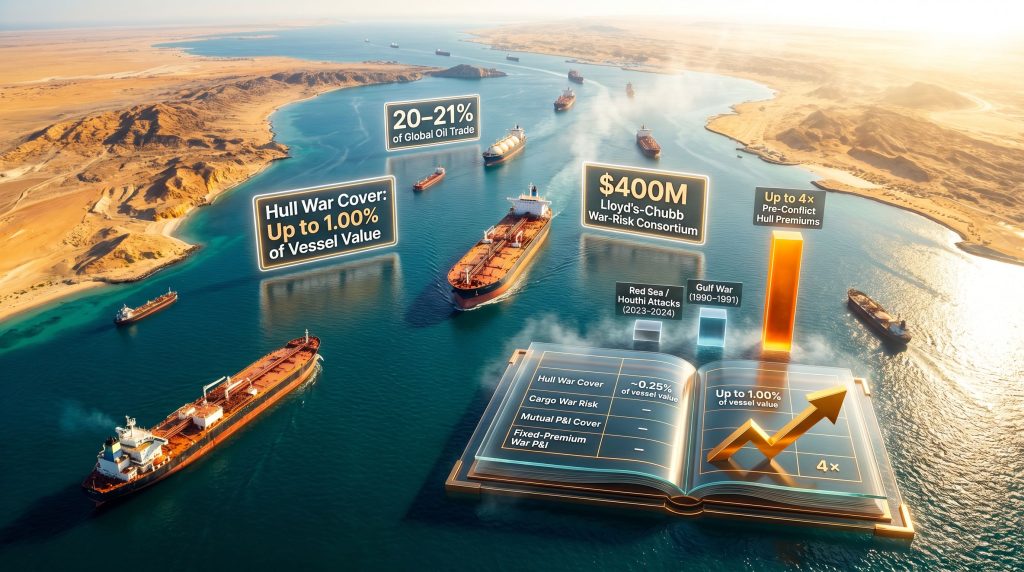
Geography imposes hard constraints on energy logistics that no amount of financial engineering can fully overcome. The Strait of Hormuz, a passage roughly 21 miles wide at its narrowest navigable point, sits between the Omani coast and Iran. Through this corridor flows an estimated 20 to 21 percent of global oil trade, including the bulk of crude exports from Saudi Arabia, Iraq, the UAE, Kuwait, and Qatar's liquefied natural gas production.
What makes Hormuz categorically different from other maritime chokepoints is the absence of a viable substitute. The Suez Canal disruptions of 2023 and 2024, caused by Houthi attacks in the Red Sea, were severe — but they had a workaround. Vessels rerouted via the Cape of Good Hope, adding distance and cost but preserving cargo delivery. Hormuz has no equivalent bypass. The existing alternatives — Saudi Arabia's East-West Pipeline to Yanbu and the UAE's Abu Dhabi Crude Oil Pipeline — carry only a fraction of current Gulf export volumes, and neither addresses global LNG supply from Qatar, which has no overland export option at all.
This geographic reality transforms any threat to Hormuz from a regional inconvenience into a systemic shock. When conflict escalated in early 2025, Brent Crude reached a reported peak of $126 per barrel, reflecting not just supply uncertainty but the market's recognition that there was no easy re-routing solution available.
How Marine War-Risk Insurance Actually Works
Marine war-risk insurance operates very differently from the standard hull and machinery cover that vessel owners maintain as a matter of routine. Standard marine policies explicitly exclude losses arising from war, acts of hostility, terrorism, and related events. War-risk cover is purchased separately and falls into several distinct categories:
- Hull war risk: Covers physical damage to the vessel itself from war-related causes during transit through a designated high-risk zone
- War P&I extensions: Covers third-party liabilities arising from war events, including crew casualties, pollution, and cargo damage
- Cargo war risk: Separately covers the value of goods being transported through conflict zones
- Fixed-premium war P&I: A non-poolable, commercially structured product distinct from mutual P&I club cover
A critical but underappreciated mechanism in this market is the listed area or high-risk zone designation. When underwriters formally classify a maritime zone as a war-risk area, existing policies typically contain automatic cancellation provisions that allow insurers to issue seven-day notice. After that period, cover lapses unless both parties agree to reinstate it — invariably at substantially revised premiums. This is not a grey area: it is a contractually mandated process that can leave vessels mid-voyage facing a coverage gap.
It is also worth distinguishing between mutual P&I cover and commercial war-risk products. Mutual P&I clubs, which are shipowner-owned cooperatives that pool third-party liability risks, have generally remained operational throughout the Hormuz conflict with comparatively limited disruption. The products most severely affected have been fixed-premium war P&I extensions and hull war cover, both of which are placed in the commercial market rather than through mutual structures.
What the Hormuz Conflict Did to Insurance Premiums
Before the conflict intensified, hull war cover for a seven-day Persian Gulf transit was typically priced at approximately 0.25 percent of the insured vessel value. For a Very Large Crude Carrier (VLCC) with an insured value of $100 to $120 million, that translates to a transit premium of roughly $250,000 to $300,000 — material but manageable within normal voyage economics.
At peak conflict conditions, those rates reportedly reached 1.0 percent of vessel value per seven-day transit, representing approximately a fourfold increase. As noted by Insurance Business Magazine, for the same VLCC, the premium jumps to between $1 million and $1.2 million for a single transit — a figure that fundamentally alters the economics of any voyage calculation.
| Coverage Type | Pre-Escalation Premium | Peak War-Risk Premium | Change |
|---|---|---|---|
| Hull War Cover (7-day transit) | ~0.25% of vessel value | Up to 1.00% of vessel value | ~4x increase |
| Cargo War Risk | Moderate, stable | Significantly repriced | Volatile, case-by-case |
| Mutual P&I Cover | Standard pooled rates | Largely unaffected | Minimal change |
| Fixed-Premium War P&I | Standard terms | Cancelled or restricted | High disruption |
Beyond the raw premium numbers, the structure of pricing changed significantly. During peak uncertainty, underwriters shifted away from fixed-term policy quotations toward day-by-day pricing, reflecting the extreme difficulty of modelling risk over even a seven-day horizon. This shift imposed operational burdens on shipowners and cargo interests who depend on stable voyage cost projections when fixing freight rates under charter-party agreements.
Elevated insurance costs feed directly into voyage economics. When war-risk premiums spike, tanker operators either absorb the cost, pass it through via freight rate increases, or avoid the route entirely. All three outcomes create distortions in global energy logistics, compounding the oil market disruption already triggered by the conflict itself.
The $400 Million Lloyd's-Chubb Consortium: Architecture and Purpose
Lloyd's of London holds a structurally dominant position in the global marine war-risk insurance market, writing an estimated 70 to 80 percent of the world's marine war business. When demand for Hormuz shipping war risk insurance surged beyond what individual syndicates could comfortably absorb, the mechanism the market reached for was a consortium structure.
The newly established facility provides $400 million in aggregate insurance capacity, structured as follows:
- $200 million allocated specifically to hull and P&I risk coverage for vessels transiting the Strait
- $200 million dedicated exclusively to cargo risk coverage
- Chubb serving as lead underwriter, coordinating participating Lloyd's syndicates and specialist market partners
- Primary policy issuance through the consortium, simplifying broker and client access to capacity
The equal split between hull/P&I and cargo capacity reflects an understanding that the two risk categories often affect different parties. Hull risk sits with the shipowner or mortgagee bank. Cargo risk sits with the commodity trader, oil major, or cargo insurer. By structuring the facility with dedicated tranches for each, the consortium avoids a scenario where demand in one category exhausts capacity that would otherwise be available for the other.
Patrick Tiernan, chief executive of Lloyd's, stated that the new facility demonstrates the market's capacity to bring together specialist underwriting expertise, claims capability, and global market capacity to support the resilience of marine supply chains. Evan Greenberg, chief executive of Chubb, noted that the consortium provides brokers and clients with a streamlined solution while underscoring the critical role that the insurance industry plays in enabling global commerce.
Why a consortium rather than open market placement? When multiple shipowners simultaneously seek war-risk cover for the same geographic zone under active conflict conditions, individual syndicate capacity is rapidly exhausted. A consortium pools capacity across multiple underwriters, maintaining market functioning when individual participants would otherwise reach their single-risk or aggregate exposure limits.
Why a Peace Deal Alone Will Not Normalise the Insurance Market
The announcement of an initial peace agreement between the United States and Iran provided a signal to crude markets, with oil prices declining sharply on the news. However, the insurance market operates on a fundamentally different evidentiary standard than financial markets. Whereas crude futures can price in a ceasefire within minutes, marine war-risk underwriters require sustained empirical evidence of safe conditions before revising their pricing models downward.
This dynamic, sometimes called market memory, reflects the underwriting principle that a single political announcement does not eliminate accumulated loss data or the residual uncertainty that follows armed conflict. Insurers must consider:
- Whether unexploded ordnance or mining activity creates residual navigational hazards
- Whether the military forces involved have formally stood down from threat postures
- Whether tanker traffic data (accessible through AIS vessel tracking systems) shows actual, sustained movement resuming safely
- Whether the political agreement holds over a period of weeks rather than days
Peter Aylott, director of policy at the UK Chamber of Shipping, stated that shipping operators would need to see a sustained body of evidence demonstrating safe transit conditions before they would be willing to normalise operations through the Strait. This is not conservatism for its own sake — it reflects genuine contractual exposure. A vessel that transits the Strait on a policy that is subsequently cancelled, or on a vessel where cover has not been formally reinstated at adequate limits, creates liability exposure for the shipowner, operator, and cargo interest alike.
Adding operational complexity is the fact that approximately 80 million barrels of crude have been reported as queued and awaiting exit from the Persian Gulf. The logistical sequencing required to move this volume safely, combined with the need for each vessel to secure valid war-risk cover before departure, means that even an optimistic scenario sees a multi-week backlog clearance timeline rather than an immediate resumption.
Goldman Sachs has issued analysis warning that Hormuz traffic volumes may not fully recover to pre-conflict levels in the near term, a view that carries significant weight for tanker market economics and insurance pricing trajectories.
The next major ASX story will hit our subscribers first
Benchmarking This Crisis Against Historical Precedents
The current Hormuz disruption is not without historical context, but it occupies a distinctive position in the hierarchy of maritime war-risk events:
| Event | Peak Premium Impact | Duration of Elevated Pricing | Market Response |
|---|---|---|---|
| Red Sea / Houthi Attacks (2023-2024) | Significant surcharges on Suez routing | Extended, 12+ months | Rerouting via Cape of Good Hope |
| Gulf War (1990-1991) | Substantial premium spikes | Months | Lloyd's consortium mechanisms activated |
| Iran-Iraq Tanker War (1980s) | Severe, some vessels effectively uninsurable | Years | Insurance market structural reform |
| Current Hormuz Conflict (2025-2026) | Up to 4x pre-conflict hull premiums | Ongoing, uncertain duration | New $400 million consortium facility |
The structural distinction between the current Hormuz situation and the 2023-2024 Red Sea disruptions is critical. Houthi attacks on shipping created a threat to one routing option, but left an alternative available. The Hormuz closure eliminated a routing option for which no comparable substitute exists. This is why the insurance market response — a purpose-built $400 million consortium rather than incremental premium adjustments — was more architecturally significant than what was required during the Red Sea episode.
The Broader Supply Chain Consequences
Insurance market functioning is the invisible bottleneck that determines when physical energy flows can normalise. Furthermore, several downstream dynamics illustrate this:
India's hesitation: Despite signals that the Strait is reopening, India has demonstrated reluctance to immediately return to Middle Eastern crude sourcing. Indian refiners who pivoted to alternative suppliers during the conflict face procurement inertia, contract obligations, and ongoing uncertainty about whether Hormuz conditions will remain stable. India has also announced a significant expansion of its strategic petroleum reserves as a direct response to the supply vulnerability exposed by the conflict.
Qatar's LNG recovery: Qatar's LNG export capacity was significantly disrupted by the closure. The insurance implications for LNG carrier transits are particularly complex, given the higher insured values of LNG vessels and the specialised nature of the coverage required.
TotalEnergies refinery damage: TotalEnergies has indicated that its affected Saudi refinery infrastructure will not reach full recovery until 2027, extending the period of supply chain uncertainty well beyond the political resolution of the conflict itself.
Bypass infrastructure momentum: Proposals for a $10 billion energy corridor designed to create Hormuz bypass capacity have gained renewed traction, with discussions involving multiple regional governments. The economics of such infrastructure, previously borderline at prevailing insurance and freight costs, look considerably more attractive when Hormuz shipping war risk insurance is priced at conflict-period levels.
The International Energy Agency has projected a potential significant oil surplus by 2027 as Middle Eastern supply returns, a timeline that aligns broadly with the infrastructure recovery and insurance normalisation trajectory that market participants are working toward. Consequently, the crude price trends expected over this period will be closely tied to how quickly the insurance market can stabilise.
Practical Risk Management for Operators Right Now
For shipowners and cargo interests navigating the current environment, a structured approach is essential:
- Engage specialist marine war-risk brokers before planning any Persian Gulf voyage — standard intermediaries lack the market access required
- Review charter-party war-risk clauses to clarify whether liability for elevated premiums sits with the owner or charterer
- Verify mutual P&I status separately from commercial war-risk extensions, which may have been cancelled or restricted
- Monitor official listed-area designations continuously, as premium triggers activate automatically upon zone listing changes
- Assess cargo and hull cover independently — the separate $200 million tranches within the consortium facility reflect the different risk holders involved
- Factor current war-risk premium levels into all voyage economics before fixing freight rates under new charter arrangements
Coverage Gap Warning: Vessels already mid-voyage when existing policies expire face a potential gap between lapsed cover and newly reinstated terms. This risk is particularly acute in a day-by-day quoting environment. Proactive broker engagement before departure is essential rather than relying on automatic policy continuity.
Frequently Asked Questions: Hormuz Shipping War Risk Insurance
What is war-risk insurance for shipping?
War-risk insurance covers physical damage to vessels, cargo, and associated liabilities arising from acts of war, terrorism, piracy, or hostile military action. These risks are excluded from standard marine hull and P&I policies, requiring separate placement in the commercial or Lloyd's market.
Why has Hormuz war-risk insurance become so expensive?
The designation of the Persian Gulf and Strait of Hormuz as an active conflict zone allowed underwriters to cancel existing policies and reinstate cover at substantially higher premiums. Hull war cover for seven-day Gulf transits reportedly reached up to 1 percent of vessel value, compared to approximately 0.25 percent before conflict intensified, representing roughly a fourfold increase in transit insurance costs.
Does a ceasefire immediately reduce insurance premiums?
Not automatically. Marine war-risk underwriters typically maintain elevated pricing for an extended period following conflict events, reflecting ongoing uncertainty and accumulated loss data. Premium normalisation depends on sustained evidence of safe transit conditions verified through tanker traffic monitoring and operational loss experience over time.
What is the Lloyd's-Chubb $400 million consortium?
A purpose-built marine war-risk insurance facility providing $400 million in aggregate capacity, equally divided between hull and P&I coverage and dedicated cargo coverage, designed to support vessels and cargo transiting the Strait of Hormuz during the post-conflict recovery period.
Can vessels sail through Hormuz without war-risk insurance?
In practice, no. Vessels cannot legally operate without valid insurance cover. Lenders, charterers, and port authorities routinely require proof of war-risk cover for voyages through designated high-risk zones. When cover becomes unavailable or unaffordably priced, shipping activity stalls regardless of the political situation. According to S&P Global Market Intelligence, this dynamic has been a defining feature of the current Hormuz disruption.
What is mutual P&I cover and is it affected by the conflict?
Mutual P&I cover is provided through shipowner-owned cooperative insurance clubs and addresses third-party liability risks. This form of cover has been largely unaffected by the Hormuz conflict. The products facing the greatest disruption have been fixed-premium war P&I extensions and hull war cover placed in the commercial market.
What This Crisis Reveals About Energy Market Resilience
The Hormuz insurance crisis exposes a fundamental truth about global energy security: the marine insurance market is not a passive reflection of geopolitical conditions but an active co-determinant of when physical energy flows can resume. Indeed, the geopolitical trade tensions underlying this crisis have demonstrated precisely how intertwined diplomatic, military, and financial systems have become. Several conclusions for investors, operators, and policymakers emerge clearly:
- Lloyd's of London's 70 to 80 percent share of global marine war insurance makes the London market a systemic node in global energy logistics — its functioning matters as much as diplomatic agreements
- The $400 million consortium facility represents a meaningful structural response, but premium normalisation will lag political resolution by months and potentially longer
- Insurance market signals, particularly AIS transit data and broker capacity availability, should be treated as leading indicators of genuine Hormuz recovery rather than lagging measures
- The conflict has materially accelerated strategic investment conversations around Hormuz bypass infrastructure, reserve diversification, and supply chain resilience that will shape capital allocation decisions across the energy sector for years ahead
- The asymmetry between Hormuz and other chokepoints — its lack of substitutes — means that future conflict risk at this location carries a structural premium that the insurance market will increasingly price into baseline rates even during quieter periods
Disclaimer: This article is intended for informational and educational purposes only and does not constitute financial, legal, or investment advice. Figures cited reflect reported market conditions and analyst commentary as of the time of writing. Insurance market conditions, geopolitical developments, and energy prices are subject to rapid change. Readers should consult qualified marine insurance professionals and financial advisers before making decisions based on this content.
Want to Stay Ahead of the Next Major Resource Discovery Triggered by Geopolitical Shifts?
While marine war-risk insurance and Hormuz supply disruptions reshape global energy markets, the ripple effects across ASX-listed resource and energy companies can create significant investment opportunities — and Discovery Alert's proprietary Discovery IQ model scans ASX announcements in real time, instantly alerting subscribers to significant mineral discoveries before the broader market reacts. Explore Discovery Alert's discoveries page to see how historic finds have generated substantial returns, and begin your 14-day free trial today to position yourself ahead of the next major market-moving announcement.